
Piroctone Olamine vs Selenium Sulfide: Key Differences Explained
2026-09-18 17:40:15
Piroctone Olamine vs Selenium Sulfide is a useful comparison for shampoo formulators, but the two ingredients should not be treated as interchangeable versions of the same raw material. Both are associated with dandruff-control products, yet their chemistry, physical form, incorporation strategy, finished-product aesthetics, quality specifications, and regulatory positioning are substantially different.
For ingredient buyers, those differences have practical consequences. Piroctone Olamine development typically focuses on solubilization, surfactant interactions, deposition, and formulation stability. Selenium Sulfide is insoluble in water and therefore creates a different engineering problem involving particle dispersion, suspension, sedimentation, and product homogeneity. Regulatory requirements also vary significantly by market. In the United States, for example, Selenium Sulfide is addressed under the FDA OTC dandruff drug monograph, while the EU Cosmetics Regulation restricts Selenium Disulphide to anti-dandruff shampoos at a maximum concentration of 1%.
For manufacturers deciding between Piroctone Olamine or Selenium Sulfide, the appropriate starting point is therefore not “which ingredient is stronger?” but “which material fits the intended product architecture, regulatory pathway, manufacturing process, and target market?”
Piroctone Olamine vs Selenium Sulfide: Quick Answer for Formulators and Buyers
The main difference between Piroctone Olamine and Selenium Sulfide is that they represent fundamentally different formulation systems. Piroctone Olamine is an organic pyridone-derived ethanolamine salt. Selenium Disulphide, CAS 7488-56-4, is an inorganic selenium-sulfur material described by PubChem as a bright orange powder that is insoluble in water.
That distinction changes how a formulator approaches the shampoo.
|
Formulation Factor |
Piroctone Olamine |
Selenium Sulfide |
|
Chemical character |
Organic pyridone derivative, ethanolamine salt |
Inorganic selenium-sulfur material |
|
CAS No. |
68890-66-4 |
7488-56-4 |
|
Typical appearance |
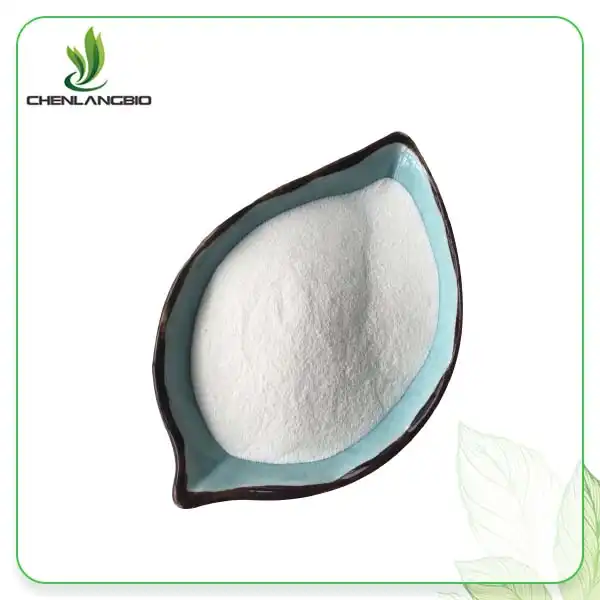
White to off-white powder |
Orange-colored powder/material |
|
Water behavior |
Limited, pH-dependent solubility |
Insoluble in water |
|
Main formulation challenge |
Solubilization, delivery and stability |
Dispersion, suspension and sedimentation control |
|
Shampoo architecture |
Can be incorporated into suitably solubilized systems |
Requires management of suspended/dispersed particles |
|
Key QC focus |
Purity, assay, impurities and batch consistency |
Identity/composition plus physical and particle-related properties where specified |
|
Regulatory approach |
Depends on market, function and product type |
Particularly market- and claim-dependent |
For this reason, Piroctone Olamine vs Selenium Sulfide for shampoo is as much a comparison of formulation architecture as it is a comparison of scalp-care ingredients.
What Is Piroctone Olamine and How Is It Used in Shampoo Formulations?
Piroctone Olamine in shampoo is commonly associated with anti-dandruff and scalp-care formulations. ECHA identifies the substance as the 1:1 compound of a substituted hydroxypyridone with 2-aminoethanol, CAS 68890-66-4, and lists it in the regulatory context of Annex V of the EU Cosmetics Regulation.
From a formulation perspective, however, simply adding the ingredient at a target concentration does not determine finished-product performance.
A 2023 study published in the International Journal of Cosmetic Science demonstrated that shampoo surfactant micellar stability and polymer coacervate properties can materially influence Piroctone Olamine delivery. Weaker association between the active and surfactant micelles improved retention on the scalp surface and delivery to follicular infundibula in the experimental systems.
This makes Piroctone Olamine shampoo formulation a delivery-system question as well as a raw-material question. Formulators should consider how the ingredient is incorporated, how it interacts with surfactants and polymers, and whether the finished shampoo maintains the desired physical and chemical stability during storage.
What Is Selenium Sulfide and Why Does Its Material Form Matter?
Selenium Sulfide in shampoo behaves very differently because it is not being incorporated as a conventionally water-soluble active.
PubChem identifies Selenium Disulphide under CAS 7488-56-4 and describes it as a bright orange powder that is insoluble in water. This physical property is critical to understanding Selenium Sulfide shampoo formulation.
Instead of asking how to create a molecular solution, the formulator needs to consider how Selenium Sulfide particles will be wetted, dispersed, suspended, and maintained uniformly throughout the product. Particle agglomeration or sedimentation can change both the appearance and homogeneity of the shampoo.
Recent formulation patent literature illustrates the engineering challenge. One Selenium Disulphide shampoo development describes using polymers to suspend particles and reports dispersion particle sizes in the 1–5 μm range. Another recent dispersion approach investigates approximately 0.5–3 μm particles to improve suspension stability. These are formulation examples rather than universal raw-material specifications, but they demonstrate why particle characteristics can matter in suspension-based systems.
For buyers evaluating Selenium Sulfide powder, physical specifications can therefore be commercially significant rather than merely descriptive.
Piroctone Olamine vs Selenium Sulfide: Key Chemical and Physical Differences
The most important Piroctone Olamine Selenium Sulfide difference becomes clear when the materials enter the manufacturing vessel.
Piroctone Olamine development generally involves finding an appropriate environment in which the ingredient can be incorporated and remain available within the finished surfactant system. Selenium Sulfide, by contrast, is water-insoluble, so the manufacturer must maintain a sufficiently uniform particulate dispersion.
This distinction affects much more than the first mixing step.
A solution-oriented formulation may be evaluated for clarity, precipitation, crystallization, pH effects, and active retention. A suspension-oriented formulation introduces additional concerns such as wetting, agglomeration, particle distribution, sedimentation, rheology, and redispersibility.
Why Raw-Material Form Changes the Formulation Strategy
For a procurement team comparing Selenium Sulfide vs Piroctone Olamine shampoo projects, one principle is especially useful:
Solubilizing an ingredient and suspending an ingredient are fundamentally different formulation tasks.
This difference can affect equipment selection, order of addition, mixing energy, rheology design, filling consistency, QC procedures, and ultimately the appearance of the finished product.
The raw-material purchasing decision should therefore be connected to manufacturing capability rather than made from ingredient name and assay alone.
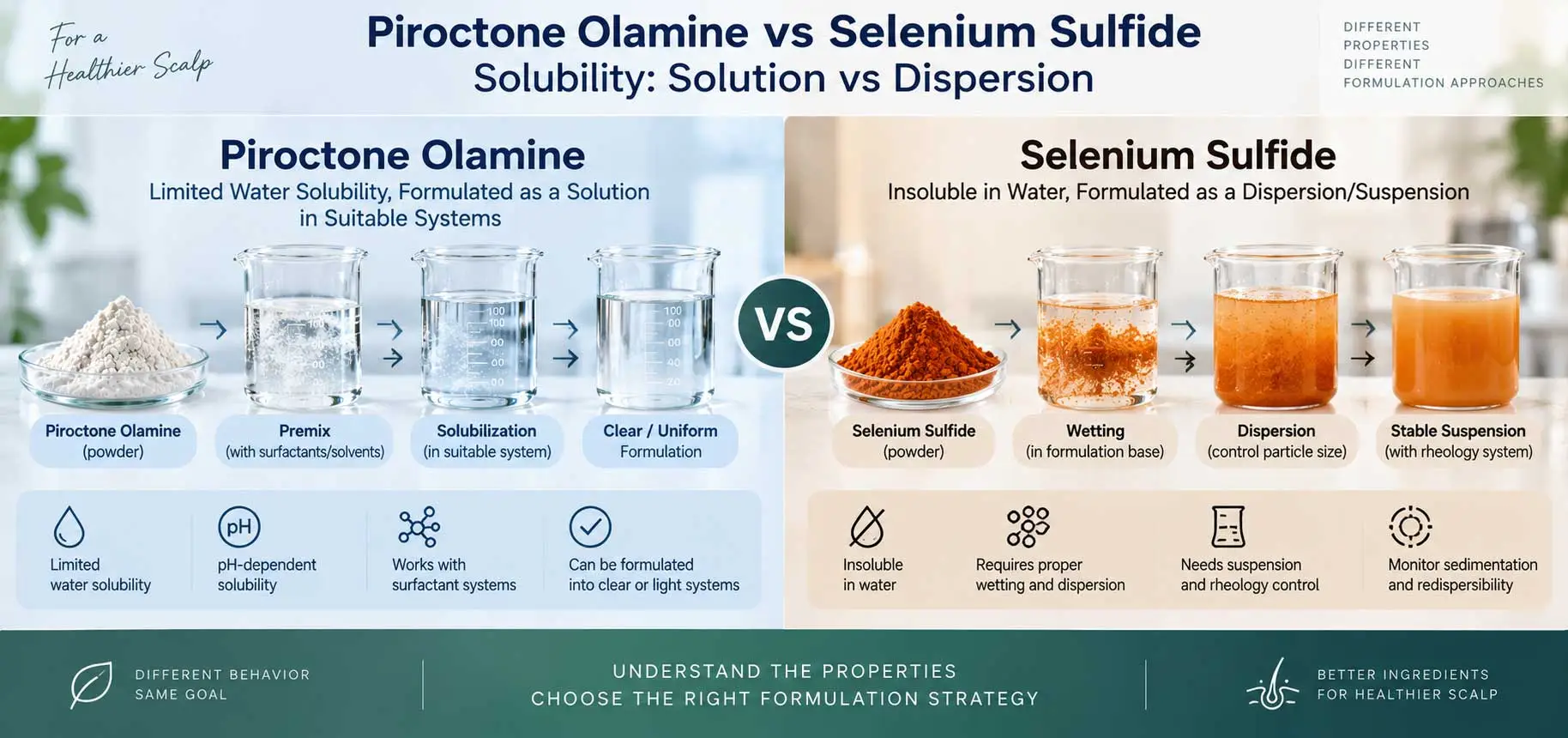
Piroctone Olamine vs Selenium Sulfide Solubility: Solution vs Dispersion
Piroctone Olamine vs Selenium Sulfide solubility is one of the clearest technical differences between these materials.
Piroctone Olamine has limited aqueous solubility, and its apparent solubility depends on conditions including pH and the surrounding solvent or surfactant environment. Consequently, formulation development often uses an appropriate premix or surfactant-assisted system before evaluating the finished shampoo.
Selenium Sulfide represents a different situation. Authoritative chemical information describes Selenium Disulphide as insoluble in water. Therefore, the useful question is generally not simply is Selenium Sulfide water soluble, but whether the formulation can maintain a uniform, stable dispersion of the particles.
Why Water Solubility Does Not Tell the Whole Formulation Story
An insoluble ingredient is not automatically unsuitable for shampoo, just as a soluble ingredient is not automatically easy to formulate.
For Selenium Sulfide, successful development may depend on particle wetting, dispersion quality, suspension rheology, and resistance to sedimentation. Patent formulation work, for example, describes high-molecular-weight polymers used specifically to inhibit reagglomeration and help suspend Selenium Disulphide particles.
For Piroctone Olamine, the development question is different: the formulator needs to maintain the intended active level within a suitable surfactant/solvent environment while avoiding unwanted precipitation or crystallization.
This distinction is particularly useful when buyers compare laboratory samples. A clear solution test is relevant to one type of formulation challenge, whereas dispersion uniformity and particle behavior may be more informative for the other.
Piroctone Olamine vs Selenium Sulfide Formulation: Different Manufacturing Challenges
A practical Piroctone Olamine vs Selenium Sulfide formulation comparison should follow each ingredient through the manufacturing process.
For Piroctone Olamine, a typical development sequence involves confirming the target concentration, selecting an appropriate premix or incorporation system, adding the material under controlled processing conditions, adjusting the finished formulation, cooling, and then inspecting for haze, precipitation, or crystals. The exact process depends on the shampoo base rather than a universal recipe.
The question of how to disperse Selenium Sulfide is fundamentally different. Because the material is insoluble, controlled wetting and dispersion become important, followed by maintaining particle distribution through a suitable suspension/rheology system. Recent technical disclosures describe milling or sanding processes and polymeric suspending systems as approaches to controlling Selenium Disulphide dispersions.
This difference becomes more important during scale-up. Laboratory agitation that produces an acceptable dispersion may not translate directly to a commercial vessel, while changes in cooling rate, shear, viscosity, or filling conditions can alter finished-product homogeneity.
The manufacturing method therefore belongs in the ingredient-selection discussion from the beginning.
Piroctone Olamine vs Selenium Sulfide pH and Stability Considerations
Piroctone Olamine vs Selenium Sulfide stability should not be reduced to a single pH number because the most important failure modes are different.
For Piroctone Olamine, formulators may monitor solubilization, crystallization, precipitation, pH drift, and active retention. Surfactant and polymer architecture can also influence its behavior and delivery.
For a Selenium Sulfide suspension, physical stability becomes especially important. Particle settling, agglomeration, changes in viscosity, poor redispersion, and non-uniform active distribution can indicate that the suspension system requires further development.
Chemical Stability and Physical Suspension Stability Are Not the Same
A product can be chemically acceptable but physically unstable.
For example, a Selenium Sulfide shampoo that develops significant sedimentation may present a homogeneity problem even without demonstrating chemical degradation. Conversely, a visually clear Piroctone Olamine shampoo does not prove that active content and delivery remain unchanged.
For this reason, Piroctone Olamine vs Selenium Sulfide pH testing should be integrated into a broader stability program that includes appearance, viscosity, homogeneity, precipitation or sedimentation, packaging compatibility, and analytical assay where appropriate.
Piroctone Olamine vs Selenium Sulfide for Clear Shampoo and Premium Scalp-Care Products
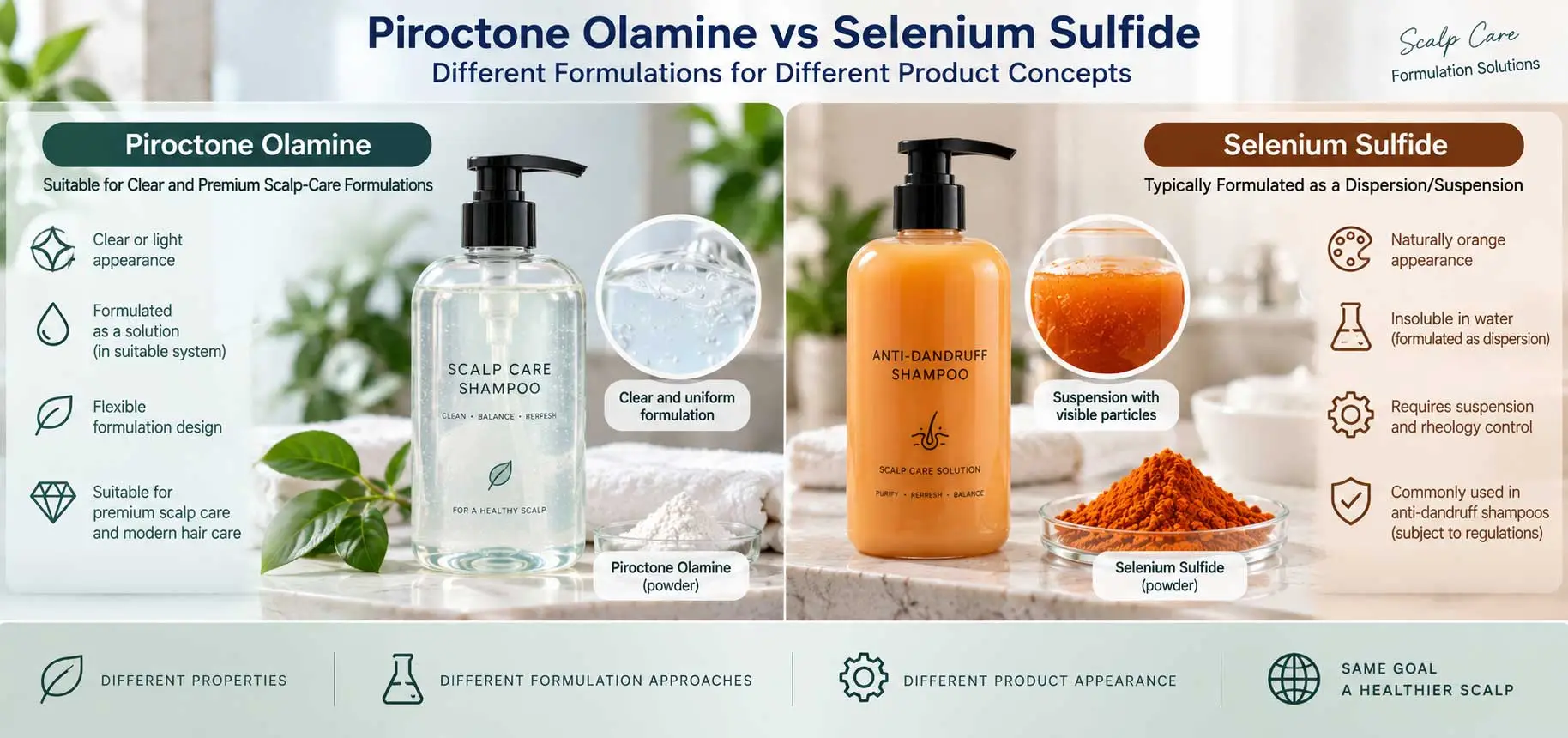
Finished-product aesthetics can become a commercial selection criterion when comparing Piroctone Olamine vs Selenium Sulfide for clear shampoo.
Selenium Disulphide is an orange-colored, water-insoluble material, so a product built around it inherently creates different visual and suspension considerations from a formula designed around a white/off-white Piroctone Olamine raw material.
This does not make one format inherently superior. An opaque treatment shampoo and a premium transparent scalp cleanser may have completely different design briefs.
However, brands seeking transparent or visually light formulations should evaluate ingredient color, suspended particles, long-term sedimentation, package visibility, and consumer expectations early in development. A clear bottle, for example, can make even minor physical instability commercially obvious.
For Piroctone Olamine clear shampoo development, clarity still cannot be assumed. Solubilization and compatibility with the complete surfactant system must be demonstrated. The advantage is therefore formulation flexibility rather than an automatic guarantee of transparency.
Piroctone Olamine vs Selenium Sulfide: How Should Formulators Choose?
When a development team asks which is better Piroctone Olamine or Selenium Sulfide, the useful answer depends on the intended product rather than a universal ranking.
|
Development Requirement |
What the Formulator Should Evaluate |
|
Transparent or light appearance |
Solubility, color and visual compatibility |
|
Suspension-based shampoo |
Particle dispersion and rheology control |
|
Premium cosmetic aesthetics |
Clarity, color, sediment and packaging |
|
Manufacturing simplicity |
Required premixing, dispersion and process control |
|
Repeat production |
Raw-material and finished-product consistency |
|
Scale-up |
Mixing, shear, cooling and filling behavior |
|
Multi-market launch |
Market-specific regulatory pathway |
|
Quality control |
Appropriate chemical and physical specifications |
The decision between Piroctone Olamine or Selenium Sulfide should therefore begin with the intended product architecture.
A formulator designing a transparent cosmetic scalp-care shampoo faces a different set of constraints from a manufacturer developing a suspension-based medicated dandruff shampoo. Ingredient selection should reflect those differences rather than trying to force both materials into the same formulation concept.
Piroctone Olamine vs Selenium Sulfide Regulations: Cosmetic or Drug Requirements?
Regulation is one of the most important differences in this comparison because the same dandruff-related commercial concept can fall under different frameworks depending on market and claims.
In the EU, the current consolidated Cosmetics Regulation lists Selenium Sulfide/Selenium Disulphide, CAS 7488-56-4, for anti-dandruff shampoos at a maximum concentration of 1%. The required warning includes “Contains selenium disulphide” and instructs users to avoid contact with eyes or damaged skin.
Piroctone Olamine appears in the EU regulatory framework under Annex V for allowed preservatives, as confirmed by ECHA. Buyers should not interpret a CosIng ingredient listing by itself as proof of authorization for every intended use; the European Commission explicitly notes that CosIng is informative and that legal conditions come from Regulation (EC) No 1223/2009 and its annexes.
The United States illustrates an even more important distinction. FDA OTC Monograph M032 lists Selenium Sulfide at 1% and micronized Selenium Sulfide at 0.6% among active ingredients for dandruff control; Selenium Sulfide at 1% is also listed for seborrheic dermatitis control.
Therefore, Selenium Sulfide FDA shampoo development cannot simply be approached as an ordinary cosmetic ingredient project when drug claims or monograph positioning apply.
For international buyers, the practical rule is clear: confirm destination market, intended claims, concentration, product category, and applicable regulatory pathway before approving the raw material or label.
Piroctone Olamine vs Selenium Sulfide COA and Quality Specifications
A useful Piroctone Olamine COA should provide enough batch-specific information for incoming QC rather than simply stating “99%.”
Our current Piroctone Olamine specification sets purity at ≥99.0%. A recent CHEN LANG BIO TECH batch reported 99.8% purity and 99.9% assay. The same COA also includes parameters such as ethanolamine, nitrosamine, residual solvents, loss on drying, pH under specified test conditions, and microbiological criteria.
Those results are batch-specific and should not be generalized to every shipment.
A Selenium Sulfide COA needs to be evaluated according to the specification relevant to the intended grade and market. Because Selenium Sulfide functions as a particulate material, procurement teams should also determine whether physical characteristics such as particle-size information are relevant to their process and finished-product specification rather than relying only on chemical identity or assay.
This is particularly important because published formulation approaches demonstrate that particle dimensions and suspension design can influence dispersion stability.
In both cases, the buyer should approve the specification before comparing commercial offers.
Sample Testing: Comparing Piroctone Olamine and Selenium Sulfide Before Scale-Up
A Piroctone Olamine sample and a Selenium Sulfide sample should not necessarily be forced into an identical shampoo base simply to create a side-by-side comparison. Their different physical behavior may require different optimized formulation architectures.
A more meaningful qualification program begins with raw-material documentation, followed by an appropriate prototype for each ingredient. R&D can then compare processing complexity, appearance, pH, viscosity, active homogeneity, crystallization or sedimentation, accelerated stability, packaging compatibility, and scale-up reproducibility.
For Piroctone Olamine formulation testing, a clear warm batch should be inspected again after cooling and storage because precipitation can occur later. For Selenium Sulfide, uniform dispersion immediately after mixing does not by itself demonstrate long-term suspension stability.
The most useful procurement sequence is therefore:
raw-material qualification → optimized laboratory prototype → stability testing → pilot production → commercial approval
This approach compares the two technologies fairly without pretending they behave identically.
Choosing a Piroctone Olamine Supplier for Shampoo Manufacturing
When qualifying a Piroctone Olamine supplier, international buyers should request a current specification, lot-specific COA, TDS, SDS, storage information, traceability, sample availability, and clear commercial supply terms.
The same discipline applies when evaluating a Piroctone Olamine manufacturer. Consistency between the development sample and subsequent production lots is particularly important because unexpected changes can create additional solubilization, stability, or QC work.
CHEN LANG BIO TECH supplies cosmetic grade Piroctone Olamine and supports formulation and procurement teams with technical documentation, samples, and commercial supply information. For customers developing scalp-care products, the objective is to provide sufficient raw-material information for qualification within the customer's own R&D and quality system rather than relying on generic marketing claims.
Piroctone Olamine Price, MOQ and Bulk Purchasing Considerations
Piroctone Olamine price is only one component of commercial formulation cost. Buyers should also consider required concentration, premix requirements, manufacturing time, QC workload, stability risk, packaging, logistics, and the cost of potential batch rework.
Before progressing to bulk Piroctone Olamine Powder, the development sample and pilot batch should ideally be qualified against an agreed specification. Procurement can then confirm the applicable Piroctone Olamine MOQ, lead time, packaging, and documentation.
When comparing Piroctone Olamine price per kg, make sure competing quotations represent equivalent grades and quality requirements. Customers preparing to buy Piroctone Olamine Powder will obtain a more meaningful comparison by evaluating total cost-in-use rather than raw-material price alone.
Buyer and Formulator Checklist: Piroctone Olamine or Selenium Sulfide?
Before choosing Piroctone Olamine or Selenium Sulfide, the R&D and procurement teams should establish the intended product function and target market first. They should then determine whether the desired formulation is transparent, opaque, solution-oriented, or suspension-based, and whether the available manufacturing equipment can reliably reproduce that architecture at commercial scale.
The finished pH, viscosity, appearance, sedimentation or crystallization risk, packaging, and storage stability should be validated rather than inferred from the raw-material specification.
Regulatory review should occur before commercial commitment, particularly when Selenium Sulfide is being considered for a U.S. dandruff product, where FDA OTC drug requirements may apply.
Finally, the buyer should approve the batch documentation, test a representative sample, and confirm pilot-scale performance.
The appropriate ingredient is determined by product architecture, regulatory requirements, manufacturing capability, and finished-formulation evidence—not by a universal ranking of dandruff-control ingredients.
FAQ: Piroctone Olamine vs Selenium Sulfide
What is the difference between Piroctone Olamine and Selenium Sulfide?
The central difference between Piroctone Olamine and Selenium Sulfide is their chemistry and physical formulation behavior. Piroctone Olamine is an organic ethanolamine salt whose development commonly focuses on solubilization and delivery, while Selenium Disulphide is a water-insoluble inorganic material that requires particle dispersion and suspension management.
Is Piroctone Olamine the same as Selenium Sulfide?
No. Piroctone Olamine vs Selenium Sulfide compares chemically distinct materials with different raw-material properties, formulation requirements, and regulatory positions.
Which is better, Piroctone Olamine or Selenium Sulfide?
There is no formulation-independent answer. A transparent cosmetic scalp-care shampoo, a suspension-based anti-dandruff product, and a U.S. OTC dandruff drug present different technical and regulatory requirements. The selection should be made against the intended product brief rather than a generic efficacy ranking.
Is Selenium Sulfide water soluble?
No. PubChem describes Selenium Disulphide as insoluble in water. This is why how to formulate Selenium Sulfide shampoo is primarily a dispersion and suspension problem rather than a conventional water-solubilization problem.
Which is easier to formulate into shampoo?
The answer depends on the shampoo architecture. Piroctone Olamine vs Selenium Sulfide formulation involves different challenges: Piroctone Olamine requires appropriate solubilization and finished-system validation, while Selenium Sulfide requires effective wetting, particle dispersion, suspension, and sedimentation control.
Can Piroctone Olamine and Selenium Sulfide be used together?
This should not be assumed from the fact that each ingredient is used in dandruff-related products. A combination would require a specific regulatory assessment for the target market and claims, together with compatibility, stability, and finished-product validation. In the U.S., formulators should pay particular attention to the permitted active ingredients and combinations specified in the applicable OTC monograph.
Should buyers test a Piroctone Olamine sample before bulk purchasing?
Yes. A representative Piroctone Olamine sample should ideally be tested in the intended shampoo system before commercial approval. Sample testing, stability evaluation, and pilot production provide more relevant procurement evidence than a COA alone.
Conclusion: Compare the Finished Formulation, Not Just the Ingredient Name
The practical lesson from Piroctone Olamine vs Selenium Sulfide is that ingredient selection extends well beyond choosing between two dandruff-related raw materials. Piroctone Olamine presents a solubilization and delivery challenge, whereas water-insoluble Selenium Sulfide introduces particle dispersion, suspension, sedimentation, and distinct regulatory considerations.
For current Piroctone Olamine specifications, COA, TDS/SDS, samples, or commercial information, contact CHEN LANG BIO TECH at admin@chenlangbio.com.
References
1. U.S. Food and Drug Administration. OTC Monograph M032: Drug Products for the Control of Dandruff, Seborrheic Dermatitis, and Psoriasis. Selenium sulfide is listed at 1%, and micronized selenium sulfide at 0.6%, for dandruff control.
2. European Union. Regulation (EC) No 1223/2009 on Cosmetic Products, consolidated version. Annex III lists Selenium Disulphide for anti-dandruff shampoos at a maximum concentration of 1%, with specified warnings. European Chemicals Agency. Piroctone Olamine — Substance Information, CAS 68890-66-4.
3. European Commission. CosIng — Cosmetic Ingredient Database and Glossary of Ingredients. The Commission notes that CosIng is informative and does not itself establish authorization for cosmetic use. National Center for Biotechnology Information. PubChem: Selenium Disulfide, CID 24087, CAS 7488-56-4.
4. Johnson ES, Chang DW, Schwartz JR, et al. Enhanced piroctone olamine retention from shampoo for superior anti-dandruff efficacy. International Journal of Cosmetic Science. 2023;45(2):236–245. DOI: 10.1111/ics.12835.
5. Recent Selenium Disulphide formulation literature/patent disclosures describing particle-dispersion and suspension approaches in shampoo systems. These sources illustrate formulation strategies rather than universal commercial specifications.

Send Inquiry
Related Industry Knowledge
- How Much Coenzyme Q10 Powder Should I Take Daily
- Finasteride vs Minoxidil: Which Treatment Delivers Better Hair Regrowth in 2025?
- How Diosmin Powder Supports Circulation and Cardiovascular Wellness in Supplements?
- HPLC vs. CPC: Which Testing Method Ensures the Real Purity of Chondroitin Sulfate?
- Elastin Peptide: The Science-Backed Ingredient for Firm Skin
- Can Liposomal Coenzyme Q10 Help with Fatigue?
- The Ultimate Guide to Tart Cherry Extract Powder
- What is the Mechanism of Action of Praziquantel
- Elastin Peptide for Skin
- What is Honokiol Powder Used For