Piroctone Olamine Solubility: How to Dissolve Piroctone Olamine Powder?
2026-09-11 07:27:43
Piroctone Olamine solubility is one of the first technical questions formulators should evaluate when developing an anti-dandruff shampoo or scalp-care product with Piroctone Olamine Powder. The ingredient has relatively low solubility in water, but its behavior changes considerably with pH, solvent selection, surfactant concentration, and the composition of the finished formulation. Published technical data, for example, report water solubility around 0.05% under certain conditions, while substantially higher levels can be achieved in propylene glycol, ethanol, and aqueous surfactant systems.
For a cosmetic manufacturer, this means that simply adding the crystalline powder directly to the water phase is rarely a sufficient formulation strategy. A reliable process needs to consider the premix, pH, processing temperature, addition sequence, surfactant system, and what happens when the finished product cools and remains in storage.
This guide explains how to dissolve Piroctone Olamine, why laboratory solubility figures do not always predict performance in shampoo, and which parameters formulators and ingredient buyers should evaluate before moving from a sample to commercial production.
Piroctone Olamine Solubility: The Quick Answer
Piroctone Olamine is not best described simply as either “water soluble” or “water insoluble.” Its aqueous solubility is limited and strongly influenced by the surrounding formulation.
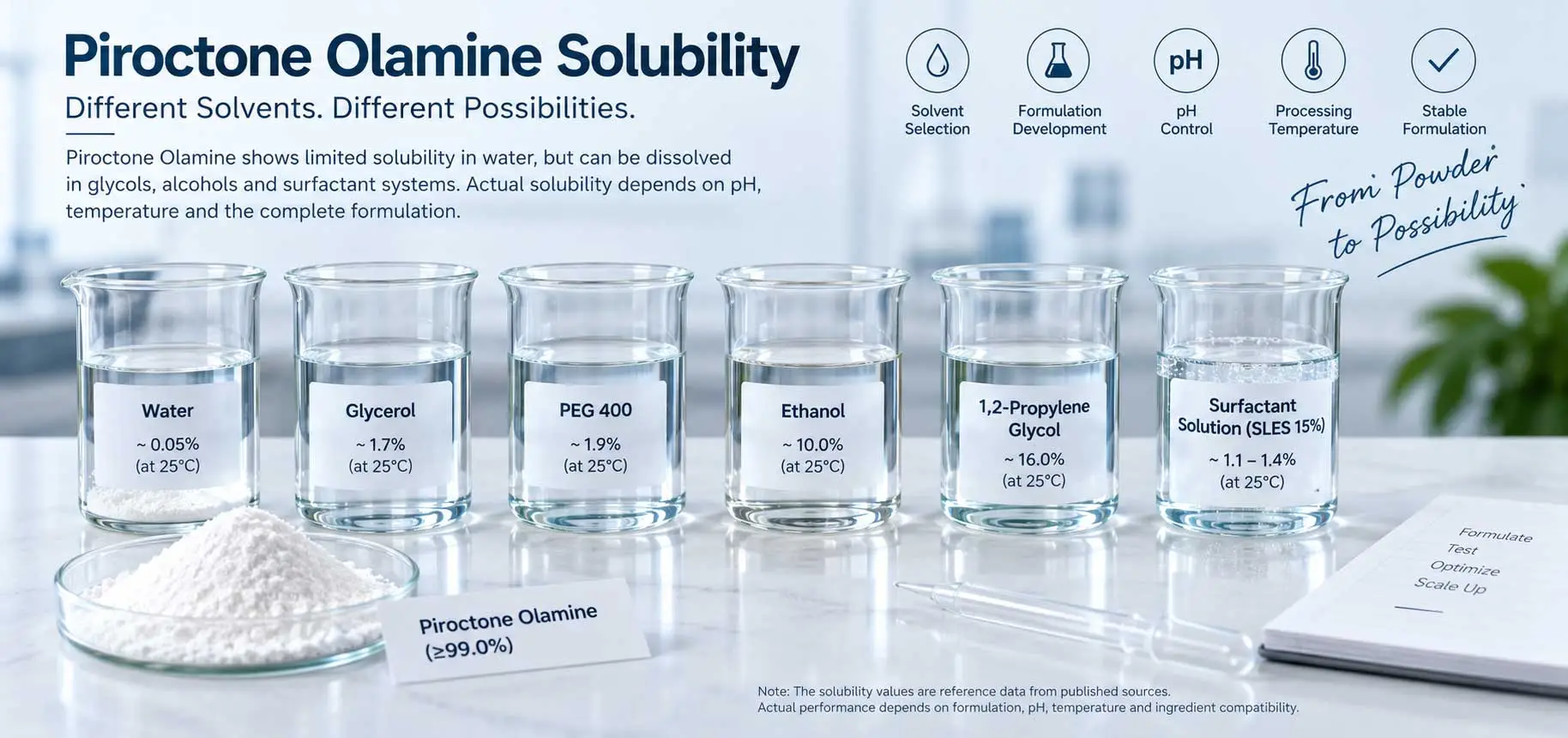
Historical technical data for Octopirox report approximately 0.05% solubility in water at room temperature, compared with about 1.7% in glycerol, 1.9% in PEG 400, 5% in isopropanol, 10% in ethanol, and 16% in 1,2-propylene glycol. The same technical literature reports substantially greater solubility in common surfactant solutions than in water alone.
More recent hazard-assessment data also demonstrate the importance of pH. Reported aqueous solubility was only 19–37.1 mg/L at pH 4–7, but increased to approximately 473–475 mg/L at pH 9 under the cited test conditions.
Therefore, when someone asks is Piroctone Olamine water soluble, the useful formulation answer is: it has limited aqueous solubility, and Piroctone Olamine water solubility should not be evaluated independently of pH and the complete formulation matrix.
What Is Piroctone Olamine Powder and Why Does Its Physical Form Matter?
Piroctone Olamine Powder, commonly abbreviated as OCT or PO, is the ethanolamine salt of piroctone. Its INCI name is Piroctone Olamine, CAS No. 68890-66-4 and EC No. 272-574-2. The EU cosmetic ingredient framework identifies functions including anti-seborrheic and preservative uses.
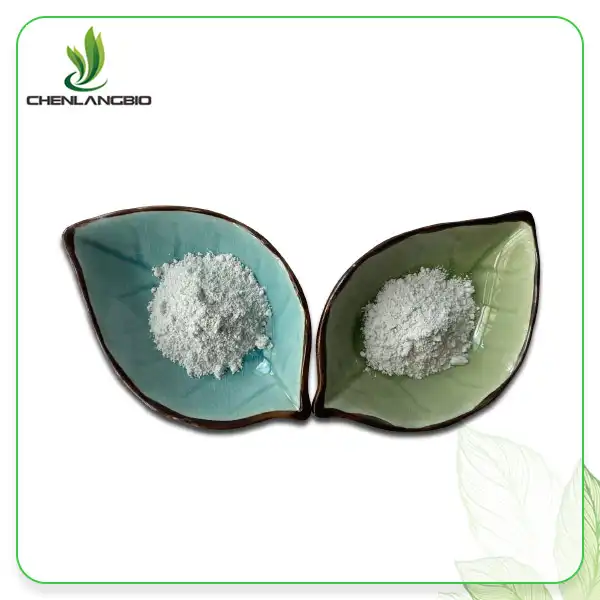
CHEN LANG BIO TECH supplies the material as a white crystalline powder with an assay of ≥99.0%. For formulators evaluating cosmetic grade Piroctone Olamine, both identity and assay matter, but neither tells the entire formulation story.
A crystalline raw material must move from its solid state into a compatible formulation environment. If the available solvent capacity is inadequate, apparently successful dispersion during mixing may later produce haze, sediment, or crystals. This is why Piroctone Olamine powder solubility should be considered as a formulation parameter rather than simply a line on a raw-material specification.
Is Piroctone Olamine Water Soluble? Understanding Solubility vs. Dispersibility
One of the most common formulation mistakes is treating dispersion and dissolution as interchangeable.
A powder may disappear visually during high-shear mixing without being molecularly dissolved. Fine suspended particles can temporarily produce a homogeneous-looking batch and subsequently become visible after cooling or storage. Conversely, a surfactant system can solubilize substantially more Piroctone Olamine than water alone.
Published Octopirox data illustrate the difference clearly. At pH 7 and room temperature, solutions containing 15% active detergent reportedly solubilized approximately 1.1–1.4% Piroctone Olamine in sodium alkyl ether sulfate, about 2.8% in sodium lauryl sulfate, approximately 2.3% in alpha-olefin sulfonate and about 1.9% in alkyl amidopropyl betaine.
These figures should not be copied directly into a new commercial formulation as guaranteed capacities. They demonstrate an important principle: Piroctone Olamine dispersibility and true solubility depend on the complete medium.
For this reason, a buyer comparing two raw-material samples should not rely on a water-only beaker test. Testing in the intended surfactant base at the target concentration and finished-product pH provides much more useful information.
What Can Dissolve Piroctone Olamine? Choosing a Suitable Solvent System
When deciding what dissolves Piroctone Olamine, formulators have several possible routes. The correct choice depends on the product architecture rather than on finding a single “best” solvent.
Published reference values provide a useful starting point:
|
Medium |
Reported Piroctone Olamine Solubility* |
|
Water |
~0.05% |
|
Glycerol |
~1.7% |
|
PEG 400 |
~1.9% |
|
Isopropanol |
~5.0% |
|
Ethanol |
~10.0% |
|
1,2-Propylene glycol |
~16.0% |
*Reference values from historical Octopirox technical data; actual performance depends on grade, temperature, pH and formulation conditions.
This explains why Piroctone Olamine solvent selection often involves glycols, alcohol-containing systems, or surfactant solutions rather than plain water. Propylene glycol is particularly noteworthy in the historical dataset, while aqueous surfactant systems can also provide useful solubilization capacity.
However, choosing the medium with the highest published number is not necessarily good formulation practice. A shampoo developer must also consider sensory properties, regulatory requirements, compatibility with the surfactant package, viscosity, fragrance, preservation strategy, and the final product concept.
The practical question is therefore not simply “What is the best solvent for Piroctone Olamine?” It is “Which solubilization strategy remains compatible and stable in this finished formula?”
How to Dissolve Piroctone Olamine Powder: A Practical Formulation Approach
A robust method for how to dissolve Piroctone Olamine Powder starts before the ingredient enters the vessel.
1. Define the target concentration
First determine the intended finished-product concentration and target market. Do not treat a supplier use level as an automatic formulation target. Product type, regional regulation, claim strategy and stability requirements all influence the final concentration.
2. Select and test the premix
Instead of relying on direct addition to water, evaluate an appropriate premix using a compatible solvent, surfactant solution, or combination suitable for the formulation.
When developing how to solubilize Piroctone Olamine, inspect the premix for residual particles rather than judging only by how quickly the powder disappears during agitation.
3. Control the process conditions
Our technical guidance is to incorporate Piroctone Olamine before emulsification and maintain the processing temperature below 80°C. This is a manufacturing recommendation, not a claim that the ingredient necessarily decomposes immediately above 80°C.
Temperature, mixing time, pH and solvent composition should be considered together.
4. Incorporate the premix into the batch
The premix should be incorporated under controlled agitation that allows uniform distribution without creating unnecessary aeration. When considering how to add Piroctone Olamine to shampoo, the correct addition sequence depends on the surfactant architecture and other formulation ingredients.
5. Recheck after cooling
A clear hot batch is not proof of a stable commercial product. Inspect the cooled formulation and repeat the evaluation after storage.
For development work, record appearance, pH, viscosity, clarity, residual particles and any evidence of recrystallization. This provides far more information than simply recording that the raw material “dissolved.”
How pH Affects Piroctone Olamine Solubility and Formulation Stability
Piroctone Olamine pH behavior deserves particular attention because solubility can change markedly across the pH range.
GreenScreen assessment data report only 19–37.1 mg/L aqueous solubility between pH 4 and 7, compared with approximately 473–475 mg/L at pH 9. Historical Octopirox technical information likewise states that aqueous-formulation solubility generally increases from acidic conditions toward neutral and weakly alkaline conditions.
That does not mean formulators should simply increase the finished shampoo pH to maximize solubility. Hair and scalp product design has other constraints, and the entire formula needs to remain appropriate for its intended application.
Instead, Piroctone Olamine pH stability should be evaluated as part of a balance between solubilization and finished-product performance.
It is also important to measure the finished formulation rather than only the premix. Surfactants, acids, electrolytes and other ingredients can shift the environment considerably after incorporation.
Processing Temperature: When Should Piroctone Olamine Be Added?
Our recommended Piroctone Olamine processing temperature is below 80°C, with the ingredient incorporated before emulsification where the product format requires an emulsification stage.
From a manufacturing perspective, however, “below 80°C” should not become the only process specification. The actual batch record should define the addition stage, temperature window, mixing time and premix procedure.
When establishing when to add Piroctone Olamine, formulators should also observe what happens during cooling. Solubility achieved under one process condition does not automatically guarantee that the active remains dissolved after the system returns to room temperature.
This distinction becomes increasingly important during scale-up, where heat transfer, mixing efficiency and residence times differ from those of a laboratory beaker.
Piroctone Olamine in Shampoo: Surfactant and Ingredient Compatibility
A commercial Piroctone Olamine shampoo formulation is a multicomponent system. Solubility can therefore change when the surfactant package, conditioning system, electrolyte level or other ingredients are modified.
This is not merely theoretical. Research published in the International Journal of Cosmetic Science demonstrated that interactions between Piroctone Olamine and shampoo micelles can affect delivery from the formulation. The researchers found that changing micellar stability and Piroctone Olamine–micelle association altered its retention on the scalp.
For Piroctone Olamine surfactant compatibility, the implication is important: solubilizing the ingredient is necessary, but maximum solubilization is not the only variable that matters in a finished shampoo.
When changing surfactants, polymers, conditioning ingredients, electrolytes or fragrance systems, formulators should therefore reassess the formula rather than assuming that the previous Piroctone Olamine compatibility result remains valid.
Clear shampoos are particularly unforgiving because small changes in solubility may become immediately visible as haze or crystals.
Common Piroctone Olamine Solubility Problems and How to Troubleshoot Them
The most useful troubleshooting begins with the observed failure rather than automatically adding more solvent.
|
Observed Problem |
Possible Explanation |
What to Check |
|
Undissolved particles |
Insufficient solvent capacity or premixing |
Premix composition, mixing and pH |
|
Haze after incorporation |
Formula compatibility issue |
Surfactants, pH, electrolytes |
|
Piroctone Olamine crystallization after cooling |
Reduced solubility in the cooled system |
Concentration and cooling profile |
|
Piroctone Olamine precipitation during storage |
Long-term formulation instability |
pH drift and storage conditions |
|
Batch-to-batch appearance changes |
Raw-material or process variation |
COA, weighing and processing records |
When Piroctone Olamine is not dissolving, increasing temperature indefinitely is not a good troubleshooting strategy. First establish whether the limitation comes from the solvent system, pH, concentration, mixing procedure or interaction with another formulation component.
The same principle applies to Piroctone Olamine shampoo stability. A batch that looks acceptable immediately after manufacturing should still be evaluated through an appropriate stability program before commercial release.
Recommended Use Level: Solubility Is Only One Part of the Decision
Our product guidance specifies up to 1.0% for rinse-off products and up to 0.5% for other products. These figures also correspond to current EU Annex V conditions for Piroctone Olamine when used within the regulated preservative framework. Comparable 1.0%/0.5% conditions are found in several other regulatory systems, including South Korea and New Zealand.
However, Piroctone Olamine recommended use level, Piroctone Olamine dosage, and the legally permitted maximum are not interchangeable concepts.
A regulatory ceiling tells a manufacturer what must not be exceeded under the relevant legal provision. It does not establish the optimal concentration for every shampoo. Likewise, a supplier recommendation does not replace the brand's safety assessment or market-specific compliance review.
This distinction is especially important for companies developing products for multiple countries because restrictions are not identical everywhere. Japan, for example, has a different published use matrix for Piroctone Olamine.
What Should Buyers Check When Sourcing Piroctone Olamine Powder?
Formulators are not the only people who need to understand solubility. Ingredient buyers should connect technical performance with raw-material quality.
When sourcing cosmetic grade Piroctone Olamine, start by confirming identity, appearance, assay and relevant impurity controls rather than comparing quotations alone. Our standard material is a white crystalline powder with an assay of ≥99.0%.
For buyers supplying the EU market, purity deserves additional attention. The relevant EU conditions associated with monoalkanolamines and their salts include minimum purity of 99%, restrictions concerning nitrosating systems, secondary amine limits and nitrosamine controls. The rules also specify nitrite-free containers.
A meaningful Piroctone Olamine COA should therefore be reviewed together with the applicable Piroctone Olamine specification, SDS and TDS. Buyers should also ask whether the supplier can provide consistent documentation across repeat batches.
A sample is particularly valuable for a formulation-sensitive material. A Piroctone Olamine sample should ideally be evaluated in the buyer's actual surfactant system, because a generic water-solubility observation cannot predict every commercial formula.
Manufacturer Perspective: What Matters Beyond Piroctone Olamine Price?
A quotation matters, but Piroctone Olamine price should be evaluated alongside specification, batch consistency, technical documentation and the quantity required.
When selecting a Piroctone Olamine manufacturer, buyers should determine whether the company can support raw-material identification, quality testing, traceability and repeat commercial supply. For an R&D team, technical communication during sample evaluation can be just as important as the initial specification sheet.
CHEN LANG BIO TECH develops and supplies food and cosmetic ingredients with manufacturing and quality-control infrastructure in China. Our broader manufacturing base in Shandong covers approximately 218 mu (about 145,000 m²), and the company's quality systems include ISO 9001 and ISO 22000 alongside other market-oriented certifications and registrations.
For customers progressing from laboratory development to bulk Piroctone Olamine Powder, we can support technical specifications, COA, TDS/SDS and commercial documentation. Piroctone Olamine MOQ and packaging requirements should be discussed according to the project stage and required quantity rather than treated as a formulation specification.
That separation is intentional: a technically suitable ingredient should be qualified first; commercial terms can then be evaluated against the required specification and supply program.
Storage and Handling of Piroctone Olamine Powder
Correct Piroctone Olamine storage is important both for maintaining raw-material quality and for regulatory compliance.
Our material should be kept tightly sealed in a dry, well-ventilated area and protected from unsuitable storage conditions. Particular attention should be paid to nitrite contamination. EU-related conditions state that relevant materials should not be used with nitrosating systems and should be kept in nitrite-free containers.
The specified Piroctone Olamine shelf life for our product is two years when stored under the recommended conditions.
FAQ: Piroctone Olamine Solubility and Formulation
Is Piroctone Olamine water soluble?
Piroctone Olamine has limited solubility in water, and the value depends strongly on conditions such as pH. Historical technical data report approximately 0.05% in water, while other assessments show substantially greater aqueous solubility under more alkaline conditions.
How do you dissolve Piroctone Olamine Powder?
How to dissolve Piroctone Olamine Powder depends on the finished formulation. Premixing in a compatible solvent or surfactant medium is generally more useful than relying on direct addition to plain water. The premix and finished batch should both be checked for residual particles and recrystallization.
What solvent can be used for Piroctone Olamine?
Published Piroctone Olamine solvent data include ethanol, propylene glycol, PEG 400, glycerol and surfactant solutions. Historical data report particularly high solubility in 1,2-propylene glycol compared with water.
When should Piroctone Olamine be added to shampoo?
Our technical guidance recommends incorporation before emulsification, with processing below 80°C. The precise sequence should still be validated in the manufacturer's own formula and process.
Why can Piroctone Olamine crystallize after cooling?
Crystallization can occur when the finished system no longer has sufficient solubilization capacity after processing or cooling. Concentration, pH, solvent composition and surfactant architecture should all be investigated rather than assuming temperature alone is responsible.
How much Piroctone Olamine is used in shampoo?
Our guidance for rinse-off products is up to 1.0%, but Piroctone Olamine dosage in shampoo should be selected according to formulation requirements and applicable market regulations. The EU Annex V maximum for the relevant use is 1.0% in rinse-off products.
What should buyers check on a Piroctone Olamine COA?
Check identity, appearance, assay and relevant controlled impurities against the agreed purchasing specification. For EU-targeted products, buyers should also understand the applicable purity, secondary-amine, nitrosamine and nitrite-related requirements rather than looking only at assay.
Conclusion: Validate Solubility in the Finished Formula
Successful Piroctone Olamine formulation depends on much more than whether the powder appears to dissolve during mixing. Published data show substantial differences between water, glycols, alcohol systems and surfactant solutions, while pH can materially change aqueous solubility.
For commercial development, the most reliable approach is to evaluate the ingredient in the actual finished formula, control the premix and addition process, and verify stability after cooling and during storage.
For formulators and ingredient buyers evaluating Piroctone Olamine Powder for shampoo or scalp-care projects, CHEN LANG BIO TECH can provide product specifications, COA, TDS/SDS, samples and commercial supply information. For technical documentation or a quotation, contact admin@chenlangbio.com.
References
1. Clariant. Octopirox® Technical/Brochure Data. Solubility of Piroctone Olamine in water, alcohol/water mixtures, glycols and surfactant systems.
2. ToxServices. GreenScreen® Executive Summary for Piroctone Olamine (CAS 68890-66-4), 2023. Physicochemical, solubility and regulatory information.
3. Tang M, et al. Characterization of piroctone olamine for topical delivery to the skin. International Journal of Cosmetic Science. DOI: 10.1111/ics.12839.
4. Johnson ES. Enhanced piroctone olamine retention from shampoo for superior anti-dandruff efficacy. International Journal of Cosmetic Science. DOI: 10.1111/ics.12835.
5. European cosmetic regulatory data for Piroctone Olamine, Annex V/35 and related Annex III conditions.
6. Korea Cosmetic Association. Piroctone Olamine Ingredient and Regulatory Information, CAS 68890-66-4.
7. New Zealand Cosmetic Products Group Standard. Piroctone Olamine conditions of use.
8. Japan Standards for Cosmetics. Piroctone Olamine regulatory entry.
9. Malvern Cosmeceutics. Patent literature summarizing published Piroctone Olamine solvent and surfactant-solubility data.

Send Inquiry
Related Industry Knowledge
- Does DHEA Affect Sleep?
- What is Tranexamic Acid Powder Used for?
- Is Kopexil Effective for Hair Growth?
- Can l use Ectoin with Tretinoin
- Is Loratadine Good for Poison Ivy
- What to Know About Ceramides for Skin
- What Is Cactus Extract Used For
- Lutein Extract Powder and zeaxanthin: Eye and vision benefits
- What is Pure Cinnamon Bark Extract
- Are Tribulus Terrestris Extract Powder Good for You