
How to Choose a Thaumatin Supplier: A Practical Buyer’s Guide
2026-09-28 14:49:21
Choosing a thaumatin supplier for commercial food production requires more than comparing a price quotation and a headline purity figure. Thaumatin is a high-intensity sweet protein, and differences in manufacturing route, analytical basis, product specification, documentation, batch consistency, and technical support can materially affect supplier qualification.
For procurement and QA teams, the objective is not simply to find a company that can ship bulk thaumatin. It is to establish whether the material being offered is clearly defined, consistently manufactured, analytically supported, suitable for the intended market, and scalable from initial evaluation to routine commercial purchasing.
A capable thaumatin manufacturer should therefore be able to explain what it produces, how quality is controlled, what its analytical results mean, and how a sample relates to subsequent commercial batches. Price matters, but it should be evaluated only after the technical basis of competing offers is understood.
Quick Answer: What Should Buyers Check When Choosing a Thaumatin Supplier?
When deciding how to choose a thaumatin supplier, start by confirming the exact product identity and manufacturing route. Then review the specification, representative COA, analytical methods, relevant regulatory documentation, production capability, and evidence of batch consistency. Before commercial approval, evaluate a traceable sample in the intended food matrix and confirm MOQ, packaging, lead time, change-control practices, and pricing terms.
A practical thaumatin supplier qualification should cover the following points:
|
Supplier Check |
What the Buyer Should Verify |
|
Product identity |
Exact commercial material being offered |
|
Manufacturing route |
How the thaumatin is produced |
|
Specification |
Defined acceptance criteria |
|
COA |
Representative or batch-specific quality results |
|
Test methods |
What the reported values actually measure |
|
Regulatory documentation |
Relevance to the destination market |
|
Production capacity |
Ability to support repeat commercial demand |
|
Batch consistency |
Control across production lots |
|
Application support |
Ability to assist formulation evaluation |
|
Sample |
Traceable to a defined production batch |
|
MOQ |
Practical starting quantity |
|
Packaging |
Protection during storage and transportation |
|
Lead time |
Stock availability and production schedule |
|
Price |
Compared on an equivalent technical and commercial basis |
This framework is more useful than ranking suppliers by a single assay number or quotation.
Thaumatin Manufacturer vs Supplier: What Should Buyers Actually Verify?
The terms thaumatin manufacturer and thaumatin supplier are often used interchangeably online, but they do not tell a procurement team enough about how the supply chain actually operates.
A manufacturer may control production directly, while a distributor or trading company may represent material produced elsewhere. Neither business model should automatically determine approval. What matters is technical accountability and transparency.
Buyers should establish who controls the manufacturing process, owns the product specification, releases commercial batches, performs or commissions analytical testing, manages deviations and change control, and responds when a technical issue arises.
This becomes particularly important when a distributor supplies material from more than one production site. Ask whether the manufacturing source can change without notification and whether specifications and test methods remain consistent between sources.
A supplier that can clearly trace each commercial batch back to its production and quality records may be more useful than a company that simply describes itself as a “factory” but cannot answer basic technical questions.
Check the Thaumatin Manufacturing Route Before Comparing Suppliers
Understanding the thaumatin manufacturing route should come before comparing assay percentages.
Traditional food-additive specifications for thaumatin have historically described material obtained by aqueous extraction from the arils of Thaumatococcus daniellii. The established E957 specifications in Europe likewise describe plant-extracted material containing primarily Thaumatin I and Thaumatin II.
Commercial technology is evolving, however, and recombinant or biosynthetic production routes also exist. JECFA's 2025 evaluation, for example, addressed recombinant Thaumatin II produced in Nicotiana tabacum seeds and established a group ADI “not specified” covering thaumatin and that recombinant Thaumatin II.
This illustrates an important procurement principle: the identity of a sweet protein and the regulatory status of a specific production route are related but separate questions.
When reviewing a thaumatin manufacturing process, ask the supplier to identify the actual route used for the product being quoted. Then determine which specification and regulatory basis apply to that material in the destination market.
Do not assume that documentation written for traditionally extracted E957 automatically covers every biosynthetic or recombinant commercial product.
Review the Thaumatin Supplier COA and Analytical Test Methods
A thaumatin supplier COA should connect a defined product specification with a traceable batch.
Before qualification, request the current specification and a recent representative thaumatin certificate of analysis. Check whether the COA identifies the batch, shows specification limits, reports actual results where appropriate, and identifies the relevant thaumatin test method or method reference.
The analytical basis matters. For example, writing “HPLC” beside a percentage does not by itself explain what the percentage represents. Buyers may need to understand what is being separated or quantified, how the result is calculated, and whether the method is suitable for the claimed parameter.
Why a Representative COA Is Better Than a Generic Template
A template COA is useful for seeing the expected test panel, but it cannot demonstrate the quality of a specific commercial batch.
During initial qualification, a recent representative COA is more informative. Once an order is placed, the commercial shipment should have appropriate lot-specific documentation so incoming QC can connect the material received with its release records.
A transparent thaumatin quality control system should make that connection straightforward.
What Regulatory Documents Should a Food Grade Thaumatin Supplier Provide?
A food grade thaumatin supplier should provide documentation relevant to the actual material being offered, but a larger document package is not automatically a better one.
The core technical package normally starts with the product specification, COA, TDS, and SDS. Depending on the manufacturing route, destination, customer qualification program, and application, buyers may also request manufacturing statements, allergen information, GMO documentation, contaminant or microbiological reports, storage and stability information, and applicable certification documents.
For international procurement, thaumatin regulatory documents require particular care. A document demonstrating compliance with one national standard does not automatically establish that the same product, production route, and intended use are acceptable in another jurisdiction.
The same principle applies to E957 terminology. Confirm that the regulatory definition being referenced actually covers the material being purchased.
Good thaumatin technical documentation should be current, internally consistent, and traceable to the commercial product. A long collection of certificates is less valuable when the product name, manufacturing source, specification, or production route cannot be reconciled across them.
How to Evaluate Thaumatin Manufacturing Capacity and Batch Consistency
Production capacity becomes important once a project moves beyond laboratory quantities.
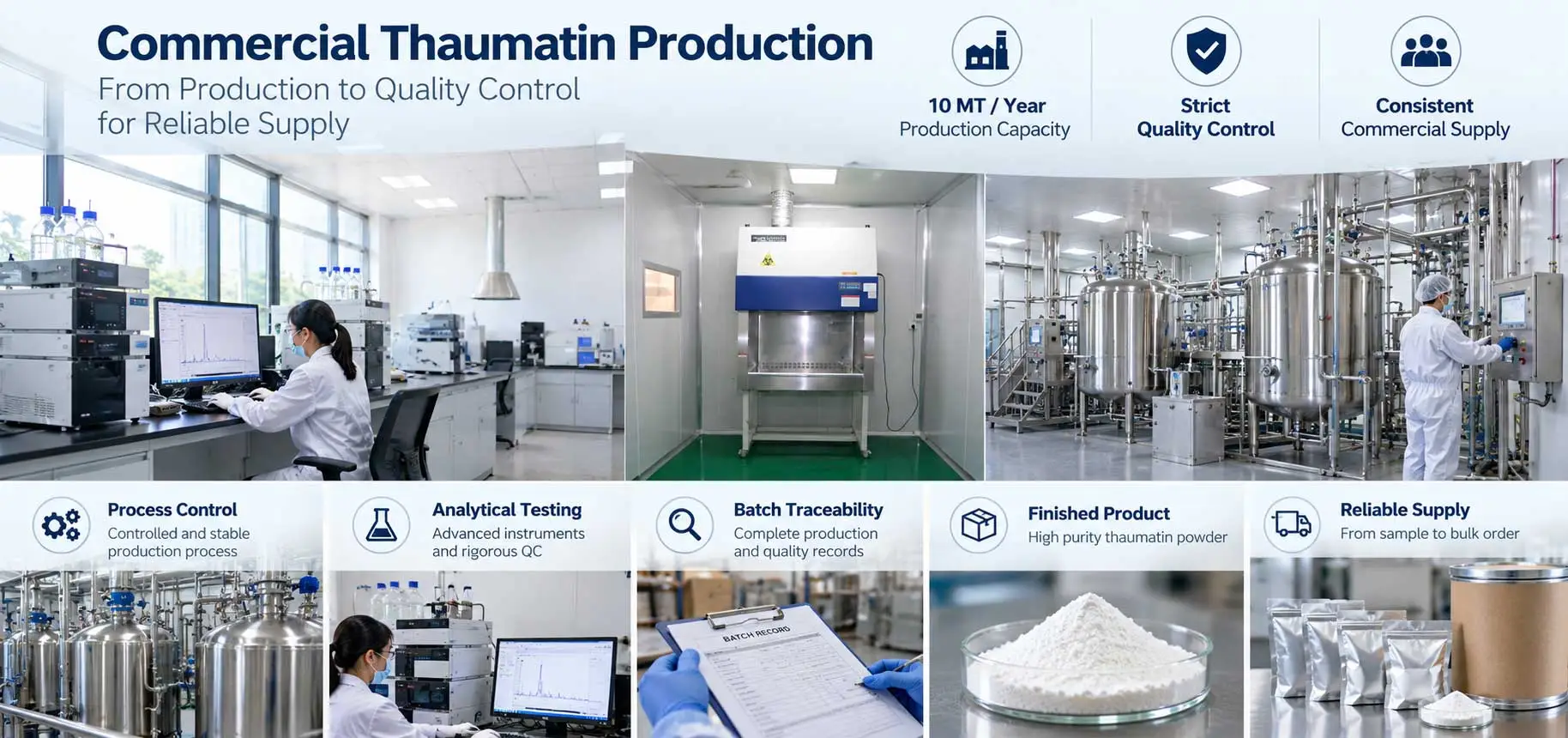
A buyer evaluating thaumatin production capacity should ask about realistic commercial output, typical production scheduling, normal lead time, scale-up capability, quality-release procedures, and the manufacturer's ability to support repeat orders.
Capacity alone, however, is not a quality metric.
For long-term purchasing, thaumatin batch consistency is often more important than a manufacturer's maximum theoretical output. Variation in important quality attributes can create additional incoming QC work or affect performance in a validated formulation.
A useful thaumatin manufacturer quality control review therefore considers raw-material or process controls, in-process monitoring, finished-product testing, batch release, traceability, deviation handling, and change control.
Ask how specification or manufacturing changes are communicated. A technically significant change introduced without adequate notification can be more disruptive than a longer initial lead time.
The objective is dependable commercial continuity: sufficient capacity combined with reproducible quality.
Why Application Support Matters When Choosing a Thaumatin Supplier
Thaumatin is not simply a drop-in replacement for sucrose or another high-intensity sweetener. Its sensory contribution can involve sweetness intensity, temporal profile, persistence, flavor modification, and bitterness masking, with performance influenced by the formulation.
For this reason, thaumatin application support can be a meaningful supplier-selection criterion.
When evaluating a thaumatin supplier for food projects, ask whether the technical team can discuss formulation conditions rather than only sending a generic dosage sheet. For a thaumatin supplier for beverages, useful support may include discussions around pH, processing conditions, flavor profile, other sweeteners in the system, and the intended sensory target.
An application laboratory is particularly useful because it connects analytical quality with actual product performance. The objective is not for a supplier to formulate the finished product on the customer's behalf, but to provide technically relevant information that shortens the qualification process.
How to Evaluate a Thaumatin Sample Before Bulk Approval
A thaumatin sample should be treated as the beginning of qualification rather than proof that a supplier has already been approved.
First, record the sample batch number and confirm that it matches the accompanying COA. Review the specification and perform incoming identity or quality testing according to your internal program.
Next, conduct thaumatin sample testing in the intended formulation.
A sweet protein that performs well in water may behave differently in a flavored beverage, dairy matrix, confectionery system, or formulation containing acids, proteins, minerals, botanical extracts, or other high-intensity sweeteners. Sensory evaluation should therefore examine more than peak sweetness. Sweetness onset, persistence, flavor interaction, secondary notes, and overall balance may all matter.
Where processing is involved, test the ingredient under representative time, temperature, pH, and storage conditions rather than extrapolating from a room-temperature bench sample.
After successful application testing, define the characteristics that need to remain controlled during commercial purchasing. This turns an approved sample into a meaningful food grade thaumatin purchasing specification.
From Thaumatin Sample to Bulk Commercial Supply
A disciplined scale-up pathway can be summarized as:
Supplier Screening → Technical Documentation → Sample Evaluation → Application Testing → Pilot Validation → Commercial Specification → Bulk Order → Incoming QC
The important transition occurs between sample approval and bulk thaumatin powder purchasing.
Confirm whether the commercial material will be manufactured at the same site, by the same route, and against the same specification as the evaluated sample. The commercial batch does not need to be the same lot as the sample, but it should fall within the approved quality framework.
A qualified bulk thaumatin supplier should be able to maintain traceability and provide appropriate documentation for subsequent production lots rather than relying indefinitely on the original sample COA.
Thaumatin MOQ, Packaging and Lead Time: What Should Buyers Confirm?
Commercial terms should be reviewed after the technical product has been defined.
Start with the thaumatin MOQ. A low MOQ can reduce the cost of initial qualification, but also confirm whether the same commercial grade remains available when demand increases.
Packaging should match purchasing volume and storage practices. For our commercial supply, standard thaumatin packaging options are:
1–5 kg aluminum foil bags for smaller requirements and qualification orders, and 25 kg paper drums for larger commercial quantities.
Our standard MOQ starts at 1 kg.
Lead time should distinguish between material available for prompt dispatch and product requiring a new manufacturing schedule. When discussing thaumatin lead time, also consider QC release, export documentation, international transportation, and destination customs procedures rather than interpreting “ready to ship” as the total door-to-door delivery time.
For repeat purchasing, agreed packaging and realistic replenishment planning are often more valuable than an unusually short lead-time promise.
How to Compare Thaumatin Price Without Choosing on Price Alone
A meaningful thaumatin price comparison requires technically equivalent products and comparable commercial terms.
Differences in manufacturing route, assay definition, specification, testing requirements, quantity, packaging, documentation, Incoterms, freight, and destination can all influence a quotation. As a result, two offers showing different thaumatin powder price figures may not represent equivalent supply.
When asking for a thaumatin price per kg, provide the supplier with the required quantity, destination country, application, target specification, and documentation requirements. This produces a more useful quotation than a generic request for the “best price.”
For larger requirements, bulk thaumatin price should also be considered in the context of qualified cost of supply. Incoming retesting, inconsistent performance, reformulation, documentation delays, rejected batches, and supply interruptions all carry costs.
The lowest invoice price can therefore be more expensive if the material creates additional qualification or production risk.
Questions to Ask a Thaumatin Manufacturer Before Placing an Order
For buyers researching how to find a thaumatin manufacturer, the following questions provide a practical starting point:
1. What is the exact manufacturing route for the product offered?
2. Which thaumatin specification controls commercial batch release?
3. How is the assay defined, and which analytical method is used?
4. Can you provide a recent representative or current batch COA?
5. Which technical and regulatory documents are available for our destination market?
6. What is your practical commercial production capacity?
7. How do you manage batch-to-batch consistency and traceability?
8. Can your technical team support application evaluation?
9. What are the MOQ, packaging options, and normal production or dispatch lead time?
10. How are significant manufacturing or specification changes communicated?
These questions are equally useful when evaluating an E957 manufacturer, provided the product being offered actually falls within the applicable E957 definition for the intended market.
What Should Buyers Look for in a Thaumatin Manufacturer in China?
When evaluating a thaumatin manufacturer China sourcing project, geographical location should be treated as a supply-chain fact rather than a quality conclusion.
International buyers should examine the same fundamentals they would use for suppliers elsewhere: manufacturing transparency, analytical capability, traceability, quality systems, documentation, batch consistency, technical responsiveness, and supply reliability.
Export experience adds another practical layer. A thaumatin powder manufacturer serving international customers should be able to prepare clear English technical documentation, understand commercial packaging and export logistics, and respond efficiently when a customer's QA or regulatory team requests clarification.
For an overseas buyer, it is also useful to establish who will manage technical communication after the order. The sales contact should have access to production, QA, and R&D teams rather than becoming a barrier between the customer and the technical information needed for approval.
A Chinese address alone does not establish whether a company is the right E957 supplier for a particular project; the qualification evidence does.
Thaumatin Supply from CHEN LANG BIO TECH
Our approach to commercial thaumatin supply is built around the same qualification principles described above.
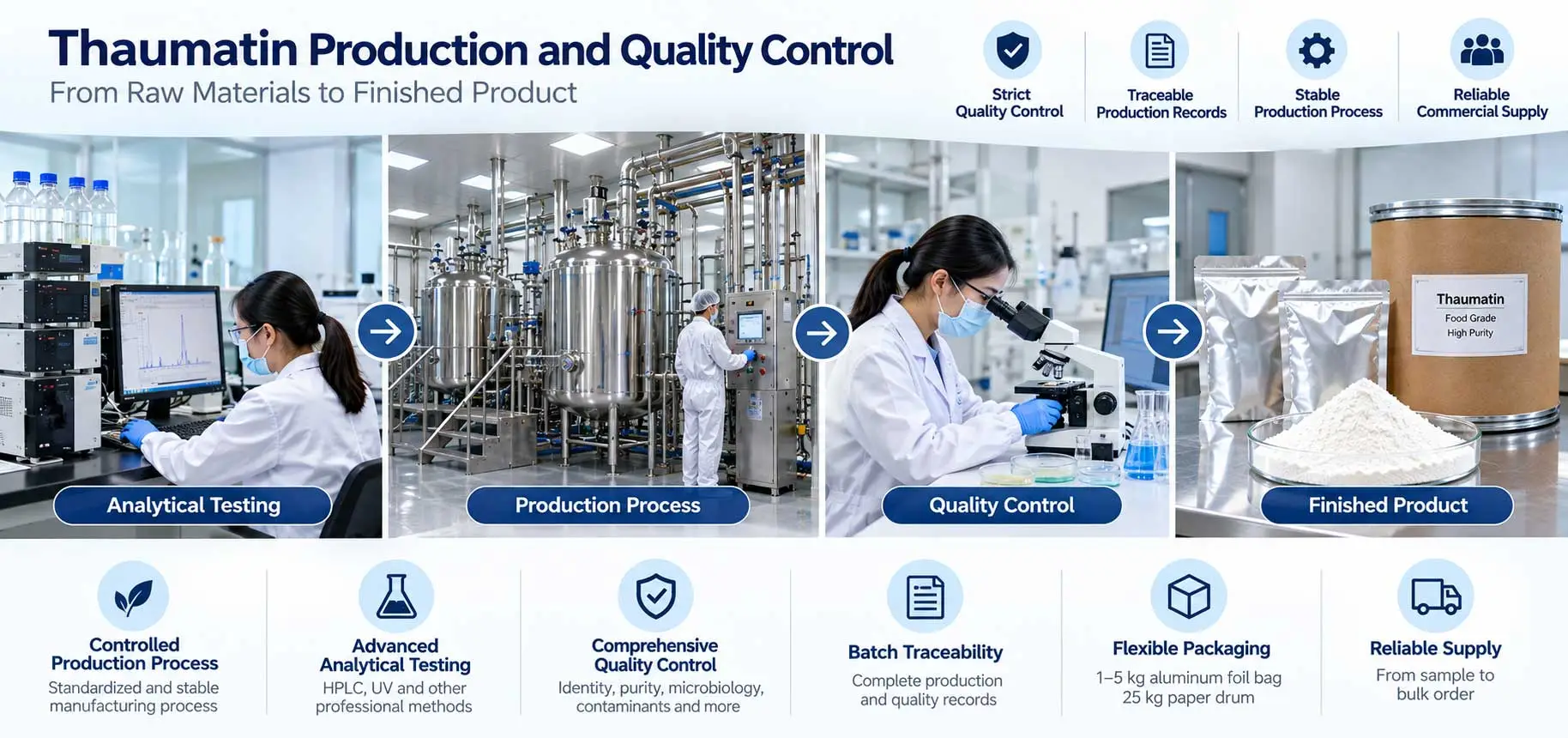
CHEN LANG BIO TECH has more than 30 years of experience with sweetener technologies and operates a commercial biosynthesis platform. Current thaumatin production capacity is approximately 10 MT per year, supported by technical R&D resources, an application laboratory, analytical quality-control capabilities, and production-stage quality management.
For our biosynthesized product, we encourage customers to evaluate the actual manufacturing route, specification, analytical basis, and documentation applicable to their destination market rather than assuming that historical specifications for plant-extracted material automatically apply.
As a thaumatin manufacturer and thaumatin supplier, our objective is to support the complete qualification path—from technical-document review and sample evaluation through application testing and repeat bulk thaumatin purchasing.
Commercial orders can start from 1 kg, with smaller quantities packed in aluminum foil bags and larger requirements available in paper drums.
Frequently Asked Questions About Choosing a Thaumatin Supplier
How do I choose a reliable Thaumatin supplier?
When considering how to choose a thaumatin supplier, verify product identity, manufacturing route, specification, COA, analytical methods, regulatory documentation, production capability, batch consistency, sample traceability, application support, and commercial terms. Price should be compared after these technical factors are aligned.
What documents should a Thaumatin supplier provide?
The basic thaumatin technical documentation normally includes a specification, representative or batch COA, TDS, and SDS. Depending on the application and destination market, additional manufacturing, regulatory, allergen, GMO, stability, microbiological, or contaminant documentation may be required.
Should I choose a Thaumatin manufacturer or distributor?
Neither business model is automatically superior. When comparing a thaumatin manufacturer vs supplier, determine who controls production, specification, batch release, traceability, change management, and technical support. Supply-chain transparency matters more than the label used on a website.
How can I compare Thaumatin purity between suppliers?
Do not compare percentages until you know what each result represents. Confirm the assay definition, analytical method, reporting basis, and specification. Two suppliers can use different analytical concepts while both describe their product using the word “purity.”
Can I request a Thaumatin sample before a bulk order?
Yes. A thaumatin sample allows the buyer to review documentation, conduct incoming testing where required, and evaluate the ingredient in the actual food or beverage matrix before commercial approval. Keep the sample batch number and corresponding COA for traceability.
What is the MOQ for Thaumatin?
Our standard thaumatin MOQ starts from 1 kg, making it possible to begin with a commercial-grade quantity for qualification before moving to larger purchasing volumes.
What packaging is available for bulk Thaumatin powder?
Our standard packaging is 1–5 kg per aluminum foil bag, while larger bulk thaumatin powder orders can be supplied in 25 kg paper drums. Packaging requirements can be discussed according to order size and destination.
What affects Thaumatin price per kg?
Thaumatin price per kg can be influenced by order quantity, product specification, manufacturing and testing requirements, packaging, documentation, freight, Incoterms, and destination. Buyers should therefore compare quotations only after confirming that the products and commercial terms are genuinely comparable.
Request a Thaumatin Sample, Specification and Commercial Quote
If you are qualifying a new source, we can discuss the product specification, current or representative COA, technical documentation, sample requirements, and commercial terms before you place a bulk thaumatin powder order.
To receive a relevant quotation, send us your intended application, required quantity, destination country, target specification, and any specific documentation requirements. Our commercial thaumatin MOQ starts from 1 kg, with 1–5 kg aluminum foil bag and 25 kg paper drum packaging available.
For a thaumatin sample, technical-document request, or current thaumatin price, contact:
Email: admin@chenlangbio.com
References
1. Joint FAO/WHO Expert Committee on Food Additives (JECFA). Thaumatin. WHO Food Additives Database. INS 957, CAS 53850-34-3.
2. Joint FAO/WHO Expert Committee on Food Additives (JECFA). Evaluation of Thaumatin and Thaumatin II Produced by Recombinant Methods. 100th JECFA Meeting, 2025.
3. EFSA Panel on Food Additives and Flavourings (FAF). Re-evaluation of thaumatin (E 957) as a food additive. EFSA Journal. 2021;19(11):6884.
4. Codex Alimentarius Commission. General Standard for Food Additives: Thaumatin (INS 957). FAO/WHO.
5. European Commission. Commission Regulation (EU) No 231/2012 laying down specifications for food additives. Specification for E957 Thaumatin.
6. Joseph JA, Akkermans S, Nimmegeers P, Van Impe JFM. Bioproduction of the Recombinant Sweet Protein Thaumatin: Current State of the Art and Perspectives. Frontiers in Microbiology. 2019;10:695.

Send Inquiry
Related Industry Knowledge
- Resveratrol 98% vs 50% Extract Which Grade Should You Choose for Your Product
- What is Liposomal Glutathione?
- How Does Hydroxypropyl Tetrahydropyrantriol Work?
- Can Cactus Extract Powder Lower Blood Sugar Levels?
- What is Podophyllin Powder Used For
- What Does Bakuchiol Do to Skin
- What Are the Macamides in Maca
- China Apple Extract Polyphenols Suppliers
- Why We Need to Use Hyaluronic Acid Powder Cosmetic Grade
- How Long Does Red Yeast Rice Extract Powder Take to Lower Cholesterol