How to Choose a Red Clover Extract Supplier: Quality, Testing and Documentation
November 20, 2026
Choosing a reliable red clover extract supplier involves more than comparing prices or selecting a product labeled 20% or 40% isoflavones. For supplement manufacturers, ingredient distributors, and procurement teams, the real challenge is verifying whether a supplier can consistently deliver material that meets defined specifications, analytical requirements, and commercial production needs.
A qualified supplier should demonstrate botanical identity, standardized isoflavone content, appropriate manufacturing controls, batch-specific testing, and reliable documentation. Equally important, buyers should understand how the extract behaves during formulation and whether the supplier can support repeat orders without unexpected changes in quality.
This guide explains how to evaluate a red clover extract manufacturer, review technical specifications, assess laboratory testing capabilities, and compare commercial supply conditions before purchasing bulk red clover extract powder.
Red Clover Extract Supplier Qualification: What Buyers Should Verify
A structured red clover extract supplier qualification process helps procurement teams distinguish between suppliers that can provide a competitive quotation and those capable of supporting long-term ingredient sourcing.
Essential Criteria for Evaluating a Red Clover Extract Manufacturer
Before approving a supplier, buyers should examine six areas: botanical identity, product standardization, manufacturing capabilities, analytical testing, quality documentation, and commercial supply reliability.
|
Evaluation Area |
What Buyers Should Verify |
|
Botanical identity |
Trifolium pratense L., plant part, raw material identification |
|
Product specifications |
Total isoflavone content, assay method, appearance, moisture |
|
Manufacturing |
Production facilities, process controls, quality management |
|
Analytical testing |
HPLC assay, heavy metals, pesticide residues, microbiology |
|
Documentation |
Batch-specific COA, TDS, SDS, traceability records |
|
Commercial supply |
MOQ, samples, packaging, lead time, shipping arrangements |
A supplier should be able to explain how these requirements are controlled, not simply confirm that the product is available.
Manufacturer vs Distributor: Understanding the Red Clover Extract Supply Chain
Working directly with a red clover extract manufacturer may provide more direct access to production information, analytical methods, and technical support. However, a qualified distributor can also offer dependable sourcing when its manufacturing relationships and quality responsibilities are transparent.
The important distinction is traceability. Buyers should establish who manufactures the ingredient, who releases each batch, and who is responsible for investigating quality deviations.
Red Clover Extract Manufacturing Capabilities and Production Facilities
Manufacturing infrastructure matters because botanical extracts are subject to variation in agricultural raw materials, processing conditions, and finished-product characteristics.
A supplier's ability to manage these variables is an important consideration when evaluating red clover extract manufacturing facilities for repeated commercial orders.
•Botanical Extract Production Lines and Manufacturing Infrastructure
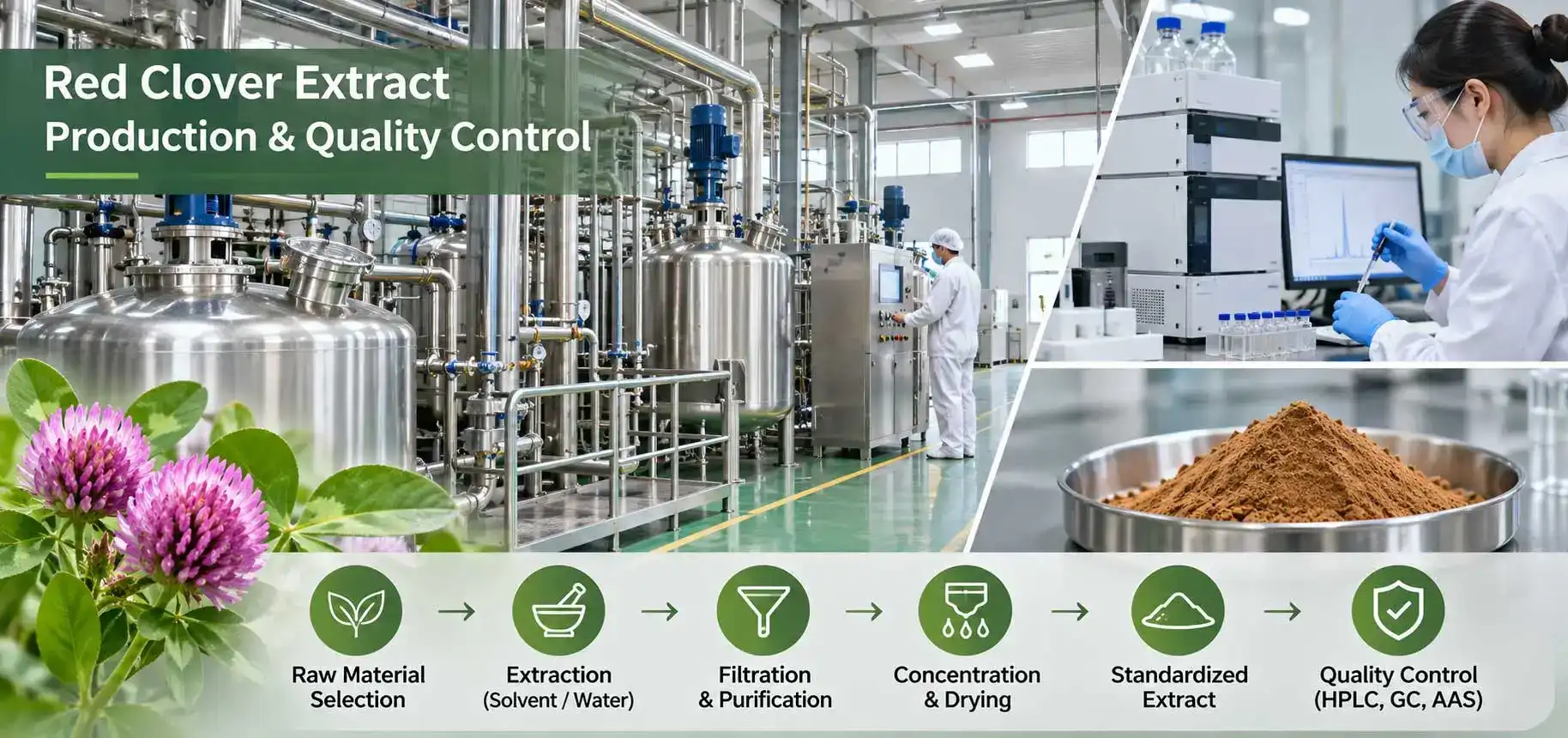
CHEN LANG BIO TECH operates a production base covering approximately 22 mu (14,667 m²), including 6,000 m² of modern manufacturing facilities. The site includes production lines for botanical extracts and functional food ingredients, supported by research, development, and quality control facilities.
This manufacturing infrastructure provides a foundation for coordinating botanical raw material processing, extraction activities, finished-product handling, and quality evaluation.
For international buyers, factory size alone is not sufficient evidence of manufacturing reliability. It should be considered alongside equipment suitability, production records, sanitation controls, and the supplier's ability to maintain consistent specifications across commercial batches.
•Research, Development and Technical Support for Botanical Extracts
Botanical extraction requires an understanding of how raw material composition and processing conditions affect the finished ingredient.
For red clover, the extraction system, solvent composition, temperature, concentration, and drying conditions can influence isoflavone recovery and the physical properties of the resulting powder.
Research and development capabilities are therefore valuable when investigating variations in assay results, powder characteristics, or formulation performance.
A technically capable supplier should be able to discuss relevant processing considerations while distinguishing established product specifications from experimental or customized requirements.
•ISO Quality Management and cGMP-Oriented Manufacturing Controls
A reliable botanical extract supplier should operate under documented quality management procedures covering raw material acceptance, production, testing, product release, and traceability.
CHEN LANG BIO TECH operates an ISO-based quality management system supported by standardized quality assurance procedures. Its manufacturing management is designed to align with applicable cGMP principles and other relevant quality requirements.
Buyers should request evidence of the applicable management system and confirm whether any certification or manufacturing compliance statement covers the specific facility and activities involved.
Red Clover Extract Specifications: Isoflavone Standardization and Product Consistency
Clearly defined red clover extract specifications are essential when comparing quotations from different suppliers.
The botanical name and declared isoflavone percentage are starting points, but they do not provide a complete technical description of the ingredient.
Red Clover Extract 8%, 20% and 40% Total Isoflavone Specifications
Standardized red clover extract is commonly evaluated according to its declared total isoflavone concentration.
CHEN LANG BIO TECH offers red clover extract specifications of 8%, 20%, and 40% total isoflavones.
|
Specification |
Nominal Total Isoflavones |
Theoretical Isoflavones per 100 mg Extract |
|
8% isoflavones |
80 mg/g |
8 mg |
|
20% isoflavones |
200 mg/g |
20 mg |
|
40% isoflavones |
400 mg/g |
40 mg |
These figures are theoretical values calculated from the declared concentrations, not batch-specific laboratory results.
A higher percentage allows a smaller ingredient quantity to provide the same nominal isoflavone amount. However, the appropriate grade also depends on formulation space, processing behavior, product positioning, and cost.
Botanical Identity and Trifolium pratense Extract Specifications
Red clover extract should be identified by its botanical source, Trifolium pratense L., together with the plant part used.
The supplier should provide appropriate botanical identification information and explain whether the material is a standardized extract or a non-standardized botanical preparation.
Depending on the product, relevant specifications may include appearance, moisture or loss on drying, particle size, bulk density, and other processing characteristics.
These properties become especially important when the ingredient will be used in automated capsule filling or tablet production.
Total Isoflavone Assay vs Individual Isoflavone Profile
Red clover contains several isoflavones, including biochanin A, formononetin, genistein, and daidzein.
However, red clover extract isoflavone content should not be evaluated solely by reading a percentage on the label.
Different analytical procedures may report total isoflavones using different analytes, calculation bases, or sample preparation methods. Consequently, two products both labeled 40% may not be directly comparable without reviewing their analytical definitions.
Buyers should confirm which compounds contribute to the reported total, whether results are expressed on an as-is or dry basis, and which analytical method supports the specification.
Red Clover Extract HPLC Testing and Contaminant Quality Control
Effective red clover extract quality control requires both identity and potency verification and appropriate testing for contaminants associated with botanical raw materials.
HPLC Analysis for Red Clover Extract Isoflavone Content
Red clover extract HPLC testing is commonly used to separate and quantify individual isoflavone components.
For meaningful supplier comparisons, procurement teams should review the analytical method, reference standards, sample preparation, and calculation approach.
Where applicable, method validation or verification information should support the method's suitability for the intended material and assay range.
A chromatogram can provide useful analytical evidence, but a chromatogram without an identifiable sample, method, and corresponding results should not be treated as complete proof of product quality.
Heavy Metals, Pesticide Residues and Residual Solvent Testing
Botanical ingredients may require testing for heavy metals, pesticide residues, and residual solvents, depending on the source material, manufacturing process, intended application, and destination market.
Our quality control center is equipped with HPLC, gas chromatography (GC), and atomic absorption spectroscopy (AAS) instruments. The laboratory has testing and control capabilities covering pesticide residues, residual solvents, heavy metals, and microbiological quality.
Different contaminants require different analytical methods. For example, GC-based methods may be used for suitable volatile solvent residues, while metal analysis requires an appropriate elemental analytical technique.
Buyers should verify the actual method, analyte coverage, detection limits, and results relevant to their product rather than relying solely on a list of available instruments.
Microbiological Testing and Finished Ingredient Quality
Red clover extract microbiological testing may include total aerobic microbial count, yeast and mold count, and specified microorganisms where relevant.
Acceptance limits should reflect the ingredient's intended use and applicable regulatory or customer requirements.
Testing is an important verification measure, but effective microbiological control also depends on raw material handling, equipment hygiene, environmental conditions, and suitable packaging.
Red Clover Extract COA, TDS and SDS: Documentation for Supplier Approval
Documentation is one of the most practical ways to evaluate a supplier before committing to a commercial order.
A complete red clover extract documentation package should allow procurement and quality teams to understand what is being supplied, how quality is assessed, and how the material should be handled.
Batch-Specific Red Clover Extract Certificate of Analysis
A red clover extract COA should identify the relevant batch and provide its applicable specifications and analytical results.
Important information includes the product identity, batch number, assay specification, actual isoflavone result, testing methods where appropriate, and relevant contaminant results.
Buyers should distinguish between a representative specification sheet and a genuine batch-specific certificate.
A sample COA may be useful during initial qualification, but the final commercial shipment should be supported by documentation traceable to the delivered batch.
Red Clover Extract TDS and SDS for Commercial Procurement
A red clover extract TDS typically describes the product's technical characteristics, specifications, recommended storage conditions, and other formulation-relevant information.
A red clover extract SDS addresses applicable hazard identification, safe handling, storage, transport, and related safety information.
These documents serve different purposes and should not be treated as interchangeable.
For international procurement, buyers should also verify whether additional documents are required by their importer, customs broker, or destination market.
Third-Party Testing and Supporting Quality Documentation
Independent red clover extract third-party testing can provide additional assurance when required by a customer's quality program.
However, a third-party report should be reviewed for laboratory identity, sample traceability, testing scope, and relevance to the supplied material.
A historical test report from an unrelated batch does not automatically establish the quality of a new shipment.
Red Clover Extract Samples and Batch Consistency Before Bulk Purchasing
Sample evaluation is an important step before approving bulk red clover extract powder for commercial production.
A laboratory sample may meet its declared assay while still presenting challenges during blending, encapsulation, or storage.
Red Clover Extract Sample Evaluation for Supplement Manufacturers
When requesting a red clover extract sample, buyers should provide the intended application and relevant formulation requirements.
For capsule and tablet manufacturing, practical evaluation may include particle size, bulk density, flow behavior, powder uniformity, and compatibility with other ingredients.
Solubility should also be assessed carefully.
Red clover isoflavones are generally poorly soluble in water, while their behavior in ethanol and other suitable organic solvents depends on the individual compounds, extract composition, and solvent conditions.
Therefore, a red clover extract powder should not be assumed to dissolve completely in water simply because it was manufactured through solvent extraction.
For aqueous beverages or liquid formulations, buyers should distinguish true dissolution from dispersion and consider whether a specifically developed water-dispersible formulation is required.
Comparing Sample COA Results with Commercial Production Batches
Red clover extract batch consistency should be evaluated through defined specifications and appropriate testing.
A pre-purchase sample and a commercial batch may have different batch numbers. Therefore, buyers should confirm that both meet the agreed specification rather than expecting identical analytical values.
Where possible, retain an approved reference sample for future comparison.
Retesting and Supplier Change Control
Changes in botanical source, processing conditions, analytical methods, or manufacturing location may affect ingredient characteristics.
Buyers should establish whether their supplier has procedures for evaluating significant changes and communicating those that may affect approved specifications.
Bulk Red Clover Extract Supplier: MOQ, Packaging and Lead Time
Commercial supply arrangements should be discussed before an ingredient is approved for production.
A dependable bulk red clover extract supplier should provide clear information about minimum order quantities, packaging, available stock, production scheduling, and shipment documentation.
Red Clover Extract MOQ and Sample Order Requirements
The red clover extract MOQ may vary according to isoflavone concentration, available inventory, and packaging requirements.
Buyers should distinguish laboratory evaluation quantities from pilot-scale and commercial orders.
When requesting a quotation, specify the required grade, quantity, destination country, and whether the purchase is intended for formulation trials or routine production.
Red Clover Extract Bulk Packaging and Storage Conditions
Appropriate packaging should protect the material from moisture, contamination, and avoidable exposure during storage and transportation.
Buyers should confirm packaging materials, net weight, sealing method, labeling, and recommended storage conditions.
For hygroscopic or poorly flowing powder formulations, packaging and handling conditions may also influence downstream manufacturing performance.
International Shipping and Red Clover Extract Lead Time
Red clover extract international shipping arrangements should account for shipment size, destination requirements, transport method, and the availability of supporting documents.
A supplier should distinguish between stock availability, order preparation time, dispatch date, and estimated transit time.
These details help purchasing teams plan production without relying on unrealistic delivery assumptions.
Red Clover Extract Bulk Price and Commercial Supplier Comparison
The lowest quoted kilogram price does not necessarily represent the lowest procurement cost.
When comparing red clover extract wholesale offers, buyers should first confirm that the products have equivalent specifications and analytical definitions.
Comparing Red Clover Extract Price per Kilogram Across Suppliers
The red clover extract price per kg can vary according to total isoflavone concentration, raw material costs, production requirements, testing, packaging, and order quantity.
For example, comparing an 8% extract with a 40% extract solely by kilogram price ignores their different nominal isoflavone concentrations.
A more useful comparison may consider the theoretical ingredient cost per gram of declared total isoflavones, provided the assay methods are comparable.
Total Procurement Cost Beyond the Quoted Ingredient Price
A meaningful red clover extract bulk price comparison should include freight, import-related costs, testing, packaging, and potential manufacturing losses.
|
Commercial Factor |
Procurement Question |
|
Assay specification |
Are the products analytically comparable? |
|
Price |
What is included in the quotation? |
|
Testing |
Are required analyses included? |
|
Packaging |
Is the packaging suitable for the intended use? |
|
Lead time |
Can the supplier meet the production schedule? |
|
Documentation |
Are shipment-specific records available? |
A quotation should be evaluated against the complete supply requirement rather than price alone.
Red Flags When Evaluating a Red Clover Extract Manufacturer
Effective red clover extract supplier verification includes identifying inconsistencies before they become commercial problems.
Inconsistent Isoflavone Specifications and Unclear HPLC Methods
A supplier claiming 40% isoflavones without identifying the analytical basis should be asked for clarification.
An unexplained difference between the quotation, specification sheet, and COA is a reason to delay approval until the discrepancy is resolved.
Missing Batch Traceability or Incomplete Quality Documents
Missing batch numbers, inconsistent product names, or test reports unrelated to the delivered material can indicate weaknesses in documentation control.
Buyers should request corrected records and verify their relevance before shipment acceptance.
Unverified Manufacturing Claims and Unrealistic Bulk Quotations
Unusually low prices are not automatically evidence of poor quality. However, they justify closer examination when accompanied by vague specifications, unsupported manufacturing claims, or incomplete testing information.
Supplier selection should remain evidence-based.
Red Clover Extract Supplier Selection Checklist and Frequently Asked Questions
A practical red clover extract supplier checklist should confirm botanical identity, agreed isoflavone specifications, analytical methods, contaminant testing, manufacturing controls, batch documentation, sample approval, and commercial terms.
What Documents Should a Red Clover Extract Supplier Provide?
At minimum, buyers should request an appropriate product specification, a representative or batch-specific COA, TDS, and SDS where applicable. Additional testing or regulatory documents depend on the intended use and destination market.
How Can Buyers Verify a Red Clover Extract Manufacturer?
Review the supplier's manufacturing facilities, quality management procedures, analytical capabilities, batch traceability, and supporting documentation. A supplier audit or independent verification may be appropriate for higher-risk sourcing programs.
What Should Buyers Confirm Before Ordering Bulk Red Clover Extract?
Before placing a red clover extract bulk order, confirm the isoflavone specification, testing requirements, approved sample, MOQ, packaging, quotation terms, lead time, and shipment documentation.
Request Red Clover Extract Specifications and Bulk Pricing
CHEN LANG BIO TECH supplies standardized red clover extract with 8%, 20%, and 40% total isoflavone specifications for commercial ingredient sourcing.
Our botanical extract manufacturing facilities, analytical testing capabilities, and quality management procedures support technical communication with supplement manufacturers and international ingredient buyers.
If you are looking to buy standardized red clover extract, contact our team with your target isoflavone concentration, required quantity, application, and destination country.
We can discuss product specifications, available quality documentation, sample requirements, and a red clover extract bulk quotation based on your purchasing needs.
Contact CHEN LANG BIO TECH: Email: admin@chenlangbio.com
References and Technical Resources
The following resources provide useful frameworks for analytical testing, botanical ingredient quality control, and supplier qualification. Their applicability depends on the product category and destination market.
1. International Council for Harmonisation (ICH). Q2(R2): Validation of Analytical Procedures.
2. World Health Organization. Quality Control Methods for Herbal Materials.
3. United States Pharmacopeia (USP–NF). Applicable botanical ingredient and dietary supplement quality standards.
4. European Medicines Agency (EMA). Guideline on Quality of Herbal Medicinal Products/Traditional Herbal Medicinal Products.
5. U.S. Food and Drug Administration. 21 CFR Part 111 — Current Good Manufacturing Practice in Manufacturing, Packaging, Labeling, or Holding Operations for Dietary Supplements.
6. European Commission. Regulation (EC) No 396/2005 on Maximum Residue Levels of Pesticides in or on Food and Feed of Plant and Animal Origin.

Send Inquiry

Related Industry Knowledge
- How to Formulate Bakuchiol Serum for Cosmetic Applications
- Which Is Better Ethyl Ascorbic Acid or L-Ascorbic Acid?
- Is Dimethylmethoxy Chromanol Safe
- What is the Internal Version of Dimethylmethoxy Chromanol
- What is Cetyl Tranexamate HCL
- Red Wine Extract Powder: Benefits and Uses
- Is It Okay to Use Bakuchiol Every Day
- Is Lotus Leaf Extract Powder Good for Weight Loss
- Is Resveratrol for Skin
- Can Diabetic Person Take Natural Stevia Extract Powder