
Ethyl Ascorbic Acid vs Ascorbyl Tetraisopalmitate: Stability and Formulation
2026-10-19 16:55:44
Choosing between ethyl ascorbic acid vs ascorbyl tetraisopalmitate is primarily a formulation decision. Although both ingredients are chemically modified vitamin C derivatives, they differ substantially in solubility, physical form, processing requirements, and compatibility with cosmetic delivery systems.
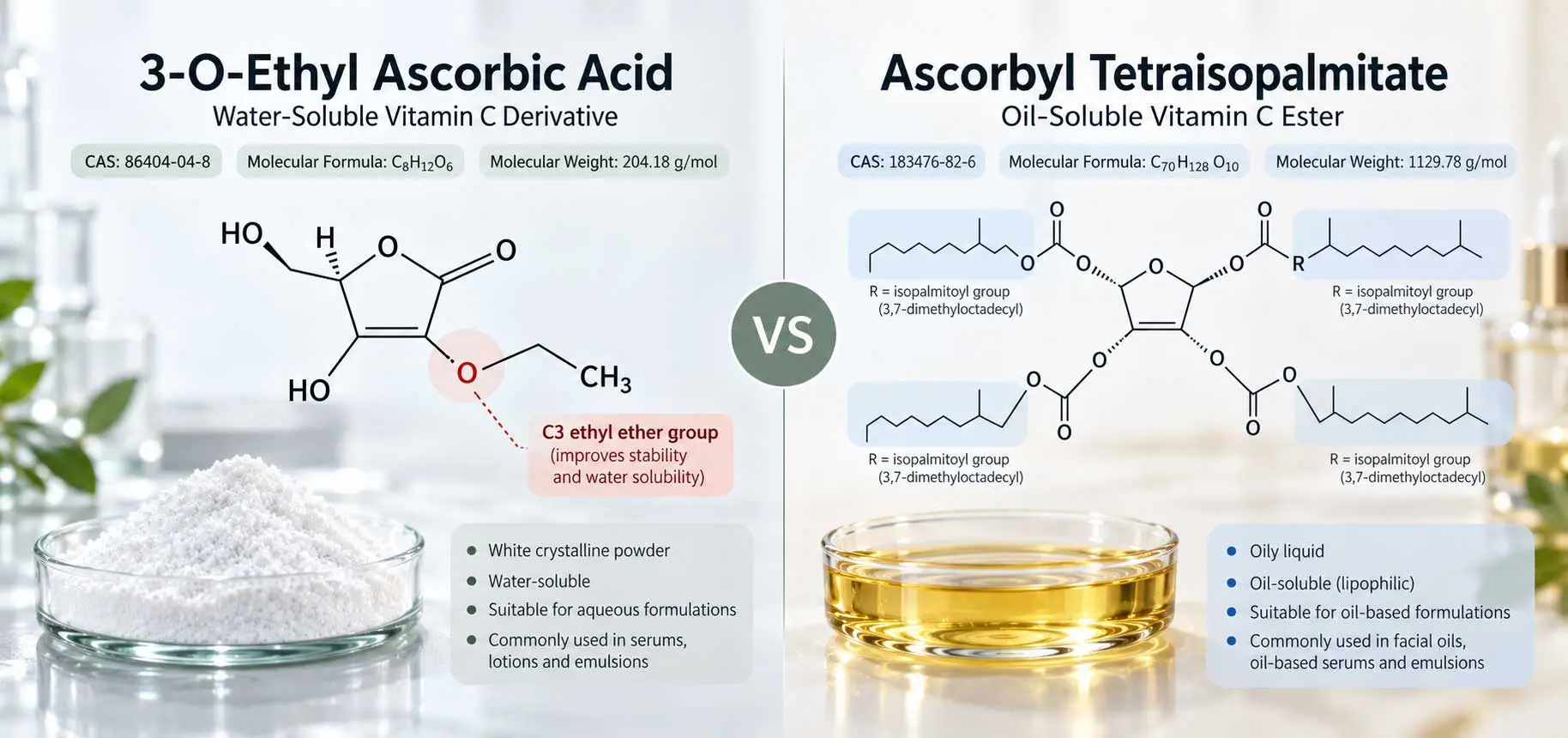
3-O-Ethyl Ascorbic Acid is a water-soluble crystalline powder commonly evaluated for aqueous serums and emulsions. Ascorbyl Tetraisopalmitate is a lipophilic vitamin C ester, generally supplied as an oily liquid for oil-based or oil-containing formulations. These differences influence ingredient incorporation, stability testing, packaging, and production costs.
Neither derivative is universally superior. A manufacturer developing a transparent aqueous serum may find ethyl ascorbic acid more practical, while a brand formulating an anhydrous facial oil may prefer ascorbyl tetraisopalmitate.
This technical comparison examines the chemical differences, stability requirements, solvent compatibility, manufacturing considerations, and purchasing criteria that matter when selecting vitamin c ingredients for cosmetic manufacturing.
What Is the Difference Between Ethyl Ascorbic Acid and Ascorbyl Tetraisopalmitate?
The main distinction between 3-o-ethyl ascorbic acid vs ascorbyl tetraisopalmitate is the chemical modification used to change the properties of the original ascorbic acid molecule.
Ethyl ascorbic acid contains an ether modification, while ascorbyl tetraisopalmitate contains four fatty acid ester groups. This structural difference explains their contrasting behavior in water- and oil-based formulations.
•3-O-Ethyl Ascorbic Acid: A Water-Soluble Vitamin C Derivative
3-O-Ethyl Ascorbic Acid, CAS 86404-04-8, is an ether-modified derivative of L-ascorbic acid. An ethyl group is attached through the oxygen at the third carbon position, changing the chemical behavior of the original molecule.
Its molecular formula is C₈H₁₂O₆, with a molecular weight of approximately 204.18 g/mol.
Commercial cosmetic grade ethyl ascorbic acid is typically supplied as a white or off-white crystalline powder. Its aqueous solubility makes it suitable for evaluation in water-based skincare formulations.
The ether modification can improve certain aspects of chemical stability compared with unmodified ascorbic acid, although the actual performance depends on the surrounding formulation.
•Ascorbyl Tetraisopalmitate: An Oil-Soluble Vitamin C Ester
Ascorbyl Tetraisopalmitate, commonly identified by CAS 183476-82-6, is a lipophilic derivative produced through esterification of ascorbic acid with branched fatty acid groups.
Unlike ethyl ascorbic acid, it is generally supplied as an oily liquid and is designed for incorporation into compatible lipid systems.
This makes it an attractive oil soluble vitamin c derivative for facial oils, oil-based serums, and the oil phases of emulsions.
Its chemical identity should be checked carefully against the supplier's INCI declaration and specification. Ascorbyl Tetraisopalmitate and Tetrahexyldecyl Ascorbate are sometimes discussed interchangeably in commercial literature, but buyers should not assume that different ingredient names or CAS numbers represent identical materials.
•Technical Comparison of Both Vitamin C Derivatives
|
Parameter |
3-O-Ethyl Ascorbic Acid |
Ascorbyl Tetraisopalmitate |
|
CAS Number |
86404-04-8 |
183476-82-6 |
|
Chemical Type |
Ether-modified vitamin C |
Fatty acid ester derivative |
|
Molecular Weight |
204.18 g/mol |
Confirm against specified chemical identity |
|
Typical Appearance |
White crystalline powder |
Oily liquid |
|
Solubility |
Water-soluble |
Oil-soluble |
|
Preferred Incorporation |
Aqueous phase |
Compatible oil phase |
|
Key Formulation Factors |
pH, dissolution, temperature |
Oil compatibility, oxidation, temperature |
|
Quality Evaluation |
Identity, assay, impurities |
Identity, assay, ester composition |
For raw material buyers, this distinction is more important than general marketing descriptions of vitamin C derivatives. The selected ingredient must be compatible with the intended product architecture before its performance can be meaningfully evaluated.
Ethyl Ascorbic Acid vs Ascorbyl Tetraisopalmitate Stability: Which Performs Better?
Comparing ethyl ascorbic acid stability with ascorbyl tetraisopalmitate stability requires consideration of their different formulation environments.
A water-soluble ingredient tested in an aqueous solution cannot be directly ranked against an oil-soluble ingredient tested in an anhydrous ester without accounting for differences in the test conditions.
How Does Ether Modification Affect Ethyl Ascorbic Acid Stability?
Unmodified L-ascorbic acid is susceptible to oxidation under certain conditions, particularly in aqueous systems exposed to oxygen, elevated temperatures, or catalytic metal impurities.
The ether modification in 3-O-Ethyl Ascorbic Acid changes the molecule's chemical reactivity and may improve its resistance to specific degradation pathways.
However, stability in dry powder form is different from stability after dissolution. Water activity, formulation pH, dissolved oxygen, and other ingredients may influence the degradation rate.
For commercial manufacturing, suppliers should distinguish between raw material shelf life and finished-product stability.
How Does Esterification Influence Ascorbyl Tetraisopalmitate Stability?
The esterification of ascorbic acid changes its polarity and makes ascorbyl tetraisopalmitate compatible with suitable oil phases.
This does not mean that an oil-based formulation is automatically resistant to oxidation.
The carrier oils, unsaturated lipids, antioxidants, trace metals, and packaging materials may influence the stability of the finished product.
For example, an oil-based serum containing oxidation-sensitive botanical oils may develop color or odor changes even when the vitamin C ester itself remains within its assay specification.
Formulators should therefore distinguish ingredient degradation from deterioration of the surrounding oil system.
What Stability Tests Should Cosmetic Manufacturers Perform?
A practical vitamin c derivative stability program should combine chemical analysis with physical evaluation.
|
Stability Test |
Water-Based Ethyl Ascorbic Acid Formula |
Oil-Based Ascorbyl Tetraisopalmitate Formula |
|
HPLC assay |
Active ingredient retention |
Active ingredient retention |
|
Accelerated aging |
Temperature-related degradation |
Temperature-related degradation |
|
Real-time storage |
Shelf-life assessment |
Shelf-life assessment |
|
Appearance |
Color and clarity |
Color and odor |
|
Physical stability |
Precipitation and viscosity |
Phase behavior and cloudiness |
|
Oxidation assessment |
Relevant oxidative changes |
Oil-phase oxidation indicators |
|
Packaging compatibility |
Container and closure interaction |
Container and oil-system interaction |
Where relevant, peroxide value testing can help assess oxidation in an oil-containing system, although it does not directly quantify ascorbyl tetraisopalmitate degradation.
Accelerated stability results should be supported by real-time testing before manufacturers establish commercial shelf-life claims.
Water-Soluble vs Oil-Soluble Vitamin C: How Does Solubility Affect Formulation?
The comparison of water soluble vs oil soluble vitamin c is central to selecting between these two ingredients.
Solubility determines where an ingredient can be incorporated, which solvents may be required, and whether the finished product can maintain its intended appearance during storage.
Ethyl Ascorbic Acid Solubility in Water-Based Formulations
Ethyl ascorbic acid solubility makes the ingredient a practical candidate for aqueous serums, lotions, and the water phases of emulsions.
However, complete dissolution should be verified at the intended use concentration.
Formulators should evaluate water quality, mixing conditions, temperature, pH, and the presence of other dissolved ingredients.
For a transparent serum, the initial appearance is not sufficient evidence of long-term physical stability. Low-temperature storage and repeated temperature changes may reveal precipitation that was not visible immediately after manufacturing.
Ascorbyl Tetraisopalmitate Solubility in Cosmetic Oils
Ascorbyl tetraisopalmitate solubility depends on the composition of the selected oil phase.
It may be incorporated into suitable cosmetic esters, emollients, or lipid blends, but compatibility should be verified with the actual materials used in the formulation.
Different oils have different polarity, viscosity, and solvent characteristics. Therefore, a vitamin C ester that mixes readily with one emollient may behave differently in another.
Manufacturers developing oil soluble vitamin c for skincare should test ingredient clarity, uniformity, and stability across the intended temperature range.
Why Does Solvent Selection Matter for Commercial Production?
Solvent selection influences more than ingredient dissolution.
It affects raw material handling, mixing time, processing temperature, sensory properties, and manufacturing costs.
A water-based serum may require relatively straightforward dissolution of ethyl ascorbic acid, while an oil-based vitamin C product may require careful selection of compatible emollients and antioxidants.
The most economical formulation is not necessarily the one containing the ingredient with the lowest purchase price. Solvent costs, processing losses, and stability performance must also be considered.
Ethyl Ascorbic Acid vs Ascorbyl Tetraisopalmitate Formulation: What Processing Conditions Matter?
Successful ethyl ascorbic acid formulation depends on controlled dissolution, ingredient compatibility, and appropriate manufacturing conditions.
For ascorbyl tetraisopalmitate, the process focuses more heavily on oil-phase compatibility and the behavior of the surrounding lipid system.
Recommended Ethyl Ascorbic Acid Concentration and Addition Temperature
For our 3-o-ethyl ascorbic acid 99%, the recommended starting use level is 0.5%–2%, depending on the cosmetic application and formulation requirements.
This ethyl ascorbic acid concentration range is a supplier recommendation for formulation development rather than a universal optimum or regulatory maximum.
We recommend adding the ingredient below 40°C after preparing a suitable aqueous phase.
The actual addition sequence should be determined through laboratory trials, with particular attention to dissolution, pH, and ingredient retention.
How to Incorporate Ascorbyl Tetraisopalmitate into Oil-Based Formulations
An ascorbyl tetraisopalmitate formulation should begin with a compatibility assessment using the intended oil blend.
The ingredient may be premixed with compatible emollients before incorporation into the main oil phase.
Formulators should confirm whether heating is necessary, how temperature affects the ingredient and carrier oils, and whether the finished product remains uniform after cooling.
For emulsions, incorporation into the oil phase must also be coordinated with the emulsification process.
Processing temperatures and recommended concentrations should follow the specific commercial grade's technical documentation rather than assumptions based on other vitamin C esters.
Compatibility with Niacinamide, Hyaluronic Acid, and Other Actives
Multi-active vitamin c serum formulation requires careful consideration of ingredient distribution between phases.
Niacinamide and hyaluronic acid are commonly incorporated into water-containing systems, while lipophilic vitamin C esters require a compatible oil environment.
In emulsions, both water-soluble and oil-soluble actives may be incorporated into different phases, provided the complete formulation remains stable.
The presence of multiple active ingredients also increases the importance of pH control, preservative compatibility, emulsion stability, and analytical testing.
No vitamin C derivative should be considered universally compatible with every skincare ingredient.
Which Vitamin C Derivative Is Better for Serums, Creams, and Facial Oils?
The best vitamin c derivative for serum development depends on the product's solvent system, desired texture, manufacturing process, and supporting stability data.
Although both ingredients can be used in skincare products, they are not direct substitutes.
•Ethyl Ascorbic Acid for Water-Based Serums and Lotions
Ethyl ascorbic acid is a logical starting point for transparent aqueous serums, lightweight lotions, and emulsions with a substantial water phase.
Its solubility profile supports incorporation into hydrophilic systems, although the final concentration and ingredient compatibility must be verified.
Published physicochemical research measured a partition coefficient, log P, of −1.07 ± 0.03 for 3-O-Ethyl Ascorbic Acid, supporting its preference for hydrophilic environments. The same study reported a pKa of 7.72 ± 0.01 and a melting point of 114.39 ± 0.5°C.
These measurements are useful for understanding formulation behavior, but they should not be interpreted as universal finished-product stability specifications.
•Ascorbyl Tetraisopalmitate for Facial Oils and Anhydrous Products
Ascorbyl tetraisopalmitate is a practical candidate for oil soluble vitamin c for facial oil development, including anhydrous serums and lipid-rich skincare products.
Its lipophilic character allows formulators to investigate oil-based systems without requiring a conventional aqueous phase.
However, the choice of emollients, antioxidants, and packaging remains important for maintaining the quality of the finished product.
•Vitamin C Ingredient Selection Matrix for Cosmetic Manufacturers
|
Product Type |
Initial Ingredient Preference |
Primary Validation |
|
Clear water-based serum |
3-O-Ethyl Ascorbic Acid |
Solubility, clarity, assay retention |
|
Anhydrous facial oil |
Ascorbyl Tetraisopalmitate |
Oil compatibility, oxidation |
|
Oil-based serum |
Ascorbyl Tetraisopalmitate |
Uniformity, odor, color |
|
Oil-in-water cream |
Either, depending on phase design |
Emulsion and chemical stability |
|
Lightweight lotion |
Depends on formulation architecture |
Viscosity, compatibility |
|
Multi-active skincare |
Depends on solvent and active system |
Full-formula stability |
These recommendations are starting points for development rather than guarantees of superior efficacy.
How Do Ethyl Ascorbic Acid and Ascorbyl Tetraisopalmitate Compare in Formulation Cost?
A meaningful vitamin c derivative cost comparison must account for the quantity of ingredient required, its usable concentration, processing requirements, and the stability of the finished formula.
The lowest quoted raw material price does not necessarily produce the lowest manufacturing cost.
Why Is Ingredient Price per Kilogram Not the Only Cost Factor?
The ethyl ascorbic acid price may differ considerably from the ascorbyl tetraisopalmitate price, depending on grade, order volume, and supplier.
However, direct price comparisons can be misleading because the ingredients have different molecular weights, formulation requirements, and potentially different recommended use levels.
Manufacturers should consider solvent costs, processing losses, quality-control testing, packaging, and the risk of rejected batches.
A formulation that requires additional stabilization or specialized packaging may cost more even when the active ingredient itself is less expensive.
How Should Buyers Calculate the Cost of Vitamin C Derivatives?
The basic raw material cost calculation is:
\[ \text{Ingredient Cost per kg of Formula} = \text{Price per kg} \times \text{Usage Rate} \]
For example, assume an ingredient is priced at USD 100/kg and used at 1%.
The ingredient contributes USD 1.00 to each kilogram of finished formula, excluding processing losses and other expenses.
For a 1,000 kg batch, the theoretical requirement is 10 kg of ingredient, representing USD 1,000 in raw material cost.
This calculation provides a consistent starting point for evaluating quotations. It does not establish that different vitamin C derivatives will deliver equivalent performance at identical concentrations.
Cosmetic-Grade Ethyl Ascorbic Acid 99%: What Quality Specifications Should Buyers Check?
A commercial ethyl ascorbic acid raw material should be evaluated using documented specifications rather than appearance or nominal purity alone.
For manufacturers producing skincare products across multiple batches, analytical consistency is essential for controlling formulation quality.
How to Evaluate an Ethyl Ascorbic Acid COA and HPLC Report
An ethyl ascorbic acid coa should identify the tested batch and provide results against clearly defined acceptance limits.
Important parameters include chemical identity, assay, related impurities, moisture, appearance, and applicable storage conditions.
When reviewing ethyl ascorbic acid hplc data, buyers should confirm how the reported purity was calculated.
HPLC area percentage and quantitative assay are not necessarily equivalent. A chromatogram showing 99% peak area does not automatically establish 99% material content by weight.
The analytical method, reference standard, sample preparation, and calculation procedure should support the reported result.
What Quality Documents Should a Cosmetic Raw Material Supplier Provide?
For 3-o-ethyl ascorbic acid 99%, procurement teams should request the current specification, batch-specific COA, technical data sheet, and safety data sheet.
Depending on the intended market and customer qualification process, additional documentation may be necessary.
CHEN LANG BIO TECH supplies ethyl ascorbic acid powder for cosmetic formulation and commercial manufacturing, with available technical documentation to support ingredient evaluation.
Our standard packaging options include 1–5 kg aluminum foil bags and 25 kg paper drums, subject to order requirements. The stated shelf life is 24 months under recommended storage conditions.
Buyers should confirm packaging, shelf life, and documentation against the current product specification before placing an order.
How to Choose an Ethyl Ascorbic Acid Supplier for Bulk Cosmetic Manufacturing
Selecting an ethyl ascorbic acid supplier requires attention to both ingredient quality and the supplier's ability to support repeat commercial orders.
For cosmetic manufacturers, reliable documentation and batch consistency are often more valuable than a small difference in the initial quotation.
What Should Buyers Expect from an Ethyl Ascorbic Acid Manufacturer?
An ethyl ascorbic acid manufacturer should provide a clear product specification, traceable batch information, appropriate analytical documentation, and realistic delivery arrangements.
Before qualifying a supplier, buyers should establish whether the material meets their formulation requirements and whether the proposed packaging is suitable for their production process.
For ongoing bulk ethyl ascorbic acid purchasing, it is also advisable to agree on specification limits, sampling procedures, and change-notification expectations.
What Information Is Needed for a Bulk Ethyl Ascorbic Acid Quotation?
To obtain an accurate ethyl ascorbic acid quotation, buyers should provide the required quantity, destination country, target specification, packaging preferences, and expected purchasing schedule.
For customers comparing ethyl ascorbic acid price per kg, the quotation should also identify the applicable delivery terms and any additional documentation requirements.
We welcome requests for commercial pricing, sample availability, and technical specifications. For customers planning to buy ethyl ascorbic acid powder, an initial sample evaluation can help confirm suitability before larger-volume purchasing.
Frequently Asked Questions About Ethyl Ascorbic Acid and Ascorbyl Tetraisopalmitate
Is Ethyl Ascorbic Acid Water-Soluble?
Yes. 3-O-Ethyl Ascorbic Acid is suitable for evaluation in water-based cosmetic formulations. Its actual solubility depends on the solvent system, temperature, and concentration. Formulators should verify complete dissolution and physical stability in the finished product.
Is Ascorbyl Tetraisopalmitate Oil-Soluble?
Yes. Ascorbyl Tetraisopalmitate is a lipophilic vitamin C ester generally incorporated into compatible oil phases. However, ascorbyl tetraisopalmitate solubility should be confirmed in the selected emollients because not all cosmetic oils have identical solvent properties.
Which Vitamin C Derivative Is More Stable?
Neither ingredient is universally more stable. Their performance depends on the formulation environment, temperature, light exposure, packaging, and other ingredients. A meaningful comparison requires analytical testing under defined conditions rather than relying on general claims.
Can Ethyl Ascorbic Acid Replace Ascorbyl Tetraisopalmitate?
Ethyl ascorbic acid may be considered an alternative to ascorbyl tetraisopalmitate when redesigning a skincare formula, but direct substitution is generally inappropriate without reformulation. Their different solubility characteristics may require changes to the solvent system, processing method, and stability protocol.
Which Vitamin C Derivative Is Better for a Facial Serum?
For an aqueous serum, ethyl ascorbic acid is often the more practical starting point. For an anhydrous facial oil or oil-based serum, ascorbyl tetraisopalmitate may be more suitable. The final choice depends on the product architecture and supporting performance data.
What Documents Should Buyers Request Before Ordering Ethyl Ascorbic Acid?
Buyers should request an ethyl ascorbic acid specification and coa, together with the TDS and SDS. Commercial orders may also require packaging details, shelf-life information, analytical methods, and other documents relevant to the intended market.
Conclusion: Selecting the Right Vitamin C Derivative for Commercial Skincare
The main difference between ethyl ascorbic acid and ascorbyl tetraisopalmitate is not simply which ingredient is more stable. Their distinct chemical structures create different solubility characteristics and formulation requirements.
For aqueous serums and many water-containing skincare products, 3-O-Ethyl Ascorbic Acid provides a practical starting point. For facial oils and anhydrous formulations, Ascorbyl Tetraisopalmitate offers a lipophilic alternative.
Commercial ingredient selection should also account for raw material quality, manufacturing conditions, stability testing, and total formulation cost.
CHEN LANG BIO TECH supplies 3-O-Ethyl Ascorbic Acid 99% for cosmetic manufacturers, formulation laboratories, and skincare brands.
For product specifications, COA, sample inquiries, or commercial quotations, contact admin@chenlangbio.com.
References
1. Iliopoulos, F., Sil, B. C., Moore, D. J., Lucas, R. A., & Lane, M. E. (2019). 3-O-ethyl-L-ascorbic acid: Characterisation and investigation of single solvent systems for delivery to the skin. International Journal of Pharmaceutics: X, 1, 100025. DOI: 10.1016/j.ijpx.2019.100025.
2. International Organization for Standardization. (2018). ISO/TR 18811:2018 — Cosmetics: Guidelines on the stability testing of cosmetic products.
3. National Center for Biotechnology Information. PubChem: 3-O-Ethyl-L-Ascorbic Acid. Chemical identity and physicochemical information.
4. Applicable supplier technical data sheets, certificates of analysis, and safety data sheets for Ascorbyl Tetraisopalmitate and 3-O-Ethyl Ascorbic Acid.
5. Batch-specific analytical and finished-formulation stability data should be used to confirm commercial specifications and any comparative performance claims.

Send Inquiry

Related Industry Knowledge
- How to Use Piroctone Olamine in Shampoo: A Practical Formulation Guide
- Is Centella Asiatica Extract Powder Better Than Vitamin C?
- Can Liposomal Glutathione Cause Weight Gain
- What are the Benefits of Ascorbyl Tetraisopalmitate in Skincare?
- What are the Health Benefits of Cactus Extract Powder?
- Is Centella Asiatica An Antioxidant
- The Ultimate Guide to Buying Instant Kava Powder Online
- What Is Cactus Extract Used For
- Is Shilajit Extract Powder Fulvic Acid Good for You
- What is Senna Leaf Extract Powder