
Ethyl Ascorbic Acid and Hyaluronic Acid: Formulation and Stability
2026-10-23 14:58:26
Ethyl ascorbic acid and hyaluronic acid can be incorporated into the same cosmetic serum, provided that the formulation is designed around the physicochemical requirements of both ingredients. The main challenge is not simply whether they can coexist in water. It is whether the finished product maintains its vitamin C derivative content, polymer integrity, viscosity, appearance, and microbiological quality throughout its intended shelf life.
3-O-Ethyl Ascorbic Acid is a small-molecule vitamin C derivative used in antioxidant and skin-tone formulations. Hyaluronic Acid and its sodium salt serve primarily as water-binding polymers, with performance strongly influenced by molecular weight and concentration. Their combination offers opportunities for developing hydrating antioxidant serums, but the appropriate formulation conditions cannot be determined from ingredient names alone.
For cosmetic formulators and raw material buyers, understanding molecular weight specifications, polymer hydration, processing conditions, and stability testing is essential before scaling a laboratory formulation into commercial production.
Ethyl Ascorbic Acid and Hyaluronic Acid Compatibility
Ethyl ascorbic acid hyaluronic acid compatibility involves two different types of materials: a relatively small organic molecule and a high-molecular-weight polysaccharide.
Chemical Properties of 3-O-Ethyl Ascorbic Acid and Hyaluronic Acid
3-O-Ethyl Ascorbic Acid is an ether derivative of L-ascorbic acid. Published physicochemical research has reported a molecular weight of 204.18 g/mol, a pKa of approximately 7.72, and a logP of approximately −1.07. These characteristics help explain its behavior in different solvent systems but do not establish a universal optimum formulation pH.
Hyaluronic Acid is a linear glycosaminoglycan composed of repeating disaccharide units containing D-glucuronic acid and N-acetyl-D-glucosamine. Unlike the vitamin C derivative, it is a polymer with a molecular weight that can vary substantially between commercial grades.
|
Property |
3-O-Ethyl Ascorbic Acid |
Hyaluronic Acid / Sodium Hyaluronate |
|
Chemical type |
Vitamin C ether derivative |
Glycosaminoglycan polymer |
|
Molecular characteristics |
Small molecule, 204.18 g/mol |
Variable polymer molecular weight |
|
Primary cosmetic role |
Antioxidant and skin-tone formulation |
Humectancy and texture modification |
|
Main processing consideration |
Dissolution and chemical stability |
Dispersion, hydration and shear |
|
Critical stability endpoint |
Active ingredient recovery |
Molecular weight and rheological behavior |
Compatibility in Water-Based Vitamin C Serums
For 3-o-ethyl ascorbic acid and hyaluronic acid, initial compatibility should be distinguished from long-term formulation stability.
A serum may appear transparent and homogeneous immediately after production while experiencing viscosity loss, discoloration, or chemical changes during storage.
Sodium Hyaluronate can influence the rheology of the continuous aqueous phase, which may affect mixing efficiency and the distribution of other ingredients. However, increased viscosity should not be interpreted as evidence that the vitamin C derivative is chemically stabilized.
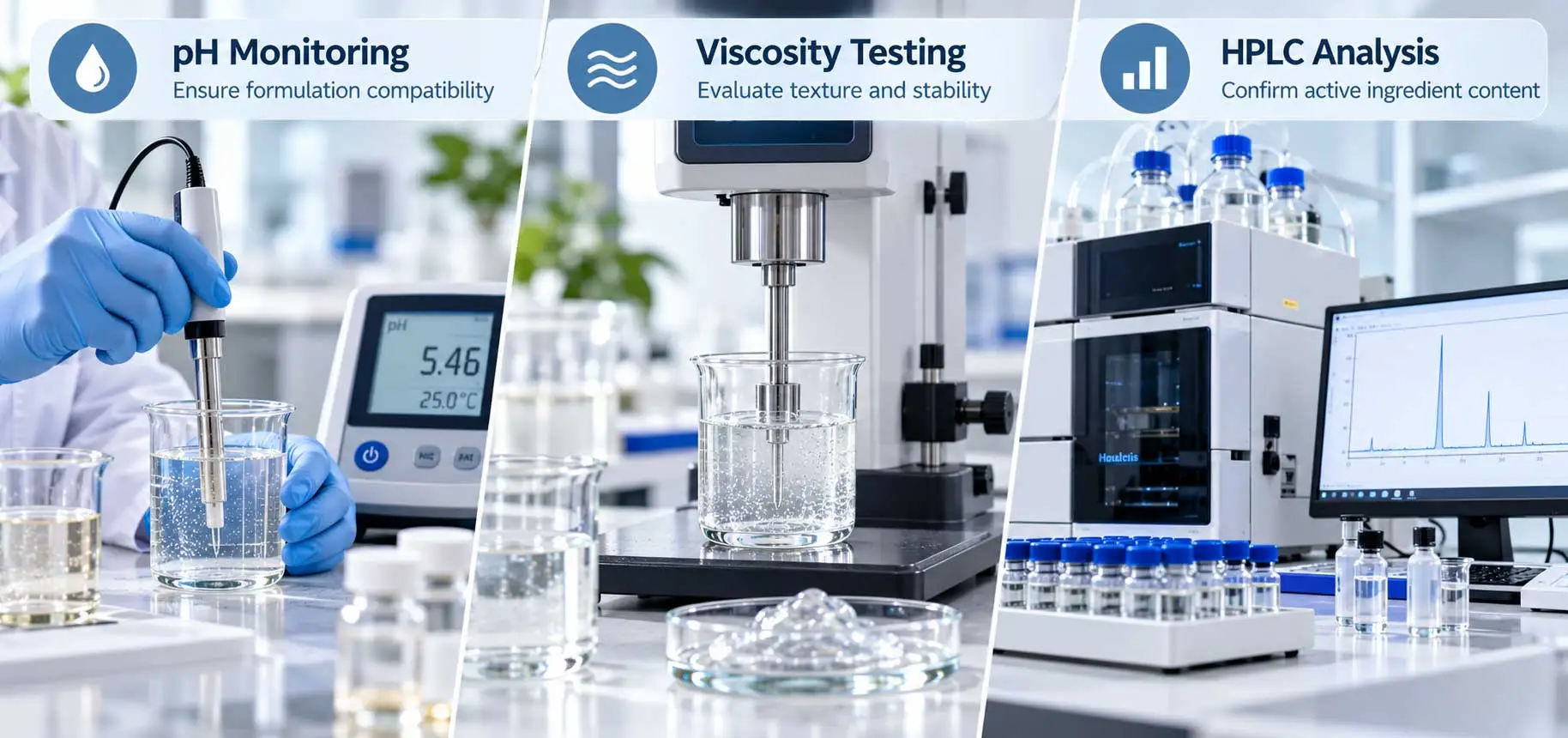
A reliable assessment requires ingredient-specific analytical testing alongside measurements of pH, viscosity, appearance, and microbiological quality.
Hyaluronic Acid vs Sodium Hyaluronate in Cosmetic Formulations
The distinction between Hyaluronic Acid and Sodium Hyaluronate is important when developing a commercial ethyl ascorbic acid hyaluronic acid serum.
Although both names are frequently used in skincare marketing, they identify chemically related but different ingredient forms.
•Understanding Hyaluronic Acid and Sodium Hyaluronate INCI Names
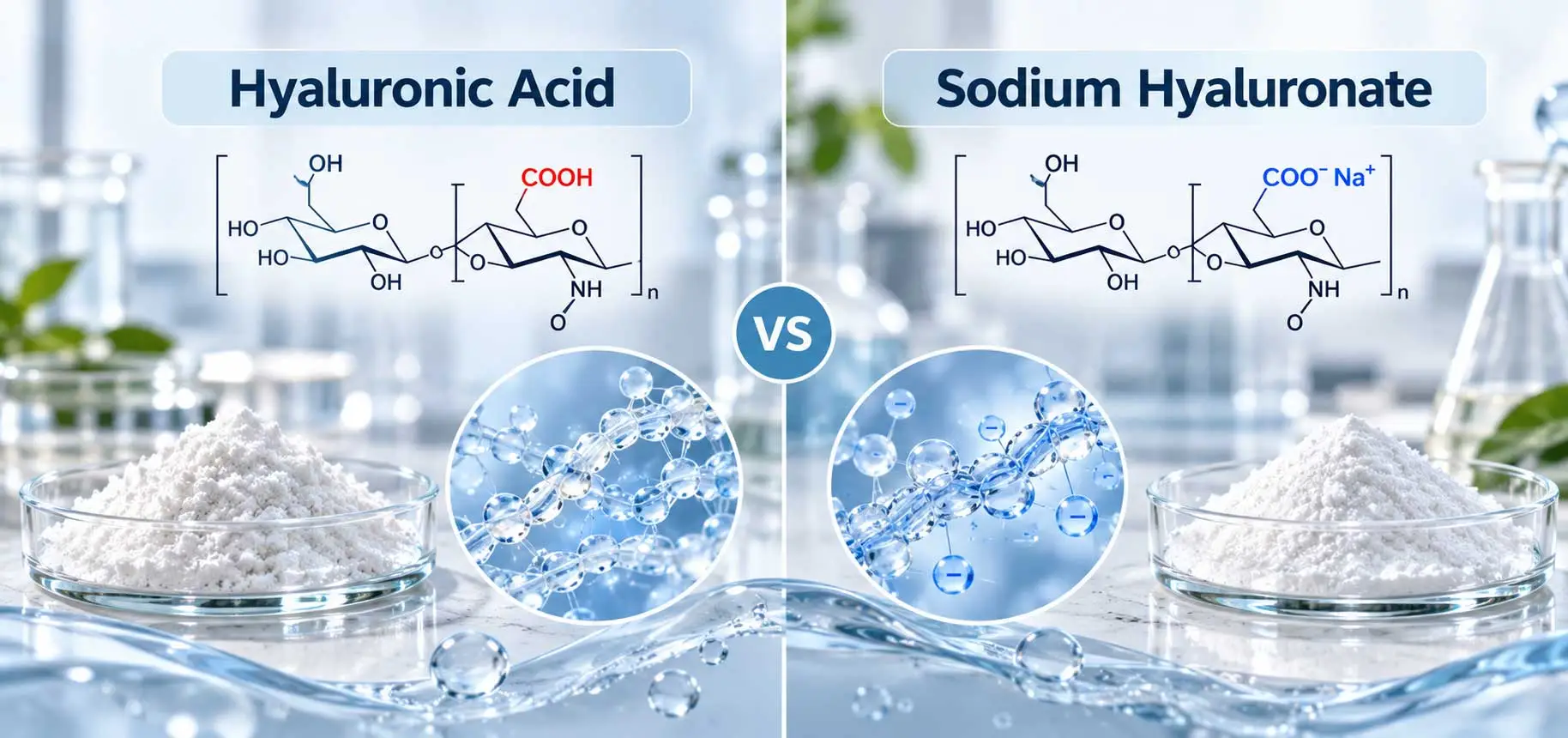
Hyaluronic Acid refers to the acid form of the polymer, while Sodium Hyaluronate is its sodium salt.
The sodium salt is widely used in aqueous cosmetic products because it is available in multiple commercial molecular weight grades and can be incorporated into water-based formulations.
The two materials should not be treated as automatically interchangeable. Their specifications, counterion composition, processing behavior, and supplied physical forms may differ.
For procurement purposes, the INCI name on the technical data sheet should match the material being purchased and the intended finished-product ingredient declaration.
•Selecting Sodium Hyaluronate for Water-Based Serums
Sodium hyaluronate and ethyl ascorbic acid can be evaluated in the same aqueous formulation, but selecting the appropriate polymer grade is critical.
Higher-molecular-weight grades generally contribute more strongly to viscosity at comparable concentrations, whereas lower-molecular-weight grades may provide a less viscous solution under equivalent conditions.
The final behavior also depends on polymer concentration, molecular weight distribution, electrolyte content, and the presence of other formulation ingredients.
Buyers evaluating cosmetic grade sodium hyaluronate should request grade-specific data rather than relying on broad marketing descriptions.
•Crosslinked and Hydrolyzed Hyaluronic Acid Ingredients
Hydrolyzed Hyaluronic Acid, Sodium Hyaluronate, and crosslinked hyaluronic acid materials are not identical raw materials.
Hydrolysis reduces polymer chain length, while crosslinking modifies the polymer network and can produce different swelling and rheological characteristics.
These distinctions affect ingredient selection, manufacturing procedures, and finished-product texture.
Formulators should verify the precise INCI designation, molecular characteristics, and supplier specifications before substituting one grade for another.
Hyaluronic Acid Molecular Weight Selection for Serum Formulation
Hyaluronic acid molecular weight for serum development is one of the most consequential raw material selection parameters.
Molecular weight influences how polymer chains interact in solution, which in turn affects viscosity, flow behavior, film formation, and sensory properties.
High-Molecular-Weight Hyaluronic Acid and Serum Rheology
High molecular weight sodium hyaluronate generally produces greater viscosity than lower-molecular-weight material at the same concentration under comparable formulation conditions.
Longer polymer chains occupy larger hydrodynamic volumes and can interact more extensively in solution. As concentration increases, chain overlap and entanglement may contribute to pronounced changes in rheological behavior.
For serum manufacturers, this can improve body and reduce excessive runniness. However, an overly viscous system may create processing difficulties, stringiness, or undesirable tack.
The relationship is not linear across all grades and concentrations. Supplier viscosity data should therefore be treated as grade-specific.
Low-Molecular-Weight Sodium Hyaluronate in Cosmetic Serums
Low molecular weight hyaluronic acid grades often contribute less viscosity at comparable concentrations, making them useful when a lighter serum texture is required.
Nevertheless, lower molecular weight does not automatically mean better cosmetic performance.
Hydration behavior, polymer concentration, sensory properties, and the complete formulation matrix remain important.
Claims that a particular molecular weight penetrates to a specific skin depth or produces superior biological effects require appropriate evidence. Such claims should not be inferred solely from the manufacturer's molecular weight classification.
Molecular Weight Distribution and Batch Consistency
Commercial Hyaluronic Acid grades are generally characterized by a distribution of polymer chain lengths rather than one exact molecular weight.
A supplier may report a weight-average molecular weight, number-average molecular weight, or a nominal range. These measurements are not interchangeable.
The analytical technique also matters. Size-exclusion chromatography, particularly when coupled with appropriate molecular weight detection, can provide information about distribution, while intrinsic viscosity methods may estimate molecular weight using established relationships.
For hyaluronic acid molecular weight grades, buyers should confirm both the reported parameter and its test method.
Two materials described as 1,000 kDa may not deliver identical viscosity if their distributions or manufacturing histories differ.
Choosing a Hyaluronic Acid Grade for Vitamin C Serums
|
Ingredient grade |
Formulation consideration |
Purchasing requirement |
|
Higher molecular weight |
Greater viscosity contribution and possible stringiness |
Molecular weight distribution and viscosity |
|
Medium molecular weight |
Balance between texture and processing |
Consistent grade definition |
|
Lower molecular weight |
Lighter rheological contribution in many systems |
Molecular weight range and impurity profile |
|
Hydrolyzed Hyaluronic Acid |
Distinct chain-length distribution and INCI identity |
Analytical characterization and grade documentation |
The preferred grade should be established through laboratory testing at the intended use concentration.
For commercial development, purchasing specifications should reflect the properties that materially influence the finished product rather than relying exclusively on nominal molecular weight.
Sodium Hyaluronate Hydration and Processing in Vitamin C Serum Manufacturing
The sodium hyaluronate hydration process is a critical manufacturing step because incomplete hydration can produce inconsistent viscosity, visible particles, and poor batch reproducibility.
Sodium Hyaluronate Powder Dispersion and Hydration
When dry Sodium Hyaluronate contacts water, the outer surface of each particle begins hydrating. If powder is added too quickly, hydrated material can surround dry particles and form persistent lumps, commonly described as fish eyes.
Effective sodium hyaluronate powder dispersion therefore requires controlled addition and adequate mixing.
Depending on the grade and formulation, manufacturers may disperse the polymer gradually into the aqueous phase or use an appropriate pre-wetting procedure. Any pre-wetting medium must be compatible with the polymer and the finished product.
Hydration time should be established experimentally. A visually uniform mixture does not necessarily indicate complete polymer hydration, particularly with higher-molecular-weight grades.
Mixing Conditions, Shear and Polymer Integrity
Hyaluronic Acid solutions can exhibit shear-thinning behavior, meaning apparent viscosity decreases as the applied shear rate increases.
This property is relevant during pumping, mixing, and filling.
Excessive mechanical processing may contribute to polymer chain degradation under certain conditions, but the effect depends on molecular weight, equipment, processing duration, and operating intensity.
Manufacturers should avoid assuming that maximum mixing speed provides the most efficient hydration.
Instead, mixing conditions should achieve uniform dispersion while minimizing unnecessary mechanical stress.
Incorporating 3-O-Ethyl Ascorbic Acid into the Hydrated System
For an ethyl ascorbic acid serum formulation, the vitamin C derivative can be evaluated for addition before or after polymer hydration, depending on the formulation design.
Adding the ingredient to a low-viscosity aqueous phase may simplify dissolution and uniform distribution. However, subsequent polymer incorporation must not compromise the established formulation conditions.
Alternatively, adding a prepared vitamin C derivative solution to a hydrated polymer system may require longer mixing to achieve uniformity.
The preferred sequence should be established through comparative trials rather than a universal processing rule.
Scaling Up from Laboratory Batches to Commercial Production
During hyaluronic acid serum manufacturing, scale-up changes mixing geometry, circulation patterns, hydration time, and temperature distribution.
A laboratory process that produces a uniform 500 g sample may behave differently in a 500 kg manufacturing vessel.
Pilot-scale evaluation should establish appropriate mixing parameters, hydration endpoints, deaeration requirements, and filling viscosity.
Batch records should also define when viscosity is measured, since readings taken before complete hydration may underestimate the final value.
Ethyl Ascorbic Acid and Hyaluronic Acid pH Compatibility and Serum Viscosity
The appropriate ethyl ascorbic acid hyaluronic acid pH range must support the vitamin C derivative, polymer, preservative system, and overall product requirements.
Establishing a Suitable pH Range for Dual-Active Serums
3-O-Ethyl Ascorbic Acid differs from conventional L-Ascorbic Acid and should not automatically be formulated at the same pH.
Meanwhile, Sodium Hyaluronate contains ionizable carboxylate groups whose behavior depends on the surrounding solution.
The optimum pH cannot be established from either ingredient's specification alone.
A preliminary development program may evaluate several pH conditions while maintaining equivalent ingredient concentrations and processing procedures.
For hyaluronic acid pH stability, testing should distinguish immediate viscosity changes from chemical degradation during storage.
The Effect of pH and Electrolytes on Sodium Hyaluronate Viscosity
Sodium hyaluronate viscosity depends on molecular weight, concentration, ionic strength, temperature, and measurement conditions.
Because Sodium Hyaluronate is a charged polymer, dissolved salts can alter electrostatic interactions between polymer segments and influence chain conformation.
Consequently, viscosity measured in purified water may differ from that observed in a finished serum containing buffers, electrolytes, and other active ingredients.
This is why supplier viscosity specifications should include the test concentration, temperature, and measurement method.
Monitoring Viscosity Drift During Shelf-Life Testing
Hyaluronic acid serum viscosity should be measured using a reproducible method with defined temperature, spindle or geometry, shear conditions, and sample preparation.
A decrease in viscosity may indicate polymer degradation, but it can also reflect changes in hydration, electrolyte balance, or the formulation's broader rheological structure.
Where meaningful viscosity loss occurs, additional molecular weight analysis may help determine whether polymer chain scission has taken place.
Ethyl Ascorbic Acid Serum Stability and Preservative Compatibility
A stable hydrating serum must maintain both chemical quality and acceptable physical properties.
Chemical Stability of 3-O-Ethyl Ascorbic Acid in Hydrating Serums
Ethyl ascorbic acid serum stability should be evaluated through an ingredient-specific assay rather than visual inspection alone.
A formulation may remain transparent while the concentration of the vitamin C derivative changes.
Storage temperature, pH, light exposure, and formulation composition may influence chemical stability.
The presence of Hyaluronic Acid does not establish that 3-O-Ethyl Ascorbic Acid is protected against degradation.
Hyaluronic Acid Degradation and Changes in Serum Texture
Hyaluronic acid stability in cosmetics is closely associated with maintaining appropriate polymer characteristics.
Hyaluronic Acid can undergo molecular weight reduction through certain chemical, oxidative, enzymatic, or mechanical processes.
Such changes may affect viscosity, elasticity, and sensory performance.
However, sodium hyaluronate degradation should not be diagnosed solely from a change in serum texture.
Additional analytical evidence may be needed to distinguish polymer degradation from reversible formulation effects.
Preservative Compatibility and Microbiological Quality
Water-based serums require an appropriate preservation strategy.
The selected preservative system must be compatible with the formulation pH, polymer, other ingredients, and intended packaging.
A satisfactory incoming microbiological specification for Sodium Hyaluronate does not demonstrate that the finished serum is adequately preserved.
Cosmetic serum preservative compatibility should be assessed through suitable formulation studies, including preservative efficacy testing where applicable.
ISO 11930 provides a recognized framework for evaluating antimicrobial protection of cosmetic products.
Accelerated and Real-Time Stability Testing
A comparative study can help identify whether observed changes arise from one ingredient or the combined formulation.
|
Sample |
Composition |
Evaluation objective |
|
A |
Base formulation |
Establish baseline behavior |
|
B |
Ethyl Ascorbic Acid only |
Monitor vitamin C derivative stability |
|
C |
Sodium Hyaluronate only |
Evaluate polymer and viscosity behavior |
|
D |
Both ingredients |
Assess combined formulation performance |
Samples should be evaluated under justified real-time and accelerated conditions.
Measurements should include pH, appearance, color, viscosity, active ingredient assay, and microbiological quality where relevant.
Accelerated testing can identify potential instability, but shelf-life conclusions should be supported by an appropriate overall stability program.
Cosmetic-Grade Ethyl Ascorbic Acid and Sodium Hyaluronate Specifications
Raw material specifications should reflect the characteristics that influence formulation performance and commercial consistency.
For cosmetic manufacturers, this means evaluating more than nominal purity or a general description of ingredient functionality.
3-O-Ethyl Ascorbic Acid 99% Specifications and COA
CHEN LANG BIO TECH supplies cosmetic grade ethyl ascorbic acid with an assay specification of at least 99%.
|
Parameter |
Specification |
|
Product name |
3-O-Ethyl Ascorbic Acid |
|
INCI |
3-O-Ethyl Ascorbic Acid |
|
CAS number |
86404-04-8 |
|
Molecular formula |
C₈H₁₂O₆ |
|
Molecular weight |
204.18 g/mol |
|
Appearance |
White to off-white crystalline powder |
|
Assay |
≥99% |
|
Packaging |
1–5 kg aluminum foil bags; 25 kg paper drums |
|
Documentation |
COA and applicable technical documentation |
For 3-o-ethyl ascorbic acid 99%, the assay value should be considered alongside identity confirmation, analytical methods, and relevant impurity requirements.
An ethyl ascorbic acid COA should correspond to the supplied batch and the agreed purchasing specification.
Sodium Hyaluronate Molecular Weight, Viscosity and Microbial Specifications
A meaningful sodium hyaluronate specification should identify the polymer grade and its relevant quality attributes.
These may include molecular weight range or distribution, viscosity, assay or content, loss on drying, microbiological limits, and applicable impurity controls.
Viscosity data should identify the solution concentration and measurement conditions.
For cosmetic raw material quality control, buyers should also review whether the supplier's molecular weight testing method is suitable for distinguishing the grades offered.
Incoming Raw Material Inspection and Supplier Qualification
Incoming inspection should confirm material identity, packaging integrity, batch documentation, and conformity with agreed specifications.
For polymeric ingredients, a change in molecular weight distribution may influence serum texture even when other quality parameters remain acceptable.
Purchasing teams should therefore coordinate with formulation and quality departments when approving new suppliers or substituting raw material grades.
Bulk Ethyl Ascorbic Acid and Sodium Hyaluronate Sourcing
Selecting an ethyl ascorbic acid manufacturer for commercial skincare production requires evaluation of material quality, documentation, and supply reliability.
The same principles apply when qualifying suppliers of Sodium Hyaluronate.
Selecting an Ethyl Ascorbic Acid Supplier for Cosmetic Manufacturing
A dependable ethyl ascorbic acid supplier should provide clearly defined product specifications and relevant batch documentation.
CHEN LANG BIO TECH supplies 99% 3-O-Ethyl Ascorbic Acid for cosmetic formulation development and commercial ingredient sourcing.
Buyers purchasing bulk ethyl ascorbic acid should confirm packaging requirements, anticipated annual consumption, and destination-market documentation before placing orders.
When comparing a sodium hyaluronate supplier, purchasing teams should pay particular attention to molecular weight consistency rather than relying exclusively on price.
Samples, Commercial Packaging and Price per Kilogram
Formulation trials should use representative raw material samples whenever possible.
Customers planning to buy ethyl ascorbic acid powder can request information about sample availability and technical documentation.
For an ethyl ascorbic acid price per kg quotation, buyers should specify the required quantity, packaging, and delivery destination.
The same approach applies to bulk sodium hyaluronate purchasing, where the exact molecular weight grade must be identified before quotations can be meaningfully compared.
For wholesale ethyl ascorbic acid inquiries, buyers should also confirm the applicable ethyl ascorbic acid MOQ, lead time, and packaging configuration.
To discuss specifications, ethyl ascorbic acid sample availability, or commercial purchasing requirements, contact admin@chenlangbio.com.
Frequently Asked Questions About Ethyl Ascorbic Acid and Hyaluronic Acid
Can ethyl ascorbic acid and hyaluronic acid be used together in a serum?
Yes. Both ingredients can be incorporated into the same cosmetic formulation. However, compatibility must be established through testing that considers vitamin C derivative recovery, polymer hydration, viscosity, pH, preservation, and finished-product stability.
Is sodium hyaluronate the same as hyaluronic acid?
They are closely related but chemically distinct forms. Sodium Hyaluronate is the sodium salt of Hyaluronic Acid. Their commercial specifications, processing characteristics, and INCI designations should be reviewed before one material is substituted for another.
Which molecular weight of hyaluronic acid is suitable for a vitamin C serum?
There is no universally preferred molecular weight. Higher-molecular-weight grades generally contribute more viscosity at comparable concentrations, while lower-molecular-weight grades may support lighter textures. The final selection should depend on the desired rheology, processing conditions, and supplier specifications.
Does ethyl ascorbic acid affect hyaluronic acid viscosity?
The effect cannot be predicted reliably from the ingredient names alone. Viscosity depends on polymer grade, concentration, pH, ionic strength, and the complete formulation. Comparative testing is needed to determine whether adding 3-O-Ethyl Ascorbic Acid changes the finished serum's rheological behavior.
What should buyers check before purchasing cosmetic-grade ethyl ascorbic acid?
Buyers should verify chemical identity, assay, batch-specific COA, relevant impurities, packaging, and storage conditions. For formulations containing Sodium Hyaluronate, molecular weight distribution, viscosity, and microbiological specifications should also be reviewed.
Conclusion: Stable Ethyl Ascorbic Acid and Hyaluronic Acid Formulations
Successful formulation of ethyl ascorbic acid and hyaluronic acid depends on selecting appropriate raw material grades and establishing reproducible manufacturing conditions.
Sodium Hyaluronate molecular weight influences serum viscosity and processing behavior, while hydration, pH, and mixing conditions affect finished-product consistency.
Chemical stability and polymer integrity should be assessed separately using suitable analytical and physical testing methods.
For commercial manufacturers, clear raw material specifications and reliable batch documentation are essential to maintaining formulation quality during scale-up.
CHEN LANG BIO TECH supplies 99% 3-O-Ethyl Ascorbic Acid for cosmetic applications.
For product specifications, samples, or commercial quotations, contact admin@chenlangbio.com.
References
1. Iliopoulos, F., et al. (2019). 3-O-Ethyl-L-Ascorbic Acid: Characterisation and Investigation of Single Solvent Systems for Delivery to the Skin. International Journal of Pharmaceutics: X, 1, 100025. DOI: 10.1016/j.ijpx.2019.100025.
2. Iliopoulos, F., et al. (2020). Topical Delivery of 3-O-Ethyl-L-Ascorbic Acid from Complex Solvent Systems. Scientia Pharmaceutica, 88(2), 19. DOI: 10.3390/scipharm88020019.
3. Cowman, M. K., and Matsuoka, S. (2005). Experimental Approaches to Hyaluronan Structure. Carbohydrate Research, 340(5), 791–809. DOI: 10.1016/j.carres.2005.01.022.
4. Fallacara, A., et al. (2018). Hyaluronic Acid in the Third Millennium. Polymers, 10(7), 701. DOI: 10.3390/polym10070701.
5. Papakonstantinou, E., Roth, M., and Karakiulakis, G. (2012). Hyaluronic Acid: A Key Molecule in Skin Aging. Dermato-Endocrinology, 4(3), 253–258. DOI: 10.4161/derm.21923.
6. International Organization for Standardization. ISO/TR 18811:2018 — Cosmetics: Guidelines on the Stability Testing of Cosmetic Products.
7. International Organization for Standardization. ISO 11930:2019 — Cosmetics: Microbiology — Evaluation of the Antimicrobial Protection of a Cosmetic Product.
8. International Council for Harmonisation. ICH Q2(R2): Validation of Analytical Procedures. 2023. General analytical validation reference; not a cosmetic-specific regulatory standard.

Send Inquiry
Related Industry Knowledge
- How Should Dihydroavenanthramides Be Used For Skincare
- Thaumatin in Beverages: What Should Manufacturers Consider?
- Ivermectin Powder for Dogs: A Trusted Solution for Parasite Control
- What Is Adenosine Triphosphate (ATP) Used for in Sports Nutrition?
- Quaternium-73 Recommended Use Level and Dosage: A Formulator’s Guide
- How to Use Freeze-Dried Raspberry Powder in Food, Beverage, and Nutritional Products
- Ergothioneine in Skincare: How It Supports Cosmetic Formulations
- Bulk Dimethylmethoxy Chromanol for Cosmetic Formulations
- What are the Health Benefits of Tetrahydrocurcumin
- How Strong is Ascorbyl Glucoside? Benefits and Uses