
Berberine HCl vs Berberine Phytosome: Bioavailability and Formulation
November 3, 2026
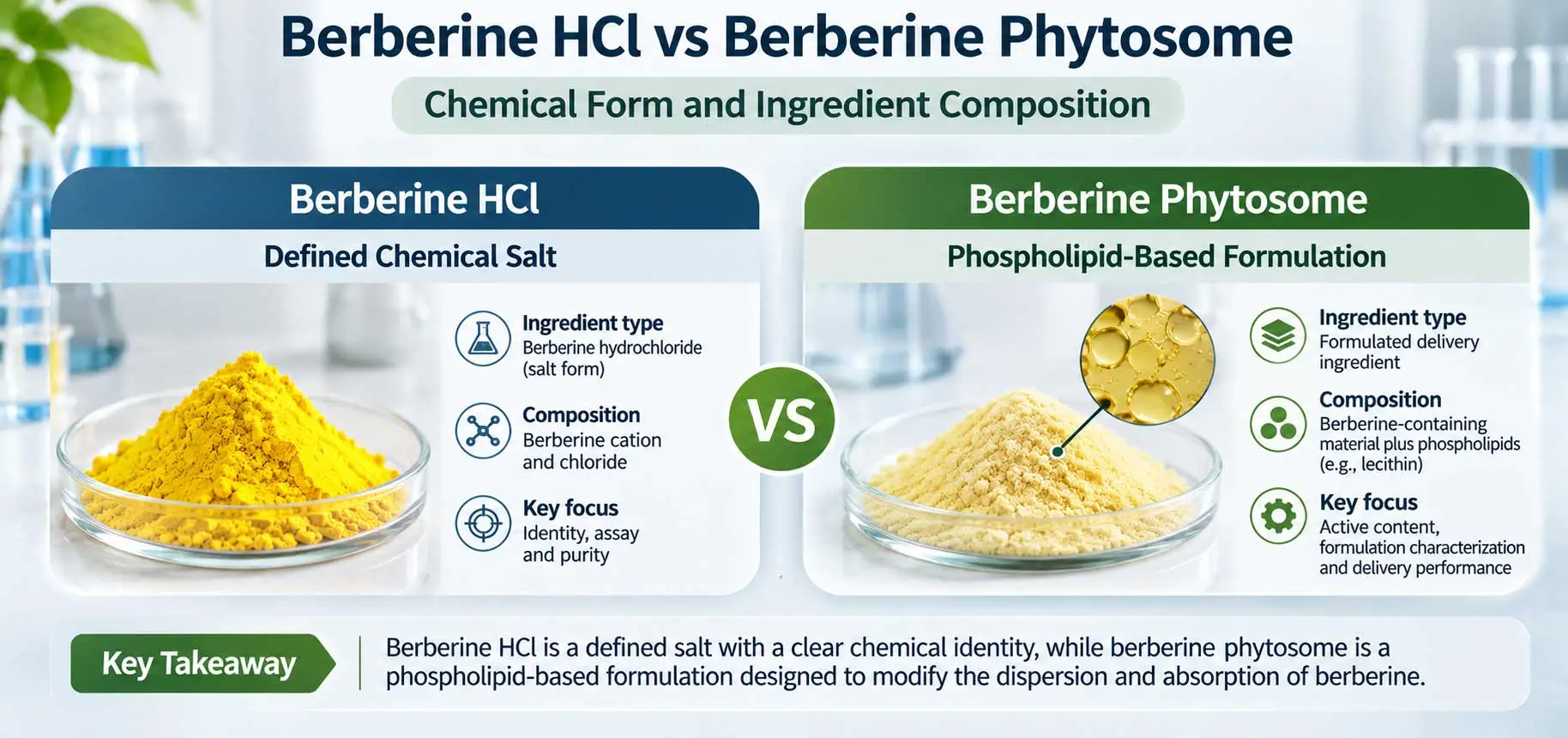
Berberine HCl vs berberine phytosome is primarily a comparison between a defined chemical salt and a formulated delivery system. Berberine hydrochloride provides a standardized form of the alkaloid for supplement manufacturing, while berberine phytosome uses phospholipid-based technology intended to modify how berberine is dispersed and absorbed.
Certain proprietary phospholipid formulations have demonstrated increased systemic berberine exposure in human pharmacokinetic research. However, those findings cannot be applied automatically to every phytosome ingredient.
For supplement manufacturers, contract manufacturers, and ingredient distributors, the choice depends on more than absorption claims. Active berberine content, analytical specifications, powder handling, formulation compatibility, and cost per finished serving all influence commercial suitability.
This guide examines the scientific and procurement considerations behind berberine phytosome vs berberine hydrochloride, with an emphasis on evidence-based ingredient selection.
Berberine HCl vs Berberine Phytosome: Chemical Form and Ingredient Composition
The fundamental distinction is chemical identity. Berberine hydrochloride is a defined chloride salt, whereas phytosomal berberine is a formulated ingredient whose composition depends on the delivery technology and manufacturing process.
Berberine HCl as a Defined Alkaloid Salt
Berberine HCl raw material contains the berberine cation associated with chloride. The anhydrous salt has a molecular formula of C₂₀H₁₈ClNO₄ and a molecular weight of approximately 371.81 g/mol.
Because its chemical identity is defined, manufacturers can establish specifications for identity, assay, moisture, related substances, and other relevant quality parameters.
However, a 98% assay of berberine hydrochloride should not be confused with 98% free berberine content. The anhydrous salt theoretically contains approximately 90.47% berberine cation by mass.
Berberine Phospholipid Complex as a Delivery Formulation
A berberine phytosome ingredient generally combines berberine-containing material with phospholipids, often using processing conditions intended to promote molecular association.
A berberine phospholipid complex is not necessarily equivalent to a liposome, micelle, or simple physical mixture of berberine and lecithin. These systems differ in composition, structure, and performance.
For procurement purposes, the supplier should identify the active starting material, phospholipid composition, active loading, and analytical evidence supporting the claimed delivery system.
|
Parameter |
Berberine HCl |
Berberine phytosome |
|
Ingredient type |
Defined chloride salt |
Phospholipid-based formulation |
|
Composition |
Berberine cation and chloride |
Berberine-containing material plus formulation components |
|
Active content |
Determined by chemical assay |
Depends on formulation and loading |
|
Primary quality concern |
Identity, purity, contaminants |
Active assay, composition, formulation characterization |
|
Formulation evaluation |
Powder properties and finished-product performance |
Loading, stability, compatibility, and supporting evidence |
|
Procurement comparison |
Cost per specified chemical content |
Cost per verified active content and formulation performance |
Berberine Phytosome Bioavailability vs Conventional Berberine HCl Absorption
The scientific interest in berberine phytosome bioavailability arises from the relatively low systemic exposure observed after conventional oral berberine administration.
However, the mechanisms limiting exposure are complex. Improving one physicochemical property does not necessarily produce a proportional increase in human absorption.
Why Conventional Berberine Has Limited Oral Bioavailability
Several factors contribute to limited berberine HCl absorption, including dissolution behavior in gastrointestinal fluids, intestinal transport, transporter-mediated efflux, and metabolism before the compound reaches systemic circulation.
Experimental research has identified interactions with intestinal transport processes and substantial presystemic metabolism. Consequently, the quantity swallowed is not equivalent to the quantity appearing in plasma as unchanged berberine.
This distinction is important when interpreting studies that report improved absorption. A higher plasma concentration may reflect changes in dissolution, transport, metabolism, or several processes simultaneously.
How Phospholipid Delivery May Influence Berberine Absorption
A berberine phospholipid delivery system may alter the interaction between berberine and the surrounding gastrointestinal environment.
Depending on its composition and manufacturing method, the formulation may influence dispersion, dissolution, membrane interactions, or the presentation of the active compound to intestinal absorption pathways.
Nevertheless, phospholipid association alone does not prove improved human bioavailability.
For buyers comparing berberine phytosome vs standard berberine, laboratory solubility, cell-based permeability, animal pharmacokinetics, and human exposure studies should be treated as different levels of evidence.
A supplier's technical presentation should clearly identify which outcomes were actually measured.
Human Berberine Bioavailability Studies: What Does the Evidence Show?
Human pharmacokinetic research provides a stronger basis for evaluating delivery technology than solubility measurements alone. Nevertheless, the results must be interpreted according to the formulation tested, administered active content, analytical method, and study design.
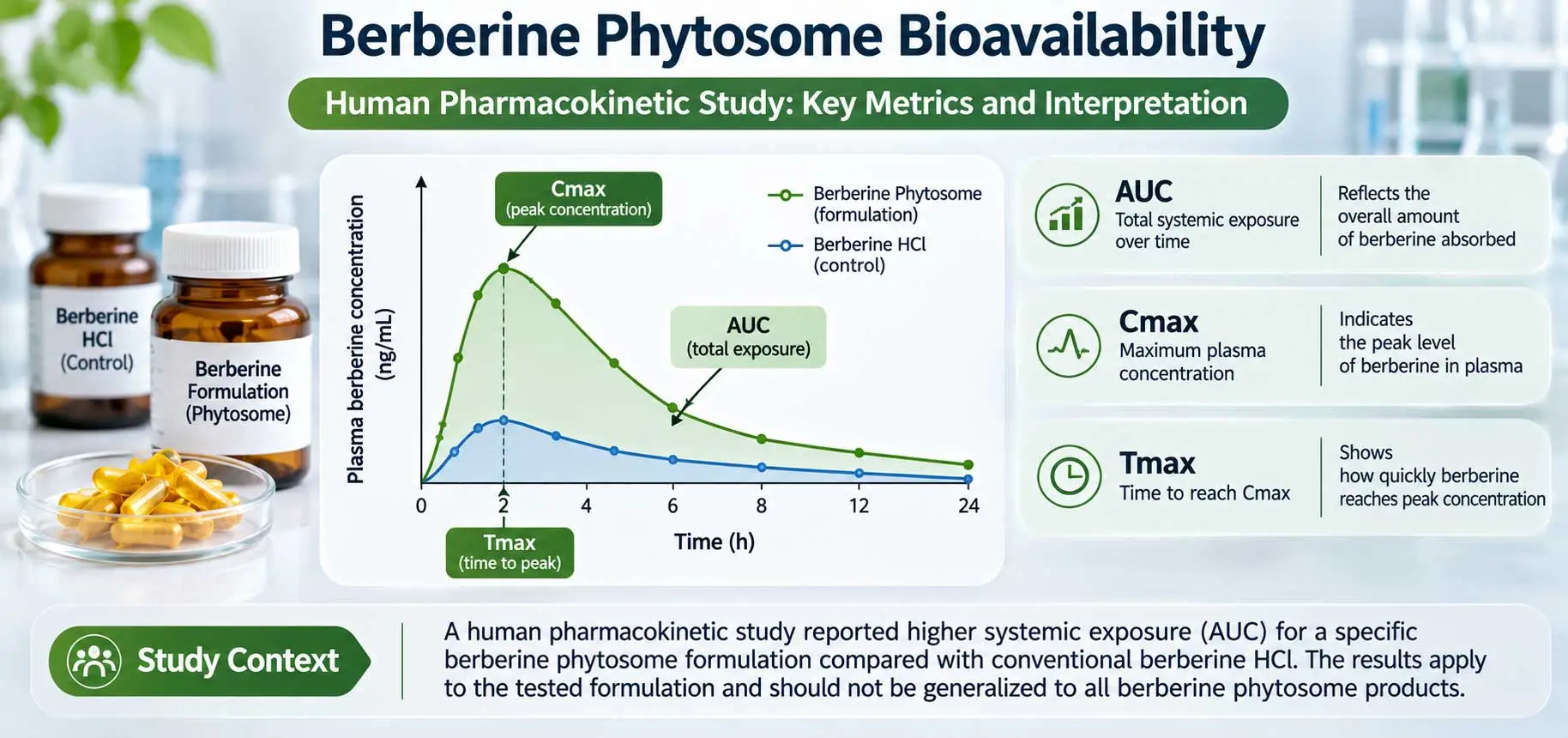
AUC, Cmax and Tmax in Berberine Pharmacokinetic Research
A 2021 study, Development of an Innovative Berberine Food-Grade Formulation with an Ameliorated Absorption, investigated a specific food-grade phytosome formulation in healthy volunteers.
The studied system contained berberine extract together with sunflower lecithin, pea protein, grape seed extract, and processing excipients. It was therefore more complex than a simple two-component mixture of berberine and phospholipids.
The researchers reported approximately fourfold and sixfold increases in total-berberine AUC for the tested phytosome dosing groups relative to the conventional berberine chloride comparator. After accounting for the different amounts of berberine administered, the reported exposure improvement was approximately tenfold on a molar-normalized basis.
Importantly, the study compared formulations with different active berberine inputs: 188 mg in the phytosome tablet and 452 mg in the comparator tablet.
These findings support enhanced exposure for that particular formulation under the study conditions. They do not establish that every commercial phospholipid complex produces an equivalent result.
Study Design, Dose Normalization and Evidence Limitations
Three pharmacokinetic measurements are particularly relevant when reviewing a berberine bioavailability study:
|
Measurement |
Interpretation |
Procurement relevance |
|
AUC |
Total systemic exposure over a defined period |
Principal metric for exposure comparisons |
|
Cmax |
Maximum measured concentration |
Indicates peak exposure |
|
Tmax |
Time required to reach Cmax |
Helps characterize absorption timing |
A higher AUC is evidence of greater systemic exposure, not necessarily superior clinical performance.
Furthermore, the concentration of unchanged berberine should be distinguished from measurements of total berberine following sample processing. Different analytical definitions can produce results that are not directly comparable.
For a berberine phytosome clinical study to support an ingredient claim, the supplier should establish that the tested formulation matches the commercial material in composition, active loading, and relevant manufacturing characteristics.
Another important distinction concerns delivery technologies. A separate 2023 human study investigated a micellar berberine formulation and reported an AUC of 78.2 ± 14.4 ng·h/mL compared with 13.4 ± 1.97 ng·h/mL for its conventional comparator. That result is specific to the studied micellar system and must not be presented as evidence for phytosomal berberine.
When examining berberine phytosome pharmacokinetics, buyers should request the original publication and verify the comparator, participant population, sample size, dosing basis, and statistical analysis before accepting a numerical absorption claim.
Berberine Phytosome Active Content vs Berberine HCl Purity
Active content is one of the most consequential differences between a conventional berberine salt and a formulated delivery ingredient.
The total weight of a phytosome ingredient includes its delivery-system components. Therefore, the labeled quantity of phytosome material is not necessarily the quantity of berberine it supplies.
Understanding Berberine Phytosome Active Content
The berberine phytosome active content should be established using a suitable quantitative assay, with the result expressed on a clearly defined basis.
For illustration, consider a hypothetical phospholipid formulation containing 30% berberine by mass.
A 500 mg serving of that ingredient would provide:
500 mg × 0.30 = 150 mg berberine.
This is an illustrative calculation, not a specification for any particular commercial phytosome product.
By contrast, high purity berberine HCl powder may have a declared assay of 98% berberine hydrochloride. Because the anhydrous salt contains chloride, its berberine-cation mass fraction differs from its salt assay.
Calculating Equivalent Berberine Input in Supplement Formulas
A theoretical 500 mg quantity of berberine HCl 98% powder, assuming an anhydrous-salt assay and an appropriate as-is calculation basis, corresponds to approximately 443 mg of berberine cation.
This can be estimated by multiplying 500 mg by 0.98 and the anhydrous salt's theoretical berberine-cation fraction of approximately 0.9047.
The result should not be interpreted as an established bioequivalent dose to any phytosome formulation.
For accurate berberine phytosome dosage calculation, formulators must first determine whether the supplier reports berberine as the free cation, hydrochloride salt, or another specified analytical equivalent.
Dose comparisons become misleading when these reporting bases are mixed.
Berberine Phytosome Formulation vs Berberine HCl for Capsules and Tablets
Ingredient selection also affects manufacturing efficiency, excipient requirements, and finished-product consistency.
Although delivery performance receives considerable attention, practical berberine phytosome formulation development must account for the physical properties of the complete ingredient.
Berberine HCl Powder Handling and Capsule Filling
For berberine HCl for supplement manufacturing, particle-size distribution, bulk density, flowability, and moisture content influence blending and capsule-filling performance.
A material with fine particles may present cohesive flow behavior, while differences in bulk density can affect capsule size and fill-weight consistency.
During tablet development, compression behavior and interactions with binders, disintegrants, and lubricants should be assessed experimentally.
A supplier's assay specification cannot substitute for these manufacturing trials.
For berberine HCl capsule formulation, manufacturers should request representative material and evaluate it under processing conditions relevant to the intended production equipment.
Phytosome Formulation Stability and Excipient Compatibility
A phospholipid-based ingredient introduces additional formulation considerations because its physical behavior depends on the complete delivery matrix.
Potential concerns include moisture sensitivity, lipid oxidation, changes in dispersion characteristics, and compatibility with other ingredients.
However, these risks are formulation-dependent. They should not be used to assume that every phytosome is less stable than crystalline berberine hydrochloride.
For a berberine phytosome tablet formulation, compression studies may be particularly important if the delivery matrix changes under mechanical stress.
Manufacturers should also determine whether the supplier's performance evidence relates to the raw ingredient, a specific finished dosage form, or both.
Where an absorption claim depends on maintaining a particular formulation structure, stability testing should evaluate the relevant physical characteristics alongside chemical assay.
Berberine HCl and Berberine Phytosome COA: Quality Specifications Compared
A certificate of analysis should establish what the supplier has tested, the methods applied, and whether the supplied batch meets the agreed specification.
However, the appropriate analytical package differs between a defined chemical salt and a formulated phospholipid ingredient.
Berberine HCl Assay, Identity and Impurity Controls
For conventional berberine hydrochloride, the principal requirements include chemical identification, quantitative assay, moisture or loss on drying, relevant impurities, and contamination controls.
A berberine HCl quality specifications review should also establish whether the reported assay is calculated on an as-is, dried, or anhydrous basis.
Where applicable, heavy metals, microbiological quality, and residual solvents should be evaluated against requirements appropriate to the intended market.
Physical parameters such as particle size may also be necessary when the ingredient is intended for automated capsule or tablet production.
Berberine Phytosome COA and Delivery-System Characterization
A berberine phytosome COA should identify the berberine content and the composition of the formulated ingredient.
Additional characterization may be needed to support claims that a genuine phospholipid complex has been produced rather than a simple physical blend.
Depending on the technology, suitable evidence may include differential scanning calorimetry, X-ray diffraction, spectroscopic analysis, or other validated techniques.
|
Quality requirement |
Berberine HCl |
Berberine phytosome |
|
Berberine identity and assay |
Essential |
Essential |
|
Related substances |
Relevant |
Relevant |
|
Phospholipid composition |
Generally not applicable |
Important |
|
Complex characterization |
Not generally required |
Relevant to technology claims |
|
Moisture and stability |
Required as appropriate |
Required as appropriate |
|
Residual solvents |
Process-dependent |
Process-dependent |
|
Heavy metals and microbiology |
Risk-based controls |
Risk-based controls |
|
Particle size and bulk density |
Application-dependent |
Application-dependent |
For berberine phospholipid complex quality, analytical identity and delivery-system performance should be treated as separate requirements. A compliant assay alone does not verify enhanced absorption.
Berberine HCl vs Berberine Phytosome Cost per Active Ingredient
Comparing berberine HCl price per kg with berberine phytosome price per kg can be misleading when the materials contain different proportions of berberine.
A meaningful procurement comparison should begin with verified active content and then incorporate manufacturing and quality-related costs.
Berberine HCl Price per kg vs Phytosome Price per kg
Consider two hypothetical quotations: conventional berberine HCl at USD 100/kg with a 98% anhydrous-salt assay, and a phytosome ingredient at USD 180/kg containing 30% berberine cation.
On a berberine-cation basis, the theoretical raw-material cost would be approximately USD 0.113/g for the HCl material and USD 0.600/g for the phytosome ingredient.
These figures are illustrative rather than current market quotations.
The calculation is:
Cost per gram of berberine = Price per kg ÷ (1,000 × Active mass fraction)
Cost per Gram of Berberine and Finished-Capsule Economics
A complete berberine ingredient cost comparison should include capsule capacity, excipients, processing losses, testing expenses, packaging, and any applicable technology licensing costs.
Buyers sourcing bulk berberine phytosome should also determine whether published performance data support the exact ingredient offered.
For bulk berberine HCl powder, consistency of assay, particle properties, and supply terms may be more important than a marginal difference in quoted price.
Greater systemic exposure in a pharmacokinetic study cannot be converted directly into an equivalent clinical dose reduction without appropriate evidence.
Selecting a Berberine HCl Supplier or Phytosome Ingredient Partner
Supplier qualification should match the technical risks of the material being purchased.
A reliable berberine HCl powder supplier should provide a clearly defined specification, batch-specific analytical results, traceability information, and consistent commercial supply.
A berberine phytosome supplier should additionally explain the delivery-system composition, active loading, characterization methods, and evidence supporting any bioavailability claims.
Supplier Qualification, Documentation and Commercial Supply
For conventional berberine hydrochloride, procurement teams should prioritize chemical identity, purity, related substances, contaminant controls, and physical properties relevant to manufacturing.
For phospholipid formulations, the qualification process should extend to formulation ownership, intellectual-property considerations, stability, and whether clinical evidence applies to the material being quoted.
When evaluating a berberine phospholipid complex manufacturer, buyers should distinguish genuine manufacturing capability from the resale of a proprietary finished ingredient.
An experienced berberine ingredient supplier should also be prepared to discuss batch changes, complaint handling, analytical discrepancies, and continuity of supply.
Sample approval should be followed by confirmation that subsequent commercial lots meet the same agreed acceptance criteria.
Bulk Berberine HCl Powder Supply from CHEN LANG BIO TECH
For supplement manufacturers and ingredient distributors, reliable sourcing begins with a clearly defined raw-material specification.
At CHEN LANG BIO TECH, we support commercial discussions involving berberine hydrochloride ingredient requirements, analytical documentation, sample evaluation, and international supply arrangements.
Buyers considering berberine HCl wholesale orders can share their target assay, required quantity, application, and destination market so that the available specification and supply terms can be reviewed.
The berberine HCl MOQ, packaging arrangements, and lead time should be confirmed against current availability and order requirements.
If you plan to buy berberine HCl powder in bulk, our team can discuss the appropriate product documentation and provide a berberine HCl bulk quotation based on your purchasing volume.
For additional specifications and product information, visit our Berberine HCl Powder page.
Frequently Asked Questions About Berberine HCl vs Phytosomal Berberine
Is berberine phytosome the same as berberine HCl?
No. Berberine hydrochloride is a defined chemical salt, while phytosomal berberine is a formulated delivery ingredient containing berberine and additional components. A phytosome may use berberine-containing material as its active input, but its finished composition and analytical specification differ from those of conventional berberine HCl.
Does berberine phytosome always have better bioavailability?
No. Human research has demonstrated improved systemic exposure for certain specific phospholipid formulations, but those findings cannot be generalized to all phytosome products. Buyers should verify that the cited study evaluated the same formulation being offered and that comparisons account for the actual administered berberine content.
How much active berberine is present in a phytosome ingredient?
The amount depends on the formulation's verified active loading. For example, 500 mg of an ingredient standardized to 30% berberine provides 150 mg berberine. The supplier should state the assay method and reporting basis so manufacturers can calculate ingredient inputs accurately.
Which berberine ingredient is more suitable for supplement manufacturing?
The choice depends on the intended dosage form, active-content requirements, supporting evidence, manufacturing performance, and commercial budget. Berberine HCl offers a defined chemical identity, while a characterized phytosome may offer formulation-specific delivery advantages. Neither option is universally superior for every supplement project.
Conclusion — Choosing Berberine HCl or Phytosome for Commercial Formulation
The berberine HCl vs berberine phytosome decision should be based on verified chemical composition, active berberine content, human pharmacokinetic evidence, processing characteristics, and total formulation cost.
Berberine HCl offers a defined salt form with established analytical specifications. Phytosome technology may improve systemic exposure, but its performance depends on the particular formulation and supporting research.
For commercial procurement, neither a higher absorption claim nor a lower price per kilogram is sufficient on its own. Manufacturers should evaluate representative samples, comparable assay data, and finished-product requirements before selecting an ingredient.Please contact our email: admin@chenlangbio.com if you need more information about berberine HCl powder.
References
1. Petrangolini, G., et al. (2021). Development of an Innovative Berberine Food-Grade Formulation with an Ameliorated Absorption: In Vitro Evidence Confirmed by Healthy Human Volunteers Pharmacokinetic Study. Evidence-Based Complementary and Alternative Medicine, 2021, 7563889. https://doi.org/10.1155/2021/7563889
2. Characterization and Pharmacokinetic Assessment of a New Berberine Formulation with Enhanced Absorption In Vitro and in Human Volunteers. Pharmaceutics, 2023, 15(11), 2567. https://pmc.ncbi.nlm.nih.gov/articles/PMC10675484/
3. Cui, Y., Zhou, Q., Jin, M., Jiang, S., Shang, P., Dong, X., & Li, L. (2024). Research Progress on Pharmacological Effects and Bioavailability of Berberine. Naunyn-Schmiedeberg's Archives of Pharmacology, 397, 8485–8514. https://doi.org/10.1007/s00210-024-03199-0
4. Murakami, T., Bodor, E., & Bodor, N. (2023). Approaching Strategy to Increase the Oral Bioavailability of Berberine, a Quaternary Ammonium Isoquinoline Alkaloid: Part 1. Physicochemical and Pharmacokinetic Properties. Expert Opinion on Drug Metabolism & Toxicology, 19(3), 129–137. https://doi.org/10.1080/17425255.2023.2203857
5. Khoshandam, A., Imenshahidi, M., & Hosseinzadeh, H. (2022). Pharmacokinetic of Berberine, the Main Constituent of Berberis vulgaris L.: A Comprehensive Review. Phytotherapy Research, 36(11), 4063–4079. https://doi.org/10.1002/ptr.7589

Send Inquiry
Related Industry Knowledge
- Hyaluronic Acid Powder for Wrinkle Reduction: A Reliable Supplier for Your Anti-Aging Formulations
- Can Madecassoside Be Used with Retinol?
- Retatrutide COA Guide: How to Verify Peptide Quality Before Buying
- How Is Genistein Used in Skincare?
- How Should Kopexil be Applied for Best Results?
- Unlocking the Benefits: Understanding the Uses of Indole-3-Carbinol
- What is Hydrolyzed Keratin
- Is Echinacea Extract Powder A Natural Antibiotic
- What's Difference Between Sleeping Pill and Melatonin Extract Powder
- Is Elderberry Extract Powder Good for Skin