
Thaumatin vs Sucralose: What Should Food Manufacturers Compare?
2026-09-24 13:37:56
When food manufacturers compare thaumatin vs sucralose, the most obvious difference is sweetness potency, but that is not the most useful place to stop. Both are high-intensity sweetening ingredients used at much lower levels than sucrose, yet they differ fundamentally in molecular structure, sensory behavior, technological function and the way their commercial specifications should be evaluated.
Thaumatin is a sweet-tasting protein associated with the food additive number E957, while sucralose is a sucrose-derived chlorinated carbohydrate identified as E955. Thaumatin is commonly described as approximately 2,000–3,000 times sweeter than sucrose by weight, while the FDA describes sucralose as about 600 times sweeter than table sugar.
Those numbers do not create a reliable substitution ratio. For a food manufacturer, a meaningful difference between thaumatin and sucralose involves sweetness onset and persistence, aftertaste, flavor modification, water solubility, processing stability, the finished-food matrix, specification, regulatory status and cost-in-use.
Quick Answer: What Is the Difference Between Thaumatin and Sucralose?
The fundamental thaumatin and sucralose difference is chemical identity. Thaumatin is a sweet protein, whereas sucralose is a high-intensity sweetener structurally derived from sucrose. This distinction contributes to different sweetness profiles and formulation behavior.
A comparison based only on “times sweeter than sugar” therefore misses many of the parameters that matter during product development.
|
Comparison |
Thaumatin |
Sucralose |
|
Ingredient type |
Sweet protein |
Sucrose-derived high-intensity sweetener |
|
Food additive number |
E957 / INS 957 |
E955 / INS 955 |
|
CAS number |
53850-34-3 |
56038-13-2 |
|
Relative sweetness |
Commonly reported around 2,000–3,000× sucrose by weight |
About 600× sucrose |
|
Sweetness behavior |
Slower onset and prolonged sweetness |
Generally faster and more sugar-like, formulation dependent |
|
Flavor modification |
Important technological role |
Primarily used for sweetness |
|
Water solubility |
Very soluble |
Readily soluble |
|
Direct sugar replacement |
No |
No |
|
Key commercial question |
Sensory performance + specification + cost-in-use |
Sensory performance + specification + cost-in-use |
Relative sweetness is a sensory comparison under defined conditions. It should not be interpreted as a universal formulation conversion factor.
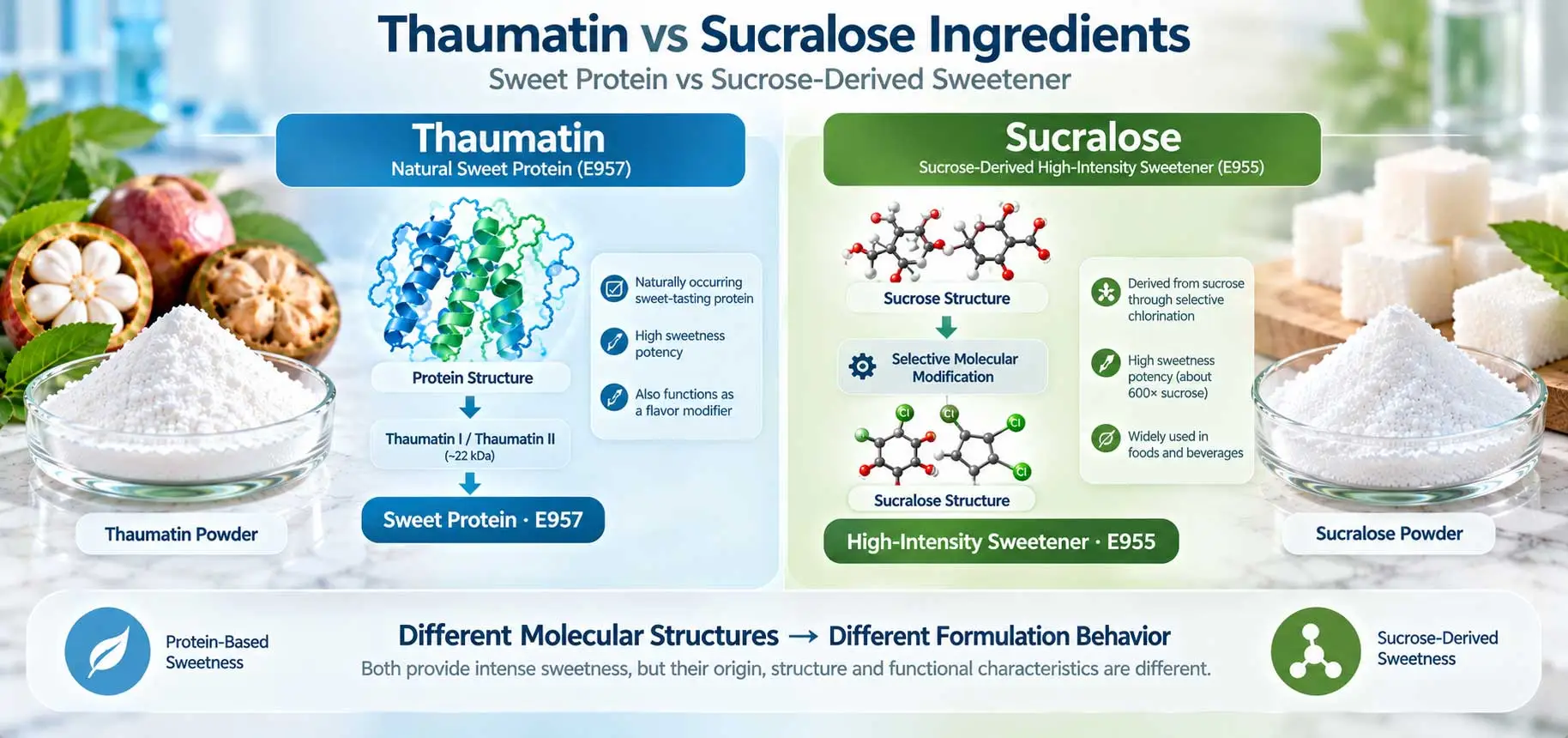
Thaumatin vs Sucralose Ingredients: Sweet Protein vs Sucrose-Derived Sweetener
What Is Thaumatin E957? Understanding the Sweet Protein
Thaumatin E957 belongs to a small group of naturally occurring sweet-tasting proteins. Conventional thaumatin specifications describe the ingredient as consisting principally of Thaumatin I and Thaumatin II. JECFA lists molecular weights of approximately 22,209 and 22,293 Da respectively and identifies thaumatin as both a sweetener and flavor enhancer.
This proteinaceous identity is important to formulators. Unlike ordinary sugars, thaumatin does not create sweetness because it is a small carbohydrate molecule. Its three-dimensional protein surface interacts with the human sweet-taste receptor, producing an unusually intense sensory response at low concentrations.
For this reason, thaumatin sweet protein should not be evaluated solely according to sweetness potency. Its lingering sweetness and flavor-modifying properties can be equally relevant to a finished formulation.
There is also an important sourcing distinction. Traditional JECFA specifications for INS 957 describe thaumatin obtained by aqueous extraction from the arils of Thaumatococcus daniellii. Newer recombinant or biosynthetic manufacturing technologies also exist, but their regulatory treatment can differ by jurisdiction. Buyers sourcing a biosynthesized grade should therefore verify that the specific production route is acceptable for their destination market rather than assuming that every material sold as thaumatin automatically falls under the same regulatory framework.
What Is Sucralose E955? Understanding Its Sucrose-Derived Structure
Sucralose E955 is chemically very different. JECFA identifies sucralose as 4,1′,6′-trichlorogalactosucrose, with CAS 56038-13-2 and INS 955.
It is produced through selective modification of the sucrose structure, in which three hydroxyl groups are replaced by chlorine atoms. This structural change produces a compound with very high sweetness intensity compared with sucrose.
Describing sucralose food additive simply as “sugar” would therefore be chemically inaccurate. At the same time, describing it only as a “chlorinated chemical” provides little useful information to a food manufacturer. For formulation work, its relevant properties are its sweetness potency, sensory profile, solubility, stability under the intended processing conditions and compliance with the regulations of the target market.
Thaumatin vs Sucralose Sweetness: Is Thaumatin Sweeter?
How Sweet Is Thaumatin Compared with Sugar?
Published values for thaumatin sweetness vary with concentration and sensory methodology, but approximately 2,000–3,000 times the sweetness of sucrose by weight is a practical reference range frequently used for commercial discussion.
That does not mean one gram of thaumatin can automatically replace 2–3 kg of sucrose in a food formulation.
Relative sweetness changes with the reference sucrose concentration, thaumatin concentration, pH, matrix and sensory protocol. The temporal profile is also different: thaumatin typically develops more slowly and persists longer than sucrose.
For this reason, thaumatin sweetness compared to sugar is best treated as an indicator of potency rather than a formulation recipe.
How Sweet Is Sucralose Compared with Sugar?
The FDA describes sucralose sweetness as approximately 600 times that of table sugar. This makes it a high-intensity sweetener that can provide substantial sweetness at comparatively low use levels.
As with thaumatin, however, sucralose sweetness compared to sugar should not be treated as an exact mathematical constant in every food.
Sweetness intensity is perceived rather than simply measured as a chemical concentration. Changes in the food matrix, reference sucrose concentration, temperature, acidity and interactions with other sweeteners or flavors can alter the result.
Is Thaumatin Sweeter Than Sucralose?
On the basis of commonly cited weight-based relative sweetness values, the answer to is thaumatin sweeter than sucralose is that thaumatin generally has the higher sweetness potency per unit weight.
A simple comparison might suggest approximately 2,000–3,000× sucrose for thaumatin versus around 600× for sucralose. That does not mean thaumatin is automatically the more suitable or economical choice.
The commercially relevant question is not which ingredient has the larger sweetness multiplier, but which ingredient or sweetening system achieves the required sensory profile at an acceptable finished-product cost.
Thaumatin vs Sucralose Taste: Onset, Persistence and Aftertaste
Thaumatin Sweetness Onset and Persistence
The thaumatin taste profile is distinguished by intense sweetness with a comparatively slow onset and prolonged persistence. Secondary sensory characteristics can become more noticeable as concentration increases.
That temporal profile matters because consumers experience sweetness over time rather than as a single numerical value. Two formulations with a similar peak sweetness can taste substantially different if one reaches that peak rapidly and the other develops more gradually.
The persistent thaumatin sweetness profile can be useful in certain flavor systems, particularly where prolonged sweetness or flavor modification is desirable. It can also become excessive if a formulation is designed only by calculating theoretical sucrose equivalence.
Sucralose Taste and Temporal Sweetness
Sucralose is often selected when formulators want high sweetness potency with a profile that can approach some characteristics of sucrose more closely than certain other high-intensity sweeteners. It should not, however, be described as tasting exactly like sugar in every formulation.
The sucralose taste profile depends on concentration and matrix. At higher relative use levels or in simplified sensory systems, lingering or secondary notes can become more apparent.
This is why a thaumatin vs sucralose taste comparison should be performed in the intended beverage, dairy product, confectionery or other finished matrix rather than only in water.
Thaumatin vs Sucralose Aftertaste
There is no technically sound universal answer to which ingredient has “less aftertaste.”
In a thaumatin vs sucralose aftertaste study, the useful parameters are sweetness onset, peak intensity, decay, persistence and any secondary flavor notes. Thaumatin is particularly associated with prolonged sweetness, while sucralose has its own concentration- and matrix-dependent temporal characteristics.
Acidity, cocoa, coffee, fruit flavors, dairy proteins and other sweeteners can all change perception. Supplier samples should therefore be compared at equivalent perceived sweetness rather than equal weight.
Thaumatin vs Sucralose for Flavor Modification and Taste Masking
Thaumatin as a Flavor Modifier
One of the most important differences in this comparison is that thaumatin has an established technological role beyond sweetness. JECFA and Codex recognize thaumatin as both a sweetener and flavor enhancer.
This makes thaumatin flavor modifier relevant when calculating formulation value. Depending on the application and concentration, developers may investigate thaumatin for modifying bitter, astringent or otherwise undesirable sensory characteristics while contributing sweetness.
The effectiveness of thaumatin bitterness masking is formulation dependent, so it should be established through controlled sensory trials rather than assumed from the ingredient specification.
Sucralose as Part of a Sweetening System
Sucralose is primarily used for high-intensity sweetness. In commercial products, however, it does not necessarily operate alone. It can form part of a broader sweetening system containing other high-intensity sweeteners, polyols, bulking ingredients, acids and flavors.
This creates an important purchasing distinction: the correct comparison may not be thaumatin versus sucralose as isolated ingredients, but one complete sweetening system versus another.
Thaumatin vs Sucralose Solubility: What Matters in Production?
Thaumatin Water Solubility and Handling
JECFA describes thaumatin as very soluble in water, making thaumatin water solubility favorable for many aqueous applications.
Because effective use levels can be low, however, achieving uniform distribution may be just as important as achieving dissolution. Accurate dosing and suitable premixing procedures become particularly relevant during scale-up.
A supplier's TDS should therefore be considered alongside laboratory observations of thaumatin solubility in the actual formulation.
Sucralose Water Solubility and Handling
Sucralose water solubility is also favorable for beverage and other aqueous applications. Commercial sucralose specifications commonly describe it as readily or freely soluble in water.
For production teams, the more useful question is whether the selected concentration dissolves efficiently under the plant's actual mixing temperature, order of addition and processing time.
High solubility on a specification sheet does not eliminate the need for a controlled manufacturing procedure.
Thaumatin vs Sucralose Heat Stability and pH Stability
Thaumatin Heat Stability as a Protein Ingredient
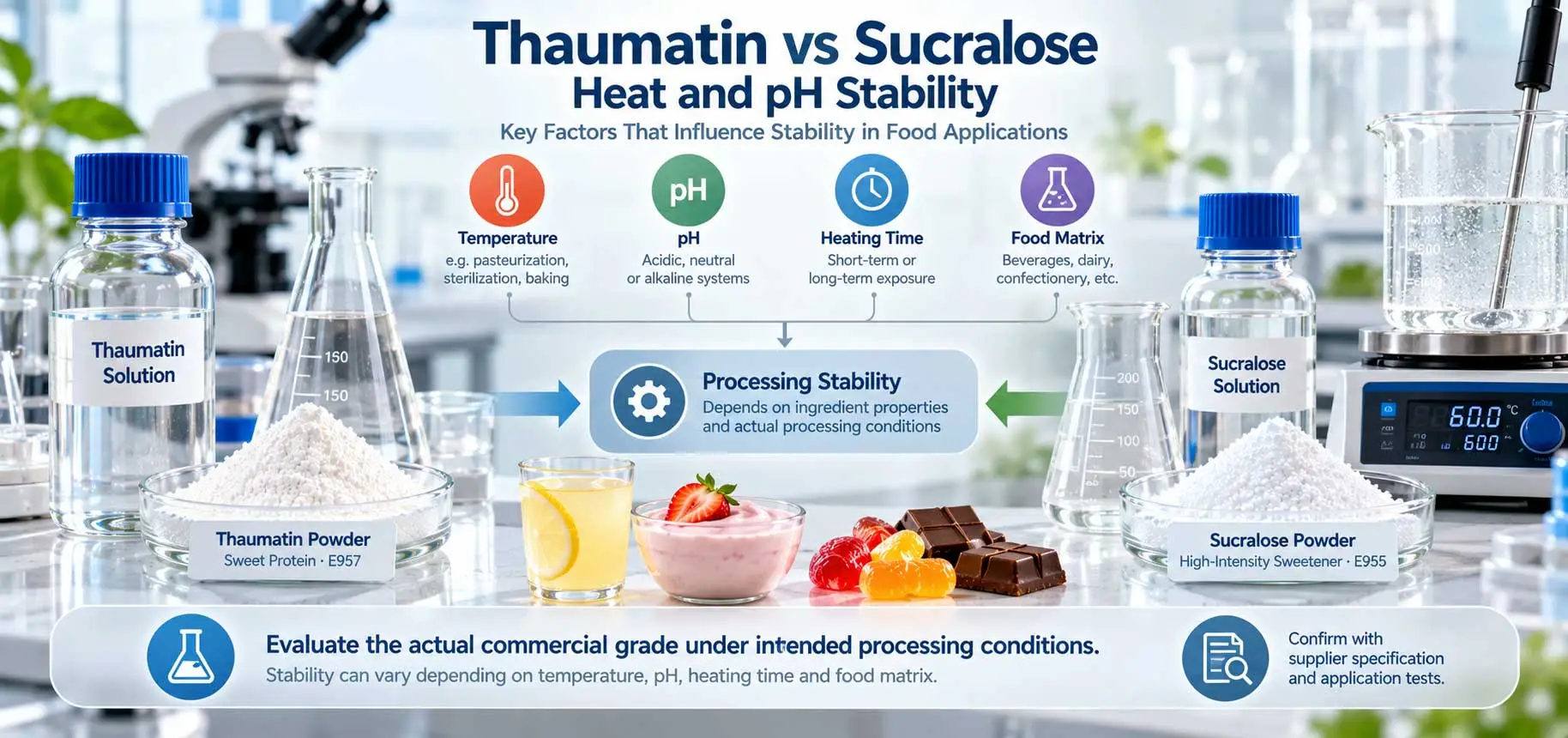
Statements about thaumatin heat stability need context. Thaumatin is a protein, and protein behavior depends on temperature, exposure time, pH and surrounding matrix.
Consequently, the question is not simply whether thaumatin is “heat stable,” but whether sweetness and other desired functionality remain acceptable after the specific process used for a beverage, dairy product or confectionery system.
This is particularly important for products exposed to prolonged heating or demanding combinations of heat and pH.
Sucralose Heat and pH Stability
Sucralose is widely used in thermally processed foods, and the FDA describes it as heat stable and suitable for applications including baked goods. More recent evidence nevertheless shows why sucralose heat stability should not be reduced to an unlimited claim.
EFSA's 2026 re-evaluation reported data from a 2% aqueous sucralose solution tested across pH 1–9 and 20–60°C. At pH 4–7.5, no detectable loss above 0.1% was reported after 48 weeks at 30°C. Under much more acidic conditions, degradation increased with temperature and time: at pH 1, the submitted data showed 61% degradation after eight days at 40°C and near-complete degradation after four days at 60°C. At pH 3, 27% degradation was reported after four weeks at 60°C.
The same EFSA assessment also highlighted uncertainty concerning potential degradation products during high-temperature domestic processes such as baking and frying, while noting that these conditions were not expected during industrial processing under currently authorized EU uses.
For food manufacturers, this is the more useful interpretation of thaumatin vs sucralose heat stability: neither ingredient should be qualified by a one-line stability claim detached from pH, temperature, exposure time and food matrix.
Can Thaumatin Replace Sucralose in Food Formulations?
There is no universal one-to-one answer to can thaumatin replace sucralose.
Why the 2,000–3,000× vs 600× Numbers Are Not a Replacement Formula
Dividing 2,500 by 600 and using the result as a replacement factor would ignore concentration-response behavior, sweetness onset, persistence, secondary taste, flavor modification and interactions with the food matrix.
It would also ignore the non-sweetness functions of other ingredients in the original formula.
An thaumatin instead of sucralose project should therefore begin with a sensory target, not an arithmetic conversion.
How to Run a Practical Replacement Trial
A practical development sequence is to benchmark the existing product first. The R&D team can then define the target sweetness profile, calculate a conservative initial trial range and prepare bench-scale prototypes.
Sensory evaluation should examine more than overall sweetness. Onset, peak intensity, persistence, flavor balance and secondary notes should be recorded. Promising prototypes should then undergo the actual thermal process, pH conditions and intended storage period before commercial scale-up.
This process converts a theoretical ingredient comparison into formulation evidence.
Can Thaumatin and Sucralose Be Used Together?
Can thaumatin and sucralose be used together? Technically, a combination can be evaluated where both ingredients and their proposed use levels comply with the requirements of the destination market.
A thaumatin sucralose blend may be investigated because the ingredients have different sweetness profiles. A formulator could explore whether faster sweetness development from one component and greater persistence from another produces a more balanced sensory curve.
The combination may also influence the total use level and cost-in-use.
There is no universal ratio for thaumatin with sucralose. The appropriate balance depends on the product, flavor system, other sweeteners, processing conditions and sensory target.
Thaumatin vs Sucralose for Beverages, Dairy and Confectionery
Thaumatin vs Sucralose for Beverages
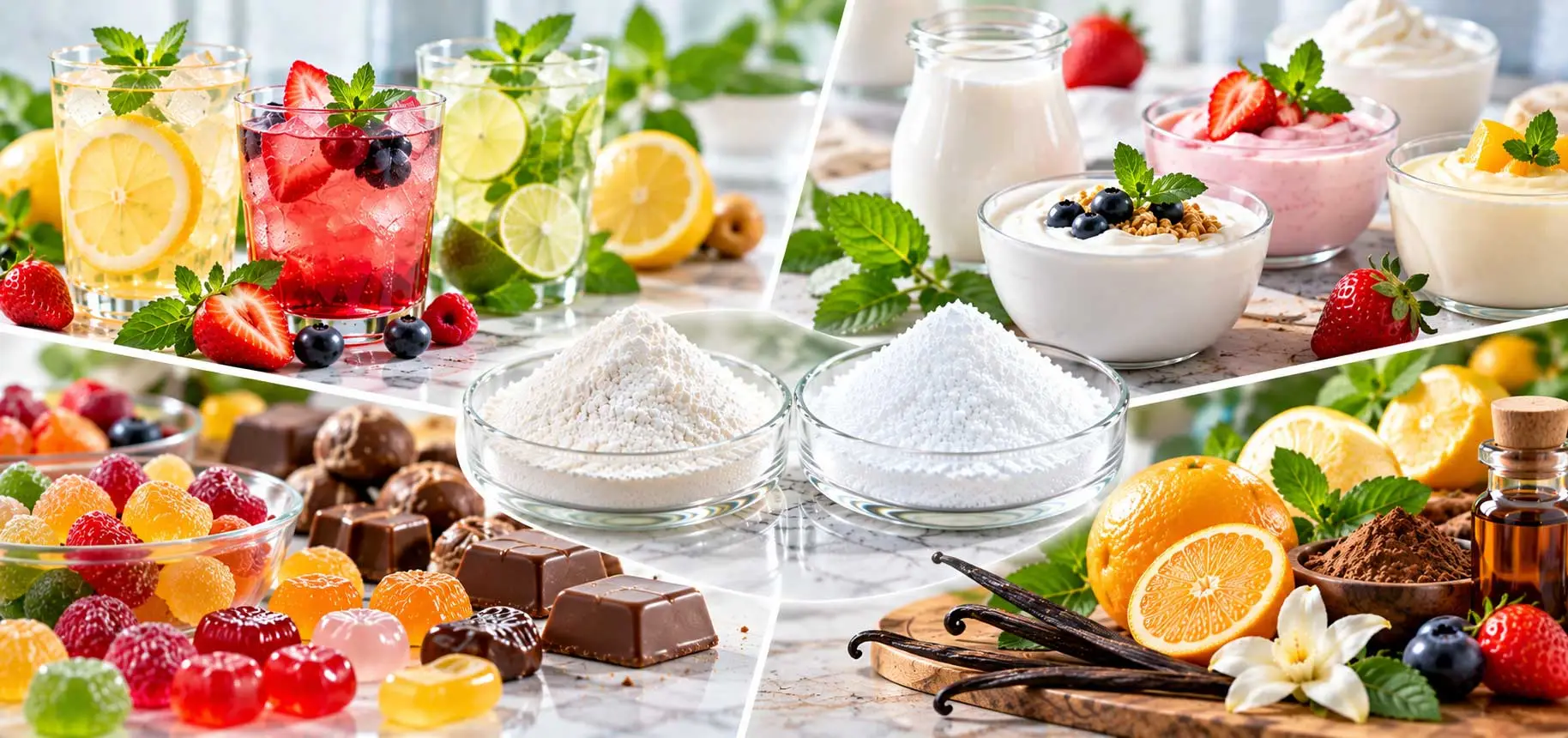
For thaumatin vs sucralose for beverages, both dissolution and sensory timing matter. Developers of acidic fruit beverages, tea, coffee or functional drinks should consider pH, pasteurization conditions, flavor interaction and shelf-life performance.
A clear beverage should also be evaluated for appearance after processing and storage rather than only immediately after mixing.
Thaumatin vs Sucralose for Dairy Products
For thaumatin vs sucralose for dairy, sweetness is perceived within a matrix containing proteins and often fat, fruit preparations, cocoa or flavor compounds.
The ingredient that performs well in an aqueous screening solution may therefore behave differently in yogurt, milk beverages or dairy desserts. Sensory trials should use the complete commercial formulation.
Thaumatin vs Sucralose for Confectionery
When evaluating thaumatin vs sucralose for confectionery, manufacturers should separate sweetness replacement from sugar replacement.
Sucrose contributes bulk, texture, crystallization behavior, browning and other physical functions. Neither thaumatin nor sucralose automatically supplies these properties simply because it can replace part of the perceived sweetness.
A reduced-sugar confection may therefore require a separate bulking and textural system.
Thaumatin vs Sucralose Cost-in-Use: Why Price per Kilogram Is Not Enough
The thaumatin price and sucralose price per kilogram are useful quotation data, but they do not tell a manufacturer which sweetening approach is more economical.
A more useful commercial calculation is thaumatin cost in use versus sucralose cost in use.
Start with the purchase price of the qualified grade, then consider the effective use level in the finished product. Add any costs associated with complementary sweeteners, bulking ingredients, flavor correction, process adjustments and expected losses during manufacturing or storage.
The result is much closer to the actual formulation cost.
This also explains why higher sweetness potency does not automatically translate into lower cost. If an ingredient requires additional formulation work to reach the desired sensory profile, the price of that complete system matters more than the cost of one powder.
How Should Food Manufacturers Compare Thaumatin and Sucralose Suppliers?
►Manufacturing Capability and Batch Consistency
Whether qualifying a thaumatin manufacturer, sucralose manufacturer, thaumatin supplier or sucralose supplier, purchasing teams should look beyond the quotation.
Useful questions include whether the supplier controls manufacturing, how the assay is measured, how batch-to-batch consistency is managed, whether application support is available and whether repeat commercial quantities can be supplied after the original sample is approved.
CHEN LANG BIO TECH has more than 30 years of experience with sweetener technologies. Our thaumatin platform has an annual production capacity of approximately 10 MT, supported by biosynthesis capabilities, R&D resources, application laboratory work and production quality controls.
This manufacturing background allows technical discussions to begin with the customer's actual sweetness and formulation target rather than with a generic product description.
►Documentation, Samples and Bulk Supply
For customers evaluating a thaumatin sample, our standard MOQ starts from 1 kg. Smaller commercial quantities can be supplied in 1–5 kg aluminum foil bags, while larger orders are available in 25 kg paper drums.
For bulk thaumatin powder or bulk sucralose powder projects, buyers should provide the required specification, application, destination market and estimated annual demand so that documentation and commercial suitability can be reviewed before scale-up.
COA, specification and other available technical documents should be assessed before approving the commercial batch. Where the intended use involves a particular regulatory definition or manufacturing route, this should be confirmed at the qualification stage rather than after formulation work has been completed.
Frequently Asked Questions About Thaumatin vs Sucralose
What is the main difference between thaumatin and sucralose?
The main difference between thaumatin and sucralose is molecular identity. Thaumatin is a sweet-tasting protein, while sucralose is a sucrose-derived high-intensity sweetener. Their different structures contribute to differences in sweetness potency, temporal sensory profile, technological function and specification requirements.
Is thaumatin sweeter than sucralose?
Using commonly cited weight-based figures, thaumatin at roughly 2,000–3,000 times sucrose has higher relative sweetness potency than sucralose at approximately 600 times sucrose. However, is thaumatin sweeter than sucralose should not be interpreted as which ingredient performs better in a finished food.
How sweet is sucralose compared with thaumatin?
The FDA describes sucralose as about 600 times sweeter than table sugar. Thaumatin is commonly reported at approximately 2,000–3,000 times sucrose by weight. Actual thaumatin vs sucralose sweetness performance depends on concentration, sensory methodology and the food matrix.
Does thaumatin taste like sucralose?
No. A thaumatin vs sucralose taste comparison typically reveals different temporal profiles. Thaumatin tends to have slower-developing, persistent sweetness, while sucralose generally has a different onset and decay pattern. Both should be evaluated in the intended finished formulation.
Which has more aftertaste, thaumatin or sucralose?
There is no universal answer. Thaumatin vs sucralose aftertaste depends on concentration, food matrix and other formulation ingredients. A controlled sensory test at comparable perceived sweetness is more informative than tasting equal concentrations in water.
Can thaumatin replace sucralose?
Can thaumatin replace sucralose depends on the application. It should not be replaced according to a fixed potency ratio because the ingredients differ in sweetness timing, flavor interaction and technological function. Bench-scale and process-validation trials are recommended.
Can thaumatin and sucralose be used together?
A combination can be evaluated where the ingredients and intended use comply with applicable regulations. A thaumatin sucralose blend may be investigated to modify sweetness onset, persistence or overall sensory balance, but there is no universal formulation ratio.
What should buyers check before purchasing food grade thaumatin?
Before selecting food grade thaumatin, buyers should confirm ingredient identity, manufacturing route, assay basis, analytical method, COA, specification, microbiological and contaminant requirements, regulatory suitability, batch consistency, shelf life and the supplier's ability to support repeat commercial production.
Sourcing Thaumatin for Commercial Food and Beverage Production
For food manufacturers, a meaningful thaumatin vs sucralose comparison should end with performance of the actual commercial grades under the intended sensory, processing and storage conditions—not with a theoretical sweetness multiplier.
CHEN LANG BIO TECH supports commercial thaumatin projects with approximately 10 MT/year production capacity, an MOQ starting from 1 kg, application support and documentation for ingredient qualification. Customers evaluating a formulation can request the current specification, thaumatin COA, sample availability and commercial quotation before moving to bulk thaumatin powder supply.
For the current thaumatin price or a project-specific quotation, please provide your application, required quantity and destination market.
Email: admin@chenlangbio.com
References
1. U.S. Food and Drug Administration. Aspartame and Other Sweeteners in Food. FDA. Sucralose is described as approximately 600 times sweeter than table sugar and approved as a general-purpose sweetener under specified conditions.
2. EFSA Panel on Food Additives and Flavourings (FAF). Re-evaluation of sucralose (E 955) as a food additive and evaluation of an extension of use. EFSA Journal. 2026.
3. European Food Safety Authority. Re-evaluation of sucralose (E 955) as a food additive — Plain Language Summary. 2026.
4. EFSA Panel on Food Additives and Flavourings (FAF). Re-evaluation of thaumatin (E 957) as a food additive. EFSA Journal. 2021.
5. Joint FAO/WHO Expert Committee on Food Additives (JECFA). Sucralose — Combined Compendium of Food Additive Specifications. FAO. INS 955; CAS 56038-13-2.
6. Joint FAO/WHO Expert Committee on Food Additives (JECFA). Thaumatin — Combined Compendium of Food Additive Specifications. FAO. INS 957; CAS 53850-34-3.
7. Codex Alimentarius. General Standard for Food Additives — Thaumatin (INS 957). Functional classes: sweetener and flavor enhancer.
8. Joseph JA, Akkermans S, Nimmegeers P, Van Impe JFM. Bioproduction of the Recombinant Sweet Protein Thaumatin: Current State of the Art and Perspectives. Frontiers in Microbiology. 2019;10:695.
9. Faus I. Recent developments in the characterization and biotechnological production of sweet-tasting proteins. Applied Microbiology and Biotechnology. 2000;53:145–151.
10. U.S. Food and Drug Administration. Guidance for Industry: Recommendations for Submission of Chemical and Technological Data for Direct Food Additive Petitions. Guidance concerning stability assessment under intended conditions of use.

Send Inquiry
Related Industry Knowledge
- How to Choose a Piroctone Olamine Supplier: A Practical Buyer’s Guide
- Levodopa Powder CAS 59-92-7: Secure Your API Supply for the Aging Population Boom
- L-Theanine vs Ashwagandha: Which Natural Ingredient Is Better for Stress Support Supplements?
- How Does Vitamin D3 Powder Support Bone Health and Calcium Absorption?
- How Does Liposomal Coenzyme Q10 Improve Absorption?
- Does Sodium Ascorbyl Phosphate Have Any Side Effects?
- How to Make Centella Asiatica Extract?
- Sodium Methylesculetin Acetate: Uses, Benefits & Safety
- What is Different Between Low Molecular and High Molecular Hyaluronic Acid Powder
- What Does Yohimbe Extract Powder Do