
Thaumatin vs Neotame: Sweetness, Taste and Application Differences
2026-10-01 12:25:48
When food manufacturers compare thaumatin vs neotame, the first number they often encounter is relative sweetness. Both are high-intensity sweeteners, yet they are fundamentally different ingredients. Thaumatin is a sweet-tasting protein, while neotame is a chemically defined high-intensity sweetener used at extremely low concentrations. That difference influences far more than the amount required to achieve sweetness.
For formulation and procurement teams, the useful comparison extends to sweetness profile, flavor interaction, solubility, processing stability, dosage accuracy, application performance, specification, and cost-in-use. A sweetener with a higher numerical potency is not automatically the more appropriate ingredient for a beverage, dairy product, confectionery system, or flavor formulation.
This guide examines the difference between thaumatin and neotame from a practical food-manufacturing perspective and explains what buyers should compare before moving from laboratory evaluation to commercial supply.
Quick Answer: What Is the Main Difference Between Thaumatin and Neotame?
The fundamental difference is molecular and functional. Thaumatin E957 is a sweet protein with both sweetening and flavor-enhancing functions. Neotame E961 is a structurally defined high-intensity sweetener that is considerably sweeter than sucrose and is also recognized for sweetening and flavor-enhancing functions.
FDA reference information describes thaumatin as approximately 2,000–3,000 times sweeter than table sugar and neotame as approximately 7,000–13,000 times sweeter. These values are useful for orientation, but they should not be converted directly into a formulation replacement ratio because perceived sweetness depends on concentration, food matrix, sensory conditions, and the target sweetness level.
|
Comparison |
Thaumatin |
Neotame |
|
Ingredient type |
Sweet protein |
Chemically defined high-intensity sweetener |
|
INS number |
957 |
961 |
|
Relative sweetness |
Approx. 2,000–3,000× sucrose |
Approx. 7,000–13,000× sucrose |
|
Molecular nature |
Protein |
Small molecule |
|
Functional role |
Sweetener and flavor enhancer |
Sweetener and flavor enhancer |
|
Sweetness profile |
Characteristically persistent |
Depends on concentration and matrix |
|
Typical dosage |
Very low |
Extremely low |
|
Selection basis |
Sensory + process + specification |
Sensory + process + specification |
The practical question is therefore not simply which ingredient is sweeter, but which one creates the required sensory profile and processing performance in the finished product.
Thaumatin E957 vs Neotame E961: Sweet Protein vs High-Intensity Sweetener
What Is Thaumatin E957?
Traditional thaumatin E957 consists principally of the sweet proteins Thaumatin I and Thaumatin II. JECFA lists molecular weights of approximately 22,209 and 22,293 Da respectively for these proteins and recognizes thaumatin as both a sweetener and flavor enhancer.
Its protein nature is central to understanding its formulation behavior. The sweetness of thaumatin is associated with its three-dimensional protein structure, which means its performance should not be interpreted in the same way as a conventional small-molecule sweetener.
For formulators, the value of a thaumatin sweet protein may extend beyond sweetness intensity. Depending on the formulation and concentration, thaumatin can influence the overall flavor profile and can be considered when working on bitterness or undesirable sensory notes.
What Is Neotame E961?
Neotame E961 is chemically very different. JECFA identifies neotame as N-[N-(3,3-dimethylbutyl)-L-α-aspartyl]-L-phenylalanine 1-methyl ester, with CAS No. 165450-17-9 and a molecular weight of 378.47. Its JECFA specification defines an assay of 97.0–102.0% on an anhydrous basis.
This molecular difference matters because neotame sweetener specifications, analytical methods, processing behavior, and dosage requirements cannot simply be evaluated using the same framework as a sweet protein.
Thaumatin vs Neotame Sweetness: Which Is Sweeter?
For buyers searching thaumatin vs neotame sweetness, neotame has the higher numerical sweetness potency in commonly cited reference ranges.
FDA information places thaumatin sweetness compared to sugar at approximately 2,000–3,000 times the sweetness of sucrose. The corresponding neotame sweetness compared to sugar is approximately 7,000–13,000 times.
Does that mean neotame should simply be used at one-quarter or one-fifth the thaumatin dosage?
No.
Relative Sweetness Is Not a Fixed Formulation Ratio
Relative sweetness is a sensory measurement, not a universal stoichiometric conversion factor. The apparent potency of a high-intensity sweetener can change with the reference sucrose concentration, sweetener concentration, food matrix, temperature, pH, sensory protocol, and endpoint used to establish equivalent sweetness.
Sweetness perception can also be nonlinear. As concentration changes, one ingredient may not increase in perceived sweetness at exactly the same rate as another.
This is why dividing 10,000 by 2,500, for example, does not establish a scientifically reliable 4:1 neotame vs thaumatin replacement ratio.
For commercial formulation, use published sweetness ranges as screening information. Establish the actual dosage through bench testing, sensory evaluation, process validation, and shelf-life work in the finished matrix.
Thaumatin vs Neotame Taste and Aftertaste: What Do Formulators Notice?
Thaumatin vs neotame taste cannot be understood from sweetness intensity alone.
Thaumatin is known for a distinctive temporal sweetness profile. Its sweetness develops differently from sucrose and can persist after consumption. At different concentrations and in different matrices, the overall perception may include secondary sensory characteristics rather than a perfectly sucrose-like profile.
Neotame also needs to be assessed at its actual use concentration. Because it is intensely sweet, small dosage changes can have meaningful sensory consequences. The flavor system, acidity, other sweeteners, and overall solids composition can influence the finished perception.
When comparing thaumatin vs neotame aftertaste, a sensory panel should therefore consider:
•sweetness onset;
•time to peak sweetness;
•sweetness intensity;
•persistence after swallowing;
•secondary flavor notes;
•interaction with aroma and flavor components; and
•overall similarity to the target sensory profile.
The most useful test is not tasting concentrated ingredient solutions side by side. It is a controlled comparison at equivalent target sweetness in the intended finished product.
For a flavored beverage, that means testing the complete beverage. For yogurt, evaluate the finished dairy matrix. For confectionery, the processing conditions and consumption pattern should be represented.
Thaumatin as a Flavor Modifier vs Neotame as a High-Intensity Sweetener
One reason thaumatin should not be evaluated purely by sweetness potency is its role as a thaumatin flavor modifier.
Codex recognizes both thaumatin and neotame under the functional classes of sweetener and flavor enhancer. However, their molecular differences mean formulators should not assume that their sensory contributions are identical.
Thaumatin is particularly interesting when sweetness is only part of the formulation objective. In some systems, formulators investigate it for flavor enhancement, sensory rounding, or thaumatin bitterness masking. The extent of these effects depends on the flavor system, concentration, undesirable note being addressed, and other ingredients present.
Neotame, meanwhile, provides exceptionally high sweetness potency and may also contribute to flavor enhancement, but its formulation role should be established experimentally rather than assumed to mirror thaumatin.
For ingredient buyers, this distinction affects cost calculations. If an ingredient contributes to both sweetness and flavor optimization, its commercial value cannot always be reduced to a theoretical sucrose-equivalent calculation.
Thaumatin vs Neotame Solubility: What Matters During Formulation?
The practical question behind thaumatin vs neotame solubility is not simply whether each ingredient can enter a liquid system.
The traditional JECFA thaumatin specification describes thaumatin solubility as very soluble in water. In contrast, the JECFA neotame monograph describes neotame as sparingly soluble in water and very soluble in ethanol.
Industrial handling introduces additional considerations.
With very-low-dose sweeteners, weighing accuracy and homogeneous distribution can become as important as intrinsic solubility. A material that is technically usable at an extremely low concentration still needs to be distributed uniformly through the production batch.
Depending on production scale, manufacturers may therefore evaluate pre-dissolution, premixing, carrier systems, addition sequence, mixing time, and dosing equipment.
The supplier should provide information for the actual commercial grade rather than relying solely on a generic statement such as “water soluble.”
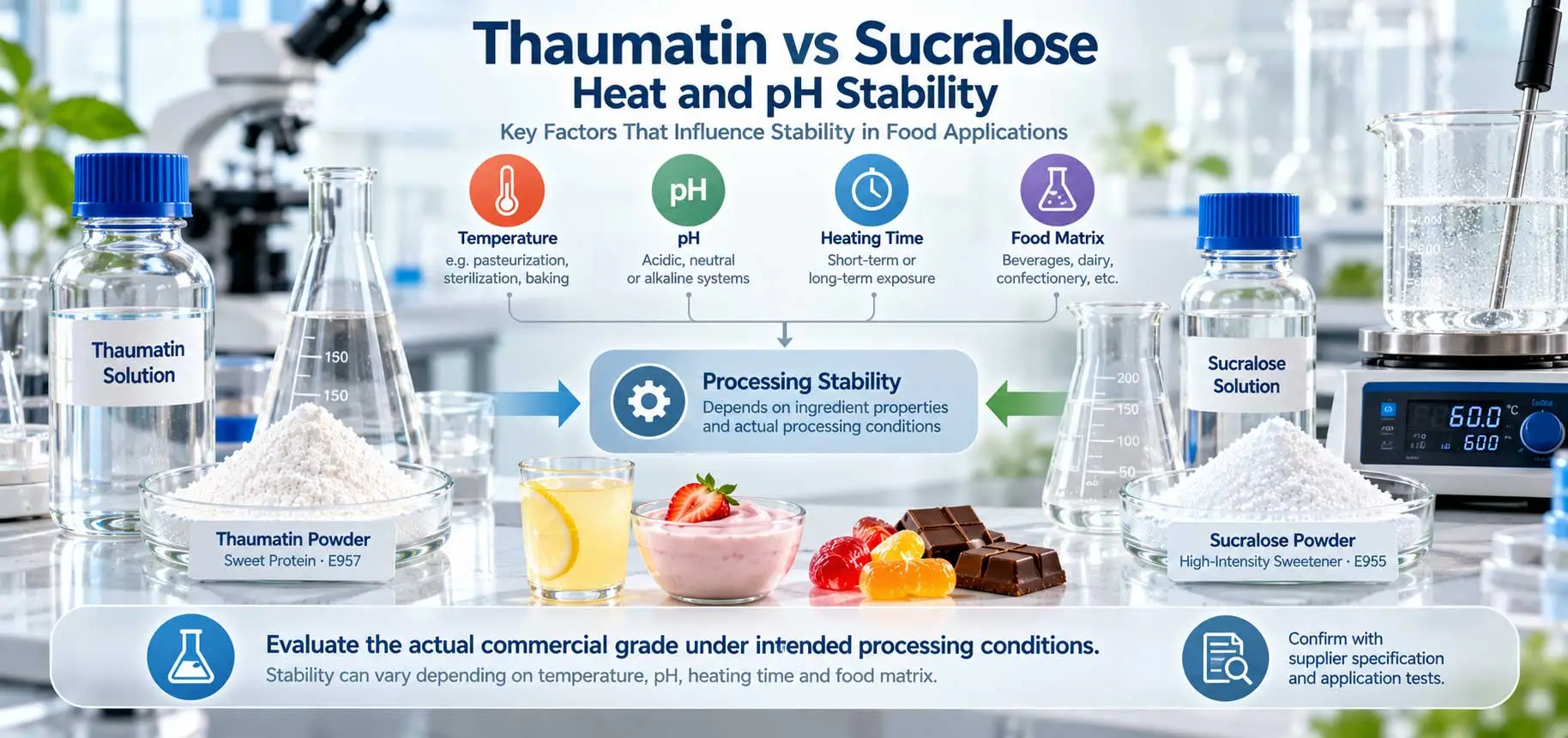
Thaumatin vs Neotame Stability: How Do pH, Heat and Processing Conditions Matter?
A useful thaumatin vs neotame stability comparison must account for the fact that one ingredient is a protein and the other is a much smaller chemically defined molecule.
For thaumatin, maintaining the protein structure is important to sweetness. Evidence submitted in FDA GRAS documentation notes that heat denaturation or disruption of disulfide bridges can cause loss of sweetness. This makes temperature alone an incomplete measure of thaumatin stability; exposure time, pH, matrix, and other processing conditions also matter.
Neotame has a different stability profile. FDA describes it as heat stable and suitable for applications involving elevated temperatures, including baking. That does not mean every formulation should assume unlimited neotame heat stability under every combination of pH, temperature, moisture, and storage time.
For commercial validation, evaluate:
pH × temperature × heating time × water activity × food matrix × storage conditions
The most useful supplier data are therefore those relevant to the intended process. When evaluating thaumatin vs neotame heat stability, a beverage manufacturer using short-time thermal processing has a different question from a confectionery manufacturer applying prolonged heat.
Can Thaumatin Replace Neotame in Food Formulations?
For buyers asking can thaumatin replace neotame, the practical answer is: not through a simple gram-for-gram substitution.
The ingredients differ in sweetness potency, molecular structure, sensory timing, flavor contribution, dosage, solubility characteristics, and processing behavior. Replacing one with the other can therefore change more than sweetness intensity.
The appropriate replacement process is:
Define Target Sweetness → Bench Screening → Adjust Dosage → Evaluate Flavor Profile → Validate Processing → Confirm Shelf-Life Performance
The reverse is also true when considering whether neotame can serve as a thaumatin alternative. A formulation using thaumatin partly for flavor modification may require additional sensory adjustment if thaumatin is removed.
The purpose of reformulation should be defined first. If the objective is only sweetness equivalence, the development path differs from a project intended to maintain sweetness, bitterness masking, and the complete flavor profile simultaneously.
Can Thaumatin and Neotame Be Used Together?
A thaumatin neotame blend can be considered when the formulation strategy calls for a multi-sweetener system and the combination is permitted for the intended food and destination market.
The technical rationale may include adjusting the sweetness curve, managing persistent or secondary sensory notes, supporting flavor balance, or optimizing the amount of individual sweeteners required.
There is no universal optimum ratio for thaumatin and neotame formulation.
A useful blend must be developed around the target food matrix, desired sweetness, other sweeteners already present, flavor system, processing conditions, and sensory results.
For commercial development, start with small controlled trials rather than adopting a supplier's generic blend ratio. Once the sensory target is established, confirm processing stability and batch reproducibility before scale-up.
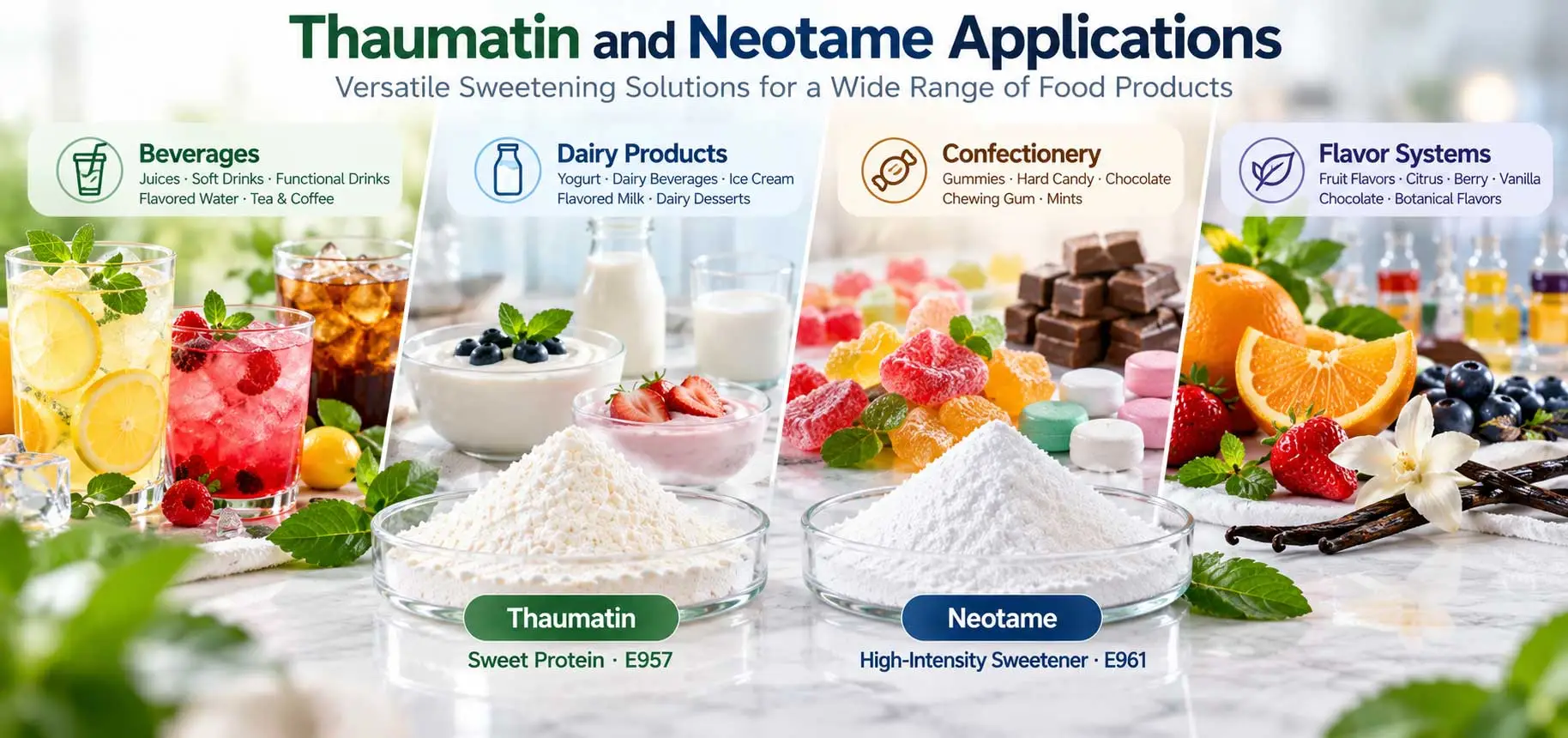
Thaumatin vs Neotame for Beverages, Dairy and Confectionery
Thaumatin vs Neotame for Beverages
When comparing thaumatin vs neotame for beverages, consider acidity, flavor system, processing temperature, sweetness persistence, and the presence of other high-intensity sweeteners.
In fruit-flavored or botanical beverages, flavor interaction may be particularly important because the formulation can contain acidic, bitter, or lingering components. The lowest theoretical dosage is therefore not necessarily the best sensory solution.
Thaumatin vs Neotame for Dairy Products
For thaumatin vs neotame for dairy, evaluate the complete protein, fat, acid, and flavor matrix.
Flavored yogurt, dairy beverages, and desserts can respond differently from clear aqueous systems. Thaumatin's flavor-modifying properties may be relevant in some applications, while neotame's very high potency can make it attractive where extremely low sweetener dosage is desired.
The selection should follow finished-product sensory testing rather than sweetness calculations alone.
Thaumatin vs Neotame for Confectionery
For thaumatin vs neotame for confectionery, processing becomes particularly important.
Hard candy, gummies, chewing gum, chocolate-flavored systems, and other confectionery products expose sweeteners to different combinations of heat, moisture, acidity, and residence time. Codex provisions also differ by food category and ingredient, so the intended use and market should be checked rather than assuming universal interchangeability.
Thaumatin and Neotame Cannot Replace the Functional Bulk of Sugar
Both ingredients can deliver substantial sweetness at low concentrations, but neither directly reproduces all the physical functions of sucrose.
In many foods, sugar contributes bulk, solids, mouthfeel, texture, water-activity effects, freezing-point behavior, and browning characteristics in addition to sweetness.
This matters in a high intensity sweetener formulation.
Reducing 10 kg of sucrose does not mean that adding a few grams of a high-potency sweetener completes the reformulation. The lost mass and functional properties may need to be addressed through fibers, polyols, carbohydrates, hydrocolloids, or other formulation components appropriate to the product.
A successful thaumatin sugar replacement or neotame-based sugar-reduction project therefore needs both a sweetness strategy and a structure/bulk strategy.
How to Compare Thaumatin and Neotame Specifications and COAs
Once an application looks promising, procurement should move from sensory performance to material qualification.
A thaumatin specification should be interpreted according to the manufacturing route and analytical basis. Traditional JECFA thaumatin specifications use nitrogen on a dried basis equivalent to a minimum protein content rather than simply defining the product through a “99% purity” statement.
A neotame specification follows a different analytical framework. The JECFA monograph specifies an assay range of 97.0–102.0% on an anhydrous basis and includes identity, water, pH, and purity-related criteria.
Consequently, a thaumatin COA and neotame COA should not be compared by placing their assay percentages next to each other.
|
Buyer Check |
Thaumatin |
Neotame |
|
Identity |
Confirm grade and production route |
Confirm chemical identity |
|
Assay |
Understand protein/analytical basis |
Review defined assay |
|
Moisture |
Check applicable specification |
Check applicable specification |
|
Purity parameters |
Route/specification dependent |
Review relevant impurities |
|
Microbiology |
Based on applicable product spec |
Based on applicable product spec |
|
Contaminants |
Market and specification dependent |
Market and specification dependent |
|
Test method |
Must support reported result |
Must support reported result |
|
Batch number |
Required for traceability |
Required for traceability |
For both food grade thaumatin and food grade neotame, the COA should correspond to the material being qualified.
Thaumatin vs Neotame Cost-in-Use: Why Price per kg Is Not Enough
Comparing thaumatin price with neotame price on a kilogram basis can be commercially misleading because their use levels can differ substantially.
A more useful starting point is:
Ingredient cost-in-use = Price per kg × Actual dosage per kg of finished product
The calculation should then be expanded where necessary to include premixing, carrier systems, additional flavor modification, analytical control, processing changes, and other formulation costs.
This means a higher thaumatin price per kg does not automatically translate into a more expensive finished formulation. Likewise, a favorable neotame price per kg does not establish the final cost until the validated dosage and supporting formulation requirements are known.
For procurement, cost comparison should begin after equivalent sensory targets have been established. Otherwise, the buyer is comparing ingredient prices rather than equivalent formulation outcomes.
How Should Buyers Compare a Thaumatin Manufacturer and Neotame Manufacturer?
Whether sourcing from a thaumatin manufacturer or a neotame manufacturer, qualification should go beyond a product list and quotation.
Review manufacturing capability, specification control, analytical methods, representative COAs, batch traceability, production capacity, change management, technical support, and commercial continuity.
The technical questions will differ because the ingredients are different. A thaumatin producer should be able to explain the production route and analytical basis for its protein product. A neotame producer should be able to support the chemical specification, assay, impurity controls, and manufacturing consistency appropriate to that material.
The same principle applies when evaluating a thaumatin supplier or neotame supplier that does not manufacture directly: identify the actual production source and understand who controls quality and technical documentation.
The appropriate supplier is the one that can consistently meet the specification required by the formulation and target market.
Thaumatin and Neotame Supply from CHEN LANG BIO TECH
Our sweetener platform covers both protein-based and high-intensity sweetener technologies, allowing technical discussions to focus on the formulation objective rather than positioning one ingredient as universally preferable.
CHEN LANG BIO TECH has more than 30 years of experience in sweetener development and production. Our current commercial production capacity includes approximately 10 MT/year for thaumatin and 2,000 MT/year for neotame, supported by biosynthesis and chemical-synthesis capabilities, R&D resources, application testing, and production-stage quality control.
For customers evaluating a thaumatin manufacturer China or neotame manufacturer China, we can support the process from specification and documentation review through samples, application evaluation, and commercial-scale supply.
For thaumatin, our standard MOQ starts from 1 kg, with 1–5 kg aluminum foil bags and 25 kg paper drums available. Neotame commercial terms, packaging, and sample requirements should be confirmed according to the specific order rather than assumed to be identical to thaumatin.
Frequently Asked Questions About Thaumatin vs Neotame
What is the main difference between Thaumatin and Neotame?
The main difference between thaumatin and neotame is their molecular nature. Thaumatin is a sweet protein, while neotame is a chemically defined high-intensity sweetener. This difference affects analytical specifications, dosage, sensory behavior, and formulation considerations.
Is Thaumatin sweeter than Neotame?
No, based on commonly cited relative sweetness ranges. FDA information describes thaumatin as approximately 2,000–3,000 times sweeter than sucrose and neotame as approximately 7,000–13,000 times sweeter. These figures should not be converted directly into a formulation replacement ratio.
Which has a longer-lasting sweetness, Thaumatin or Neotame?
Thaumatin is particularly associated with persistent sweetness, but a meaningful comparison should be made at equivalent target sweetness in the finished formulation. Concentration, matrix, flavor system, and other sweeteners can influence the temporal profile.
Can Thaumatin replace Neotame?
Can thaumatin replace neotame? Potentially in some formulation objectives, but not through direct gram-for-gram substitution. The new dosage and sensory profile need to be established experimentally and validated under actual processing and storage conditions.
Can Thaumatin and Neotame be used together?
They can be evaluated as part of a multi-sweetener system where the intended use is permitted, but there is no universal thaumatin neotame blend ratio. The appropriate combination depends on the food matrix and target sensory profile.
Which is more suitable for beverages?
There is no universal choice for thaumatin vs neotame for beverages. Consider acidity, processing conditions, flavor profile, desired sweetness curve, other sweeteners, dosage accuracy, and regulatory conditions for the target market.
What documents should buyers request?
Before commercial approval, buyers should normally review the applicable specification, batch or representative COA, TDS, and other technical or regulatory documents relevant to the ingredient, production route, intended use, and destination market.
Can I request samples before commercial purchasing?
Yes. Sample evaluation is recommended before scaling to commercial orders. It allows the formulation team to compare sensory performance and processing behavior before committing to bulk quantities.
Request Thaumatin or Neotame Samples and Commercial Pricing
If you are evaluating thaumatin or neotame for a new sweetening system, send us your target application, required quantity, destination country, specification requirements, and current formulation objective. We can discuss the appropriate technical documentation, COA, sample availability, and commercial quotation before scale-up.
For a thaumatin sample, neotame sample, or quotation for bulk thaumatin powder or neotame, contact:
Email: admin@chenlangbio.com
References
1. U.S. Food and Drug Administration. Aspartame and Other Sweeteners in Food. FDA.
2. U.S. Food and Drug Administration. Sweetness Intensity of Sweeteners Compared to Table Sugar.
3. Joint FAO/WHO Expert Committee on Food Additives. Thaumatin — Combined Compendium of Food Additive Specifications. INS 957.
4. Joint FAO/WHO Expert Committee on Food Additives. Neotame — Combined Compendium of Food Additive Specifications. INS 961.
5. Codex Alimentarius. General Standard for Food Additives — Thaumatin (INS 957).
6. Codex Alimentarius. General Standard for Food Additives — Neotame (INS 961).
7. U.S. Food and Drug Administration. GRAS Notice 738 — Thaumatin.

Send Inquiry
Related Industry Knowledge
- Is Kopexil Better Than Minoxidil for Hair Loss?
- Pomegranate Powder Recipes for Every Lifestyle
- Future Trends of Sodium Methylesculetin Acetate in Healthcare
- What is 4-Butylresorcinol Used for
- Is Praziquantel Safe for Humans
- What Are the Benefits of Alpha-GPC Bodybuilding
- Latest Discovery: Hydrogel Dressings Containing NMN May Accelerate the Healing of Diabetic Ulcers
- Dimethylmethoxy Chromanyl Palmitate For Skin
- Does Green Coffee Bean Extract Powder Reduce Belly Fat
- What Are the Benefits of Hops Extract Xanthohumol