
Spermidine vs NMN: Key Differences, Benefits and Supplement Applications
2026-04-29 15:16:11
What Is Spermidine?
Spermidine is a naturally occurring polyamine found in all living cells, where it contributes to essential biological functions related to cellular maintenance and regulation. For those exploring what is spermidine, it is best understood as a compound involved in processes that support normal cell activity rather than as a single-function ingredient.
From a scientific perspective, the interest in spermidine benefits has grown due to its role in cellular systems that are widely studied in research environments. While naturally present in certain foods, including wheat germ and soy derivatives, the concentration of spermidine in these sources can vary significantly.
For commercial applications, this variability is often addressed through standardized production. In this context, spermidine trihydrochloride has become the preferred form used in manufacturing. As a spermidine supplement ingredient, it offers improved stability, defined purity, and better compatibility with modern formulation processes.
From a supply chain perspective, spermidine is treated as a specialized spermidine raw material, where consistency and reproducibility are essential. This is particularly relevant for brands developing products at scale, where even minor variations in composition can affect formulation outcomes.
In practice, companies working with spermidine prioritize standardized materials that can support both research and commercial production. This approach allows for better control over quality, while also meeting the expectations of regulated markets.

What Is NMN?
Nicotinamide mononucleotide (NMN) is another compound frequently discussed in the context of modern supplement development. For readers asking what is NMN, it is typically described as a precursor involved in biochemical pathways related to cellular metabolism.
Interest in NMN supplement applications has increased as research has explored its relationship with NAD+ pathways. These studies have contributed to broader discussions around cellular processes and how different compounds may interact within these systems.
From a formulation standpoint, NMN is generally used in capsule or powder formats, similar to other functional ingredients. However, compared to more established compounds, the regulatory landscape and product positioning for NMN can vary across different regions.
When considering NMN benefits, it is important to maintain a research-based perspective. Much of the available information is derived from controlled studies, and interpretations should be aligned with scientific context rather than generalized conclusions.
In practice, NMN is often evaluated alongside other compounds, particularly in comparative discussions where different ingredients are assessed based on stability, cost, and formulation suitability.
Spermidine vs NMN: Key Differences Explained
When comparing spermidine vs NMN, the differences are best understood across several dimensions, including origin, functional context, and practical application.
One of the primary distinctions lies in how these compounds are positioned within research. While both are studied in relation to cellular processes, they are associated with different pathways. This is why discussions around difference between spermidine and NMN often focus on their respective roles rather than attempting to place them in direct competition.
From a sourcing perspective, spermidine—particularly in its standardized form—tends to offer greater consistency. By contrast, NMN supply and specification can vary depending on production methods and regulatory conditions.
In formulation, the comparison of NMN vs spermidine becomes more practical. Factors such as stability, compatibility with other ingredients, and scalability all influence how each compound is used in real-world products.
Another key difference relates to manufacturing integration. Standardized forms such as spermidine trihydrochloride are designed to meet consistent specifications, which can simplify large-scale production. This level of control is particularly valuable for companies focused on maintaining uniform product quality.
Overall, rather than asking which compound is “better,” most industry professionals evaluate them based on application context, technical requirements, and long-term feasibility.
Mechanism Comparison: Cellular Pathways and Research Focus
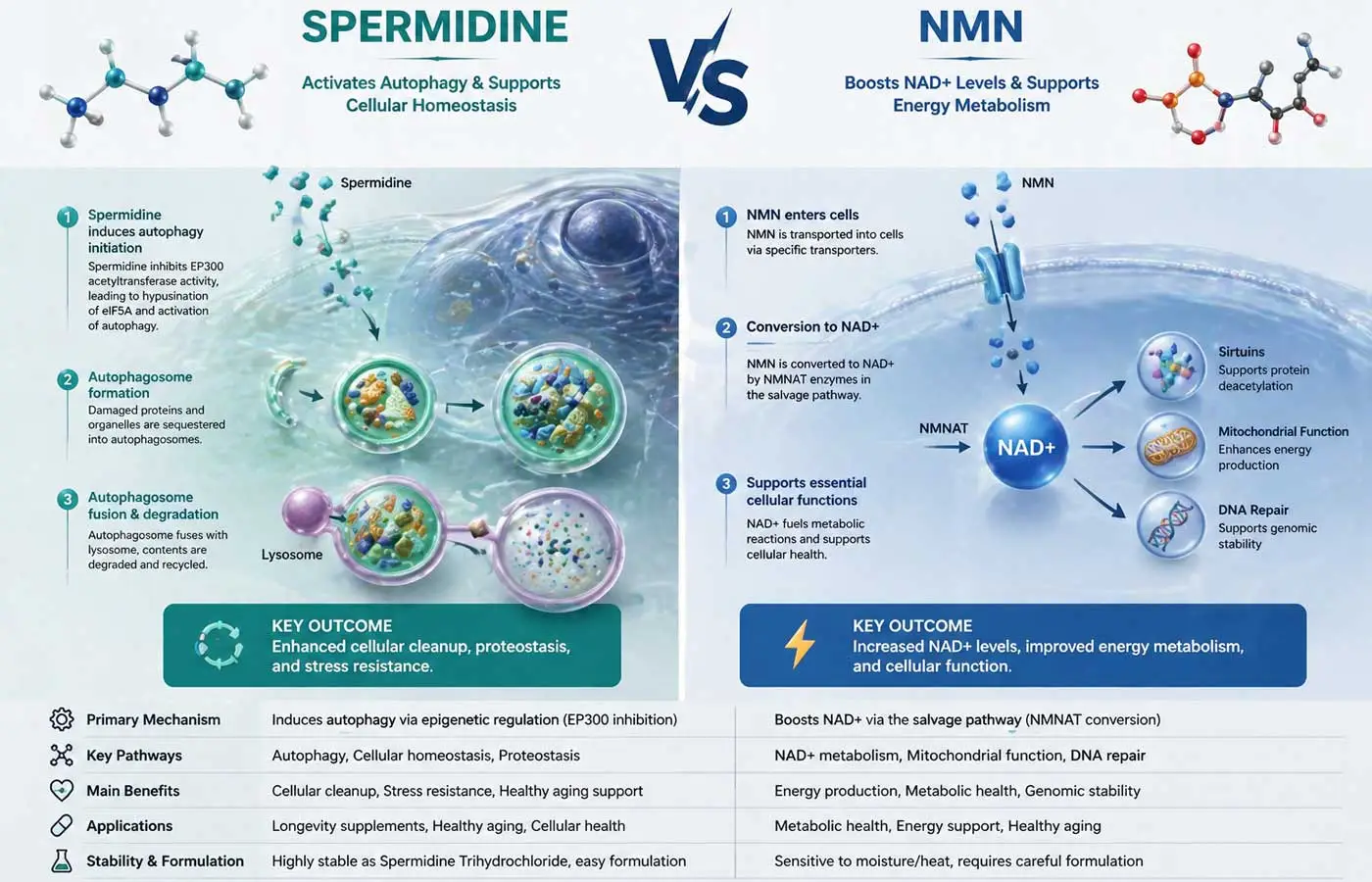
At the research level, comparisons between spermidine and NMN often center on their involvement in different cellular pathways. Understanding these distinctions is important for interpreting how each compound is positioned in scientific discussions.
Spermidine is frequently associated with studies on spermidine autophagy, a cellular process related to internal recycling and maintenance mechanisms. Research exploring the autophagy cellular process examines how cells manage internal components under varying conditions, and spermidine has been included in this context as part of broader investigations.
NMN, on the other hand, is typically discussed in relation to NMN NAD+ pathway dynamics. These pathways are involved in cellular metabolism and energy-related processes, making NMN a subject of interest in studies focused on metabolic regulation.
From a broader perspective, both compounds are part of ongoing research into cellular health supplements and their potential roles in supporting normal biological function. However, it is important to emphasize that these mechanisms are studied under controlled conditions and should not be interpreted as direct functional outcomes in finished products.
In discussions around longevity mechanism, these compounds are often presented as examples of how different biochemical pathways are being explored. For manufacturers and suppliers, the relevance lies not in making claims, but in understanding how research trends influence product development and ingredient demand.
From an industry standpoint, the key takeaway is that each compound operates within a distinct scientific framework. As a result, their applications are better evaluated based on formulation requirements and sourcing considerations rather than simplified comparisons.
Benefits Comparison
When comparing functional ingredients, discussions around benefits are often the starting point. However, evaluating spermidine benefits and NMN benefits requires a careful, research-based perspective rather than simplified conclusions.
In scientific literature, spermidine has been explored in relation to cellular processes associated with maintenance and regulation. Studies examining cellular health benefits often reference its role in pathways linked to internal cellular balance, though these findings are typically derived from controlled environments.
Similarly, NMN has been investigated within research focused on metabolic pathways. Discussions around longevity supplements comparison frequently include NMN due to its association with NAD+ related processes, which are relevant to cellular metabolism.
From an industry perspective, the key takeaway is not whether one compound is categorically superior, but how each aligns with specific product objectives. Research trends may influence ingredient selection, but formulation decisions are ultimately based on stability, sourcing, and scalability.
For manufacturers and product developers, understanding these distinctions helps position ingredients appropriately within product portfolios, rather than relying on generalized benefit comparisons.
Supplement Applications: Which Is More Practical for Formulation?
From a formulation standpoint, practicality often outweighs theoretical comparisons. When evaluating spermidine supplement versus NMN supplement applications, manufacturers typically consider factors such as stability, compatibility, and ease of integration.
Spermidine—particularly in standardized forms such as spermidine trihydrochloride powder—is widely used due to its relatively stable profile and adaptability across different dosage forms. It can be incorporated into capsules, tablets, and powder blends with predictable behavior during processing.
In contrast, NMN formulations may require more careful handling depending on the production environment and storage conditions. This can influence how it is positioned within product development, especially for companies seeking long shelf-life products.
For teams working on supplement formulation ingredient selection, these differences are often decisive. Ingredients that offer consistent performance across batches tend to reduce production variability and improve efficiency.
As a result, many manufacturers prioritize materials that combine technical reliability with supply stability—particularly when scaling production beyond initial product launches.
Cost and Supply Chain Comparison
Cost considerations play a central role in ingredient selection, especially for companies planning large-scale production. When comparing spermidine price and NMN price, it becomes clear that differences extend beyond simple cost per kilogram.
Standardized materials such as spermidine trihydrochloride bulk are often produced within established supply chains, where manufacturing processes and raw material sourcing are well-defined. This contributes to more predictable pricing structures and stable availability.
In comparison, NMN supply can be influenced by regulatory shifts and production constraints, which may affect both pricing and long-term availability. These factors are particularly relevant for companies planning sustained product lines.
From a procurement perspective, evaluating NMN bulk price alongside supply reliability is essential. Lower upfront cost does not necessarily translate to long-term efficiency if supply disruptions or specification inconsistencies occur.
For buyers, the key consideration is total value rather than unit price. This includes consistency, documentation, and the ability to maintain supply over time—factors that often favor more established raw material categories.
Stability and Manufacturing Considerations
Stability is a critical factor in determining how an ingredient performs in real-world applications. When comparing spermidine stability and NMN stability, differences in chemical properties can influence formulation strategies and production outcomes.
Spermidine, particularly in its trihydrochloride form, is generally valued for its stability under standard manufacturing conditions. This allows for more predictable processing and reduces the risk of degradation during production and storage.
In contrast, NMN may require more controlled handling depending on formulation design and environmental factors. This can affect both shelf life and production efficiency, especially in large-scale manufacturing environments.
For companies involved in supplement manufacturing, these considerations are not merely technical—they directly impact cost, quality control, and product consistency. Stable raw materials tend to simplify production workflows and reduce variability between batches.
From a sourcing perspective, evaluating raw material stability alongside purity and documentation helps ensure that selected ingredients can meet both technical and commercial requirements.
Why Spermidine Trihydrochloride Is Preferred in Manufacturing
In practical manufacturing environments, ingredient selection is rarely based on theoretical comparisons alone. Instead, companies prioritize materials that offer consistency, scalability, and ease of integration. This is where spermidine trihydrochloride has become increasingly preferred.
Compared to variable natural extracts, standardized spermidine provides a more controlled composition. For manufacturers working with high purity spermidine, this level of consistency allows for more precise formulation and reduces variability across production batches.
Another key advantage lies in process compatibility. As a stable compound, spermidine trihydrochloride integrates well into existing manufacturing workflows, making it suitable for large-scale supplement production. This is particularly important when products need to meet strict quality and regulatory expectations.
From a sourcing perspective, working with a qualified spermidine manufacturer ensures access to materials that meet defined specifications. This includes not only purity standards but also analytical verification, batch traceability, and long-term supply stability.
For companies focused on scaling production, these factors often outweigh initial cost considerations, making standardized spermidine a practical and reliable choice.
How to Choose Between Spermidine and NMN for Your Product Line
For product developers and procurement teams, the decision between spermidine and NMN is less about direct comparison and more about alignment with business objectives. When evaluating spermidine vs NMN which to choose, several practical factors come into play.
First, formulation requirements should be considered. Ingredients that offer stable performance and compatibility with different delivery formats tend to simplify production. This is why many companies evaluating longevity supplement ingredient selection prioritize materials with predictable behavior under manufacturing conditions.
Second, supply chain reliability is essential. Stable sourcing ensures that production timelines can be maintained without disruption. In this context, spermidine—particularly in standardized forms—often provides advantages in consistency and availability.
Cost structure is another important consideration. While both ingredients may vary in pricing depending on quality and scale, the overall value is determined by how efficiently they can be integrated into production.
Ultimately, the choice depends on the intended product positioning. For companies focused on long-term scalability and consistent quality, ingredients that combine stability, supply reliability, and technical support tend to be more practical.
How to Work with a Reliable Spermidine Supplier
Selecting the right supplier is a critical step in ensuring both product quality and supply continuity. Evaluating a spermidine bulk supplier involves more than comparing quotations—it requires a clear understanding of technical capability and operational experience.
A reliable supplier should be able to support the full lifecycle of a project, from early-stage development to large-scale production. This includes expertise in synthesis, process optimization, and quality control.
For example, companies with long-term experience in small-molecule chemistry are often better positioned to handle complex production requirements. At CHEN LANG BIO TECH, nearly 30 years of industry experience have been dedicated to small molecule design, synthesis, and manufacturing, as well as the delivery of biological raw materials for life science applications.
This level of experience allows for efficient transition from concept to production. With a strong technical team and integrated R&D capabilities, processes such as route design, screening, and scale-up can be managed with precision and speed.
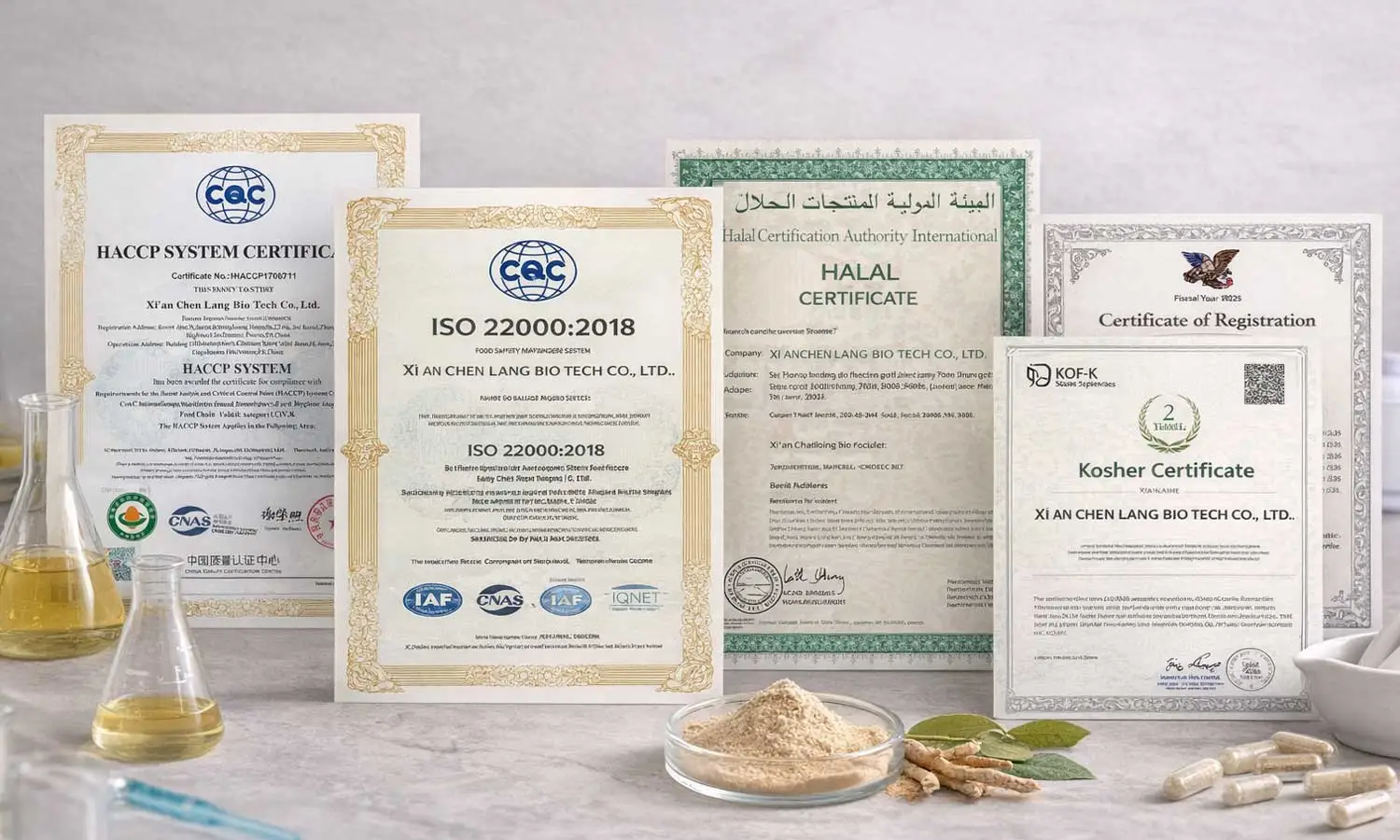
In addition, advanced production facilities and analytical systems make it possible to deliver materials across a wide range—from milligram-level development to ton-scale manufacturing. Compliance with international standards such as ISO9001 and GMP further supports consistent quality and traceability.
For buyers sourcing spermidine trihydrochloride bulk, these capabilities translate into greater confidence in both product quality and long-term supply stability.
Where to Buy Spermidine Trihydrochloride in Bulk
For companies ready to move into procurement, identifying the right sourcing channel is essential. Buyers looking to buy spermidine trihydrochloride typically evaluate suppliers based on a combination of quality, documentation, and responsiveness.
The global supply landscape includes both manufacturers and distributors, but working directly with a spermidine trihydrochloride bulk supplier often provides greater transparency. Direct manufacturers can offer better insight into production processes, quality control, and customization options.
In practice, buyers prioritize suppliers who can provide:
•High purity material (commonly ≥99%)
•Complete documentation, including COA and analytical data
•Stable production capacity for ongoing supply
•Clear communication and technical support
For companies operating in regulated markets, these factors are essential in ensuring compliance and maintaining product quality.
Rather than focusing solely on price, experienced buyers evaluate sourcing decisions based on total value—combining quality, reliability, and long-term partnership potential.
FAQ About Spermidine vs NMN
Which is more suitable for supplement manufacturing, spermidine or NMN?
For most manufacturers, spermidine trihydrochloride is often preferred due to its stability and consistent specifications. It integrates more easily into standard formulations, while NMN may require tighter control depending on processing and storage conditions.
How do spermidine and NMN compare in bulk cost?
When comparing NMN vs spermidine, spermidine generally offers more stable pricing in bulk due to established production processes. NMN pricing can vary more depending on supply conditions and regulatory factors.
Which ingredient is easier to source at scale?
From a supply chain perspective, spermidine bulk supplier networks are typically more stable and scalable. NMN availability may fluctuate depending on market and regulatory changes, which can affect long-term sourcing.
What purity level is recommended for spermidine raw material?
Most commercial applications require high purity spermidine at ≥98%–99%. Buyers should verify purity with HPLC data and a complete COA to ensure consistency in formulation.
Which ingredient offers better formulation flexibility?
In terms of difference between spermidine and NMN, spermidine trihydrochloride is generally more adaptable across capsules, tablets, and powder systems. Its stability allows for simpler and more consistent processing.
How should buyers evaluate a spermidine supplier?
A reliable spermidine supplier should provide consistent production, verified analytical data, and full documentation. Experience in scale-up and compliance (e.g., GMP, ISO) is also critical for long-term supply.
Which is more suitable for long-term product development?
For long-term planning, standardized ingredients like spermidine trihydrochloride are often preferred due to consistent quality, stable supply, and easier integration into scalable manufacturing.
Conclusion: Choosing the Right Ingredient for Long-Term Product Success
In the evolving landscape of functional ingredients, comparisons such as spermidine vs NMN are part of a broader effort to understand how different compounds can be applied in real-world products.
While research continues to explore various biological pathways, the practical decision for manufacturers comes down to reliability, scalability, and consistency. For companies working with spermidine trihydrochloride, these factors often align well with the demands of modern supplement production.
Ultimately, successful product development depends on selecting ingredients that can be consistently sourced, effectively formulated, and supported by reliable suppliers. This approach not only improves production efficiency but also supports long-term growth in competitive markets.
Contact for Technical Details and Bulk Supply
For companies planning to buy spermidine trihydrochloride or evaluate sourcing options, direct communication with an experienced supplier can provide valuable insight.
If you require:
•Product specifications and COA
•Analytical data such as HPLC or NMR
•Sample evaluation before bulk orders
•Information on spermidine trihydrochloride bulk supply
You can contact CHEN LANG BIO TECH for further details.
📧 Email: admin@chenlangbio.com
🌐 Website: www.chenlangbio.com
💬 WhatsApp / WeChat: +86-17782478823

Send Inquiry
Related Industry Knowledge
- Does DHEA Affect Sleep?
- Low vs High Molecular Weight Hyaluronic Acid Powder: Which is Right for Your Anti-Aging Skincare Formulation
- What Are the Competitive Advantages of Buying Bulk Acetylcysteine Powder from China?
- Can L-Ergothioneine Support Cognitive Health?
- Is Mung Bean Peptide Powder Suitable for Vegetarians and Vegans
- How to Use Instant Kava Powder for Relaxation?
- How is loratadine Absorbed
- Where Can You Buy Mangiferin
- China Dimethylmethoxy Chromanyl Palmitate Supplier
- Hydroxypinacolone Retinoate