
Piroctone Olamine Compatibility: What to Consider in Shampoo and Scalp-Care Formulations
2026-09-20 15:10:03
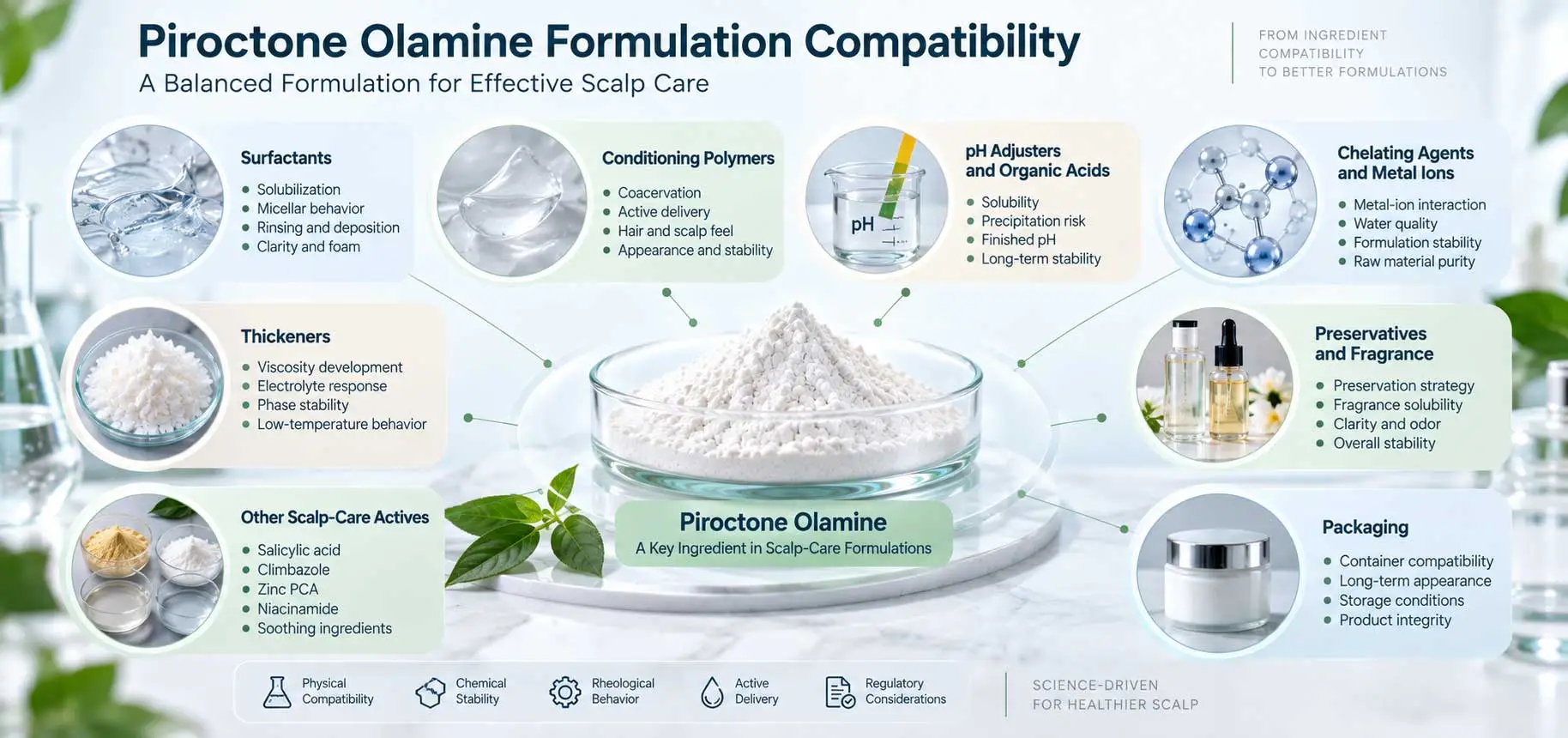
Piroctone Olamine compatibility is not simply a question of whether the powder can be mixed with another cosmetic ingredient without an immediate visible reaction. In a commercial shampoo or scalp-care product, compatibility involves solubilization, pH, surfactant behavior, polymer interactions, rheology, active delivery, long-term physical stability, packaging, and the presence of other functional ingredients.
This distinction matters when moving from a laboratory concept to commercial production. A raw material may fully comply with its specification and still behave differently when introduced into a complex shampoo base. For formulators and ingredient buyers, Piroctone Olamine formulation compatibility should therefore be demonstrated in the intended finished system rather than assumed from the properties of the individual raw materials.
Is Piroctone Olamine Compatible With Shampoo Ingredients?
Piroctone Olamine can be formulated with many ingredient classes commonly found in shampoos and scalp-care products, but there is no useful universal “compatible with everything” statement. Piroctone Olamine compatibility in shampoo depends on the composition and processing conditions of the complete formulation.
A formulator should evaluate several aspects together:
|
Compatibility Area |
What Should Be Evaluated |
|
Surfactants |
Solubilization, micellar association, deposition and clarity |
|
Conditioning polymers |
Coacervation, active delivery and appearance |
|
Thickeners |
Viscosity development and long-term rheology |
|
pH adjusters |
Solubility, precipitation and finished pH |
|
Chelators / metal ions |
Complexation and formulation stability |
|
Other scalp actives |
Solubility, pH, physical stability and regulatory conditions |
|
Preservatives / fragrance |
Preservation strategy, clarity and solvent environment |
|
Processing |
Temperature, order of addition and cooling behavior |
|
Packaging |
Long-term appearance and product integrity |
For this reason, Piroctone Olamine shampoo compatibility is best treated as an experimental formulation question rather than a fixed property listed on a TDS.
What Does Piroctone Olamine Formulation Compatibility Actually Mean?
A compatibility assessment should answer more than whether the batch looks homogeneous immediately after mixing.
Physical compatibility concerns visible changes such as crystallization, precipitation, haze, sediment, phase separation or unexpected color development. Some problems become apparent only after cooling or several weeks of storage.
Chemical compatibility considers whether Piroctone Olamine and other relevant ingredients remain sufficiently stable under the intended pH, temperature, light and storage conditions.
Rheological compatibility concerns the behavior of the thickening system. A shampoo can remain visually homogeneous yet undergo unacceptable viscosity drift after changes in electrolyte concentration, surfactant composition or pH.
Delivery compatibility is particularly important in rinse-off anti-dandruff products. Surfactants and conditioning polymers can influence the association and deposition of Piroctone Olamine, so two visually similar shampoos may not deliver the active in the same way.
Finally, regulatory compatibility is separate from chemical compatibility. Two ingredients appearing together in an experimental formula does not establish that every concentration, product category, claim or market combination is permitted.
A meaningful Piroctone Olamine compatibility testing program considers all of these dimensions.
Piroctone Olamine Surfactant Compatibility in Shampoo
Piroctone Olamine surfactant compatibility deserves particular attention because the surfactant system performs more than a cleansing function. It can influence solubilization, micellar association, rinsing and the amount of active retained on the scalp.
Piroctone Olamine has limited aqueous solubility, while its behavior can change substantially in surfactant-containing systems. Consequently, a water-only compatibility test does not accurately represent performance in a commercial shampoo.
Research published in the International Journal of Cosmetic Science provides a useful illustration. Johnson and colleagues investigated Piroctone Olamine delivery from shampoo and found that modifying surfactant micellar stability affected the association between the active and micelles. Weaker association in the experimental systems increased retention on the scalp surface and delivery to follicular infundibula. The study also showed that polymer coacervation could be optimized to improve active delivery.
This means that evaluating Piroctone Olamine with anionic surfactants, amphoteric materials or nonionic components should go beyond checking whether the batch remains clear.
The practical questions are whether the surfactant blend provides adequate solubilization at the intended active level, remains stable after pH adjustment and cooling, and supports the intended delivery profile after rinsing.
Published compatibility or solubility data can help select a starting system, but they should not be treated as guaranteed capacities for a different commercial formulation.
Piroctone Olamine Compatibility With Sulfate-Free Surfactants
The growing sulfate-free hair-care market makes Piroctone Olamine sulfate-free shampoo an important development area, but “sulfate-free” describes what is absent rather than defining a single surfactant architecture.
A sulfate-free shampoo may use isethionates, sarcosinates, glutamates, glucosides, amphoterics or combinations of several surfactant families. These systems can differ considerably in micelle structure, electrolyte response, thickening behavior, foam, clarity and active solubilization.
Therefore, Piroctone Olamine compatibility with sulfate-free surfactants should be assessed in the actual base. Successful use in one published sulfate-free formulation cannot establish universal compatibility with every sulfate-free surfactant combination.
During development, formulators should monitor whether the intended concentration remains uniformly incorporated after final pH adjustment, cooling and storage. Rheology also matters because a change in the surfactant package that solves solubilization can simultaneously alter viscosity or conditioning performance.
The relevant question is not simply “Can Piroctone Olamine be used in sulfate-free shampoo?” It can. The development question is whether the particular sulfate-free system delivers acceptable solubility, deposition, sensory properties and stability.
Piroctone Olamine Polymer Compatibility and Scalp Deposition
Conditioning polymers deserve attention because Piroctone Olamine polymer compatibility can influence both physical properties and active delivery.
Cationic polymers used in shampoos can interact with surfactants during dilution and rinsing to form coacervates. This process is commonly associated with deposition of conditioning materials onto hair and scalp surfaces, but the polymer characteristics can also affect delivery of functional actives.
Johnson et al. reported that increasing cationic-polymer charge density in their experimental shampoo systems optimized coacervation and improved Piroctone Olamine delivery. Importantly, this does not mean that simply adding more cationic polymer will improve every formula. Polymer molecular characteristics, concentration, surfactant architecture and dilution behavior all contribute to the outcome.
When assessing Piroctone Olamine conditioning polymer compatibility, formulators should therefore monitor appearance and viscosity while also considering what happens during product use. A polymer can be physically compatible in the bottle but still change deposition behavior during rinsing.
For anti-dandruff shampoos, Piroctone Olamine scalp deposition is a formulation variable worth considering alongside nominal active concentration.
Piroctone Olamine Thickener Compatibility: Viscosity Is Part of Formulation Stability
Piroctone Olamine thickener compatibility is often overlooked because viscosity problems may initially appear unrelated to the active.
In practice, incorporating Piroctone Olamine can require a solvent or surfactant-based premix, followed by pH adjustment. These changes can alter the environment in which the rheology modifier operates. Salt-thickened surfactant systems, polymeric rheology modifiers, gums and acrylate-based thickeners do not respond identically to changes in electrolytes, solvents and surfactant ratios.
A proper Piroctone Olamine shampoo viscosity assessment should therefore compare the target formula after manufacture and throughout stability testing.
Watch for progressive thinning or thickening, poor low-temperature recovery, haze, sediment and phase separation. If viscosity changes, the investigation should consider the complete surfactant-electrolyte-thickener relationship rather than assuming that Piroctone Olamine itself is directly responsible.
Piroctone Olamine Compatibility With pH Adjusters and Organic Acids
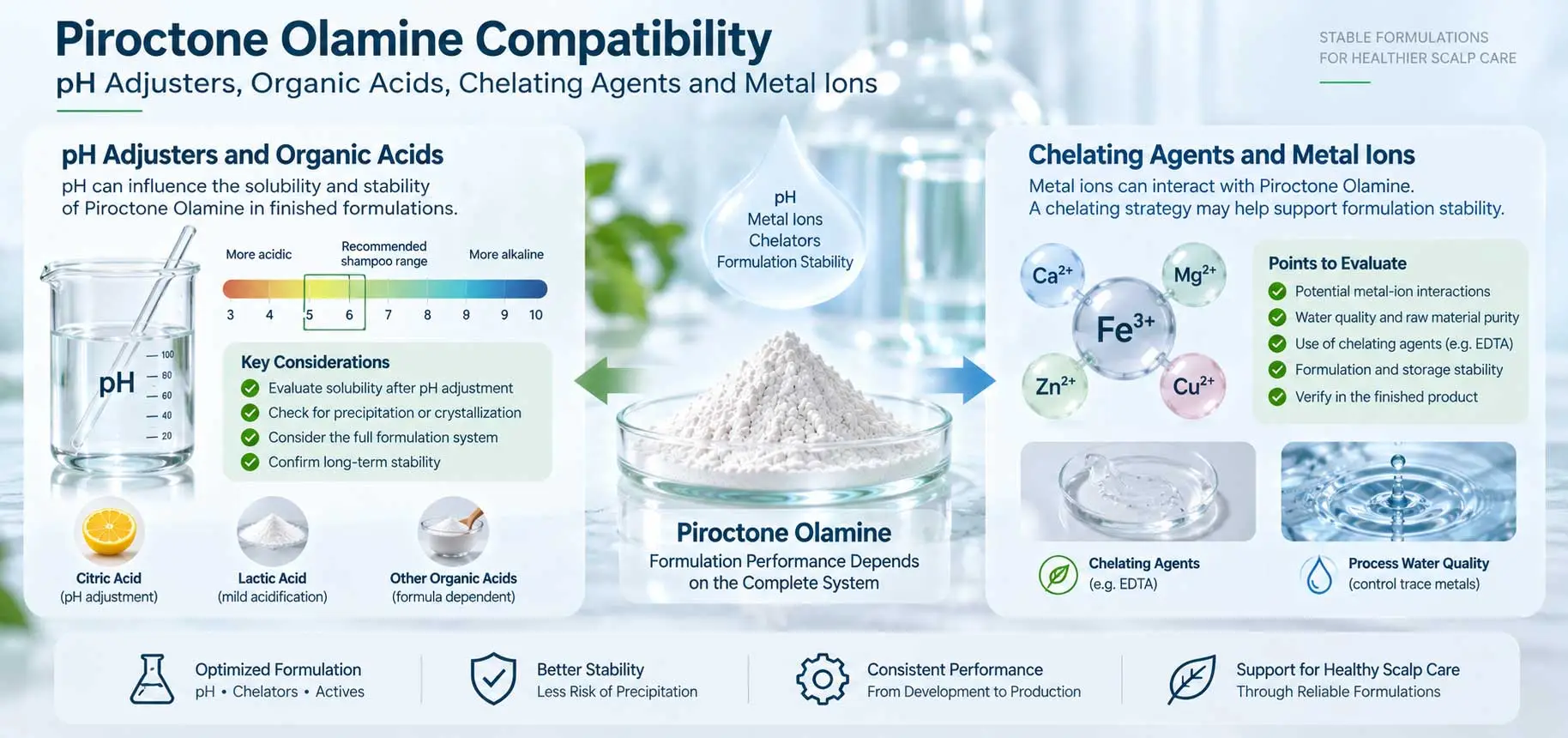
Piroctone Olamine pH compatibility is closely connected to solubility.
Physicochemical research published in 2023 showed that Piroctone Olamine exists in ionization equilibria and that its behavior in aqueous media is influenced by pH. The same study also demonstrated large differences in solubility between different solvents, reinforcing why pH cannot be considered independently of the surrounding formulation.
For formulators using citric acid or another acidifying system, the critical point is what happens after the final pH is established. A premix that appears completely incorporated before acidification may behave differently after the finished shampoo reaches its target pH.
This is why questions about Piroctone Olamine with citric acid should not be reduced to a binary compatibility statement. After adjustment, evaluate clarity where relevant, precipitation, crystallization, viscosity and stability over time.
The pH of a raw-material QC solution should also not be mistaken for a recommended shampoo pH. Piroctone Olamine shampoo pH needs to be selected for the complete product and verified through finished-formula testing.
Piroctone Olamine Compatibility With Chelating Agents and Metal Ions
Metal-ion interactions are a less obvious but technically relevant part of Piroctone Olamine chelating agent compatibility.
Recent research published in Chemical Papers investigated Piroctone Olamine complexation with metal ions, with particular characterization of its interaction with Fe(III). This provides a scientific reason for formulators to consider the metal-ion environment rather than treating it as irrelevant to active behavior.
It does not mean that trace metal exposure will automatically cause a commercial shampoo to fail, nor does it justify labeling all metal-containing ingredients incompatible. It does indicate that water quality, raw-material impurities and metal exposure can be sensible investigation points when unexplained changes occur.
Questions about Piroctone Olamine EDTA compatibility should be approached in the same evidence-based way. A chelating agent may be useful within a formulation strategy, but its effect should be confirmed in the complete system rather than inferred from the individual ingredients.
For scale-up, control of process water and raw-material quality is generally more useful than trying to correct an unexplained metal-related problem after commercial production has begun.
Piroctone Olamine Preservative and Fragrance Compatibility
The antimicrobial activity of Piroctone Olamine does not remove the need for a properly designed finished-product preservation strategy.
When considering Piroctone Olamine preservative compatibility, formulators should evaluate the preservative system according to the complete formula, packaging and expected consumer use. Appropriate microbiological or preservative-efficacy testing should be performed where required; the presence of an anti-dandruff active should not be treated as evidence that the shampoo is adequately preserved.
Piroctone Olamine fragrance compatibility is another finished-formula issue. Fragrance introduces an additional mixture of materials and often changes the solubilization requirements of a clear shampoo. A system that remains clear before fragrance addition may develop haze afterward.
Fragrance load, solubilizers, surfactant composition, active concentration and temperature should therefore be evaluated together rather than troubleshooting each material in isolation.
Piroctone Olamine Compatibility With Other Scalp-Care Actives
Multi-active scalp-care formulas can address complementary objectives, but evidence that two ingredients have been used together is different from proof that they will be compatible in every formulation.
|
Combination |
Why It May Be Considered |
What Requires Validation |
|
Piroctone Olamine + Salicylic Acid |
Anti-dandruff activity plus scale management |
pH, solubility and stability |
|
Piroctone Olamine + Climbazole |
Multi-active anti-dandruff system |
Regulatory status, stability and performance |
|
Piroctone Olamine + Zinc PCA |
Broader oily-scalp positioning |
Formula stability and metal-ion environment |
|
Piroctone Olamine + Niacinamide |
Broader scalp-care positioning |
pH, stability and claims |
|
Piroctone Olamine + soothing ingredients |
Scalp-comfort concept |
Finished-system compatibility |
Piroctone Olamine and Salicylic Acid Compatibility
There is meaningful published evidence for Piroctone Olamine with salicylic acid in finished shampoos. A randomized study reported a shampoo containing 0.75% Piroctone Olamine and 2% salicylic acid, while other clinical work has also investigated formulas containing both actives.
These studies demonstrate that the combination can be formulated successfully under defined conditions. They do not establish a universal recipe.
Piroctone Olamine salicylic acid compatibility still requires attention to pH because salicylic acid introduces its own solubility and formulation constraints. The solvent environment, surfactant system, order of addition and regulatory conditions for the target market should all be reviewed.
Piroctone Olamine and Climbazole Compatibility
A published clinical study evaluated a shampoo containing 0.5% Piroctone Olamine with 0.45% climbazole and reported effective anti-dandruff performance under the tested conditions.
This provides useful evidence that a Piroctone Olamine climbazole combination is technically feasible. It should not be converted into a recommendation that those concentrations are optimal—or permitted—for every product and market.
When developing Piroctone Olamine with climbazole, verify current destination-market regulations, individual ingredient limits, formulation stability and finished-product performance.
Piroctone Olamine With Zinc PCA or Niacinamide
Both Piroctone Olamine with zinc PCA and Piroctone Olamine with niacinamide are commercially interesting scalp-care concepts.
Recent clinical research has included formulations containing Piroctone Olamine, salicylic acid and Zinc PCA, showing that these ingredients can coexist in specifically developed systems. That evidence should still not be generalized to every shampoo base or concentration.
For niacinamide, formulation development should focus on the complete pH and stability environment rather than assuming compatibility from ingredient popularity. In both cases, the appropriate conclusion is to validate the intended commercial formula.
Piroctone Olamine Compatibility With Packaging and Processing Conditions
Piroctone Olamine formulation stability also depends on how the product is manufactured and stored.
Our current technical guidance recommends incorporating the ingredient before emulsification where relevant and maintaining processing below 80°C. The latter should be treated as a manufacturing recommendation, not as evidence that Piroctone Olamine suddenly decomposes above 80°C.
During scale-up, evaluate hold time, heating and cooling history, order of addition and the point at which final pH is established.
Piroctone Olamine packaging compatibility should be assessed with the actual finished formula in the intended commercial package. Observe appearance, color, odor, viscosity, precipitation and container interaction throughout the company's established stability program.
Piroctone Olamine Compatibility Testing: A Practical Formulator Protocol
A useful Piroctone Olamine compatibility testing protocol follows the product beyond the day it is made.
|
Test Stage |
What to Observe |
|
Initial preparation |
Incorporation, clarity or intended appearance, homogeneity |
|
Final pH adjustment |
Haze, precipitation, crystallization, viscosity |
|
24–48 hours |
Appearance, pH, viscosity, odor |
|
Accelerated storage |
Phase behavior, color, precipitation, viscosity drift |
|
Low-temperature storage |
Crystallization, haze, rheology changes |
|
Intended packaging |
Product and container interaction |
|
Analytical testing |
Active content where appropriate |
|
Performance testing |
Delivery and intended claims where required |
The exact protocol should follow the manufacturer's internal development and regulatory requirements rather than a generic internet template.
For Piroctone Olamine shampoo stability testing, include the final fragrance, preservative, colorant, conditioning system and commercial packaging whenever possible. Testing an incomplete laboratory base can be useful during screening, but it does not replace validation of the finished formula.
A shampoo that is clear on Day 1 has demonstrated only initial appearance—not long-term compatibility.
Common Piroctone Olamine Compatibility Problems and How to Investigate Them
When Piroctone Olamine formulation troubleshooting is required, the visible defect is a starting point rather than a diagnosis.
|
Observation |
Areas Worth Investigating |
|
Piroctone Olamine crystallization in shampoo |
Solvent system, concentration, pH, cooling and storage temperature |
|
Haze after acidification |
pH-dependent solubility and surfactant environment |
|
Viscosity loss |
Surfactant, electrolyte and thickener balance |
|
Piroctone Olamine precipitation or sediment |
Solubilization, pH, other ingredients and storage conditions |
|
Unexpected color change |
Metal ions, fragrance, oxidation and other formula components |
If a Piroctone Olamine shampoo cloudy issue appears only after several weeks, repeating the original hot-process beaker test is unlikely to identify the entire problem. Review the batch history, final pH, storage temperature and ingredient additions, and compare failed samples with retained controls.
Troubleshooting should change one meaningful variable at a time whenever practical.
Why a Piroctone Olamine COA Cannot Prove Formulation Compatibility
A Piroctone Olamine COA answers an important but different question: did a particular raw-material batch meet its approved specification?
A suitable Piroctone Olamine specification may include identity, appearance, purity or assay, relevant impurities, residual solvents, moisture-related parameters and microbiological criteria where applicable.
None of those results can tell the buyer whether a particular shampoo will remain clear, maintain viscosity, avoid crystallization or deposit the active efficiently.
For this reason, purchasing a cosmetic grade Piroctone Olamine should involve both raw-material qualification and formulation validation. A strong COA is essential evidence of batch quality; it is not a finished-product compatibility certificate.
Request a Piroctone Olamine Sample Before Bulk Qualification
A representative Piroctone Olamine sample is one of the most useful tools when a project moves from supplier screening to technical approval.
When comparing sources, use the same shampoo base, active concentration, addition sequence, processing temperature, finished pH, packaging and stability conditions. Otherwise, a formulation change can easily be mistaken for a raw-material difference.
The Piroctone Olamine formulation sample should also represent the grade intended for future commercial supply as closely as practical. Before approval, confirm that the sample specification corresponds to the proposed production material.
Choosing a Piroctone Olamine Supplier for Formulation Development
A technically useful Piroctone Olamine supplier does more than provide a purity figure and quotation.
During qualification, buyers should request a current specification, batch-specific COA, TDS, SDS, storage information and a representative sample. For ongoing production, batch consistency, traceability, change control and responsive technical communication become increasingly important.
When evaluating a Piroctone Olamine manufacturer, ask whether the documentation supports the exact grade being offered and whether commercially supplied batches will continue to meet the approved specification.
A reliable cosmetic grade Piroctone Olamine supplier should make it easier for QA and R&D teams to qualify the material, rather than requiring them to reconstruct basic technical information from marketing literature.
Buying Piroctone Olamine Powder for Commercial Shampoo Production
Before deciding to buy Piroctone Olamine Powder, qualify the specification and representative sample in the intended formulation. Once technical approval is established, procurement can compare Piroctone Olamine price on an equivalent grade, documentation, packaging, quantity and Incoterm basis.
For projects progressing to bulk Piroctone Olamine Powder, MOQ and lead time should also be confirmed against production requirements rather than considered independently of quality and supply continuity.
CHEN LANG BIO TECH can provide current product specifications, batch documentation, sample support and commercial quotations for qualified projects. For technical documents or purchasing information, contact admin@chenlangbio.com.
FAQ: Piroctone Olamine Compatibility in Shampoo Formulations
Is Piroctone Olamine compatible with shampoo surfactants?
Piroctone Olamine surfactant compatibility depends on the complete surfactant blend. Surfactants can influence solubilization, micellar association and scalp deposition, so compatibility should be evaluated in the intended shampoo rather than through a water-only test.
Can Piroctone Olamine be used in sulfate-free shampoo?
Yes. Piroctone Olamine in sulfate-free shampoo is technically feasible and has been evaluated in published formulations. Because sulfate-free systems vary considerably, solubility, viscosity, deposition and stability should still be verified for the specific surfactant package.
Can Piroctone Olamine be used with salicylic acid?
Yes, published clinical formulations have contained both ingredients. Piroctone Olamine with salicylic acid still requires formulation-specific assessment of pH, solubility, stability, processing and applicable regulatory conditions.
Can Piroctone Olamine be combined with climbazole?
Published research has evaluated a shampoo containing both actives. However, Piroctone Olamine with climbazole should be validated for the intended formulation, and current regulatory requirements for each target market should be checked before commercialization.
Can Piroctone Olamine be used with niacinamide?
The combination is a plausible scalp-care formulation concept, but a universal compatibility conclusion should not be assumed. Piroctone Olamine with niacinamide should be tested at the intended concentrations, finished pH and storage conditions.
Why does Piroctone Olamine crystallize in shampoo?
Possible contributors include insufficient solubilization, changes in pH, concentration, cooling conditions, storage temperature or interactions within the finished system. Piroctone Olamine crystallization in shampoo should be investigated using the complete formula and batch history.
How should formulators test Piroctone Olamine compatibility?
Begin with the complete intended formulation and monitor incorporation, final pH, appearance, viscosity and crystallization. Continue through appropriate accelerated, low-temperature and packaging stability studies, adding analytical or performance testing when required by the development program.
Compatibility Should Be Demonstrated in the Finished Formulation
The most useful way to approach Piroctone Olamine compatibility is as a finished-product question rather than a permanent property assigned to the raw material. Published research and supplier technical information can identify promising surfactants, solvents and formulation strategies, but they cannot reproduce every commercial shampoo matrix.
For ingredient buyers, this makes raw-material quality and formulation validation complementary parts of qualification. A well-documented material, representative sample and disciplined compatibility program provide a stronger basis for scale-up than relying on a single purity figure or a generic compatibility claim.
References
1. Johnson ES, Chang DW, Schwartz JR, et al. Enhanced piroctone olamine retention from shampoo for superior anti-dandruff efficacy. International Journal of Cosmetic Science. 2023;45:236–245. DOI: 10.1111/ics.12835.
2. Tang CF, Paz-Alvarez M, Pudney PDA, Lane ME. Characterization of piroctone olamine for topical delivery to the skin. International Journal of Cosmetic Science. 2023;45:345–353. DOI: 10.1111/ics.12839.
3. Lodén M, Wessman C. The antidandruff efficacy of a shampoo containing piroctone olamine and salicylic acid in comparison to that of a zinc pyrithione shampoo. International Journal of Cosmetic Science. 2000;22(4):285–289. DOI: 10.1046/j.1467-2494.2000.00024.x.
4. Schmidt-Rose T, Braren S, Fölsch E, et al. Efficacy of a piroctone olamine/climbazol shampoo in comparison with a zinc pyrithione shampoo in subjects with moderate to severe dandruff. International Journal of Cosmetic Science. 2011;33(3):276–282. DOI: 10.1111/j.1468-2494.2010.00623.x.
5. Chen Z, Xia L, Gao D, et al. Investigation of complexation behavior of piroctone olamine salt with Fe(III) ions and influence on antifungal activity. Chemical Papers. 2026. DOI: 10.1007/s11696-026-04732-6.
6. European Parliament and Council. Regulation (EC) No 1223/2009 on Cosmetic Products. Consolidated version and applicable annexes.
7. European Chemicals Agency (ECHA). Piroctone Olamine — Substance Information. CAS 68890-66-4.

Send Inquiry
Related Industry Knowledge
- What Is Phycocyanin Powder?
- Does P5P Interfere With Sleep?
- Bulk Tadalafil Powder: How to Choose a Reliable Supplier?
- What Are the Key Benefits of 3,3, DIIDOLYLMETHANE for Health?
- What are the Benefits of Acetyl Hexapeptide-8 in Skincare?
- How Does Tranexamic Acid Powder Work in the Body?
- Choosing the Best Podophyllin Powder Supplier
- Lupinus Albus Extract for Skin: Benefits and Application
- Does All Green Tea Have EGCG?
- What is Cyanotis Arachnoidea Extract