
KSM-66 vs Regular Ashwagandha Extract: How to Choose the Right Option for Supplements
2026-03-27 17:00:57
Ashwagandha Extract Powder: Why This Comparison Matters in Supplement Development
In the evolving landscape of nutraceutical formulation, ashwagandha extract powder has transitioned from a traditional botanical ingredient into a standardized, application-driven functional compound. This shift is largely driven by increasing demand for consistency, reproducibility, and clinically aligned formulations across global supplement markets.
As brands move toward evidence-based product development, the comparison between branded extracts such as KSM-66 vs regular ashwagandha extract has become increasingly relevant. This is not simply a matter of branding—it reflects deeper considerations related to composition, extraction methods, active compound concentration, and formulation flexibility.
From a formulation and sourcing perspective, the distinction between these two options affects several critical variables:
•Active compound standardization (withanolides content)
•Dosage efficiency and formulation design
•Cost structure and scalability
•Supply chain flexibility
For companies working with an experienced ashwagandha extract supplier or ashwagandha extract powder manufacturer, understanding these differences is essential for aligning ingredient selection with product strategy.
In practical terms, this comparison represents a broader industry question:
👉 Should formulations rely on branded, fixed-spec extracts, or flexible, customizable botanical extract specifications that can be adapted to different applications?
What Is KSM-66 Ashwagandha Extract?
KSM-66 is a proprietary, branded form of ashwagandha extract developed through a root-only extraction process. It is widely positioned in the market as a “full-spectrum” extract designed to preserve the natural balance of bioactive compounds found in Withania somnifera.
Extraction Method and Composition Profile
Unlike some botanical extracts that incorporate both root and leaf material, KSM-66 ashwagandha is produced exclusively from root material. The extraction process is typically water-based, avoiding the use of synthetic solvents, and is designed to retain a broad spectrum of naturally occurring constituents.
The extract is commonly standardized to:
•Approximately 5% withanolides (measured by HPLC)
Withanolides are the primary bioactive compounds associated with ashwagandha’s functional properties, including stress modulation and adaptogenic activity.
In addition to withanolides, KSM-66 contains:
•Alkaloids (trace levels)
•Saponins
•sitoindosides
The “full-spectrum” positioning refers to the preservation of these compounds in ratios similar to the natural root, rather than isolating specific fractions.
Clinical Dosage and Application Data
KSM-66 has been used in multiple human clinical studies, which has contributed to its market recognition. Across these studies, typical dosage ranges are:
|
Application Area |
Daily Dosage Range |
Duration |
|
Stress and cortisol reduction |
300 – 600 mg/day |
8–12 weeks |
|
Sleep support |
300 – 600 mg/day |
6–12 weeks |
|
Sports performance / strength |
300 – 600 mg/day |
8+ weeks |
These dosage ranges are consistent with a 5% withanolides ashwagandha extract, delivering approximately:
•15–30 mg of withanolides per day
From a formulation standpoint, this places KSM-66 within the category of moderate-potency standardized extracts, suitable for general wellness and performance-oriented products.
Typical Applications of KSM-66 in Supplements
Due to its clinical positioning and brand recognition, KSM-66 is commonly used in:
•Stress support supplements
•Sleep formulations
•Sports nutrition products
•Testosterone and performance blends
In these applications, it is often selected not only for its composition but also for its association with published clinical data.
From a commercial perspective, branded ashwagandha extract such as KSM-66 is frequently used in products positioned around:
•Clinical validation
•Brand recognition
•Premium market segments
What Is Regular Ashwagandha Extract Powder?
In contrast to branded extracts, ashwagandha extract powder refers to a broader category of standardized botanical extracts that can be produced with varying specifications depending on formulation requirements.
Standardization and Withanolides Content
A key characteristic of standardized ashwagandha extract is its flexibility in withanolides concentration.
Common specifications include:
•2.5% withanolides
•5% withanolides
•10% withanolides (high potency)
Unlike fixed-spec branded extracts, these products can be tailored to meet specific formulation goals. This allows manufacturers to adjust:
•Potency
•Dosage requirements
•Cost efficiency
For example:
•A 5% extract aligns closely with KSM-66 in terms of active compound concentration
•A 10% extract provides higher potency, enabling lower dosage and more compact formulations
This flexibility is one of the defining characteristics of botanical extract specification design.
Flexible Specifications for Different Applications
One of the primary advantages of working with a qualified ashwagandha extract powder supplier is the ability to customize extract specifications based on application needs.
For example:
•Stress and daily wellness products → 5% extract
•Sports nutrition and premium formulations → 10% or higher
•Functional beverages → lower concentration, improved solubility
This level of adaptability supports formulation flexibility, allowing brands to optimize ingredient selection for both performance and cost.
From a sourcing perspective, bulk ashwagandha extract offers:
•Scalable production capacity
•Greater pricing flexibility
•Wider application range
This makes it particularly suitable for companies seeking long-term supply stability and customizable product development.

KSM-66 vs Regular Ashwagandha Extract: Key Differences
When comparing KSM-66 with regular ashwagandha extract powder, the distinction lies not only in composition but also in formulation strategy, cost structure, and supply flexibility.
Comparative Analysis
|
Parameter |
KSM-66 |
Regular Ashwagandha Extract Powder |
|
Type |
Branded extract |
Standardized extract |
|
Raw Material |
Root only |
Root or root + leaf |
|
Withanolides Content |
Fixed (~5%) |
Customizable (2.5%–10%+) |
|
Dosage Range |
300–600 mg |
125–600 mg (depending on spec) |
|
Cost Structure |
Higher, brand-driven |
Flexible, spec-dependent |
|
Formulation Flexibility |
Limited |
High |
|
Supply Model |
Controlled distribution |
Scalable bulk supply |
Interpretation for Buyers and Formulators
From a formulation standpoint, the comparison between KSM-66 vs ashwagandha extract reflects two fundamentally different approaches:
1, Fixed, branded specification
•Consistent and recognized
•Limited flexibility
•Higher cost
2, Customizable standardized extract
•Adjustable potency
•Scalable supply
•Greater formulation freedom
For buyers evaluating ashwagandha extract price per kg, it is important to consider:
•Cost per dosage
•Formulation efficiency
•Long-term supply capability
Rather than focusing solely on brand identity, many manufacturers prioritize extract comparison based on application requirements, aligning ingredient selection with formulation goals.
Cost, Flexibility, and Supply: Which Option Is More Practical?
From a sourcing and formulation perspective, the comparison between KSM-66 and ashwagandha extract powder is ultimately a question of cost efficiency, flexibility, and supply scalability rather than brand recognition alone.
For most supplement manufacturers, evaluating ashwagandha extract price per kg is only the starting point. A more relevant metric is the total cost per effective dosage, which includes extract concentration, formulation efficiency, and production scalability.
While branded extracts such as KSM-66 typically carry a higher unit cost due to intellectual property and brand positioning, bulk ashwagandha extract offers a more flexible cost structure. This flexibility allows manufacturers to optimize formulations based on target markets, dosage requirements, and product positioning.
For example, when sourcing from an experienced ashwagandha extract supplier, companies can adjust withanolides content (e.g., 5% vs 10%) to balance potency and cost efficiency. This level of customization is rarely available in fixed-spec branded extracts.
Supply Chain Flexibility and Production Scalability
Supply stability is a critical consideration in large-scale supplement manufacturing. Branded extracts are typically distributed through controlled channels, which may limit availability and increase lead times.
In contrast, working with a qualified ashwagandha extract powder manufacturer provides access to:
•Scalable production capacity
•Flexible order volumes
•Stable long-term supply
At CHEN LANG BIO TECH, our approach to ashwagandha extract powder production is built around direct raw material sourcing and controlled manufacturing processes. By sourcing ashwagandha directly from India, we ensure consistency at the origin level while maintaining stable supply for global customers.
This model supports both small-batch product development and large-scale commercial production, making it suitable for companies requiring bulk ashwagandha extract supplier partnerships.
When Should You Choose KSM-66?
Despite the advantages of flexible extracts, there are specific scenarios where KSM-66 remains a suitable option.
Branded Positioning and Clinical Association
KSM-66 is often selected in formulations where brand recognition and clinical association play a central role. Products positioned around clinically studied ingredients may benefit from using a branded ashwagandha extract with established market visibility.
In these cases, the value of KSM-66 lies not only in its composition but also in its positioning as a recognized ingredient within the supplement industry.
For certain formulations—particularly those targeting premium consumer segments—this branding can support product differentiation.
Fixed Specification and Simplicity in Formulation
Because KSM-66 is standardized to a fixed withanolides content, it provides a straightforward formulation pathway for companies that do not require customization.
This can simplify ingredient selection in:
•Single-ingredient products
•Clinically positioned supplements
•Predefined formulation concepts
However, this fixed specification also limits flexibility compared to standardized ashwagandha extract options that can be tailored to different applications.
When Is Regular Ashwagandha Extract Powder the Better Choice?
For most supplement manufacturers, especially those focused on scalability and formulation flexibility, ashwagandha extract powder provides a more adaptable solution.
Customization and Formulation Flexibility
One of the primary advantages of working with a professional ashwagandha extract powder supplier is the ability to customize extract specifications.
At CHEN LANG BIO TECH, we provide standardized ashwagandha extract with adjustable withanolides content, allowing formulators to align ingredient strength with product requirements.
This flexibility supports:
•Multi-ingredient formulations
•Targeted dosage strategies
•Product differentiation across multiple SKUs
In practice, this means that manufacturers are not constrained by a single specification, but can develop formulations based on specific performance goals.
Controlled Quality and Analytical Validation
From a quality perspective, consistency is achieved through validated analytical methods.
Each batch of ashwagandha extract powder is tested using HPLC testing, ensuring accurate measurement of withanolides content. These methods are fully verifiable and aligned with industry-standard analytical protocols.
In addition, standardization is calibrated using USP reference standards, which provides an additional level of assurance regarding active compound accuracy.
This combination of HPLC testing and USP standard calibration ensures that extract quality remains consistent across production batches—an essential factor for brands requiring reproducible formulations.
Manufacturing Environment and Processing Technology
Production quality is directly influenced by manufacturing conditions.
At CHEN LANG BIO TECH, ashwagandha extract powder is produced in facilities operating under Chinese GMP standards, ensuring:
•Clean and controlled production environments
•Absence of foreign contaminants
•Consistent processing conditions
In addition, specialized processing technologies—such as water-based debittering techniques—are applied to improve the sensory profile of the extract. This is particularly important for applications in functional foods and beverages, where taste can influence final product acceptance.
Raw Material Sourcing and Origin Control
Raw material quality is a foundational factor in extract performance.
By sourcing ashwagandha directly from India, CHEN LANG BIO TECH ensures:
•Authentic botanical origin
•Stable raw material supply
•Reduced variability in active compounds
This direct sourcing model supports long-term consistency and allows for better control over the entire production chain, from raw material selection to finished extract.
How to Choose a Reliable Ashwagandha Extract Supplier
Selecting the right supplier is one of the most important decisions in supplement manufacturing. Beyond product specifications, supplier capability directly affects product quality, regulatory compliance, and supply stability.
Certifications and Quality Assurance Systems
A qualified ashwagandha extract powder manufacturer should operate under recognized quality systems and provide full certification support.
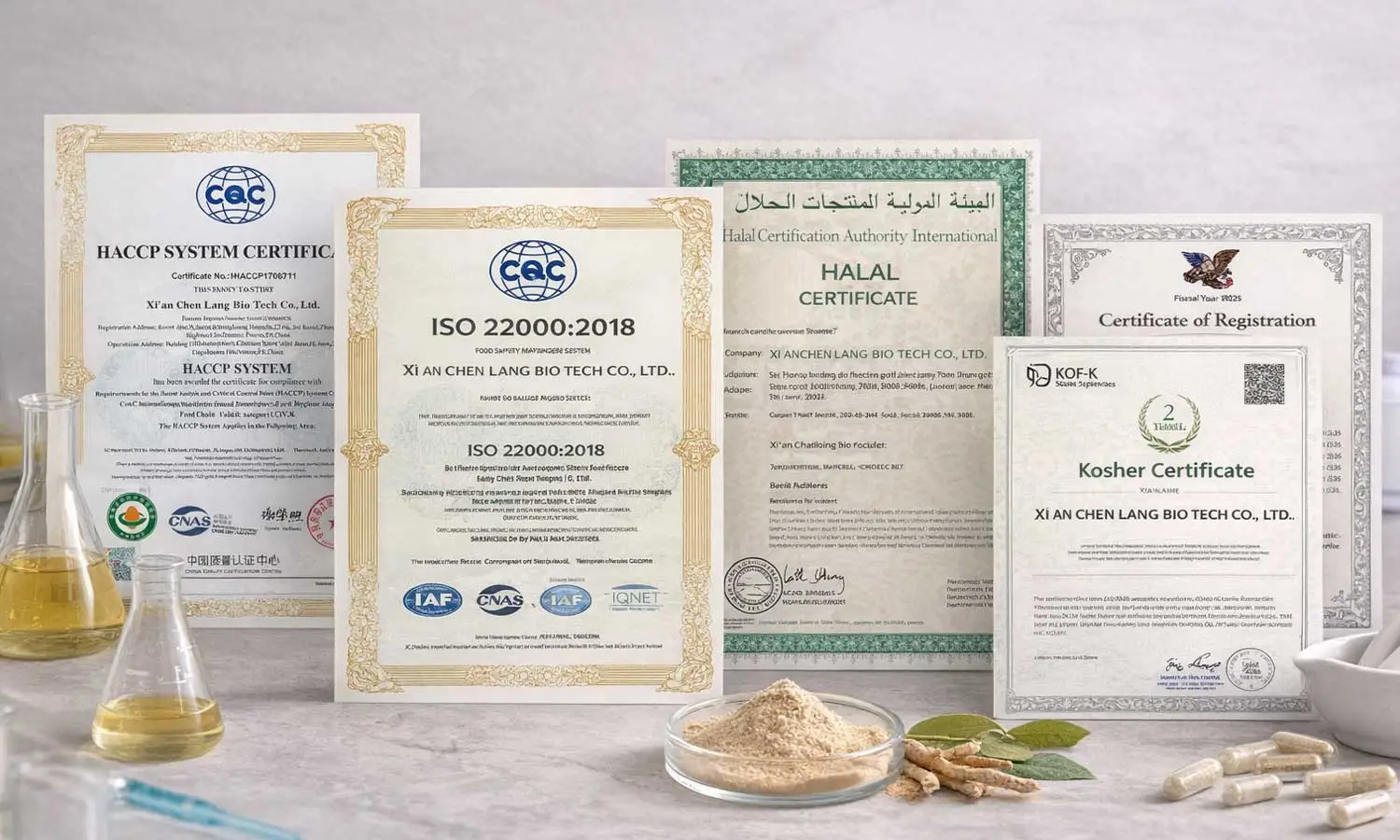
At CHEN LANG BIO TECH, production is supported by internationally recognized certifications, including:
♦HACCP (food safety management)
♦ISO-based quality systems
♦Halal and Kosher certifications
These certifications reflect structured control over production processes, traceability, and product safety—key requirements for global supplement markets.
Standardization, Testing, and Documentation
Reliable suppliers must provide transparent and verifiable documentation.
For ashwagandha extract powder, this includes:
♦Certificate of Analysis (COA)
♦Withanolides content verification
♦Third-party testing reports
At CHEN LANG BIO TECH, analytical validation is based on HPLC testing methods, ensuring that each batch meets defined specifications. These methods are reproducible and can be independently verified, supporting both regulatory compliance and formulation accuracy.
Supply Stability and Long-Term Partnership Capability
For companies sourcing at scale, supply stability is as important as product quality.
An experienced bulk ashwagandha extract supplier should be able to provide:
♦Consistent batch production
♦Scalable manufacturing capacity
♦Reliable global delivery
CHEN LANG BIO TECH focuses on long-term supply partnerships, supporting customers with stable production capacity and consistent product quality across different markets.
FAQ: KSM-66 vs Ashwagandha Extract Powder
Is KSM-66 better than regular ashwagandha extract?
Not necessarily. KSM-66 is a branded ashwagandha extract, while ashwagandha extract powder offers customizable specifications. The better option depends on formulation goals and application requirements.
What is the difference between KSM-66 and standardized extract?
The main difference lies in flexibility. KSM-66 has a fixed composition, while standardized ashwagandha extract can be adjusted in terms of withanolides content and application design.
Which option is more cost-effective?
In most cases, bulk ashwagandha extract provides better cost efficiency due to flexible specifications and lower unit cost compared to branded extracts.
Can regular extract replace KSM-66?
In many formulations, ashwagandha extract powder with similar withanolides content (e.g., 5%) can serve as an alternative, depending on formulation strategy and positioning.
Where to source bulk ashwagandha extract powder?
Sourcing typically involves working with a reliable ashwagandha extract supplier or ashwagandha extract powder manufacturer that provides standardized extracts, validated testing, and stable supply.
Conclusion: Choosing Between KSM-66 vs Ashwagandha Extract Powder for Supplement Applications
When evaluating KSM-66 vs ashwagandha extract powder, the decision should be guided by formulation objectives, target market positioning, and long-term sourcing strategy rather than by brand recognition alone.
KSM-66 represents a fixed-spec, branded extract with established clinical positioning, making it suitable for products that emphasize ingredient recognition and standardized composition. In contrast, ashwagandha extract powder offers greater flexibility in terms of withanolides content, dosage design, and application-specific customization. This makes it particularly relevant for manufacturers developing differentiated formulations across categories such as stress support, sleep optimization, and sports nutrition.
From a technical and commercial perspective, understanding the difference between KSM-66 vs regular ashwagandha extract, as well as standardized ashwagandha extract vs branded extract, allows formulators to make more informed decisions regarding potency, cost efficiency, and scalability. In many cases, working with a qualified ashwagandha extract supplier enables better alignment between extract specification and product requirements, especially when flexibility and supply continuity are critical.
For companies sourcing bulk ashwagandha extract powder, consistency in raw material quality, validated analytical methods, and controlled manufacturing conditions remain key factors in ensuring reliable product performance.
At CHEN LANG BIO TECH, production of ashwagandha extract powder is managed through standardized extraction processes, HPLC-based verification of withanolides content, and direct raw material sourcing to support consistent batch quality. For technical documentation, specification details, or formulation-related inquiries, further information can be provided upon request:
📧 Email: admin@chenlangbio.com
🌐 Website: www.chenlangbio.com

Send Inquiry
Related Industry Knowledge
- What is Trans-resveratrol Used For
- How Does Indole-3-methanol Contribute to Hormone Balance and Immune Support?
- What are the Health Benefits of Resveratrol Powder?
- What is the Difference Between D-Luciferin Potassium Salt and D-Luciferin Sodium Salt?
- How Can I Use Mung Bean Peptide Powder in My Diet?
- Pure Fisetin for Brain Health and Memory Boost
- Can l use Ectoin with Tretinoin
- Is Phenylethyl Resorcinol Better Than Vitamin C
- What Does Fisetin Do For The Body?
- Frankincense Extract for Sale and Frankincense Extract Benefits