
Is Thaumatin Safe? Safety, Side Effects and Regulatory Status
2026-10-15 15:42:33
Is thaumatin safe for use as a food sweetener? This question matters to food manufacturers, formulation specialists, and ingredient buyers evaluating high-intensity sweeteners for commercial products. Thaumatin has undergone scientific safety evaluations and has a history of use in food applications. However, a responsible safety assessment must consider the identity of the ingredient, its manufacturing process, intended use, and applicable regulatory requirements.
For companies assessing is thaumatin sweetener safe for a new formulation, the distinction between an ingredient's general toxicological profile and the regulatory status of a specific commercial material is particularly important.
This guide examines the scientific evidence, potential adverse effects, international regulatory evaluations, and quality documentation that manufacturers should review before approving thaumatin for food production.
What Does the Scientific Evidence Say About Thaumatin Safety?
Available scientific evaluations support the safety of assessed thaumatin materials under their specified conditions of use. The Joint FAO/WHO Expert Committee on Food Additives (JECFA) has assigned thaumatin an acceptable daily intake (ADI) of “not specified,” while the European Food Safety Authority (EFSA) concluded that the evaluated food additive E957 did not raise a safety concern at the assessed exposure levels.
However, thaumatin safety cannot be generalized to every manufacturing route or commercial product without reviewing the relevant evidence.
|
Safety Question |
Evidence-Based Interpretation |
|
Is thaumatin considered safe? |
Evaluated materials have not raised safety concerns under the assessed conditions. |
|
Are adverse effects established? |
Available assessments have not identified a characteristic adverse-effect profile. |
|
Is there an ADI? |
JECFA established an ADI “not specified.” |
|
Is thaumatin permitted worldwide? |
Authorization depends on jurisdiction, material identity, and intended use. |
|
Does manufacturing route matter? |
Yes. Biosynthetic materials may require route-specific regulatory evaluation. |
For commercial applications, thaumatin sweetener safety should be assessed alongside product specifications, manufacturing controls, and destination-market requirements.
What Is Thaumatin Sweetener and Why Does Its Protein Structure Matter?
Thaumatin is a family of intensely sweet proteins originally identified in the fruit of Thaumatococcus daniellii, a plant native to tropical West Africa. Thaumatin I and thaumatin II are among the best-characterized members of this protein family.
Unlike small-molecule sweeteners such as sucralose or acesulfame potassium, thaumatin consists of amino acids arranged in a folded protein structure stabilized by disulfide bonds.
Its sweetness is commonly described as approximately 2,000–3,000 times that of sucrose, although perceived intensity depends on concentration and testing conditions.
The protein structure is relevant to safety evaluation because thaumatin digestion involves the breakdown of dietary proteins into smaller peptides and amino acids.
Nevertheless, the fact that an ingredient is a protein does not independently establish its safety. Protein identity, digestibility, potential allergenicity, and manufacturing-related impurities must also be considered.
Thaumatin Safety Assessment: What Have JECFA and EFSA Concluded?
International evaluations provide an important scientific foundation for understanding thaumatin safety assessment, but their conclusions must be interpreted within the scope of the materials and uses examined.
•JECFA Thaumatin Evaluation and the 2025 Group ADI
The thaumatin JECFA evaluation established an ADI of “not specified” for thaumatin in 1985.
This designation is used when the available toxicological, biochemical, and exposure information indicates that a numerical ADI is unnecessary for the evaluated uses.
At its 100th meeting in 2025, JECFA extended its evaluation to include a specifically assessed recombinant thaumatin II produced using a defined manufacturing system, establishing a group ADI of “not specified.”
This development is particularly relevant to manufacturers investigating alternative production technologies.
However, the conclusion does not automatically apply to every recombinant protein, production organism, or biosynthetic process. The evaluated material's identity and manufacturing
characteristics remain essential.
•EFSA Thaumatin E957 Safety Re-Evaluation
The thaumatin EFSA safety re-evaluation published in 2021 examined the available toxicological evidence and dietary exposure information for thaumatin (E957).
EFSA concluded that there was no safety concern for thaumatin E957 at the refined exposure estimates associated with its reported uses and use levels.
The assessment also identified limitations in parts of the available evidence, including information relevant to allergenicity and certain long-term toxicological endpoints.
|
Authority |
Evaluation |
Principal Conclusion |
|
JECFA |
1985 |
ADI “not specified” for evaluated thaumatin |
|
EFSA |
2021 |
No safety concern at assessed exposure levels for E957 |
|
JECFA |
2025 |
Group ADI “not specified,” including a specifically evaluated recombinant thaumatin II |
These findings support the established scientific understanding of thaumatin while emphasizing the importance of product identity and exposure conditions.
Thaumatin Toxicity: What Do Toxicological Studies Show?
The available thaumatin toxicity literature includes studies examining acute toxicity, repeated-dose exposure, genotoxic potential, and other endpoints relevant to food additive safety.
Regulatory evaluations have not identified a toxicological concern that would require establishing a numerical ADI for the assessed materials.
In its 2021 re-evaluation, EFSA reviewed animal studies in which thaumatin was administered at relatively high doses. The evaluated evidence did not indicate adverse effects at the highest tested levels in certain repeated-dose studies.
However, toxicological interpretation requires attention to study design, duration, dose selection, and the quality of the underlying data.
The absence of an observed adverse effect in a particular study does not establish that every possible endpoint has been investigated.
A professional thaumatin toxicology review should therefore distinguish between established findings, supporting evidence, and remaining data limitations.
For ingredient buyers, the practical implication is that safety conclusions should be supported by recognized evaluations and documentation corresponding to the actual supplied material.
Thaumatin Side Effects: Are There Known Health Risks?
Concerns about thaumatin side effects often arise because consumers and food manufacturers want to understand whether high-intensity sweeteners may produce unwanted physiological effects.
Based on the available regulatory evaluations, thaumatin has not been associated with a clearly established pattern of adverse effects under the assessed conditions of food use.
However, this does not mean that adverse reactions are biologically impossible or that all populations and exposure scenarios have been studied equally.
When considering thaumatin health risks, three factors deserve particular attention: the evidence available for the ingredient itself, the amount consumed under realistic dietary conditions, and the quality of the commercial material.
Manufacturing impurities or an incorrectly identified ingredient represent separate quality concerns that cannot be resolved simply by referring to the general safety profile of thaumatin.
Similarly, reports of symptoms following consumption of a multi-ingredient food product cannot automatically be attributed to thaumatin without an appropriate investigation.
Thaumatin Allergy: What Does the Evidence Say About Allergenicity?
Because thaumatin is a protein, thaumatin allergy and potential immune responses deserve consideration during safety evaluation.
Food allergies involve immune reactions to specific proteins or protein-derived structures. However, being a protein does not automatically make an ingredient a clinically established food allergen.
In its 2021 re-evaluation, EFSA noted that the available evidence was insufficient to reach a definitive conclusion regarding the potential for oral sensitization.
This distinction matters when discussing thaumatin allergenicity with food manufacturers.
The existing safety assessments should not be interpreted as proof that allergic reactions are impossible. Equally, there is insufficient justification for presenting thaumatin as a common food allergen.
For biosynthetic materials, allergenicity assessment may also consider the identity of the expressed protein and the presence of residual host-cell proteins.
Manufacturers should review the relevant evidence for the specific ingredient rather than relying on broad claims about protein-based sweeteners.
Thaumatin Digestion and Metabolism: How Is the Sweet Protein Processed?
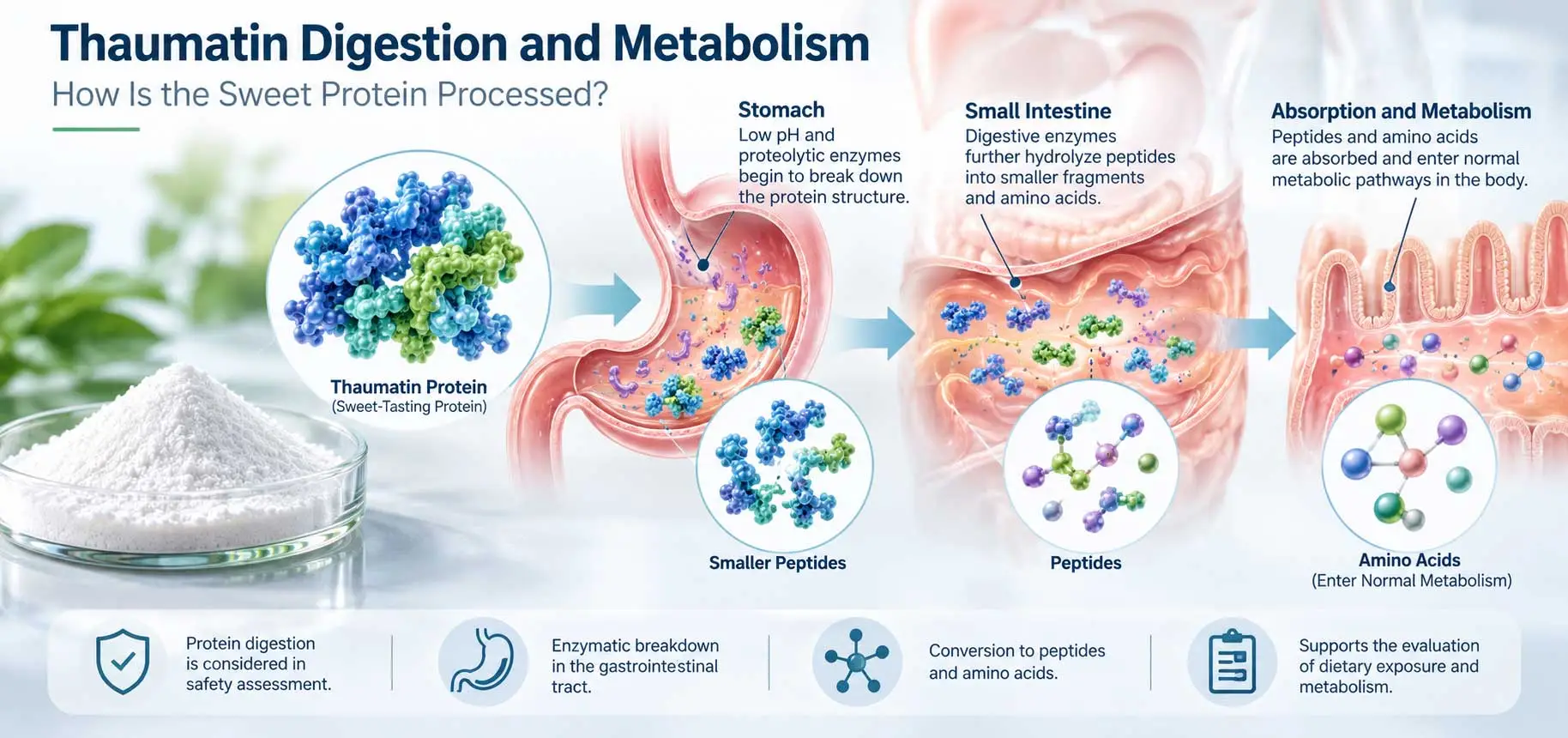
As a dietary protein, thaumatin is expected to undergo enzymatic breakdown within the gastrointestinal tract.
Proteolytic enzymes act on protein structures, producing peptides and amino acids that may undergo further digestion and absorption.
This general pathway is relevant to thaumatin metabolism and helps explain why protein digestibility is considered in safety evaluations.
However, digestion should not be described as instantaneous or complete under every possible condition without supporting evidence.
Protein stability, processing history, and the surrounding food matrix may influence digestion behavior.
For commercial ingredient assessment, the key question is whether the available digestion and toxicological evidence adequately characterizes the material intended for use.
Thaumatin Acceptable Daily Intake: What Does “ADI Not Specified” Mean?
The thaumatin acceptable daily intake is frequently misunderstood.
JECFA's designation of “ADI not specified” does not mean that the ingredient has an ADI of zero. Nor does it authorize unlimited addition to food products.
Rather, it indicates that, based on the available safety information and the evaluated conditions of use, establishing a numerical daily intake limit was considered unnecessary.
The term thaumatin ADI not specified must therefore be interpreted in the context of the underlying evaluation.
Food manufacturers remain responsible for complying with applicable food-category permissions, use levels, purity criteria, and other regulatory requirements.
A favorable ADI conclusion does not replace the need to verify whether a particular thaumatin material is legally suitable for a specific product and destination market.
Thaumatin FDA Status: Is Thaumatin Approved in the United States?
Understanding thaumatin FDA status requires distinguishing between food additive approval, Generally Recognized as Safe (GRAS) conclusions, and the regulatory treatment of flavoring ingredients.
The FDA has reviewed several GRAS notices involving thaumatin and has issued “no questions” response letters regarding the notifiers' safety conclusions for specified products and intended uses.
For example, GRAS Notice GRN 738 covers certain sweetening applications, including chewing gum, confectionery, ice cream, and selected beverages. Other notices address particular thaumatin II materials and their proposed uses.
However, an FDA “no questions” letter is not equivalent to a universal approval covering every product sold as thaumatin.
When investigating thaumatin GRAS status, food manufacturers should verify the relevant notice, production method, ingredient specifications, proposed application, and use level.
A manufacturer sourcing a biosynthetic material should not assume that a GRAS conclusion concerning a different production system automatically applies to its ingredient.
For US-market products, regulatory qualification must correspond to the actual commercial material and its intended conditions of use.
Thaumatin E957: What Is Its Safety and Regulatory Status in the EU?
Thaumatin E957 is recognized within the European Union's food additive regulatory framework. Its authorized applications and conditions of use are governed by EU food additive legislation.
The European safety assessment and the legal authorization of a particular commercial ingredient are related but distinct matters.
EFSA evaluates scientific safety evidence, while the applicable regulations establish which additives may be used, in which food categories, and under what conditions.
Under the conventional EU specification, thaumatin E957 is described as material obtained through acidic aqueous extraction of the fruit arils of Thaumatococcus daniellii.
This definition is particularly relevant to the thaumatin EU regulation requirements for products manufactured using alternative technologies.
A biosynthetic thaumatin product should not automatically be represented as complying with the conventional E957 specification merely because it contains a protein with the same amino acid sequence.
Before placing a product on the EU market, manufacturers should verify its regulatory identity, production route, applicable specifications, and permitted use.
Biosynthetic Thaumatin Safety: Does the Manufacturing Route Matter?
The development of biotechnology-based sweet proteins has introduced important questions concerning recombinant thaumatin safety and regulatory equivalence.
Although different manufacturing technologies may produce proteins with closely related or identical amino acid sequences, the complete commercial ingredient can differ in its impurity profile, production residues, and processing history.
These differences are relevant to product-specific safety assessment.
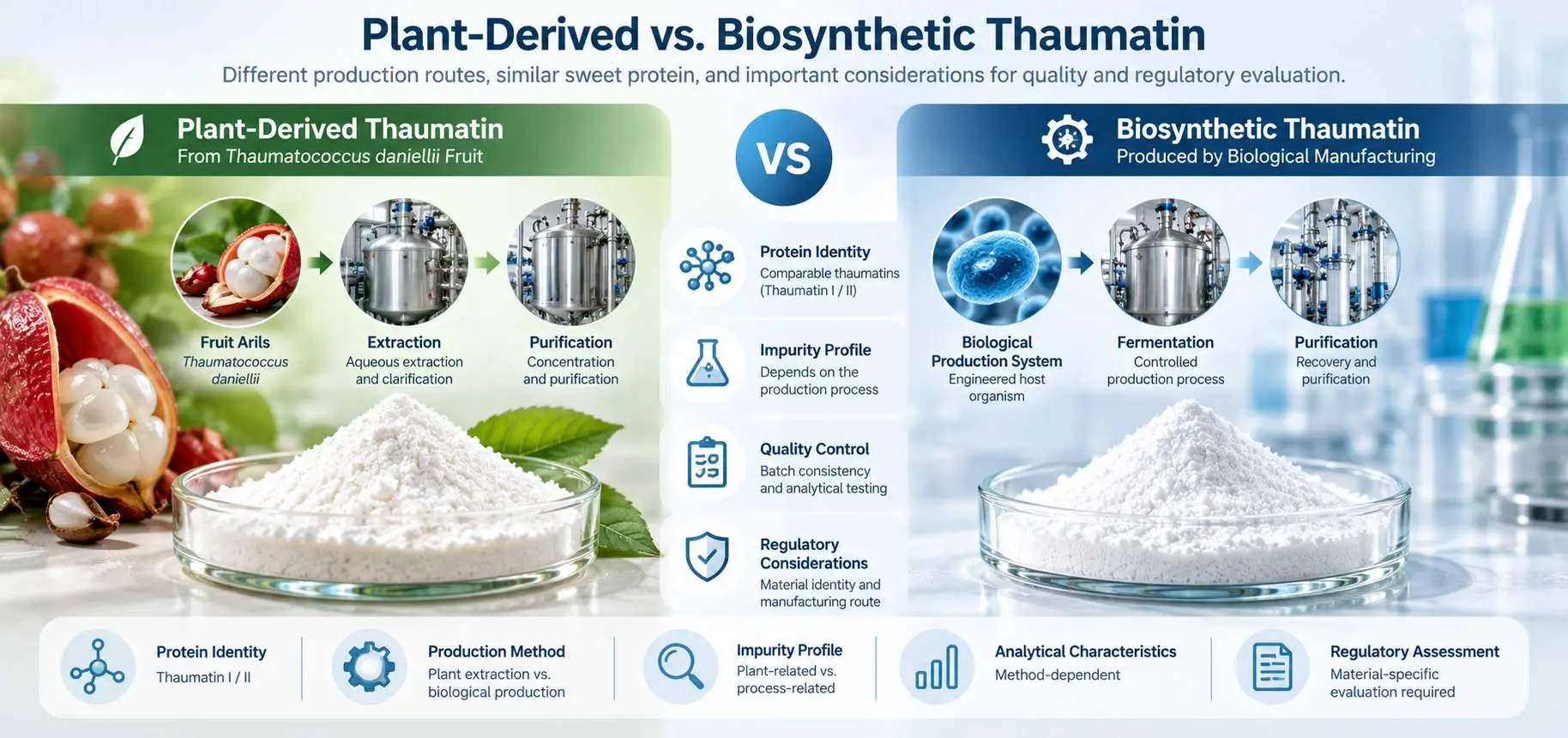
•Plant-Derived Thaumatin vs. Biosynthetic Thaumatin
Traditional commercial thaumatin is obtained from plant material through extraction and purification.
Biosynthetic production uses a biological manufacturing system to produce the target sweet protein, followed by recovery and purification.
The two approaches may produce comparable target proteins, but equivalence should be demonstrated through appropriate analytical characterization rather than assumed from the ingredient name.
•Host Organism, Protein Identity, and Process-Related Impurities
A biotechnology-derived ingredient may require evaluation of the production organism, genetic construct, expressed protein identity, and manufacturing controls.
Depending on the production system, relevant quality parameters may include residual host-cell proteins, residual DNA, processing aids, microbiological quality, and other process-related impurities.
The significance of each parameter depends on the actual production method and the characteristics of the finished ingredient.
•What Regulatory Evidence Is Needed for a Biosynthetic Product?
The biosynthetic thaumatin regulatory status must be evaluated against the requirements of each destination market.
In 2025, JECFA expanded its group ADI evaluation to include a specifically assessed recombinant thaumatin II produced in the seeds of Nicotiana tabacum. This scientific conclusion does not automatically cover unrelated biosynthetic production systems.
For commercial qualification, buyers should request a manufacturing-route declaration, product identity information, relevant safety documentation, and a regulatory statement addressing the intended application.
The objective is to establish that the safety and regulatory evidence applies to the ingredient being purchased, not merely to another material with a similar commercial description.
Food Grade Thaumatin: Which Specifications Matter for Safety?
The quality of food grade thaumatin should be evaluated using specifications appropriate to its identity, production method, and intended food application.
Relevant parameters may include protein identity, assay, microbiological quality, heavy metals, moisture, and manufacturing-related impurities.
Buyers should also understand what a reported thaumatin purity percentage actually measures.
For example, total protein content determined by a nitrogen-based method is not necessarily equivalent to the concentration of a particular thaumatin protein established using a selective analytical technique.
A declaration of 99% purity is therefore meaningful only when accompanied by a clearly defined analytical method and specification basis.
For regulated food applications, a high assay result does not independently establish compliance with all applicable additive specifications.
The complete quality profile, rather than a single purity figure, should form the basis of ingredient approval.
Thaumatin COA and TDS: What Should Ingredient Buyers Verify?
A current thaumatin COA should document the results for a specific manufacturing batch, with clearly identified test methods and acceptance criteria.
The thaumatin TDS should provide complementary information about the ingredient's technical characteristics, handling requirements, and relevant application considerations.
|
Document |
What Buyers Should Verify |
|
Certificate of Analysis |
Batch-specific results and analytical methods |
|
Technical Data Sheet |
Material identity, properties, and handling |
|
Product Specification |
Defined quality acceptance criteria |
|
Manufacturing Declaration |
Production route and relevant process information |
|
Regulatory Statement |
Destination-market and intended-use applicability |
|
Traceability Documentation |
Batch identification and change control |
Documentation should be consistent across the supplier's specification, commercial quotation, and delivered material.
Any discrepancy involving identity, production method, or analytical results should be resolved before commercial approval.
How Should Food Manufacturers Evaluate a Thaumatin Supplier?
Selecting a thaumatin supplier requires an assessment of both technical capability and documentation reliability.
A qualified supplier should be able to explain how the ingredient is manufactured, which quality parameters are controlled, and how consistency is maintained between batches.
Buyers should also review traceability, specification management, change notification procedures, and the availability of relevant regulatory information.
For international food manufacturers, one question is especially important:
Does the regulatory documentation describe the exact material being supplied?
A supplier's general manufacturing certifications cannot replace evidence that a particular ingredient is suitable for the intended food application and destination market.
This distinction becomes particularly important when sourcing ingredients produced through newer biotechnology platforms.
Thaumatin Manufacturing and Commercial Supply from CHEN LANG BIO TECH
As a thaumatin manufacturer, CHEN LANG BIO TECH combines more than 30 years of sweetener industry experience with research, manufacturing, and analytical quality control capabilities.
Our commercial thaumatin is produced through biosynthesis, supported by an annual production capacity of approximately 10 metric tons.
For food manufacturers evaluating this ingredient, we can provide available technical documentation and samples to support product qualification.
Our standard thaumatin MOQ is 1 kg, with packaging options including 1–5 kg aluminum foil bags and 25 kg paper drums.
Customers seeking bulk thaumatin powder can discuss commercial quantities, product specifications, packaging, and delivery requirements with our sales team.
We recognize that manufacturing capability alone does not establish regulatory approval. Customers should assess the suitability of the supplied material for their intended market before commercial use.
Frequently Asked Questions About Thaumatin Safety
Is Thaumatin Safe to Eat?
Evaluated thaumatin materials have not raised safety concerns under their assessed conditions of use. However, is thaumatin safe to eat must be considered in relation to the specific ingredient, intended application, and applicable regulations.
Is Thaumatin Harmful to Humans?
Available regulatory assessments have not identified a characteristic harmful-effect profile under evaluated exposure conditions. The question is thaumatin harmful cannot be answered with an unconditional guarantee covering every material or individual.
Does Thaumatin Have Side Effects?
No consistent adverse-effect pattern has been established for assessed food uses. However, the available evidence does not establish that individual reactions are impossible.
Can Thaumatin Cause Allergic Reactions?
Thaumatin is a protein, and potential allergenicity is relevant to safety assessment. Existing human evidence does not support a definitive conclusion excluding oral sensitization.
Is Thaumatin FDA Approved?
The FDA has issued no-questions letters for certain thaumatin GRAS notices. These responses concern specified materials and uses rather than granting universal authorization to every commercial thaumatin product.
Is Biosynthetic Thaumatin the Same as E957?
Not necessarily for regulatory purposes. A biosynthetic product may contain a comparable target protein, but compliance with E957 specifications depends on the applicable legal definition and manufacturing requirements.
Request Thaumatin Safety Documentation and Samples
If you are evaluating thaumatin for food or beverage manufacturing, our team can assist with product specifications, available quality documentation, and sample arrangements.
Please provide your intended application, destination market, required quality parameters, and estimated purchasing quantity. We can then discuss the appropriate material for technical evaluation, including thaumatin sample availability and a quotation based on your project requirements.
For customers comparing thaumatin price options, we recommend reviewing analytical specifications and regulatory suitability alongside commercial terms before making a purchasing decision.
CHEN LANG BIO TECH Email: admin@chenlangbio.com
References
1. EFSA Panel on Food Additives and Flavourings (FAF). (2021). Re-evaluation of thaumatin (E 957) as food additive. EFSA Journal, 19(11), 6884. DOI: 10.2903/j.efsa.2021.6884.
2. Joint FAO/WHO Expert Committee on Food Additives (JECFA). (1985). Evaluation of Thaumatin. Twenty-ninth Meeting. WHO Technical Report Series 733.
3. Joint FAO/WHO Expert Committee on Food Additives (JECFA). (2025). Evaluation of Thaumatin and Thaumatin II. One Hundredth Meeting. WHO/FAO.
4. U.S. Food and Drug Administration. Aspartame and Other Sweeteners in Food. Section on Thaumatin.
5. U.S. Food and Drug Administration. GRAS Notice Inventory. GRN 738: Thaumatin; GRN 910 and GRN 920: Thaumatin II.
6. European Parliament and Council. (2008). Regulation (EC) No 1333/2008 on Food Additives.
7. European Commission. (2012). Commission Regulation (EU) No 231/2012 Laying Down Specifications for Food Additives, including Thaumatin (E957).

Send Inquiry
Related Industry Knowledge
- Is Hydroxyphenyl Propamidobenzoic Acid Suitable For All Skin Types
- What Is Nitenpyram Powder? Uses, Benefits and Applications
- Is PQQ Safe for Daily Use in Supplement Formulations?
- Best Nootropic Ingredients for Focus Supplement Formulation (Including L-Theanine) – Bulk Supplier & OEM Manufacturer Guide China 2026
- Ergothioneine vs Alpha Lipoic Acid: Which Antioxidant Delivers Better Value for Supplement Formulators?
- The Role of Zeaxanthin Powder in Cognitive Health Support
- Can Women Use Turkesterone?
- The Science Behind Isobutylamido Thiazolyl Resorcinol in Skin Care
- What Is Lufenuron Used For
- What Pure Nature Raspberry Ketone Good For