
How to Use Zeaxanthin Powder in Dietary Supplement Formulations?
2026-09-07 16:53:49
How to use zeaxanthin powder correctly in a dietary supplement depends on three variables that should be established before formulation begins: the active zeaxanthin assay, the physical delivery system of the ingredient, and the finished dosage form. A 5% microencapsulated powder, for example, cannot be substituted gram-for-gram for a 20% conventional grade simply because both are sold as zeaxanthin powder.
This distinction matters because zeaxanthin is inherently lipophilic. PubChem reports a molecular formula of C₄₀H₅₆O₂, molecular weight of 568.9 g/mol and calculated XLogP of 10.9, which helps explain why native zeaxanthin is poorly suited to direct dispersion in water.
A practical zeaxanthin powder formulation therefore starts with the commercial ingredient rather than the active molecule in isolation. Formulators need to know how much active material the powder delivers, what carrier or encapsulation system is present, how the powder behaves during processing, and whether its stability has been demonstrated under conditions relevant to the finished product.
Zeaxanthin Powder Formulation Starts with the Ingredient Grade
The term zeaxanthin powder for supplements does not describe one universally interchangeable raw material. Two powders carrying the same ingredient name may have very different active concentrations, carrier systems, particle characteristics and processing behavior.
A conventional concentrated powder may be appropriate for a dry capsule or tablet project where higher active loading is desirable. A microencapsulated zeaxanthin powder, by contrast, incorporates the carotenoid into a carrier or wall system. This can improve powder handling and protect carotenoids from environmental stress while also making certain grades easier to disperse in aqueous matrices.
That distinction is supported by carotenoid research more broadly. Reviews of carotenoid encapsulation identify poor water solubility and sensitivity to oxygen, light and heat as major formulation limitations and describe encapsulation as one strategy for improving their technological performance.
Consequently, a zeaxanthin ingredient specification should be reviewed before formulation work begins. The R&D team needs the active assay, physical form and relevant carrier information rather than relying only on a product name such as “zeaxanthin powder.”
At CHEN LANG BIO TECH, we treat grade selection as part of formulation qualification. A customer developing a capsule and another developing an instant powder beverage may both require zeaxanthin, but they do not necessarily require the same delivery system.
How Much Zeaxanthin Powder Should Be Added to a Formulation?
A common formulation mistake is confusing the required amount of active zeaxanthin with the weight of the commercial ingredient.
The basic zeaxanthin formulation calculation is:
Ingredient required = Target active zeaxanthin ÷ Ingredient assay
Consider a hypothetical formulation designed to contain 10 mg of active zeaxanthin per finished unit. If the raw material is standardized to 5% zeaxanthin:
10 mg ÷ 0.05 = 200 mg of ingredient
If the same formula instead uses a 20% material:
10 mg ÷ 0.20 = 50 mg of ingredient
These figures demonstrate zeaxanthin assay calculation only. They are not intake recommendations.
The distinction becomes particularly important during supplier changes. Replacing a 5% grade with a 10% material without recalculating the formula changes both active delivery and the amount of carrier entering the finished product.
Commercial formulation may require additional considerations beyond the theoretical calculation. The batch COA should be checked against the specification, while any proposed overage should be justified through manufacturing and stability data rather than applied as an arbitrary percentage. Label declarations and applicable regulations in the target market also need to be considered separately.
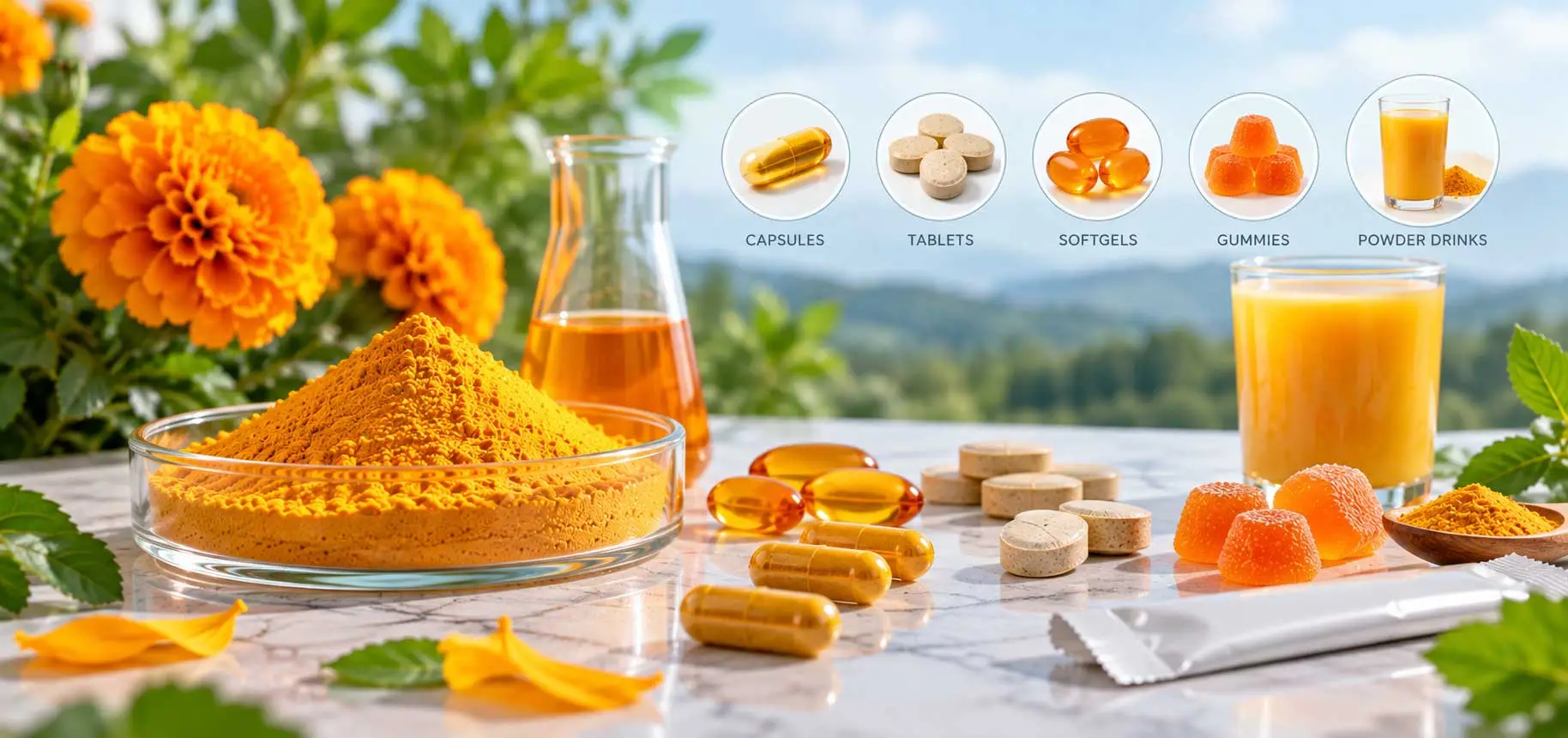
Why Zeaxanthin Assay Matters More Than Powder Weight
The simplest way to understand zeaxanthin active content is that 10 mg of zeaxanthin powder is not necessarily 10 mg of zeaxanthin.
The following table illustrates how zeaxanthin powder concentration changes the required ingredient weight:
|
Zeaxanthin assay |
Ingredient required to provide 10 mg active* |
|
5% |
200 mg |
|
10% |
100 mg |
|
20% |
50 mg |
Formulation calculation example only; not a recommended intake level.
This matters beyond arithmetic. Moving from 20% to 5% active content quadruples the raw-material mass required in this example. In a capsule, that affects fill space. In a tablet, it changes the proportion of the formula occupied by the carotenoid ingredient and its carrier. In a powder blend, it can alter bulk density and blending behavior.
A zeaxanthin standardized powder should therefore be evaluated according to both assay and its effect on the complete formulation.
Conventional vs CWS Zeaxanthin Powder: Which Form Is Better for Your Formula?
Neither conventional powder nor CWS zeaxanthin powder is universally better. The appropriate choice depends on what the formulation needs the ingredient to do.
|
Formulation requirement |
Conventional grade |
CWS / microencapsulated grade |
|
Dry capsule |
Often suitable |
Suitable |
|
Tablet |
Depends on powder properties |
Can be suitable |
|
Aqueous dispersion |
Generally challenging |
Usually more appropriate |
|
Solid drink |
Limited dispersibility |
Often preferred |
|
Oil-based system |
Grade dependent |
CWS technology may be unnecessary |
|
Active loading |
Potentially higher |
Carrier reduces active percentage |
CWS is commonly used commercially to describe a cold-water-dispersible form. Calling such a material water dispersible zeaxanthin powder is often more technically accurate than implying that the zeaxanthin molecule itself has become freely water soluble.
The distinction is important. Microencapsulation modifies the delivery system surrounding the carotenoid; it does not change the molecular identity of zeaxanthin.
For R&D teams, the decision should therefore begin with the finished matrix. A dry high-loading capsule may favor one grade, whereas a reconstituted powder beverage may justify the additional functionality provided by a dispersible system.
How to Use Zeaxanthin Powder in Capsules
For zeaxanthin powder for capsules, the central formulation problem is often not dissolution but content uniformity.
A relatively small amount of active ingredient can be difficult to distribute evenly through a much larger excipient blend. Differences in particle size, density and flow can encourage segregation during mixing, transfer and filling. The situation becomes more complex when a low-assay zeaxanthin preparation contributes a substantial amount of carrier to the formula.
A zeaxanthin capsule formulation should therefore consider the raw material's particle characteristics and bulk behavior alongside assay. Appropriate premixing or geometric dilution may help distribute a low-level component before it enters the main blend, but the actual process should be validated on the manufacturer's equipment.
This is also why a representative sample is more useful than evaluating a specification alone. Flow, color distribution and blend behavior can be observed during laboratory and pilot trials before a commercial lot is committed.
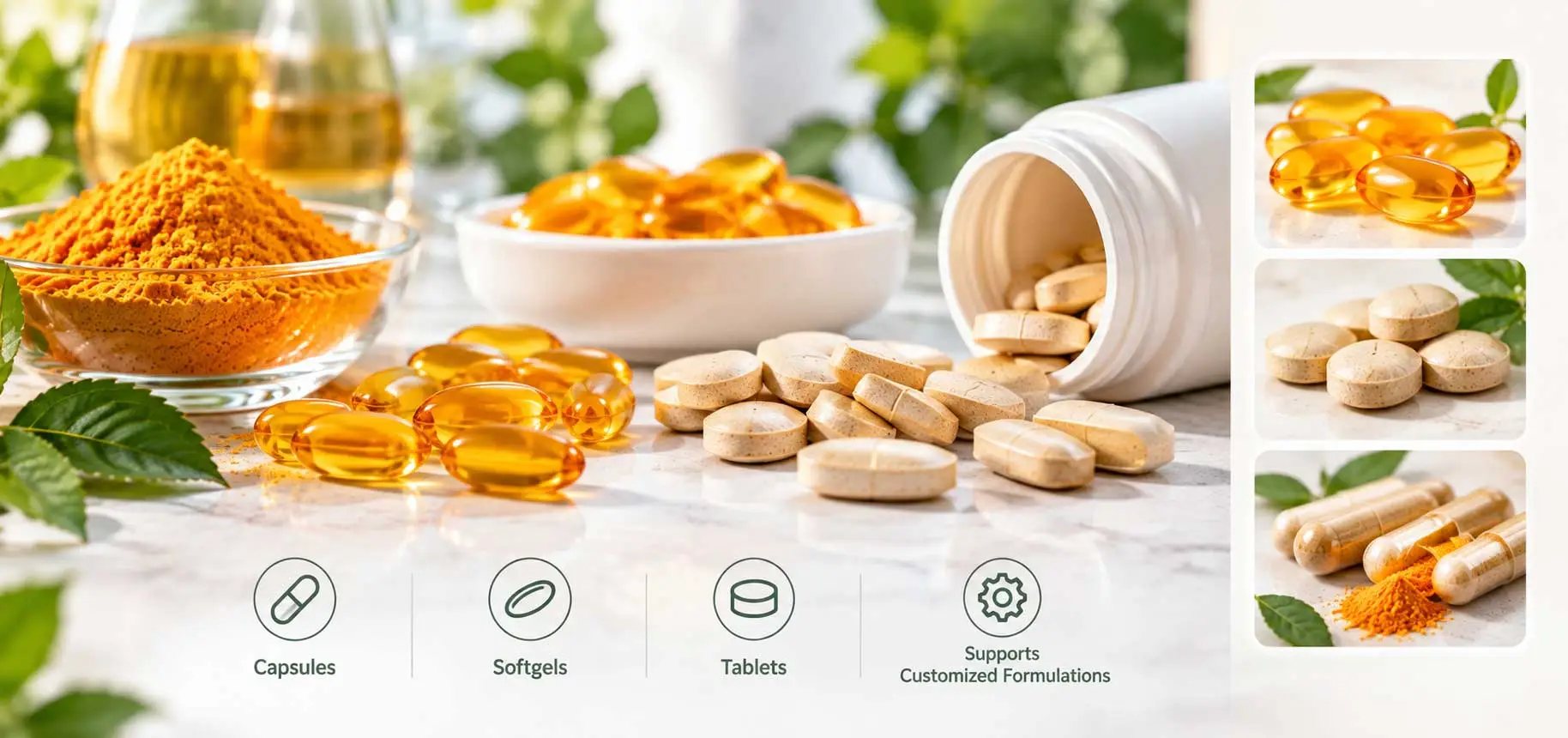
How to Formulate Zeaxanthin Powder into Tablets
Zeaxanthin powder for tablets introduces additional processing stresses because the ingredient must remain sufficiently uniform and stable through blending and compression and, depending on the process, granulation.
Direct-compression systems place particular emphasis on powder flow, particle compatibility and content uniformity. Wet granulation introduces moisture and a subsequent drying stage, making processing exposure relevant for a carotenoid ingredient.
Carotenoids contain an extended conjugated structure that is susceptible to environmental degradation and isomerization. Reviews consistently identify heat, light and oxygen among the important degradation drivers.
For this reason, a zeaxanthin tablet formulation should not adopt a universal processing-temperature limit from an unrelated product. The better approach is to compare supplier stability information with the intended process and confirm performance in a pilot batch.
Zeaxanthin for Softgels: When an Oil-Compatible Form Makes More Sense
Zeaxanthin for softgels follows different formulation logic from a water-dispersible powder.
The calculated XLogP of zeaxanthin is 10.9, consistent with its strongly lipophilic character. An oil-compatible preparation can therefore make sense when the finished dosage form itself is oil based.
Formulators should examine carrier-oil compatibility, suspension or dispersion stability, sedimentation and active uniformity throughout filling. Oxidative stability also matters because both the carotenoid and the lipid phase can be affected by the surrounding environment.
A CWS system should not be selected simply because it uses more elaborate delivery technology. In a zeaxanthin softgel formulation, an oil-compatible grade may provide a more logical route when it matches the manufacturing process and required active concentration.
The best delivery system is the one designed for the finished dosage form.
How to Use Zeaxanthin in Gummies Without Losing Formulation Control
Zeaxanthin for gummies presents a different combination of challenges: an aqueous processing environment, heat exposure, matrix pH, color distribution and finished-product uniformity.
A microencapsulated zeaxanthin for gummies may offer useful formulation advantages where the delivery system improves dispersion or protects the carotenoid, but its suitability should still be demonstrated in the actual gummy matrix.
Processing conditions vary significantly between manufacturing systems. For that reason, prescribing a universal maximum temperature for every zeaxanthin gummy formulation would be misleading. Exposure time matters as well as peak temperature, and the behavior of a purified carotenoid cannot automatically predict the stability of a commercial encapsulated powder.
The more defensible development route is to measure the active before and after pilot processing, then evaluate stability in the finished gummy under the intended packaging and storage conditions.
Using Zeaxanthin Powder in Powder Blends and Solid Drinks
Dry systems appear simple until the consumer adds water.
For zeaxanthin powder for solid drinks, conventional carotenoid powder may wet poorly, float at the surface, agglomerate or settle after reconstitution. These effects should not automatically be described as a solubility failure because dissolution and dispersion are different physical phenomena.
A cold water dispersible zeaxanthin grade uses formulation technology to improve interaction with the aqueous phase. The carotenoid remains lipophilic, but the engineered powder can wet and distribute more effectively than an untreated conventional material.
Dry blending still requires attention to segregation. A zeaxanthin ingredient with very different particle size or bulk density from the rest of the premix can redistribute during conveying or packaging.
For a zeaxanthin powder for powder blends, R&D should therefore evaluate both dry-blend uniformity and, when relevant, reconstitution behavior.
Zeaxanthin Powder Dispersibility: Why the Carrier System Matters
Zeaxanthin powder dispersibility cannot be predicted from assay alone.
A 5% microencapsulated product contains much more than the active carotenoid. Its wall or carrier system contributes to wetting, physical protection, powder handling and dispersion behavior. Particle engineering can further influence how quickly the material enters an aqueous phase and whether visible agglomerates or sediment appear.
This is one reason two powders with identical active assays can perform differently in the same formula.
Research on carotenoid encapsulation also shows that performance depends strongly on the encapsulation technique and wall system rather than simply on the presence of a carrier.
For procurement teams, this means a zeaxanthin carrier system should be treated as part of the ingredient specification. When aqueous performance matters, a small formulation trial provides much more useful information than comparing two COAs solely by active percentage.
How to Protect Zeaxanthin Stability During Supplement Manufacturing
Zeaxanthin formulation stability should be considered during processing, not only during warehouse storage.
The carotenoid's conjugated polyene structure makes it vulnerable to oxidation and isomerization. Reviews identify light, heat, oxygen, metals and free radicals among the factors capable of accelerating carotenoid change. Another review describes carotenoid degradation through oxidation, isomerization and other reactions and notes experimental work in which zeaxanthin degradation under defined light/iodine conditions followed first-order kinetics.
These observations do not provide a universal shelf life for commercial zeaxanthin powder. They explain why process design matters.
A sealed foil package and an open blending vessel represent very different environments. During manufacturing, the ingredient may encounter room lighting, headspace oxygen, heat, moisture and prolonged hold times.
For this reason, zeaxanthin stability during processing should be verified under representative manufacturing conditions. For storage, our zeaxanthin powder is supplied in sealed, light-protective packaging, with 1–5 kg aluminum foil bags and 25 kg fiber drums available for commercial quantities.
Does Zeaxanthin Powder Interact with Other Supplement Ingredients?
Zeaxanthin compatibility should be evaluated within the complete matrix rather than through a generic list of “compatible” and “incompatible” ingredients.
Important variables include pH, water activity, oxidative environment, oils, mineral components, other carotenoids and the physical properties of the excipient system. The relevance of each factor depends on the dosage form.
Lutein and zeaxanthin, for example, are frequently considered together in carotenoid formulations. Their chemical relationship does not eliminate the need to confirm the individual assay and physical behavior of each commercial ingredient.
An effective lutein and zeaxanthin formulation therefore begins with clearly defined raw-material specifications and then evaluates the combined system during pilot processing and stability work.
Where compatibility data are unavailable, empirical testing is preferable to assuming that a combination is stable because the ingredients have previously appeared together in other products.
Why Pilot Testing Matters Before Commercial Production
A zeaxanthin pilot formulation connects the specification on paper with what actually happens on manufacturing equipment.
At laboratory scale, formulators can assess color distribution, wetting, dispersion and compatibility with the selected excipients. Pilot production then reveals issues that may not appear in a small beaker or bench-top blend, including segregation during transfer, changes in mixing efficiency and longer exposure to environmental conditions.
Finished-product assay is particularly valuable because it provides evidence of whether the active survives the process at the expected level.
Requesting a representative zeaxanthin powder sample before approving a commercial grade therefore has a practical purpose. The sample can be evaluated against the intended process while the corresponding specification and documentation are reviewed in parallel.
A logical qualification path is laboratory evaluation, pilot production and then commercial-scale approval—not selecting a grade solely from its quoted assay.
What Should a Zeaxanthin COA Confirm Before Formulation?
A zeaxanthin COA should establish what was measured in the supplied batch. At minimum, the formulation team should confirm product identity and assay and review relevant physical, microbiological and contaminant parameters against the agreed specification.
For a CWS product, the assay basis is particularly important because most of the powder mass may consist of the delivery system rather than active zeaxanthin.
Zeaxanthin HPLC assay provides quantitative information about the carotenoid, while the wider specification addresses whether the complete ingredient meets the agreed quality requirements.
At CHEN LANG BIO TECH, batch quality control is supported by analytical instrumentation including HPLC and a traceable quality-management process. For formulation customers, COA and specification review can be combined with sample evaluation before commercial approval.
A useful distinction for purchasing teams is:
A COA confirms what is in the batch; it does not by itself prove that the grade will perform correctly in your formulation.
Performance still needs to be tested in the intended matrix.
How to Select a Zeaxanthin Powder Supplier for Formulation Projects
A zeaxanthin powder supplier should be able to support the transition from a specification sheet to an actual formulation.
For an R&D project, that means providing a representative sample together with batch documentation and sufficient technical information to understand the grade. When stability or dispersion is critical, relevant technical data should be discussed before scale-up rather than after a formulation problem occurs.
Our zeaxanthin supply chain begins upstream. CHEN LANG BIO TECH works with a marigold raw-material network covering more than 200,000 mu across Yunnan, India and Zambia, supported by production and analytical quality control. This provides a practical foundation for traceability and commercial supply rather than relying only on spot-market finished material.
The supplier qualification decision should ultimately combine raw-material identity, batch consistency, documentation, formulation suitability and supply continuity.
Scaling a Zeaxanthin Formula from Laboratory to Commercial Production
A formula that performs well in a 1 kg development batch still needs verification before bulk zeaxanthin powder enters full-scale production.
Larger equipment changes mixing dynamics. Ingredient addition sequence, blender loading, mixing time, transfer steps and hold periods can all influence uniformity. Environmental exposure can also increase simply because a commercial process takes longer.
Scale-up should therefore preserve the formulation's active ratio while confirming that the manufacturing process produces representative samples across the batch.
Supply planning becomes important at the same stage. Commercial buyers need consistent specifications across lots and packaging appropriate for production volumes. For our zeaxanthin products, smaller quantities can be packed in 1–5 kg aluminum foil bags, while 25 kg fiber drums support larger requirements.
The objective is not merely to purchase more raw material; it is to reproduce the approved pilot formulation reliably at commercial scale.
Zeaxanthin Powder Price Should Be Evaluated by Cost-in-Use
Zeaxanthin powder price per kilogram is useful only when the grades being compared are technically equivalent.
A simple active-cost comparison can begin with:
Ingredient cost per unit of active = Ingredient price ÷ Active fraction
A 5% grade requires four times the ingredient weight of a 20% grade to deliver the same theoretical active amount. That does not automatically make the 20% grade the better choice: the lower-assay product may contain a delivery system that provides dispersion or processing functionality needed by the formulation.
Cost-in-use should therefore consider active loading together with processing performance, losses, rework risk and finished-product suitability.
From Sample Approval to Commercial Zeaxanthin Orders
Commercial ordering should follow technical approval rather than precede it.
After the selected grade passes laboratory evaluation, the formulation can move to pilot production and specification confirmation. Only then does zeaxanthin MOQ become a useful commercial question, because the required grade and projected manufacturing volume are known.
This sequence also reduces the risk of purchasing a large quantity of material that meets an assay specification but performs poorly in the intended dosage form.
Frequently Asked Questions About Zeaxanthin Powder Formulation
How do you use zeaxanthin powder in supplements?
How to use zeaxanthin powder depends on its assay and delivery form. Calculate the required ingredient weight from the active concentration, then select a grade compatible with the finished dosage form. Capsules, softgels and aqueous powder systems can require very different physical forms even when the target active is identical.
How do I calculate the amount of zeaxanthin powder needed?
For a zeaxanthin powder dosage calculation, divide the target amount of active zeaxanthin by the ingredient's assay expressed as a decimal. For example, 10 mg ÷ 0.05 requires 200 mg of a 5% ingredient. This illustrates formulation mathematics only and is not a recommended intake.
Can zeaxanthin powder be added directly to water?
Conventional zeaxanthin is highly lipophilic; PubChem reports a calculated XLogP of 10.9. It therefore should not be expected to behave like a freely water-soluble ingredient. A CWS or microencapsulated grade can provide improved water dispersibility when an aqueous system is required.
Which zeaxanthin powder is better for capsules?
Zeaxanthin powder for capsules should be selected according to active loading, particle characteristics, bulk behavior and blend uniformity. A high-assay conventional grade may reduce fill weight, while an encapsulated grade may offer different handling or stability characteristics. Pilot blending should confirm the choice.
Can microencapsulated zeaxanthin be used in gummies?
Yes, a microencapsulated grade can be considered for gummy development, but suitability depends on the specific carrier system and process. Heat exposure, matrix pH, dispersion and finished-product stability should be evaluated under actual manufacturing conditions rather than assumed from the ingredient name.
What should I check before I buy zeaxanthin powder?
Before you buy zeaxanthin powder for formulation work, confirm the active assay, delivery form, specification, analytical documentation and compatibility with the intended dosage form. A representative sample should ideally be evaluated before a commercial grade is approved.
Can I request a zeaxanthin powder sample for formulation testing?
Yes. A zeaxanthin powder sample is useful for evaluating blend behavior, dispersion, color distribution and processing compatibility before scale-up. The sample should correspond as closely as possible to the commercial grade and specification that would be supplied after approval.
Zeaxanthin Powder Formulation Support from CHEN LANG BIO TECH
As a zeaxanthin manufacturer, CHEN LANG BIO TECH supports formulation projects from raw-material selection and sample evaluation through specification review, HPLC quality control and commercial supply. Conventional and CWS microencapsulated forms can be discussed according to the finished-product matrix rather than selecting a grade solely by assay.
For formulation samples, technical specifications or project quotations, contact admin@chenlangbio.com.
References
1. PubChem. Zeaxanthin, CID 5280899. National Center for Biotechnology Information. Molecular formula C₄₀H₅₆O₂, molecular weight 568.9 g/mol and calculated XLogP3-AA 10.9.
2. Saini RK, et al. Chemistry, Occurrence, Properties, Applications, and Encapsulation of Carotenoids—A Review. Plants. 2023;12. Reviews carotenoid sensitivity to light, heat, oxygen and other environmental factors and the role of encapsulation in improving technological performance.
3. Carotenoids: Dietary Sources, Extraction, Encapsulation, Bioavailability, and Health Benefits—A Review of Recent Advancements. Antioxidants. 2022;11. Discusses carotenoid oxidation, isomerization, thermal and light sensitivity, extraction and encapsulation technologies.

Send Inquiry
Related Industry Knowledge
- Is Broccoli Extract Powder Good for Detoxification?
- Is Acetyl Hexapeptide-8 Safe for Skin?
- Can Acetyl Hexapeptide-8 be Used with Other Anti-aging Ingredients?
- How to Make Phellinus Linteus Tea?
- What is Potassium Methoxysalicylate?
- Soapnut Extract Powder: Benefits and Uses
- How to Mix Monobenzone Powder
- Why May Ectoin be the New Niacinamide
- What Is The Best Way To Take Fisetin?
- What is Cyanotis Arachnoidea Extract