
Zeaxanthin Stability: Effects of Light, Heat, Oxygen and Storage
2026-09-04 16:47:50
Zeaxanthin stability depends on more than the assay value shown on a fresh batch COA. Zeaxanthin is a xanthophyll carotenoid with an extended conjugated polyene system, and that same structure that gives the molecule its characteristic color also makes it sensitive to light, elevated temperature, oxygen and the surrounding formulation environment. Under unfavorable conditions, the material can undergo isomerization, oxidative degradation and measurable loss of carotenoid content. For ingredient buyers, this means stability has to be considered across the whole commercial chain—from processing and packaging to transport, warehousing and storage after opening.
Published data support this concern. In freeze-dried sweet corn stored for 12 weeks, degradation accelerated under higher temperature, light exposure and ordinary rather than vacuum packaging. The lowest degradation rate was observed under vacuum packaging at 4 °C in the dark, while the highest occurred in ordinary packaging at 37 °C under light.
The practical conclusion is straightforward: a zeaxanthin ingredient should be evaluated as a product system, not as an isolated molecule. Its physical form, carrier matrix, packaging, storage conditions and stability evidence all influence whether the material remains within specification over its declared shelf life.
Why Is Zeaxanthin Chemically Sensitive to Light, Heat and Oxygen?
Zeaxanthin chemical stability is closely linked to the molecule's conjugated double-bond structure. Carotenoids contain alternating single and double bonds that form a delocalized π-electron system. This structure determines their light-absorbing properties, but it also makes them susceptible to structural changes under environmental stress. Reviews of carotenoid chemistry describe sensitivity to light, high temperature, oxygen, metals and free radicals, with possible formation of epoxide products and shorter-chain degradation products.
Two degradation pathways should be distinguished. Zeaxanthin isomerization involves rearrangement around double bonds, such as conversion from an all-trans configuration toward cis forms. Oxidation is different: oxygen attacks the unsaturated structure and can initiate further chemical breakdown.
These reactions may occur together rather than independently. A carotenoid exposed to light in the presence of oxygen can undergo photo-oxidative reactions, while heating can accelerate both isomerization and oxidative degradation.
For procurement teams, this matters because a loss in product quality does not necessarily begin with complete destruction of the molecule. Changes in isomer distribution can occur before or alongside broader zeaxanthin degradation. A stability program therefore needs an analytical method capable of detecting more than obvious color change.
How Does Light Affect Zeaxanthin Stability?
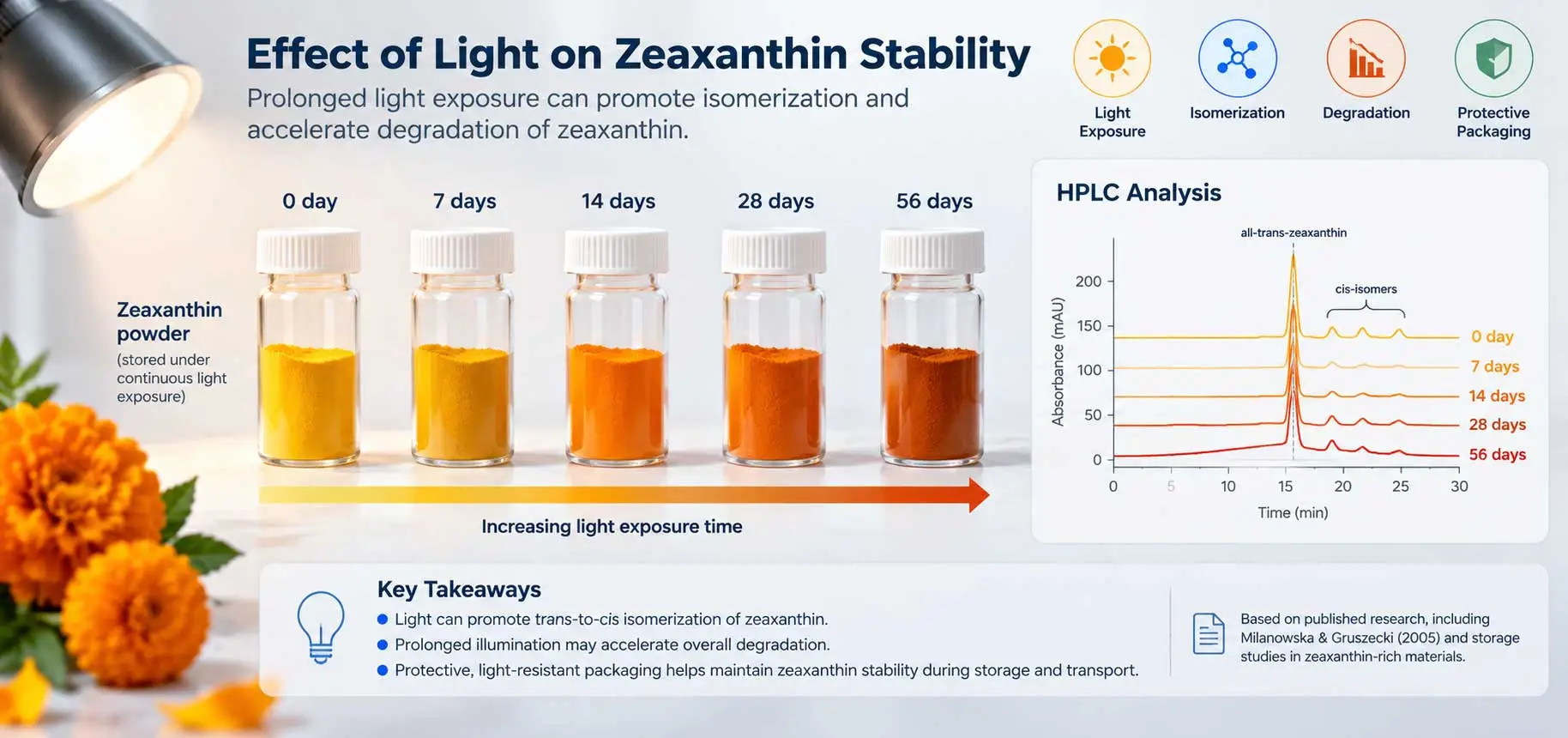
Zeaxanthin light stability is an important consideration because zeaxanthin absorbs strongly in the visible region and can undergo photochemical changes under prolonged illumination.
Milanowska and Gruszecki investigated the light-induced and heat-induced isomerization of all-trans zeaxanthin using HPLC. Their work confirmed that illumination can promote stereochemical changes in zeaxanthin and that the molecule does not remain chemically static under light exposure.
Storage research provides a more application-oriented picture. Freeze-dried sweet corn was held under dark and light conditions at 4, 20 and 37 °C for 12 weeks. Light accelerated deterioration, and under the same temperature conditions, trans-to-cis conversion occurred more readily in illuminated samples than in dark-stored samples.
This does not mean that brief exposure to normal laboratory lighting automatically ruins a commercial powder. The relevant risk depends on exposure duration, product form, packaging barrier and temperature.
For zeaxanthin light degradation, the more realistic commercial concerns are prolonged exposure through transparent packaging, repeated sampling under bright light, extended warehouse illumination and storage of opened containers near direct sunlight. This is why packaging that limits light transmission can be part of the stability strategy rather than simply a cosmetic packaging choice.
What Happens to Zeaxanthin When It Is Exposed to Heat?
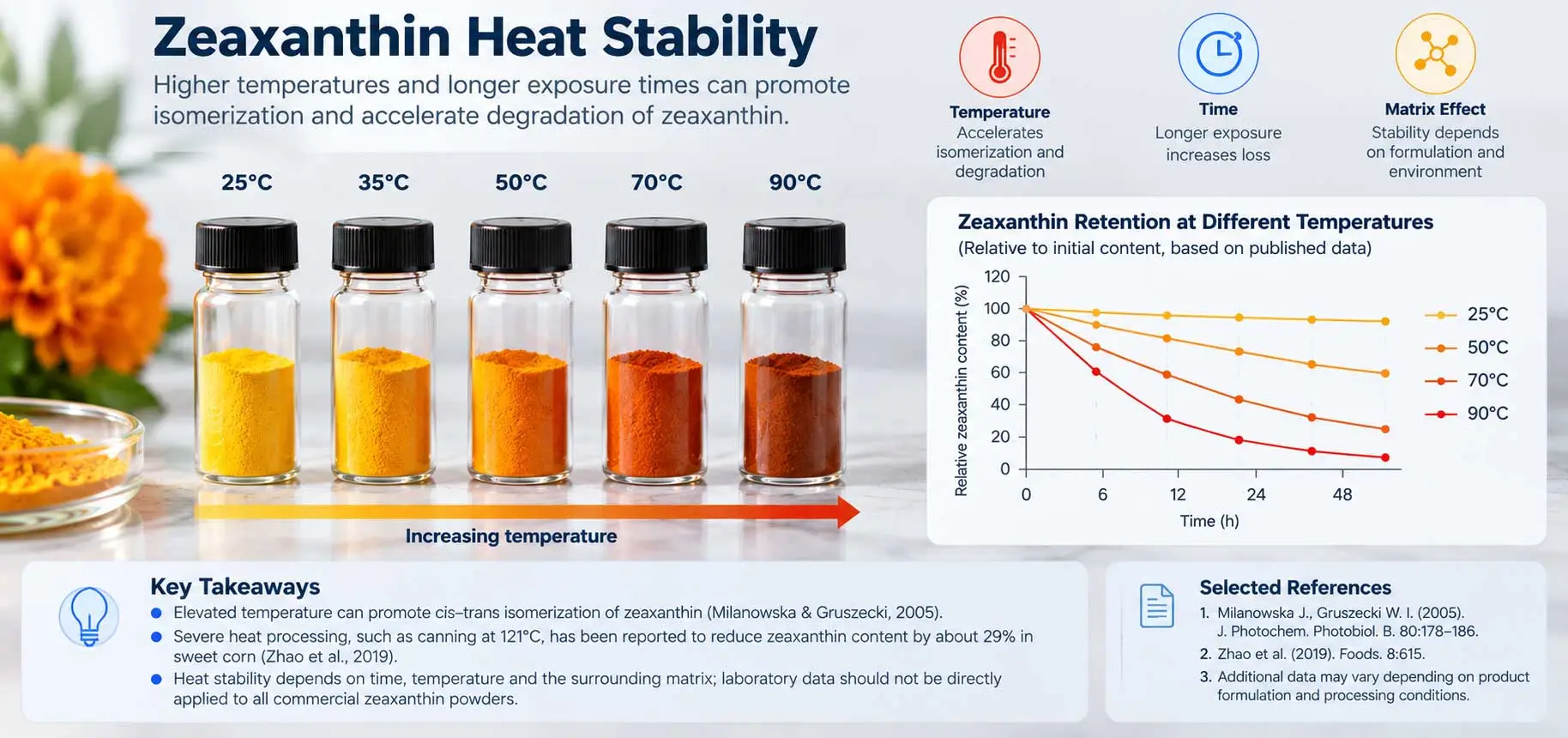
Zeaxanthin heat stability is better understood as a time-temperature relationship than as a single safe or unsafe temperature.
The controlled study by Milanowska and Gruszecki evaluated heat-induced zeaxanthin isomerization over 35–95 °C. Their HPLC data showed temperature-dependent changes in stereochemical composition, demonstrating that higher thermal exposure can increase isomerization.
Other food-processing data illustrate how severe processing can affect zeaxanthin content. A review of zeaxanthin reports that canning sweet corn at 121 °C was associated with a 29% decrease in zeaxanthin content in the cited study.
However, neither of these figures should be converted into a universal storage limit for commercial powder. The first study involved zeaxanthin in an organic-solvent system, while the second involved a food matrix under canning conditions. A stabilized powder, an oil dispersion and a microencapsulated ingredient may behave differently.
That distinction is important when evaluating zeaxanthin thermal stability. Drying, formulation processing, long-term warehouse storage and short transportation excursions are not equivalent forms of heat exposure. Their duration, oxygen availability and surrounding matrix differ substantially.
A technical specification should therefore avoid simplistic claims such as “stable below X °C” unless that temperature is supported by product-specific stability data. Recommended zeaxanthin storage temperature should come from the actual grade's documentation, not from a laboratory degradation paper.
Why Is Oxygen a Major Factor in Zeaxanthin Degradation?
Zeaxanthin oxidation is another central stability mechanism. The molecule's highly unsaturated polyene chain is vulnerable to oxidative attack, particularly when oxygen exposure is combined with light or thermal stress.
Carotenoid reviews describe auto-oxidation as a radical-driven process occurring in the presence of oxygen and photo-oxidation as degradation promoted by oxygen and light together. Oxidation can lead to epoxides, apocarotenoids and other breakdown products.
A zeaxanthin-containing microcapsule study also noted that carotenoids are prone to degradation under thermal stress, especially when oxygen is present. The authors described oxygen attack on the ring or polyene chain as an initiating route toward oxidation products.
For commercial powder, zeaxanthin oxidative stability is influenced by how much air reaches the active material during storage. Headspace oxygen, repeated opening, poorly sealed liners and packaging with low oxygen-barrier performance can all increase exposure.
This is why oxygen and heat should not be treated as separate checklist items. A warm but well-protected formulation may behave differently from the same material exposed to both elevated temperature and repeated air exchange.
Does Moisture Affect Zeaxanthin Powder Stability?
Zeaxanthin powder moisture deserves attention for a slightly different reason. Moisture is not always the dominant direct chemical degradation pathway for the carotenoid itself, but it can strongly influence the physical condition of commercial powders and the carrier matrices used in formulated grades.
This is particularly relevant for microencapsulated systems based on modified starches, proteins or other hydrophilic wall materials. Higher environmental humidity may alter powder flow, increase caking or affect the physical state of the encapsulation matrix.
In one study comparing several zeaxanthin-containing microcapsules, water activity values ranged approximately from 0.229 to 0.280, depending on drying technique and wall material. The researchers also reported differences between whey-protein and OSA-modified-starch systems, illustrating that moisture-related properties depend strongly on the encapsulation matrix rather than on zeaxanthin alone.
For zeaxanthin moisture stability, therefore, a dry and well-sealed environment supports both chemical and physical quality, especially in formulated powders.
Does Zeaxanthin Form Affect Its Stability?
Zeaxanthin powder stability cannot be generalized across all commercial grades. A concentrated carotenoid material, a standardized conventional powder, an oil-compatible preparation and a microencapsulated CWS product place zeaxanthin in different physical environments.
A concentrated powder may leave a greater proportion of the carotenoid exposed to surrounding conditions. An oil matrix changes oxygen diffusion and chemical environment. A microencapsulated grade introduces a carrier barrier between the active phase and the outside environment.
This is why stability data should be interpreted for the exact ingredient form being purchased. A result obtained from a food matrix cannot automatically establish the shelf life of a spray-dried powder, and data from one microencapsulation system should not be transferred to another.
Natural zeaxanthin stability is therefore not simply a property of botanical origin. Manufacturing and formulation decisions made after extraction can significantly influence how the finished material behaves.
Does Microencapsulation Improve Zeaxanthin Stability?
Microencapsulated zeaxanthin stability can be improved because the wall matrix reduces direct interaction between carotenoid material and some external stressors. The degree of protection, however, depends on how the microcapsule is constructed.
A 2021 study compared microfluidic-jet spray drying, conventional two-fluid nozzle spray drying and freeze-drying for systems containing zeaxanthin, lutein, β-carotene and fish oil. Microencapsulation efficiency differed markedly: the microfluidic-jet process achieved 94.0–95.1%, conventional spray drying 84.4–91.7%, and freeze-drying 69.9–77.3%.
Those structural differences also affected storage behavior. After four weeks at 55 °C, carotenoid retention differed between the systems. For β-carotene, for example, retention was reported at 44.5% in conventional spray-dried microcapsules, compared with 59.7% after freeze-drying and 53.3% after microfluidic-jet spray drying. The study included zeaxanthin in the same multi-carotenoid system and showed that drying technology and wall material influenced overall retention.
The buyer takeaway is not that one drying method is universally superior. It is that zeaxanthin microencapsulation stability depends on wall material, encapsulation efficiency, particle morphology and process design.
Microencapsulation adds protection; it does not make zeaxanthin permanently resistant to oxygen, light or heat.
Conventional vs Microencapsulated Zeaxanthin: Which Is More Stable?
A zeaxanthin powder stability comparison should start with the intended application rather than assuming that the most processed material is automatically the best.
|
Stability Consideration |
Conventional Powder |
Microencapsulated Grade |
|
Exposure of active |
More dependent on surrounding formulation |
Carrier can provide added physical protection |
|
Moisture behavior |
Grade-specific |
Strongly influenced by wall material |
|
Oxidative protection |
Relies on matrix and packaging |
Can be improved by encapsulation design |
|
Water-based applications |
Usually limited |
Can be formulated for improved dispersion |
|
Appropriate use |
Depends on dosage form |
Depends on dosage form |
The microencapsulated option may provide an advantage where both physical protection and aqueous handling matter. Conventional material can remain entirely suitable for dry or lipid-compatible applications when the surrounding formulation already provides an appropriate environment.
A stable zeaxanthin ingredient is therefore the grade that retains specification under its real processing and storage conditions, not simply the one with the most complex formulation technology.
What Packaging Helps Protect Zeaxanthin from Light and Oxygen?
Zeaxanthin packaging should address the specific degradation pathways relevant to carotenoids. The main functions are protection from light, oxygen and moisture while maintaining seal integrity throughout storage and transport.
Evidence from the sweet-corn stability study is instructive. Vacuum packaging combined with dark storage reduced zeaxanthin degradation relative to ordinary packaging, particularly at elevated temperatures. The lowest degradation rate occurred in vacuum-packed samples held at 4 °C in darkness, while the most aggressive condition was ordinary packaging at 37 °C under light.
That study involved a food matrix rather than industrial zeaxanthin powder, but it clearly demonstrates the interaction among oxygen availability, temperature and light.
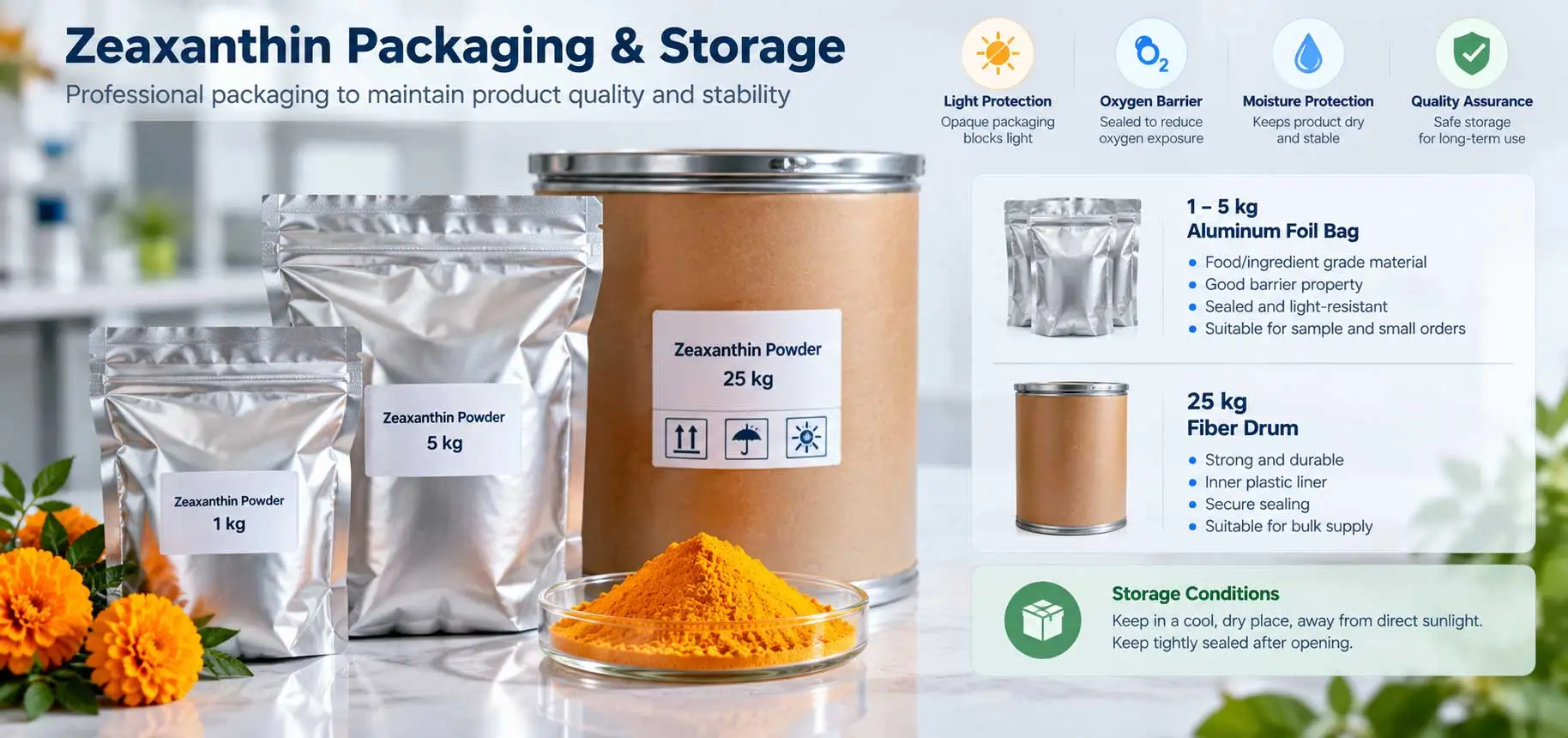
For commercial zeaxanthin powder packaging, opaque or otherwise light-protective materials and suitable oxygen/moisture barriers are more meaningful than decorative packaging alone. Inner liners should maintain their seal, and containers should be promptly reclosed after sampling.
Packaging should therefore be viewed as part of the zeaxanthin stability system, not merely as a shipping container.
How Should Zeaxanthin Powder Be Stored?
Zeaxanthin storage conditions should generally minimize the same factors known to accelerate carotenoid deterioration: excessive heat, direct light, oxygen exposure and moisture.
In practice, that means keeping the product sealed in its original protective packaging in a cool, dry location away from direct sunlight and unnecessary temperature fluctuation. The exact temperature range should follow the TDS or product-specific stability documentation.
The distinction between recommended storage and short-term transport exposure is important. A temporary temperature excursion does not automatically prove that a batch is unusable, just as a nominally cool warehouse does not guarantee stability if packaging has been compromised.
For zeaxanthin powder storage, the correct response to a significant excursion is to review duration, maximum temperature, package integrity and available stability evidence rather than applying an unsupported universal cut-off.
What Happens After a Zeaxanthin Package Is Opened?
Zeaxanthin storage after opening introduces conditions that are not identical to unopened shelf-life testing.
Each opening can replace part of the protected headspace with ambient air and can expose the powder to humidity and light. Repeated sampling may therefore create a different stability environment from the original sealed package.
For laboratory or factory use, the practical approach is to minimize unnecessary opening time, use clean dry sampling tools and reseal the container promptly. If the material will be consumed over a long period after first opening, pack size should also be considered during procurement.
The printed shelf life should not automatically be interpreted as a guarantee for material left repeatedly exposed or poorly resealed.
How Is Zeaxanthin Shelf Life Determined?
Zeaxanthin shelf life should be tied to a defined product form, packaging configuration and storage condition. A shelf-life statement without those conditions provides incomplete technical information.
Stability programs can include real-time studies, accelerated studies or both. Real-time testing follows the product under its intended storage conditions over the relevant period. Accelerated studies expose material to more stressful environments to reveal degradation trends more quickly, but they should not be treated as interchangeable with real-time evidence without an appropriate scientific basis.
The importance of matrix and condition is demonstrated by published storage data. Zeaxanthin in freeze-dried sweet corn behaved differently depending on temperature, illumination and packaging over a 12-week study.
A microencapsulation study similarly showed clearly different carotenoid retention after four weeks at 25 °C versus 55 °C, with substantial effects from drying method and wall composition.
These findings illustrate a core purchasing principle:
A zeaxanthin stability study is meaningful only when the buyer knows which product form, packaging and storage conditions the results actually represent.
The shelf life of one grade should therefore never be borrowed to justify another formulation merely because both contain zeaxanthin.
How Is Zeaxanthin Degradation Measured During Stability Testing?
Zeaxanthin stability testing HPLC is particularly useful because stability loss may involve both a decline in total assay and changes in isomer distribution.
The heat- and light-isomerization study discussed earlier used HPLC to monitor stereochemical changes in all-trans zeaxanthin. The sweet-corn storage study also used HPLC to quantify zeaxanthin during the 12-week experiment.
HPLC can therefore help evaluate zeaxanthin assay stability while also providing chromatographic information relevant to isomeric changes when the method is designed for that purpose.
Appearance may be monitored as a supporting physical observation, particularly because carotenoid degradation can alter color. However:
Visual stability is not the same as chemical stability.
A powder can look generally acceptable while measurable assay or isomer composition has changed. This is why serious stability qualification should not rely on visual color alone.
What Stability Information Should Ingredient Buyers Review?
Zeaxanthin stability data should match the exact commercial material under consideration.
A technically useful product file should establish the recommended storage environment and declared shelf life for the selected grade. The buyer should also understand the packaging configuration used to support that shelf-life claim and whether the available evidence is based on real-time, accelerated or other stability work.
The COA answers a different question: it demonstrates the batch condition at release. It does not, by itself, prove how that batch will behave after many months of storage.
This distinction is important during ingredient approval. A product may meet assay at shipment while still requiring appropriate storage controls to remain within specification later.
Why Stability Matters When Comparing Zeaxanthin Ingredients
A zeaxanthin supplier should be able to connect stability recommendations with the actual formulation being supplied. Release testing is only one part of reliable commercial supply.
At CHEN LANG BIO TECH, zeaxanthin quality management includes raw-material traceability, processing control and analytical testing. HPLC capability supports batch-level evaluation, while packaging and storage guidance are linked to the selected product form rather than treated as generic statements for every grade.
For ingredient buyers, this matters because stability is most credible when manufacturing, analytical release and storage recommendations are internally consistent.
Should Zeaxanthin Price Be Compared Without Considering Stability?
Zeaxanthin price is meaningful only after technical equivalence has been established.
A lower kilogram cost can become less attractive if the material requires higher formulation overage, experiences greater processing loss or demands additional stabilization steps in the customer's application. These outcomes are not inevitable, but they are legitimate factors in cost-in-use analysis.
The more useful commercial comparison therefore considers active content, formulation form, expected handling conditions and demonstrated stability together rather than treating price as an isolated procurement metric.
Zeaxanthin Stability Is a Product-System Question, Not a Single Number
Zeaxanthin stability cannot be summarized by one temperature or one shelf-life figure. It results from the interaction among molecular structure, ingredient form, processing history, oxygen and light exposure, packaging and storage conditions.
For procurement, the most reliable comparison is therefore not “Which powder claims the longest shelf life?” It is “Which grade has stability evidence that actually corresponds to the product, package and conditions we intend to use?”
That question leads to better raw-material qualification and more predictable commercial performance.
Frequently Asked Questions About Zeaxanthin Stability
Is zeaxanthin stable?
Is zeaxanthin stable? Zeaxanthin can be sufficiently stable for commercial use when it is appropriately formulated, packaged and stored, but the carotenoid is sensitive to light, elevated temperature and oxygen. Published storage and isomerization studies show that these conditions can change zeaxanthin content or stereochemical composition over time.
Does light degrade zeaxanthin?
Light can promote zeaxanthin isomerization and can contribute to photo-oxidative degradation, particularly when oxygen is present. In a 12-week storage study, light accelerated deterioration compared with dark storage under otherwise comparable conditions.
Is zeaxanthin heat stable?
There is no universal temperature threshold applicable to every commercial grade. Laboratory work has demonstrated heat-induced isomerization between 35 and 95 °C, while food-processing studies show that severe heating can reduce zeaxanthin content. Product form and exposure time must therefore be considered together.
Does oxygen affect zeaxanthin?
Zeaxanthin oxygen degradation is chemically plausible because oxygen can attack the highly unsaturated carotenoid structure. Reviews describe both auto-oxidation and photo-oxidation pathways, and microcapsule research reports greater carotenoid degradation under thermal stress when oxygen exposure is involved.
What is the best way to store zeaxanthin powder?
The best way to store zeaxanthin powder is generally in tightly sealed protective packaging, in a cool and dry location away from direct light and unnecessary heat. Exact conditions should always follow the product-specific specification or TDS rather than a generic internet recommendation.
Does microencapsulation make zeaxanthin more stable?
Does microencapsulation improve zeaxanthin stability? It can provide additional protection by placing the carotenoid within a carrier matrix, but performance depends on wall material, particle structure and encapsulation efficiency. Published research shows significant differences in carotenoid retention among different microencapsulation systems.
Can buyers request stability information before a commercial order?
Before deciding to buy zeaxanthin powder, buyers can review the recommended storage conditions, shelf-life statement and available product-specific stability documentation. This is especially useful when the intended application involves heat processing, long international transit or extended inventory storage.
Zeaxanthin Stability and Sample Support from CHEN LANG BIO TECH
As a zeaxanthin manufacturer, CHEN LANG BIO TECH supports ingredient qualification with product specifications, batch-specific quality documentation and storage information appropriate to the selected grade. HPLC testing and supply-chain traceability provide additional support for commercial quality control.
Samples can be discussed for formulation and handling evaluation before scale-up. Commercial packaging and zeaxanthin MOQ are confirmed after the appropriate product form has been selected.
For technical information, samples or a quotation, contact admin@chenlangbio.com.
References
1. Milanowska J., Gruszecki W. I. Heat-Induced and Light-Induced Isomerization of the Xanthophyll Pigment Zeaxanthin. Journal of Photochemistry and Photobiology B: Biology. 2005;80(3):178–186. The study investigated all-trans zeaxanthin isomerization under illumination and temperatures from 35 to 95 °C using HPLC.
2. Xiao Y., Li D., Liu C. Stability of Zeaxanthin in Freeze-Dried Sweet Corn Kernels during Storage. Food Science. 2014;35(6):229–233. Vacuum and ordinary packages were studied for 12 weeks at 4, 20 and 37 °C under light and dark conditions.
3. Syamila M., Gedi M. A., Briars R., et al. A Comparison of Microfluidic-Jet Spray Drying, Two-Fluid Nozzle Spray Drying, and Freeze-Drying for Co-Encapsulating β-Carotene, Lutein, Zeaxanthin, and Fish Oil. Foods. 2021;10:1522. The research compared encapsulation efficiency, reconstitution properties and carotenoid retention during storage.
4. Chemistry, Occurrence, Properties, Applications, and Encapsulation of Carotenoids—A Review. This review summarizes carotenoid sensitivity to oxygen, light, heat, metals and free radicals, as well as oxidation and encapsulation mechanisms.
5. Carotenoids: Dietary Sources, Extraction, Encapsulation, Bioavailability, and Health Benefits—A Review of Recent Advancements. The review discusses heat-, light- and oxygen-mediated carotenoid isomerization and degradation.
6. A Mechanistic Review of β-Carotene, Lutein, and Zeaxanthin in Eye Health and Disease. This paper provides structural context for zeaxanthin and other carotenoids, including the role of the conjugated polyene chain in light absorption and susceptibility to isomerization and oxidation.
7. Zeaxanthin: Metabolism, Properties, and Antioxidant Protection of Eyes, Heart, Liver, and Skin. The review discusses the influence of thermal processing on zeaxanthin and cites a 29% decrease in sweet-corn zeaxanthin content after canning at 121 °C.

Send Inquiry
Related Industry Knowledge
- Methyloxetanecarbamido Thiazolyl Resorcinol vs Thiamidol Which Works Better for Hyperpigmentation
- HPLC vs. CPC: Which Testing Method Ensures the Real Purity of Chondroitin Sulfate?
- Is Chondroitin Sulfate Powder Suitable for Everyone?
- Meglumine Powder: A Game-Changer in Pharmaceuticals
- Is Kopexil Effective for Treating Male and Female Pattern Baldness?
- Sodium Methylesculetin Acetate vs. Other Antioxidants
- How to Use Instant Kava Powder for Relaxation?
- Sea Buckthorn Oligopeptide vs. Collagen: Which is Better
- What is Praziquantel Tablet Used For
- What Are the Macamides in Maca