
How to Choose a Reliable Pine Bark Extract Supplier?
2026-06-02 12:34:13
Introduction
Global demand for pine bark extract continues to grow across dietary supplements, functional foods, beverages, cosmetics, and specialty nutrition products. As more brands incorporate botanical ingredients into their formulations, the focus has shifted from simply finding a supplier to identifying a long-term supply partner capable of supporting product quality, regulatory compliance, and business growth.
For many buyers, supplier selection starts with pricing. However, experienced procurement teams know that the lowest-priced ingredient often becomes the most expensive choice in the long run. Inconsistent specifications, delayed shipments, missing documentation, and unstable supply can lead to formulation challenges, production interruptions, and customer complaints that far outweigh any initial savings.
This is particularly true when sourcing bulk pine bark extract. Unlike commodity ingredients, botanical extracts require expertise in raw material selection, extraction technology, quality control, and standardization. The reliability of the supplier directly affects the consistency of the finished product.
Today's international buyers are increasingly evaluating suppliers based on several key factors:
•Manufacturing capabilities
•Quality certifications
•Product documentation
•Technical support
•Supply chain stability
•Export experience
A professional pine bark extract manufacturer should be able to provide not only a high-quality ingredient but also the documentation and technical resources needed to support commercial production in multiple markets.
As regulatory expectations become more demanding and competition within the health and wellness industry continues to increase, choosing a reliable pine bark extract supplier is no longer just a purchasing decision. It is a strategic decision that influences product quality, brand reputation, and long-term business performance.
This guide outlines the key criteria buyers should evaluate when selecting a maritime pine bark extract supplier, helping procurement teams make more informed sourcing decisions while reducing supply chain risks.
Why Supplier Selection Matters for Bulk Pine Bark Extract Procurement
The Supplier Impacts More Than the Ingredient
When evaluating bulk pine bark extract procurement, many companies initially compare specifications and pricing. While these factors are important, they represent only a small part of the overall sourcing equation.
The supplier behind the ingredient often has a greater influence on product success than the ingredient itself. A consistent, well-documented extract allows manufacturers to maintain stable production processes and deliver uniform products to the market. In contrast, inconsistent raw materials can create formulation adjustments, quality deviations, and operational inefficiencies that affect both production costs and customer satisfaction.
For brands operating in competitive categories such as dietary supplements, functional beverages, and beauty-from-within products, maintaining consistency is essential. Customers expect the same quality every time they purchase a product. That expectation starts with reliable ingredient sourcing.
Quality Consistency Protects Brand Reputation
One of the most important factors in pine bark extract sourcing is batch-to-batch consistency. Variations in active compounds, color, particle size, moisture content, or processing characteristics can affect manufacturing performance and finished product quality. Even small differences can create significant challenges for brands producing large commercial volumes.
Reliable suppliers invest heavily in:
•Raw material qualification
•Standardized extraction processes
•In-process quality control
•Finished product testing
•Batch traceability systems
These controls help ensure that customers receive the same quality material with every order. For procurement managers, consistency reduces risk. For product developers, it reduces formulation variability. For brands, it protects market reputation.
Regulatory Compliance Begins With Supplier Quality
Regulatory expectations for botanical ingredients continue to increase across global markets.
Manufacturers often need access to:
•Certificates of Analysis (COA)
•Heavy metal reports
•Microbiological testing
•Product specifications
•Traceability records
Without these documents, product registration and quality approval processes can become significantly more complicated. A professional pine bark extract supplier should be able to provide clear, accurate, and up-to-date documentation that supports customer compliance requirements.
This becomes especially important when supplying products to North America, Europe, Australia, the Middle East, and other highly regulated markets.
Supply Stability Supports Business Growth
A supplier may meet your requirements today, but can they support your growth tomorrow? This is one of the most overlooked questions during supplier evaluation.
Many brands begin with relatively small purchase volumes during product development. As sales increase, demand can grow rapidly. Suppliers lacking adequate production capacity may struggle to maintain lead times, resulting in inventory shortages and delayed deliveries.
For this reason, experienced buyers evaluate manufacturing scale alongside product quality. Reliable pine bark extract manufacturers typically operate established production facilities, maintain inventory planning systems, and possess sufficient production capacity to support long-term customer growth.
Procurement Is Ultimately a Risk Management Function
The role of procurement extends beyond securing competitive pricing. Modern sourcing teams are responsible for reducing operational risks, maintaining supply continuity, and ensuring quality consistency throughout the product lifecycle.
When viewed from this perspective, choosing a reliable botanical extract supplier becomes a strategic business decision rather than a simple purchasing transaction.
The most successful brands often build long-term partnerships with suppliers that demonstrate strong manufacturing capabilities, transparent quality systems, and a proven commitment to customer support.
Evaluate Manufacturing Capabilities and Production Capacity When Choosing a Pine Bark Extract Manufacturer
Manufacturing Strength Is One of the Most Important Supplier Evaluation Criteria
When evaluating a pine bark extract manufacturer, buyers often focus on specifications, pricing, and lead times. While these factors are important, they only tell part of the story.
The reality is that product quality is largely determined by what happens inside the manufacturing facility. A supplier's production capabilities directly influence:
•Product consistency
•Batch reproducibility
•Quality control standards
•Delivery reliability
•Scalability
For companies purchasing bulk pine bark extract, understanding how an ingredient is produced can provide valuable insight into long-term supply reliability.
Look Beyond the Product Specification Sheet
Many suppliers can provide a specification sheet. Far fewer have the manufacturing infrastructure necessary to consistently deliver the same quality material year after year. When assessing a potential maritime pine bark extract supplier, buyers should consider several questions:
Does the supplier operate its own manufacturing facility?
Are production processes standardized?
Is there sufficient capacity to support future growth?
Are quality systems integrated into production?
Can the supplier provide traceability from raw material to finished product?
These questions often reveal more about a supplier's reliability than pricing alone.
GMP Production Standards Matter
For botanical extracts, manufacturing standards are particularly important. Suppliers operating under GMP-oriented production systems generally implement stricter controls throughout the manufacturing process, helping reduce variability and improve product consistency.
This includes:
•Raw material inspection
•Production monitoring
•In-process testing
•Finished product verification
•Documentation management
For buyers developing products for regulated markets, these controls provide additional confidence that the ingredient can meet both internal quality requirements and customer expectations.

Production Capacity Should Match Your Growth Plans
One of the most common sourcing mistakes occurs when brands select a supplier based solely on current demand. A supplier may be able to fulfill a small development order today but struggle to support larger commercial volumes later.
Experienced procurement teams often evaluate:
•Annual production capacity
•Manufacturing scalability
•Inventory management systems
•Supply chain resilience
before establishing long-term supply agreements.
For growing brands, supplier capacity is not simply an operational issue. It becomes a strategic consideration that can affect future expansion plans.
What International Buyers Typically Look For
Many global supplement, food, beverage, and cosmetic companies prefer working with manufacturers that combine production scale with technical expertise. As part of the supplier evaluation process, buyers often prioritize facilities that offer:
•Modern extraction technology
•Multiple production lines
•Clean manufacturing environments
•Dedicated quality control systems
•Strong documentation practices
These capabilities help reduce operational risks and improve overall supply stability.
Manufacturing Experience Creates Long-Term Value
Experience is another factor that is often overlooked. A manufacturer with decades of extraction experience has typically encountered a wide range of raw material, processing, and quality challenges. This accumulated expertise often translates into better process control and more reliable product quality.
For example, suppliers that have been involved in botanical extraction and ingredient manufacturing for many years are often better equipped to support customers across different industries, including dietary supplements, functional beverages, cosmetics, food ingredients, and specialty nutrition products.
This broader manufacturing experience can be particularly valuable when product requirements become more complex or customized specifications are needed.
Reliable Production Is the Foundation of Reliable Supply
Ultimately, the most successful supplier relationships are built on operational consistency. Strong manufacturing infrastructure, qualified personnel, standardized production systems, and sufficient production capacity create the foundation for long-term supply reliability.
For buyers sourcing bulk pine bark extract, evaluating manufacturing capabilities early in the procurement process can help avoid quality issues, supply disruptions, and unnecessary costs later.
Why Quality Certifications and Documentation Are Critical for International Buyers
Certifications Help Verify Supplier Credibility
In today's global ingredient market, certifications are no longer optional. They have become one of the primary ways buyers evaluate supplier credibility before placing an order. A professional pine bark extract supplier should be able to demonstrate not only product quality but also compliance with recognized quality management systems.
For international buyers, certifications provide independent verification that manufacturing processes are controlled, documented, and regularly reviewed. This reduces procurement risk and helps streamline supplier qualification procedures.
ISO Certifications Are Often the First Checkpoint
Among the most commonly requested certifications are:
•ISO22000
•ISO9001
These standards help demonstrate that a supplier operates under structured quality and food safety management systems. For procurement managers, certification does not automatically guarantee product quality. However, it does provide an additional layer of confidence that the supplier has implemented formal procedures covering production, quality control, corrective actions, and continuous improvement.
Many multinational customers include ISO certification as a minimum requirement during supplier evaluation.
Documentation Is Just as Important as the Ingredient
Even a high-quality extract may be unsuitable for commercial use if adequate documentation is unavailable. This is particularly true for companies selling products in regulated markets.
Typical documentation requests include:
Product Specification Sheet
Provides key information regarding:
•Active compounds
•Appearance
•Solubility
•Particle size
•Testing standards
Certificate of Analysis (COA)
Confirms that a specific production batch meets specification requirements.
•Heavy Metal Testing
Demonstrates compliance with applicable safety limits.
•Microbiological Testing
Verifies microbiological quality and manufacturing hygiene standards.
•Traceability Documentation
Allows buyers to track production history and raw material sourcing.
These documents are often required before a quality team will approve a new ingredient supplier.
•Regulatory Compliance Is Becoming Increasingly Important
Global regulations continue to evolve. Whether a customer operates in dietary supplements, functional beverages, food ingredients, cosmetics, or pharmaceutical-related sectors, documentation requirements are becoming more detailed and more stringent.
Suppliers that maintain organized documentation systems are generally able to support customers more efficiently during:
•Product development
•Supplier qualification
•Regulatory review
•Customer audits
This reduces delays and helps accelerate product launches.
•Quality Systems Reflect Long-Term Commitment
Quality certifications and documentation should not be viewed as marketing tools. Instead, they serve as indicators of how seriously a supplier approaches quality management and regulatory compliance.
Manufacturers that invest in certifications, documentation systems, and product testing are often making a long-term commitment to serving international markets.
For buyers seeking a certified pine bark extract manufacturer, these factors can provide valuable insight into supplier reliability and operational maturity.
In many cases, the quality systems behind the ingredient are just as important as the ingredient itself.
Understanding Pine Bark Extract Specifications Before You Buy
For many procurement teams, comparing prices is often the easiest part of sourcing a botanical ingredient. The more important challenge is determining whether different suppliers are actually offering comparable products. With pine bark extract, specifications can vary significantly between manufacturers. Differences in active compound content, extraction methods, solubility, particle size, and quality documentation can all affect product performance, manufacturing efficiency, and regulatory compliance.
Before selecting a supplier, buyers should understand which specifications truly matter and how those specifications align with their intended application.
Active Compound Content: Understanding OPCs and Procyanidins
One of the first specifications buyers evaluate is the concentration of active compounds within the extract. The primary bioactive components in pine bark extract are oligomeric proanthocyanidins (OPCs) and other naturally occurring procyanidins. These compounds are widely recognized for their antioxidant properties and are often used as key quality indicators when comparing suppliers.
Depending on the manufacturing process and intended application, standardized extracts may contain varying levels of these compounds. Common commercial specifications range from 65% to 95% OPCs.
When reviewing a product specification sheet, buyers should pay close attention to:
•OPC content and standardization level
•Total procyanidin concentration
•Analytical testing methods
•Batch-to-batch consistency
•Verification through third-party or in-house laboratory testing
For many international brands, standardized pine bark extract offers significant advantages. Consistent active compound levels help simplify formulation development, improve manufacturing reproducibility, and reduce quality-related risks during commercial production.
Why Standardization Matters
Standardization is often one of the strongest indicators of a supplier's manufacturing capabilities and quality management practices. A standardized extract helps ensure that every production batch delivers comparable performance. This consistency becomes particularly important for supplement manufacturers, beverage formulators, and cosmetic brands that require predictable ingredient functionality across multiple production runs.
Without proper standardization, variations in active compound levels may lead to:
•Reformulation requirements
•Product performance inconsistencies
•Additional quality control costs
•Regulatory challenges in certain markets
When evaluating a pine bark extract manufacturer, buyers should look beyond the percentage listed on the specification sheet. Equally important is understanding how those values are measured and maintained. Reliable suppliers typically provide:
•Validated analytical methods
•Detailed specification sheets
•Batch-specific Certificates of Analysis
•Established quality control procedures
These factors provide greater confidence that the ingredient will perform consistently over the long term.
Solubility, Particle Size, and Functional Performance
While active compound content receives significant attention, physical characteristics are equally important when selecting the right pine bark extract specification.
An extract may meet the desired OPC level but still create manufacturing challenges if its physical properties are not suitable for the intended application.
Several key parameters should be evaluated during supplier qualification.
Water Solubility
For beverage manufacturers and powdered drink formulations, solubility is often a critical requirement.
A high-quality water-soluble pine bark extract should disperse efficiently without excessive sedimentation or clumping. Poor solubility can negatively affect product appearance, processing efficiency, and consumer experience.
Applications that commonly require enhanced solubility include:
•Functional beverages
•Instant drink powders
•Liquid dietary supplements
•Nutritional shots
Understanding solubility characteristics early in the sourcing process can help avoid costly formulation adjustments later.
Particle Size Distribution
Particle size influences several aspects of manufacturing performance, including:
•Mixing efficiency
•Powder flowability
•Suspension stability
•Encapsulation performance
•Product texture and mouthfeel
For example, a beverage application may require a finer particle size to improve dispersion, while tablet manufacturing may prioritize flow characteristics during production.
A professional supplier should be able to provide detailed particle size specifications and explain how those characteristics affect product performance.
Moisture Content and Stability
Moisture content is another important quality parameter that is sometimes overlooked during procurement.
Excessive moisture can affect:
•Shelf life
•Powder stability
•Storage conditions
•Packaging requirements
Maintaining appropriate moisture levels helps preserve product quality throughout transportation, storage, and manufacturing.
Sensory Characteristics
For food, beverage, and cosmetic applications, sensory properties can also influence ingredient selection.
Buyers should evaluate:
•Color consistency
•Odor profile
•Taste characteristics
•Compatibility with finished formulations
These factors may seem secondary compared to active compound content, but they often play a significant role in product development and consumer acceptance.
Suppliers that provide comprehensive technical documentation—including solubility data, particle size information, and sensory specifications—can help manufacturers make more informed sourcing decisions.
Customization and Application-Based Grades
Not all pine bark extracts are designed for the same end use.
Different industries often require different specifications, making application-specific customization an important consideration when selecting a supplier.
Experienced manufacturers understand that ingredient requirements vary depending on formulation goals, processing conditions, and regulatory expectations.
Pine Bark Extract for Dietary Supplements
The dietary supplement sector remains one of the largest markets for pine bark extract.
In this category, buyers typically prioritize:
•High OPC content
•Standardized active compounds
•Excellent batch consistency
•Strong documentation support
Capsules, tablets, sachets, and powdered supplements often require highly standardized extracts to ensure label claim accuracy and product consistency.
Pine Bark Extract for Functional Beverages
Beverage applications present a different set of challenges.
Manufacturers frequently focus on:
•Water solubility
•Flavor compatibility
•Color stability
•Processing performance
A pine bark extract for functional beverages may require customized specifications that differ significantly from those used in capsules or tablets.
Selecting the appropriate grade can improve formulation efficiency and reduce development timelines.
Pine Bark Extract for Cosmetic Applications
The growing demand for botanical ingredients in skincare and beauty products has increased interest in pine bark extract for skincare formulations.
Cosmetic manufacturers often evaluate:
•Particle size
•Appearance
•Stability in emulsions
•Compatibility with active ingredients
Depending on the formulation, customized grades may be preferred to optimize product texture and performance.
The Value of Customized Specifications
A supplier capable of offering customized pine bark extract specifications can provide significant advantages during product development.
Customization may include:
•Different OPC concentrations(10~95%)
•Solubility adjustments
•Particle size modifications
•Application-specific testing
•Tailored packaging solutions
For brands developing innovative products, this flexibility can reduce formulation challenges and accelerate commercialization.
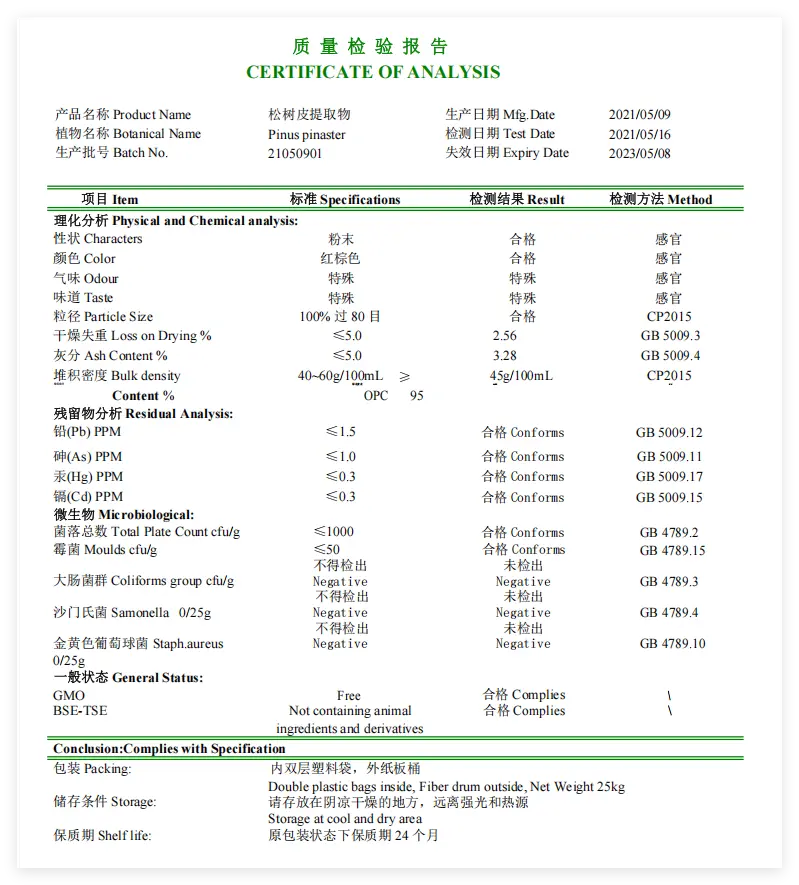
Certificates of Analysis (COA) and Documentation
Even the highest-quality ingredient can create procurement challenges if supporting documentation is incomplete. For international buyers, documentation is often just as important as the product itself. Before approving a new supplier, procurement and quality teams typically review a range of technical documents to verify compliance, safety, and consistency.
Essential Documents Buyers Should Request
A professional pine bark extract supplier should be able to provide:
Certificate of Analysis (COA)
The COA confirms that a specific production batch meets established specifications. Typical information includes:
Active compound content
Appearance
Moisture levels
Microbiological results
Heavy metal testing
Product Specification Sheet
This document outlines the technical characteristics of the ingredient and serves as a reference for quality approval and formulation development.
Heavy Metal Testing Reports
Many international markets require verification that botanical ingredients comply with established limits for contaminants such as lead, arsenic, cadmium, and mercury.
Microbiological Testing Reports
Microbiological testing helps verify product safety and manufacturing hygiene standards.
Traceability Documentation
Traceability systems allow buyers to track materials throughout the supply chain and support regulatory compliance requirements.
Why Documentation Matters
Comprehensive documentation supports:
•Supplier qualification
•Regulatory submissions
•Customer audits
•Product registrations
•Internal quality reviews
Incomplete documentation can delay product launches, complicate audits, and increase procurement risks.
For this reason, many buyers specifically seek a certified pine bark extract supplier with established quality systems and transparent documentation practices.
Key Takeaways for Procurement Teams
Selecting the right pine bark extract supplier requires more than comparing prices or reviewing a single specification sheet. A thorough evaluation should include:
1.Verification of OPC and procyanidin content
2.Assessment of standardization and batch consistency
3.Review of solubility, particle size, and functional performance.
4.Consideration of application-specific requirements
5.Availability of customized specifications when needed
6.Comprehensive COA and supporting documentation
7.Strong quality management and traceability systems
By focusing on these factors, procurement teams can reduce sourcing risks, improve product consistency, and establish long-term partnerships with suppliers capable of supporting future business growth.
Ultimately, understanding specifications before purchasing is one of the most effective ways to ensure that the bulk pine bark extract you source today continues to meet your quality, regulatory, and commercial requirements tomorrow.
Can Your Supplier Support Multiple Industries and Product Applications?
Why Application Experience Matters More Than Many Buyers Realize
When evaluating a pine bark extract supplier, buyers often focus on manufacturing capacity, certifications, and pricing. While these are important factors, another consideration is frequently overlooked: Can the supplier support the industries and applications you serve?
This question becomes increasingly important as product development becomes more sophisticated. A supplier that understands how pine bark extract is used across different markets often brings a deeper level of technical knowledge, formulation insight, and practical problem-solving capability.
In many cases, this experience can help accelerate development timelines and reduce formulation risks.
Industry Experience Creates Better Technical Support
The requirements of a dietary supplement manufacturer are different from those of a cosmetic company. Similarly, a functional beverage developer may have completely different concerns regarding:
•Solubility
•Flavor impact
•Processing conditions
•Stability requirements
Suppliers serving multiple industries are often exposed to a broader range of formulation challenges and customer requirements. This experience allows them to provide more practical guidance regarding:
•Specification selection
•Ingredient compatibility
•Processing recommendations
•Documentation requirements
For procurement teams, this translates into a more valuable supplier relationship.

Dietary Supplement Applications
The largest market for pine bark extract remains dietary supplements. Within this sector, the ingredient is commonly used in:
•Capsules
•Tablets
•Sachets
•Powder blends
•Nutritional formulations
Supplement manufacturers often focus on:
•OPC content
•Standardization
•Batch consistency
•Regulatory documentation
A supplier familiar with the supplement industry understands these requirements and can provide specifications that align with commercial production needs.
Functional Beverage Applications
As discussed in our article on Pine Bark Extract in Functional Beverages, beverage applications introduce a completely different set of formulation considerations. These may include:
•Water solubility
•Taste profile
•Beverage stability
•Particle size requirements
Not every extract suitable for capsules will perform well in beverages. This is why beverage manufacturers frequently seek suppliers capable of providing application-specific guidance and customized specifications.
Cosmetic and Personal Care Applications
Demand for pine bark extract for skincare has increased significantly in recent years.
Cosmetic manufacturers often evaluate ingredients based on:
•Appearance
•Stability
•Formulation compatibility
•Sensory performance
Suppliers with experience supporting cosmetic applications are generally better positioned to recommend suitable specifications and provide relevant documentation.
This is particularly valuable for brands developing:
•Serums
•Creams
•Lotions
•Beauty-from-within concepts
Food Ingredient and Functional Nutrition Applications
Food applications may introduce additional requirements related to:
•Ingredient compliance
•Labeling
•Processing compatibility
•Flavor systems
A supplier working across food, beverage, and supplement sectors often develops a stronger understanding of how botanical ingredients perform under different manufacturing conditions.
Why Diversified Suppliers Often Create Less Risk
A supplier serving multiple industries typically invests in:
•Broader technical expertise
•More robust quality systems
•Greater production flexibility
•Expanded testing capabilities
These investments can benefit customers regardless of their specific application. For buyers seeking a long-term sourcing partner, industry diversification often indicates operational maturity and a stronger commitment to product development support.
Supply Chain Reliability and Export Experience: Often Overlooked but Essential
A Good Product Is Not Enough
Many supplier evaluations focus heavily on product specifications. However, once a product moves into commercial production, supply chain performance often becomes just as important as ingredient quality.
A supplier may offer an excellent pine bark extract specification, but if deliveries are inconsistent or documentation is delayed, operational challenges can quickly emerge. This is why experienced procurement teams place significant emphasis on supply chain reliability.
Consistent Supply Supports Business Growth
Launching a successful product often creates new sourcing challenges. As sales increase, demand forecasts become more aggressive, production schedules become tighter, and inventory management becomes more critical. Under these conditions, inconsistent supply can create:
•Production delays
•Inventory shortages
•Missed sales opportunities
•Increased operational costs
Reliable bulk pine bark extract suppliers understand the importance of long-term planning and production forecasting. Their ability to support growing demand often becomes a key competitive advantage for customers.
Export Experience Matters for International Buyers
For companies operating in global markets, export capability is a critical consideration. International shipments often require:
•Export documentation
•Product certifications
•Customs support
•Packaging compliance
•Shipping coordination
Suppliers familiar with international trade processes can significantly reduce administrative burdens for buyers. This becomes especially valuable when shipping to highly regulated markets where documentation accuracy is essential.
Documentation Speed Can Affect Product Launches
One of the most common frustrations among procurement teams is delayed documentation. Even when product quality is excellent, missing or incomplete documents can delay:
•Supplier approval
•Quality reviews
•Product registration
•Commercial production
Professional suppliers typically maintain organized documentation systems that allow customers to quickly obtain:
•COAs
•Specifications
•Testing reports
•Compliance documents
Fast access to documentation often accelerates product development timelines.
Packaging and Logistics Flexibility
Different customers have different operational requirements. Some may need:
•Small development quantities
•Commercial production volumes
•Customized packaging
•Export-ready pallet configurations
Suppliers capable of supporting these requirements often provide a smoother procurement experience.
Long-Term Reliability Is a Competitive Advantage
Ultimately, buyers are not simply purchasing an ingredient. They are investing in a supply relationship. The most successful partnerships are built on:
•Consistent quality
•Reliable communication
•Strong logistics support
•Export experience
•Operational transparency
For international manufacturers, these factors can have a direct impact on product availability, customer satisfaction, and long-term business growth.
When evaluating a global pine bark extract supplier, reliability should be viewed not as an added benefit, but as a fundamental requirement.
Technical Support and Product Development Assistance Can Save Time and Cost
A Supplier Should Be More Than a Raw Material Vendor
One of the biggest differences between an average supplier and a valuable long-term partner is the level of technical support they provide.
In today's competitive ingredient market, manufacturers are under constant pressure to shorten development cycles, improve formulation efficiency, and launch products faster. As a result, many buyers are looking beyond pricing and specifications when evaluating suppliers.
The reality is that sourcing a botanical extract involves far more than placing an order.
Questions often arise regarding:
•Specification selection
•Ingredient compatibility
•Application suitability
•Regulatory documentation
•Production scalability
•Quality requirements
A supplier capable of providing guidance in these areas can help customers avoid costly mistakes and significantly reduce development timelines.
Technical Expertise Can Reduce Formulation Risk
Every application presents unique challenges.
A pine bark extract intended for a capsule product may require different characteristics than one used in:
•Functional beverages
•Powder blends
•Cosmetic formulations
•Food applications
Without proper guidance, buyers may select specifications that appear suitable on paper but create unexpected challenges during manufacturing.
Experienced suppliers can often provide practical recommendations regarding:
•OPC content selection
•Solubility requirements
•Particle size optimization
•Application-specific grades
•Documentation requirements
This knowledge can save considerable time during formulation development.
Product Development Support Creates Long-Term Value
Many successful ingredient partnerships begin during product development rather than procurement.
Manufacturers increasingly prefer suppliers who understand how ingredients perform in real-world applications and can support product innovation rather than simply supplying raw materials.
This becomes particularly important when customers require:
•Customized specifications
•New formulation concepts
•Alternative ingredient options
•Technical documentation support
Suppliers with extensive experience across botanical extracts, functional ingredients, and health-related product categories often provide a broader perspective that helps customers accelerate decision-making.
Why Experience Matters
When evaluating a potential pine bark extract supplier, experience should not be underestimated.
Manufacturers with decades of extraction expertise have typically worked with customers across multiple industries and markets. This accumulated knowledge often translates into stronger technical support and more practical recommendations.
For example, suppliers with long-standing experience in plant extraction and ingredient manufacturing are often better equipped to understand:
•International quality expectations
•Application-specific requirements
•Regulatory considerations
•Supply chain challenges
This expertise becomes particularly valuable when customers are developing products for export markets.
A Strong Technical Team Can Become a Competitive Advantage
The most successful brands rarely work alone. Behind many successful product launches is a network of reliable ingredient partners providing technical assistance, quality support, and formulation guidance.
For procurement managers, selecting a supplier with strong technical capabilities can help reduce risk.
For product developers, it can help solve challenges faster.
For growing brands, it can improve speed-to-market.
Ultimately, technical support is not an additional service.
It is often one of the most valuable benefits a supplier can provide.
Conclusion
Choosing a reliable pine bark extract supplier requires more than comparing prices. Procurement teams should evaluate manufacturing capability, certifications, documentation, technical support, and supply chain reliability. A comprehensive supplier checklist not only minimizes sourcing risks but also ensures smooth product development, consistent quality, and successful long-term business growth.
Looking for a Trusted Pine Bark Extract Supplier?
Whether you are developing dietary supplements, functional beverages, or cosmetic formulations, technical support, standardized specifications, and bulk supply options are available.
Contact Us:
•Email: admin@chenlangbio.com
•WhatsApp: +86-17782478823

Send Inquiry
Related Industry Knowledge
- Feed the Growing Demand: Supply High-Quality Levodopa Powder for Global Parkinson's Care
- What Are Procyanidins in Pine Bark Extract and Why Do They Matter in Formulations?
- Why Are Global Buyers Choosing Chen Lang Bio’s Milk Thistle Extract for OEM Production?
- How Does Natural Daidzein Powder Help Maintain Healthy Cell Growth?
- What are the Potential Health Benefits of Spermidine Supplementation?
- Pure Pomegranate Powder: Top Health Benefits
- Can You Take EGCG Everyday
- Can Hyaluronic Acid Powder Be Used in DIY Skincare
- Can Bakuchiol Help With Acne
- What Benefits of Spine Date Seed Extract Powder?