
CWS Zeaxanthin for Beverage Formulations: Dispersibility, Stability and Processing
2026-09-08 16:12:55
CWS zeaxanthin for beverages is designed to solve a practical formulation problem: native zeaxanthin is highly lipophilic, while most beverage systems are predominantly aqueous. A CWS or microencapsulated delivery system improves how the carotenoid wets, disperses and distributes in water, but that does not mean the zeaxanthin molecule itself has become truly water soluble. It also does not mean that good dispersion in a glass of water automatically predicts stability in a finished drink.
For beverage formulators, three separate questions need to be answered. First, will the powder enter the aqueous phase without excessive floating or agglomeration? Second, will the dispersion remain physically uniform during shelf life? Third, will the zeaxanthin retain its chemical integrity after exposure to pH, heat, oxygen, light and the beverage matrix?
Those questions make zeaxanthin beverage formulation a delivery-system problem as much as an active-ingredient problem.
What Does CWS Zeaxanthin Mean in a Beverage Ingredient?
CWS zeaxanthin powder is generally supplied as a formulated ingredient in which zeaxanthin is associated with a carrier or encapsulation system designed to improve handling in aqueous applications.
In commercial language, CWS is sometimes expanded as “cold water soluble.” From a formulation perspective, “cold-water dispersible” is often the more accurate description. Native zeaxanthin remains a strongly lipophilic xanthophyll; formulation technology modifies how the finished powder behaves in water rather than fundamentally converting the carotenoid into a hydrophilic molecule.
PubChem reports zeaxanthin with a calculated XLogP of 10.9, consistent with its strong lipophilicity.
A 2023 study evaluating a porous granular cold-water-soluble starch carrier reported a saturated zeaxanthin solubility of 9.22 μg/mL for unencapsulated zeaxanthin. In that specific experimental system, incorporation into the optimized starch carrier increased the measured saturated solubility to 14.45 μg/mL, a 56.72% increase. The same work also reported more homogeneous color distribution after encapsulation.
Those values should not be treated as universal performance data for all commercial products. Their more useful implication is that the carrier system can materially change the way zeaxanthin behaves in an aqueous environment.
CWS describes the delivery behavior of the commercial ingredient, not a fundamental change in the molecular solubility of zeaxanthin.
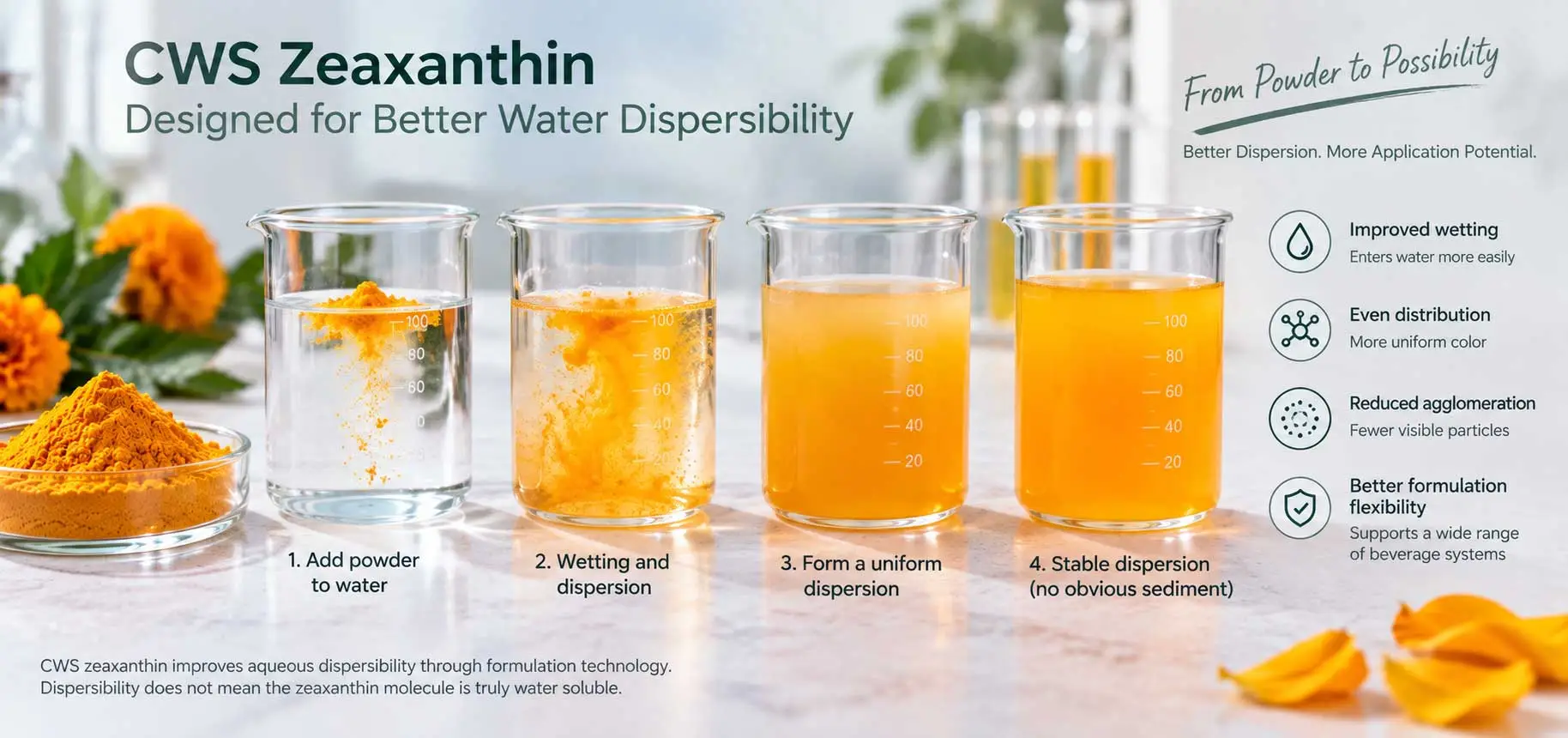
Why Native Zeaxanthin Is Difficult to Formulate into Water-Based Beverages
Zeaxanthin solubility in water is intrinsically poor because the molecule contains a long conjugated hydrocarbon framework with only two hydroxyl groups. Its highly lipophilic character favors non-aqueous environments rather than bulk water.
In a practical beverage system, this can present as poor wetting, surface floating, visible agglomeration, non-uniform color or sediment formation. These are not necessarily identical phenomena, and they should not all be described simply as “poor solubility.”
For example, a powder may initially wet but later sediment. Another material may remain suspended but produce visible haze. A third may form a relatively uniform dispersion while still experiencing chemical loss of active zeaxanthin over time.
This distinction matters because zeaxanthin dispersibility in water is a physical property of the commercial grade, whereas molecular solubility describes the behavior of zeaxanthin itself.
For a beverage developer, the correct question is therefore not simply:
“Is zeaxanthin soluble in water?”
A much more useful question is:
“How does this specific grade disperse and remain stable in the beverage matrix we are developing?”
How Microencapsulation Improves Zeaxanthin Dispersibility
Microencapsulated zeaxanthin for beverages uses formulation architecture around the carotenoid to improve its technological behavior.
Depending on the product design, the system may use starch-derived materials, proteins, gums or other carrier components. The purpose is to reduce direct exposure of the hydrophobic carotenoid phase to the surrounding water while improving particle wetting and distribution.
Research on porous cold-water-soluble starch illustrates the principle. In the 2023 study noted above, the optimized carrier produced more uniform aqueous color distribution and reduced visible adherence of zeaxanthin to the vessel compared with untreated material.
Other work with protein-based systems has similarly shown that zeaxanthin can interact with food proteins in ways that influence dispersion and storage behavior. Recent studies have examined caseinate and whey protein isolate as carriers for lutein and zeaxanthin, with pH strongly affecting binding and stability.
The key point is not that one carrier is universally superior.
Zeaxanthin microencapsulation improves performance by engineering the interface between the carotenoid and the aqueous phase. The effectiveness of that design depends on the carrier chemistry, particle structure and actual beverage environment.
Dispersibility Is Not the Same as Long-Term Beverage Stability
A major formulation mistake is assuming that a powder that looks good five minutes after mixing will remain satisfactory throughout shelf life.
CWS zeaxanthin stability has at least three distinct components.
Initial dispersibility describes how readily the ingredient enters and distributes through the liquid. Physical stability describes whether the system remains acceptably uniform over time. Chemical stability describes whether active zeaxanthin is retained without excessive oxidation, isomerization or degradation.
Those properties can diverge.
A beverage may initially appear visually uniform yet develop sediment, surface rings or flocculation later. Conversely, a product may remain visually homogeneous while zeaxanthin assay gradually declines.
This is why:
A CWS zeaxanthin powder can disperse rapidly in water and still require separate validation for sedimentation, aggregation, color stability and active retention during beverage shelf life.
For procurement teams, a supplier demonstration in purified water is therefore useful only as an initial screening test.
The finished formulation still has to be evaluated.
Beverage Matrix Matters More Than a Simple Water Dispersion Test
A real CWS zeaxanthin formulation contains far more than water.
Fruit acids, proteins, minerals, sugars, sweeteners, hydrocolloids, flavors, botanical extracts and other functional ingredients can all change the physical environment around dispersed particles.
Protein-containing beverages are a particularly good example. A 2024 study in Food Research International found that pH and thermal pretreatment altered the interaction of lutein and zeaxanthin with sodium caseinate. Lower pH strengthened hydrophobic binding in that system, and preheated caseinate also enhanced carotenoid binding.
Another 2024 study compared caseinate–pectin systems at pH 3.0 and 7.0. The pH 3.0 polyelectrolyte complex provided greater chemical protection to lutein/zeaxanthin during storage than the pH 7.0 co-solution in that particular formulation.
These studies show why zeaxanthin functional beverage formulation cannot be reduced to a powder-water test.
A grade that performs well in purified water may behave differently in an acidic juice drink, dairy beverage or mineral-rich liquid supplement.
How pH Affects Zeaxanthin in Beverage Formulations
Zeaxanthin pH stability should be evaluated in the context of the complete delivery system.
In the 2024 caseinate study, lutein/zeaxanthin interactions were evaluated over pH 1.5–7.5. The researchers found stronger hydrophobic binding at lower pH and also reported that preheating the casein carrier increased binding.
A separate study used pH 3.0 and 7.0 caseinate–pectin systems. The pH 3.0 complex showed slower degradation during storage than the corresponding pH 7.0 co-solution.
At first glance, it would be tempting to conclude that low pH is always better. That would be incorrect.
These results apply to defined protein and polysaccharide carrier systems. Another formulation may respond differently because ionic strength, protein type, emulsifier selection and particle charge are different.
Accordingly, there is no universal CWS zeaxanthin pH that can be recommended for every beverage.
The most useful pH data are generated with the actual commercial grade in the intended beverage matrix.
This is particularly important for acidic juice beverages and neutral dairy or plant-protein systems, where colloidal behavior can differ substantially.
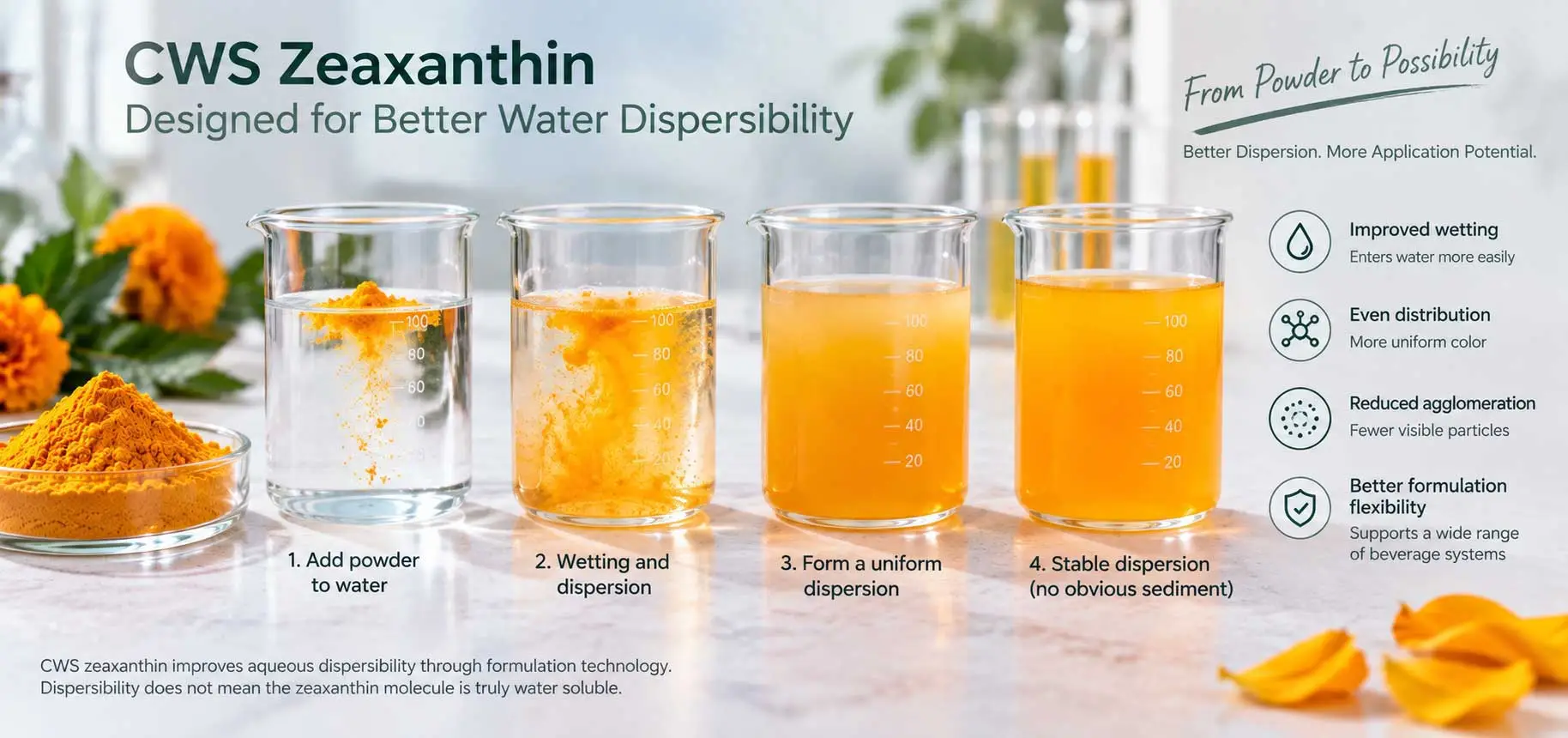
How Heat Processing Affects Zeaxanthin Beverage Stability
Zeaxanthin heat stability is also matrix dependent.
A 2013 Food Chemistry study examined thermal degradation of xanthophylls, including zeaxanthin, in real blood-orange juice and model systems at 45, 60, 75 and 90°C. The authors found that degradation behavior depended on temperature, pH, carotenoid form and the surrounding matrix. Degradation rates were lowest in the real juice system, illustrating that model solutions do not always predict behavior in an actual food matrix.
Interestingly, heat can also affect the carrier rather than simply degrading the carotenoid. In the 2024 caseinate study, the protein was preheated to 85°C, and this treatment strengthened lutein/zeaxanthin binding to caseinate in that particular system.
These two findings point to a more useful formulation principle:
Heat cannot be evaluated independently of the zeaxanthin delivery system and beverage matrix.
This is why there is no scientifically defensible universal statement such as “CWS zeaxanthin is stable below 60°C” for every product.
Time matters as much as temperature. A short high-temperature process and a long moderate-temperature hold create different exposures.
Pasteurization and UHT: Should Zeaxanthin Be Added Before or After Heat Treatment?
Questions about zeaxanthin pasteurization stability often lead directly to another practical question: should the ingredient be added before or after thermal processing?
There is no universal answer.
If zeaxanthin is incorporated before pasteurization or UHT, the selected grade must tolerate the actual heat profile sufficiently to meet finished-product assay and appearance requirements.
Post-process addition may reduce thermal exposure, but it introduces other manufacturing considerations. Any ingredient added after the primary kill step must be handled within an appropriate hygienic process so that microbiological control of the beverage is not compromised.
The right choice therefore depends on:
the thermal profile, holding time, filling process, hygienic design, packaging method and grade-specific stability.
The most defensible approach is to evaluate finished-product zeaxanthin assay before and after the real processing cycle.
The correct zeaxanthin addition point should be selected from process validation, not from temperature alone.
This makes when to add zeaxanthin to beverages a process-development question rather than a rule that can be answered from a generic specification sheet.
Does Homogenization Improve CWS Zeaxanthin Dispersion?
Zeaxanthin homogenization can improve particle distribution in some beverage systems, but it is not automatically necessary for every CWS ingredient.
A well-designed CWS powder may disperse effectively under ordinary mixing. Protein beverages or more complex emulsified matrices may benefit from higher shear because homogenization can break up agglomerates and improve distribution of dispersed phases.
However, increasing shear indefinitely is not a substitute for selecting the correct carrier system.
Homogenization changes the whole beverage, including protein interactions, emulsion droplet size and hydrocolloid behavior. In some systems, excessive processing can create new instability rather than solving an existing one.
For this reason, CWS zeaxanthin beverage processing should begin with the supplier's incorporation guidance, followed by pilot testing using the actual production equipment or a technically representative process.
Light and Oxygen Still Matter After Zeaxanthin Is Dispersed
Once zeaxanthin has entered the liquid phase, the formulation is still exposed to environmental stress.
Zeaxanthin light stability is relevant because carotenoids contain extended conjugated double-bond systems that are susceptible to photochemical change. Oxygen adds another pathway for oxidative deterioration.
For an RTD beverage, practical exposure sources include dissolved oxygen, package headspace, oxygen-permeable packaging and retail lighting.
Microencapsulation can reduce direct environmental exposure, but it should not be interpreted as permanent protection.
A transparent beverage bottle stored under bright retail lighting presents a very different environment from a dry CWS powder sealed in an opaque foil bag.
The relevant stability question therefore becomes:
How well does the finished beverage protect the ingredient?
not simply:
How stable was the powder before formulation?
This distinction is especially important when designing shelf-life studies for a zeaxanthin beverage stability program.
How CWS Zeaxanthin Behaves in Different Beverage Systems
The formulation challenge changes considerably across beverage categories.
|
Beverage system |
Main formulation concern |
|
Clear functional drink |
haze, visible particles, ring formation |
|
Juice beverage |
acidity, color interaction, thermal exposure |
|
Dairy beverage |
protein interactions, homogenization, sedimentation |
|
Plant-protein beverage |
minerals, protein aggregation, physical stability |
|
Liquid supplement |
high active loading and storage stability |
|
Powder-to-drink system |
wetting, reconstitution and sedimentation |
A zeaxanthin for juice drinks project may tolerate natural turbidity and strong orange-yellow coloration, making some dispersion issues less visually noticeable.
A zeaxanthin for protein beverages project is different because protein–carotenoid interactions can influence both physical and chemical behavior. The recent caseinate studies demonstrate that pH and protein treatment can materially affect xanthophyll binding and stability.
A liquid supplement may prioritize high active loading, whereas an instant powder needs reliable reconstitution.
This is why one CWS grade should not automatically be assumed suitable for every beverage type.
Clear Beverages Require More Than “Water Dispersible” Zeaxanthin
Zeaxanthin for clear beverages presents one of the strictest physical requirements.
A powder may disperse very well while still creating measurable turbidity. Suspended particles and carrier structures can scatter light even when they are too small to sediment rapidly.
That means:
dispersible ≠ optically clear.
Particle size distribution, carrier composition and refractive-index differences between dispersed particles and the surrounding liquid can all affect haze.
If a customer is developing a transparent functional water, clarity requirements should therefore be discussed at the beginning of grade selection.
A supplier's statement that the ingredient is “water dispersible” does not establish that it will produce a transparent beverage.
For this type of project, the customer should evaluate haze and visual appearance directly in the target formulation rather than relying on photographs of the ingredient dispersed in water.
How to Test CWS Zeaxanthin Before Approving a Beverage Formula
A CWS zeaxanthin formulation test should reproduce the conditions the ingredient will actually encounter.
Initial observations should include wetting and color distribution during incorporation. After processing, the development team should examine physical stability for sedimentation, aggregation or ring formation and monitor whether the beverage remains acceptable under realistic storage.
Chemical evaluation should be run separately. Active retention cannot be confirmed by visual appearance alone.
A meaningful zeaxanthin beverage stability test therefore considers the actual formulation, actual process and intended packaging.
The most relevant CWS zeaxanthin stability test is the one performed in the intended beverage matrix under representative processing and packaging conditions.
This is why requesting a CWS zeaxanthin sample before scale-up is valuable. At CHEN LANG BIO TECH, application samples can be evaluated by customers against their own matrix and processing route before a larger commercial quantity is committed.
Why HPLC Assay Matters Before and After Beverage Processing
A supplier COA tells the manufacturer how much zeaxanthin is present in the incoming ingredient. It does not prove that the same theoretical amount will remain in the beverage after processing and storage.
Zeaxanthin HPLC assay can therefore be useful at several stages.
The incoming ingredient establishes the starting point. Post-processing analysis can reveal whether heat, oxygen or manufacturing losses changed active recovery. Shelf-life testing then shows whether the finished beverage retains acceptable active content over time.
This is particularly important when overage is being considered.
Overage should not be chosen arbitrarily simply because carotenoids can degrade. It should be justified by process and stability data for the actual formula.
Another useful principle is:
Visual color is not a substitute for zeaxanthin assay.
A beverage can remain orange-yellow even when quantitative carotenoid composition has changed.
Selecting a CWS Zeaxanthin Supplier for Beverage Development
A CWS zeaxanthin supplier should be able to discuss more than active percentage.
The grade specification should clearly identify the assay basis and product form. For microencapsulated material, carrier information and relevant physical performance should also be understood. Batch COA and analytical documentation should correspond to the grade being sampled.
Application communication matters as well.
A useful technical conversation starts with the beverage:
Is it clear or cloudy?
Acidic or neutral?
Protein-containing or protein-free?
Pasteurized, UHT processed or cold filled?
RTD or powder-to-drink?
The supplier can then recommend a grade based on the formulation rather than simply quoting the highest concentration available.
CHEN LANG BIO TECH supplies CWS microencapsulated zeaxanthin for projects where improved aqueous handling is required. Product specifications, COA information and representative samples can be discussed according to the customer's matrix and processing conditions.
Scaling CWS Zeaxanthin from Lab Trial to Commercial Beverage Production
A successful laboratory beaker trial is an important step, but bulk CWS zeaxanthin powder introduces additional process variables.
Commercial tanks change mixing energy, ingredient addition sequence, hydration time and circulation pattern. Larger batches may also remain exposed to oxygen or elevated temperature for longer periods.
For this reason, the approved laboratory addition method should be challenged at pilot scale before the final commercial process is locked.
Scale-up should confirm:
the same dispersion quality, acceptable sedimentation behavior, active recovery after processing and consistency between production lots.
Supply continuity is also part of this stage. CHEN LANG BIO TECH supports natural carotenoid production through a marigold sourcing network covering more than 200,000 mu across Yunnan, India and Zambia, combined with industrial extraction and downstream quality-control capability.
For a beverage manufacturer, manufacturing scale only becomes valuable when it is accompanied by reproducible grade performance.
CWS Zeaxanthin Price Should Be Evaluated by Formulation Performance
CWS zeaxanthin price should not be assessed only as cost per kilogram.
A lower-priced ingredient can become more expensive if poor dispersion creates additional homogenization work, batch reprocessing or reformulation. A more functional delivery system may cost more per kilogram while reducing process complexity.
Assay also changes the comparison. A low-active CWS grade requires more ingredient weight to deliver the same amount of active zeaxanthin than a higher-assay material.
For beverage procurement, the more useful metric is therefore cost-in-use.
The lowest ingredient price is not necessarily the lowest formulation cost if the grade creates sedimentation, processing loss or reformulation work.
Technical equivalence should be established before commercial quotations are compared.
Frequently Asked Questions About CWS Zeaxanthin for Beverages
Is CWS zeaxanthin soluble in water?
Is CWS zeaxanthin water soluble? The zeaxanthin molecule remains highly lipophilic. CWS formulation technology improves the aqueous behavior of the commercial ingredient through carriers and particle engineering. For many products, “cold-water dispersible” therefore describes the functional behavior more accurately than true molecular solubility.
How do you add zeaxanthin powder to a beverage?
How to add zeaxanthin to beverages depends on the CWS grade and manufacturing process. The powder may be pre-dispersed or incorporated directly under mixing according to the supplier's technical guidance. The actual beverage should then be evaluated because acids, proteins, minerals and hydrocolloids can alter dispersion behavior.
What pH is suitable for CWS zeaxanthin?
There is no universal CWS zeaxanthin pH that applies to every product. Studies with caseinate-based xanthophyll delivery systems show that pH can strongly alter binding and storage stability, but the direction and magnitude of the effect depend on the carrier system.
Can zeaxanthin withstand pasteurization?
Zeaxanthin pasteurization stability depends on temperature, exposure time, matrix and delivery system. Research on xanthophylls in blood-orange juice evaluated temperatures from 45 to 90°C and found that matrix and carotenoid form materially influenced degradation. Product-specific pilot processing is therefore more informative than a universal temperature claim.
Can CWS zeaxanthin be used in clear beverages?
Potentially, but zeaxanthin for clear beverages requires more than good dispersion. A CWS grade may still create haze because dispersed particles scatter light. Transparency should be tested in the final beverage, including after storage.
How should beverage manufacturers evaluate a CWS zeaxanthin sample?
A CWS zeaxanthin sample should be tested in the intended beverage rather than only in water. Developers should observe incorporation, color uniformity, physical stability and processing behavior, and use quantitative assay where active retention is important.
What should I check before I buy CWS zeaxanthin powder?
Before deciding to buy CWS zeaxanthin powder, confirm the active assay, carrier or delivery form, product specification and suitability for the intended beverage. A representative sample should ideally be tested through the actual processing and packaging system before commercial scale-up.
CWS Zeaxanthin Beverage Formulation Support from CHEN LANG BIO TECH
As a zeaxanthin manufacturer, CHEN LANG BIO TECH supports beverage developers with CWS microencapsulated zeaxanthin grades, product specifications, batch documentation and application samples. Our natural carotenoid supply chain combines marigold sourcing, industrial processing and HPLC-based quality control to support commercial formulation projects.
For a CWS zeaxanthin specification, beverage application sample or project quotation, contact admin@chenlangbio.com.
References
1. PubChem. Zeaxanthin, CID 5280899. National Center for Biotechnology Information. Reports molecular weight of 568.9 g/mol and calculated XLogP3-AA of 10.9 for zeaxanthin.
2. Pulsed Electric Field-Assisted Enzymatic and Alcoholic–Alkaline Production of Porous Granular Cold-Water-Soluble Starch: A Carrier with Efficient Zeaxanthin-Loading Capacity. The study reported zeaxanthin saturated solubility of 9.22 μg/mL and 14.45 μg/mL after incorporation into its optimized starch carrier, together with improved aqueous color distribution.
3. Zhang G., He L., Qi X., et al. Decreased formulation pH and protein preheating treatment enhance the interaction, storage stability, and bioaccessibility of caseinate-bound lutein/zeaxanthin. Food Research International. 2024;195:114971. Examined carotenoid–caseinate interactions across pH 1.5–7.5 and the effect of protein preheating.
4. Zhang G., Yan Y., He L., et al. pH-driven fabrication of a caseinate–pectin polyelectrolyte complex as a promising carrier for lutein and zeaxanthin delivery: Microencapsulation, stability, and sustained release properties. International Journal of Biological Macromolecules. 2024;281:136101. Compared carrier behavior at pH 3.0 and 7.0 and reported improved chemical stability for the pH 3.0 polyelectrolyte complex in the tested system.
5. Hadjal T., Dhuique-Mayer C., Madani K., Dornier M., Achir N. Thermal degradation kinetics of xanthophylls from blood orange in model and real food systems. Food Chemistry. 2013;138(4):2442–2450. Evaluated zeaxanthin and other xanthophylls at 45, 60, 75 and 90°C in real juice and model systems and demonstrated the importance of carotenoid form, pH and matrix.
6. Non-covalent complexes of lutein/zeaxanthin and whey protein isolate formed at different pH levels: Binding interactions, storage stabilities, and bioaccessibilities. 2024. Evaluated xanthophyll–whey protein interactions over pH 2.5–9.5 and reported that carrier interactions and storage behavior varied with pH.

Send Inquiry
Related Industry Knowledge
- Why Green Tea Extract EGCG Powder is the Ultimate Ingredient for Your Weight Loss Supplements
- Bifida Ferment Lysate vs Probiotics: Which Is Better for Sensitive Skin?
- The Science Behind Lupinus Albus Extract and Its Benefits
- Is Camellia Oleifera Seed Extract Sustainable
- What is Dimethylmethoxy Chromanol Used for in Skincare
- Can Coenzyme Q10 Powder Improve Skin Health
- What Does Coenzyme Q10 Do for Your Body
- What is Phenylethyl Resorcinol in Skin Care
- What is Turkesterone Powder? The Newest Supplement In the Whole Market Improve Immunity
- What Does Yohimbe Extract Powder Do