
Adenosine Triphosphate (ATP) vs Adenosine Diphosphate (ADP): Understanding the Energy Cycle
2026-01-08 16:17:49
In the sports nutrition and performance supplement industry, energy-related ingredients are often discussed using simplified terms such as “energy boosters” or “performance enhancers.” However, for ingredient buyers, formulators, and brand owners, a deeper understanding of how energy is actually produced, transferred, and reused in the body is essential when evaluating raw materials and designing effective formulations.
This is where the comparison between adenosine triphosphate (ATP) and adenosine diphosphate (ADP) becomes relevant. Although these two molecules are closely related and continuously converted into one another inside the body, they play distinct roles within the cellular energy cycle. In this article, we explain the ATP–ADP relationship from a sports nutrition and sourcing perspective, helping buyers understand why ATP is widely discussed in supplements, how ADP fits into the same cycle, and how this knowledge supports better formulation and procurement decisions.
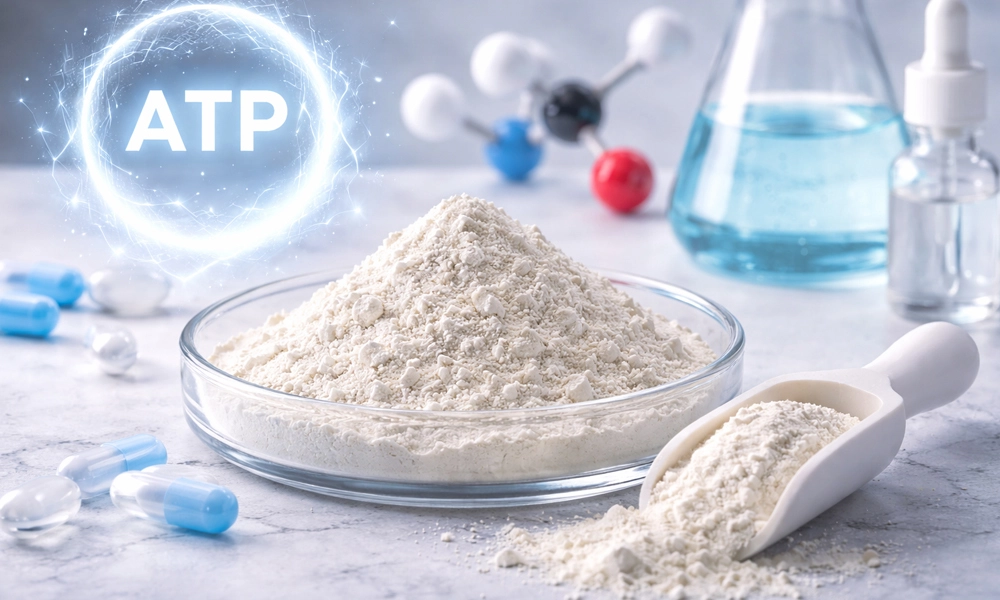
Why ATP vs ADP Matters for Sports Nutrition Brands
Many buyers first encounter the topic of ATP vs ADP when researching energy metabolism or when comparing energy-related ingredients for sports nutrition products. A common misunderstanding is to treat ATP and ADP as two separate “options,” similar to how one might compare different supplement ingredients.
In reality, ATP and ADP are two states of the same energy system, constantly cycling during physical activity. For sports nutrition brands, understanding this cycle helps clarify:
•Why ATP is used as a functional ingredient narrative;
•Why ADP itself is rarely positioned as a supplement ingredient;
•How energy support concepts can be communicated in a scientifically grounded and compliant way.
For procurement teams, this knowledge also supports more informed discussions with suppliers and R&D partners.
ATP and ADP in One Sentence: The Fast Explanation
At its core, ATP is the molecule that stores and releases energy for cellular work, while ADP is the form ATP becomes after energy has been released.
ATP contains three phosphate groups. When one phosphate group is removed, energy is released and ATP becomes ADP. This process is reversible: ADP can be converted back into ATP through metabolic pathways. This continuous ATP–ADP energy cycle is what allows muscles to contract repeatedly during exercise.
This simple explanation is the foundation for understanding ATP vs ADP difference in sports nutrition.
How the ATP–ADP Cycle Works During Exercise
During physical activity, muscle contraction requires a constant supply of energy. That energy comes directly from ATP. When a muscle fiber contracts, ATP is broken down into ADP and inorganic phosphate, releasing energy in the process.
As exercise intensity increases, the rate of ATP breakdown increases significantly. To sustain movement, the body must rapidly regenerate ATP from ADP. This regeneration occurs through several interconnected energy systems, including:
•The phosphagen system (rapid ATP resynthesis)
•Glycolytic pathways
•Oxidative metabolism
From a sports nutrition perspective, the key point is that ATP turnover during exercise is extremely high. Even short bursts of intense activity rely on efficient ATP regeneration. This is why sports nutrition formulations often focus on ingredients that support different parts of the ATP cycle rather than a single energy mechanism.
ATP vs ADP: What’s the Real Difference in Energy Terms?
From an energy metabolism perspective, the distinction between adenosine triphosphate (ATP) and adenosine diphosphate (ADP) is not about two separate substances competing for the same role, but rather about two functional states within a continuous energy cycle.
ATP represents energy in its biologically available form. It is the molecule that directly supplies energy for muscle contraction, ion transport, and other energy-dependent cellular processes. When ATP is hydrolyzed, energy is released and ATP is converted into ADP, marking the transition from energy availability to energy expenditure.
ADP, therefore, does not function as an energy source on its own. Instead, it reflects a post-energy-release state, signaling the need for ATP regeneration through metabolic pathways such as the phosphagen system, glycolysis, and oxidative phosphorylation. This distinction explains why, in sports nutrition and performance-related discussions, ATP is referenced as an energy-supporting concept, while ADP is primarily used as a biochemical indicator of energy turnover rather than a functional ingredient.
For sports nutrition brands and ingredient buyers, understanding this relationship is essential. ATP is discussed because it aligns with energy availability and utilization, whereas ADP serves as a reference point for energy demand and recovery, not as a formulation input.
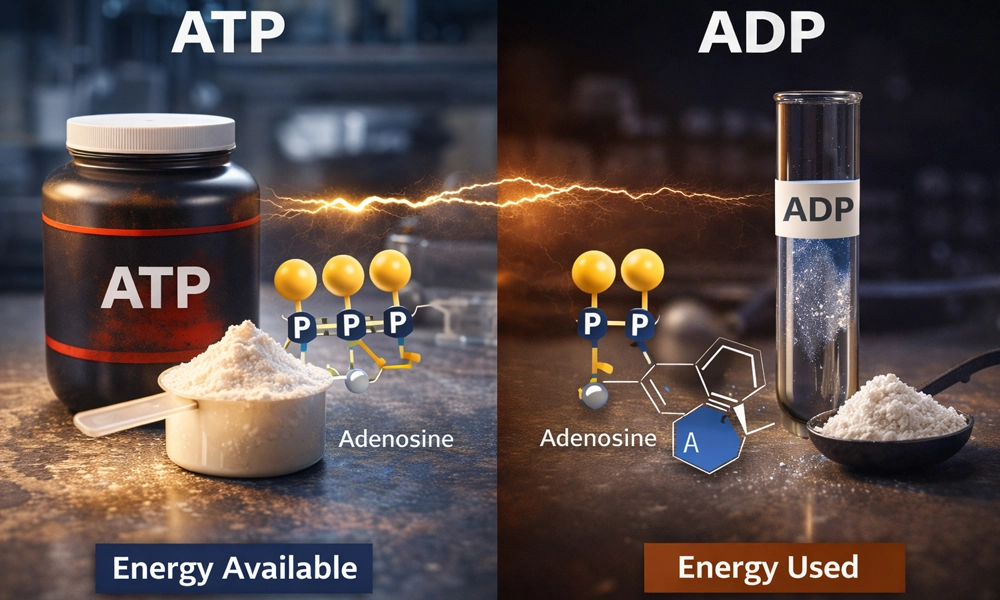
ATP vs ADP: Functional Comparison Table
|
Aspect |
Adenosine Triphosphate (ATP) |
Adenosine Diphosphate (ADP) |
|
Molecular State |
High-energy phosphate form |
Lower-energy phosphate form |
|
Phosphate Groups |
Three phosphate groups |
Two phosphate groups |
|
Functional Role |
Direct energy transfer for cellular work |
Product of ATP hydrolysis after energy release |
|
Role in Muscle Activity |
Fuels muscle contraction and mechanical work |
Indicates energy has been consumed |
|
Position in Energy Cycle |
Energy availability and utilization stage |
Energy demand and regeneration stage |
|
Relevance to Sports Nutrition |
Referenced as a supportive energy metabolism concept |
Used mainly for biochemical explanation, not formulation |
|
Use as Supplement Ingredient |
Yes, discussed in energy-related formulations |
No, not positioned as a functional ingredient |
|
Relationship to Recovery |
Represents usable energy |
Signals need for ATP resynthesis |
Why This Distinction Matters for Sports Nutrition Formulation
From a formulation and sourcing standpoint, this comparison clarifies an important misconception: ATP and ADP are not interchangeable ingredients, nor are they alternatives to one another. They are part of the same biochemical cycle, but only ATP represents energy in a form that is functionally relevant to product positioning.
This is why sports nutrition formulations focus on ATP-related concepts and on ingredients that support ATP availability and regeneration, rather than ADP itself. For buyers, recognizing this difference helps prevent misinterpretation of ingredient roles and supports more accurate communication with R&D teams and suppliers.
Why Supplement Brands Talk About ATP (and Rarely Talk About ADP)
From a product development and marketing perspective, ATP is far more suitable for supplement positioning than ADP.
First, ATP aligns naturally with concepts such as energy metabolism support, training performance, and physical output, all of which are commonly accepted and compliant narratives in sports nutrition.
Second, ADP is best understood as an intermediate state rather than an input. While ADP plays a critical role inside cells, it does not function as a standalone ingredient concept for finished products.
As a result, when buyers search for ATP used in sports nutrition products, they are typically evaluating how ATP supports an energy framework, not comparing ATP and ADP as competing ingredients.
Where ATP Fits in Sports Nutrition Formulas
In real-world formulations, ATP is rarely used alone. Instead, it appears as part of multi-ingredient systems designed to support different aspects of performance and training.
Common product categories where ATP is used include:
•Pre-workout formulations, where ATP supports energy metabolism concepts without increasing stimulant load
•Endurance and performance products, emphasizing sustained physical output
•Recovery and training adaptation formulas, where ATP supports energy restoration routines
In each case, ATP functions as a supporting ingredient, reinforcing the product’s energy narrative rather than acting as a direct stimulant.
ATP vs Creatine vs Caffeine: A Buyer-Friendly Energy Map
To fully understand the role of ATP, it is helpful to compare it with other widely used energy-related ingredients.
ATP is directly involved in energy transfer at the cellular level
Creatine supports rapid regeneration of ATP during short, high-intensity activity
Caffeine primarily affects the central nervous system, increasing alertness and perceived energy
From a formulation standpoint, these ingredients are not interchangeable. Instead, they are often used together to support different stages of the energy cycle. This is why many sports nutrition products combine ATP with creatine or caffeine rather than choosing one over the others.
How Buyers Evaluate ATP Raw Materials
From a procurement perspective, selecting an ATP supplier involves more than reviewing pricing.
Professional buyers typically evaluate:
•Certificate of Analysis (COA) for every batch;
•Clear specification ranges and testing methods;
•Batch-to-batch consistency;
•Traceability and documentation support;
•Stable supply capacity and delivery timelines.
As a nutritional ingredient manufacturer, CHEN LANG BIO TECH works closely with customers to meet these requirements. We supply ATP-related raw materials with complete batch documentation, structured quality control, and consistent production standards. Our experience supporting international customers allows us to respond efficiently to technical and regulatory inquiries, helping buyers reduce sourcing risk and maintain product quality.
FAQ: Common Questions About ATP vs ADP
Does ATP turn into ADP during exercise?
Yes. ATP is converted into ADP when energy is released for muscle contraction.
Is ADP better than ATP for energy?
No. ADP represents energy that has already been used. ATP is the usable energy form.
Why do supplements mention ATP but not ADP?
ATP aligns with energy metabolism support, while ADP is an internal metabolic intermediate.
How does creatine relate to the ATP–ADP cycle?
Creatine supports rapid regeneration of ATP from ADP during high-intensity activity.
Is ATP stable in supplements?
Stability depends on formulation and storage conditions and should be verified with suppliers.
Conclusion: Using the ATP–ADP Cycle to Make Better Product Decisions
Understanding the relationship between ATP and ADP provides valuable insight for sports nutrition brands and ingredient buyers. ATP and ADP are not competing ingredients, but two states of the same energy system, continuously cycling during physical activity.
For product development teams, this knowledge supports better formulation strategies and more credible energy positioning. For procurement teams, it reinforces the importance of sourcing high-quality ATP raw materials from reliable suppliers.
By approaching ATP not as a marketing shortcut, but as part of a well-understood energy cycle, brands can build sports nutrition products that are scientifically grounded, compliant, and aligned with long-term market expectations.
Interested in ATP Raw Materials for Sports Nutrition?
If you would like to receive specifications, COA samples, or technical support related to adenosine triphosphate ingredients, the team at CHEN LANG BIO TECH is available to assist.
📧 Email: admin@chenlangbio.com
References
1, Berg, J. M., Tymoczko, J. L., & Stryer, L. (2015). Biochemistry (8th ed.). W. H. Freeman and Company.
2, Katch, V. L., McArdle, W. D., & Katch, F. I. (2018). Exercise Physiology: Nutrition, Energy, and Human Performance (9th ed.). Wolters Kluwer.
3, Hargreaves, M., & Spriet, L. L. (2020). Skeletal muscle energy metabolism during exercise. Nature Metabolism, 2(9), 817–828.
4, Kenney, W. L., Wilmore, J. H., & Costill, D. L. (2020). Physiology of Sport and Exercise (7th ed.). Human Kinetics.
5, EFSA Panel on Dietetic Products, Nutrition and Allergies (NDA). (2012). Guidance on the scientific requirements for health claims related to physical performance and energy metabolism. EFSA Journal, 10(7), 2817.

Send Inquiry
Related Industry Knowledge
- How Much DHEA Should a Woman Take for Weight Loss?
- Trending Ingredients to Watch: Sodium Polyglutamate
- Top 6 Ways Grape Seed Extract Enhances Overall Wellness
- What Are the Key Applications of Acetylcysteine Powder in Modern Health Supplements?
- Quinoa Seed Extract for Natural Wellness
- Are Hops Good for Gut?
- How to Use Instant Kava Powder for Relaxation?
- What Is The Best Way To Take Fisetin?
- Is Centella Asiatica Extract Powder Good for Skin
- What is Sex Powder