What Is Yohimbine Hydrochloride Powder? Composition, Purity, Testing, and Supplier Guide
2026-07-30 17:04:04
Introduction: What Is Yohimbine Hydrochloride Powder and Why Does Standardization Matter for Raw Material Buyers?
What is yohimbine hydrochloride powder? For professional ingredient buyers, yohimbine hydrochloride powder is a purified alkaloid raw material derived from Pausinystalia yohimbe and supplied in a standardized hydrochloride salt form. Unlike a traditional botanical extract, it represents a defined chemical compound with controlled specifications, making it easier for manufacturers to evaluate, test, and manage during raw material qualification.
When companies source specialty botanical-derived ingredients, the main consideration is not only where the ingredient comes from, but whether the supplier can provide consistent quality, reliable analytical data, and complete technical documentation. This is particularly important for yohimbine HCL, where buyers typically evaluate factors such as purity level, HPLC testing, specification requirements, and batch-to-batch consistency before approving a supplier.
As a professional supplier of botanical-derived active compounds, CHEN LANG BIO TECH provides standardized yohimbine hydrochloride powder with a typical purity specification of 98% tested by HPLC. Our role is not simply to supply a chemical ingredient, but to support global customers with reliable raw materials, quality documentation, and technical information required for supplier evaluation.
For manufacturers, distributors, and research-oriented companies, understanding the identity, composition, and quality standards of yohimbine hydrochloride is the first step toward selecting a suitable raw material source. This guide explains the essential characteristics of yohimbine HCL raw material, including its botanical origin, chemical structure, purity evaluation, testing methods, manufacturing considerations, and how to choose a reliable supplier.
What Is Yohimbine Hydrochloride Powder? Understanding the Standardized Yohimbine HCL Raw Material
Yohimbine hydrochloride powder is the hydrochloride salt form of yohimbine, a naturally occurring indole alkaloid originally obtained from the bark of Pausinystalia yohimbe, a tree native to regions of West Africa. In the raw material industry, yohimbine is valued as a botanical alkaloid compound that can be isolated, purified, and standardized into a consistent ingredient format.
Compared with a whole plant extract, yohimbine HCL powder provides manufacturers with a clearly defined material profile. The production process focuses on obtaining a purified compound with controlled specifications rather than maintaining the complete range of naturally occurring plant constituents found in the original botanical source.
For companies purchasing 98% yohimbine hydrochloride powder, the most important characteristics usually include:
•defined chemical identity;
•controlled purity specification;
•reliable analytical verification;
•consistent physical properties;
•complete quality documentation.
These factors allow manufacturers to establish clear incoming material standards and compare different suppliers based on measurable quality indicators rather than general product descriptions.
In professional raw material sourcing, a supplier’s ability to provide analytical evidence is often as important as the ingredient itself. A qualified yohimbine hydrochloride supplier should be able to provide documentation such as a Certificate of Analysis (COA), product specification sheet, and analytical testing records to support customer quality requirements.
Yohimbine Hydrochloride Source and Raw Material Classification: From Botanical Alkaloid to Standardized Ingredient
The origin of yohimbine hydrochloride begins with Pausinystalia yohimbe, a botanical source known for containing naturally occurring alkaloid compounds. During raw material manufacturing, the objective is to separate and purify the target alkaloid before converting it into the hydrochloride salt form used for standardized ingredient supply.
Understanding the difference between botanical source and final ingredient format is important for buyers evaluating yohimbine raw material. The original plant material and the finished purified compound are not the same product category.
A botanical extract generally contains multiple components from the plant matrix, while purified yohimbine hydrochloride powder represents a more specifically characterized ingredient.
|
Category |
Description |
|
Botanical Source |
Pausinystalia yohimbe bark |
|
Ingredient Type |
Purified botanical alkaloid |
|
Chemical Form |
Hydrochloride salt |
|
Commercial Format |
White crystalline powder |
|
Quality Evaluation |
Purity assay, identification, analytical testing |
For manufacturers, this distinction affects how the raw material is managed throughout the supply chain. A standardized compound allows companies to define clearer specifications, establish more predictable quality control procedures, and maintain consistency between different production batches.
This is why many professional buyers searching for a yohimbine powder supplier focus on more than product availability. They evaluate whether the supplier has the analytical capability, manufacturing experience, and documentation system necessary to support long-term cooperation.
Why Manufacturers Choose Standardized Yohimbine HCL Instead of Non-Standardized Botanical Materials
The growing demand for standardized botanical ingredients has increased the importance of quality consistency in raw material procurement. When manufacturers evaluate yohimbine hydrochloride powder, they are usually looking for a material that fits into a controlled production environment.
A purified compound provides several practical advantages during supplier qualification:
First, the ingredient identity is clearly established. Buyers can confirm that the material corresponds to the specified compound through analytical testing rather than relying only on botanical descriptions.
Second, the quality specification is easier to define. For example, a buyer sourcing yohimbine hydrochloride manufacturer products can establish acceptance criteria based on parameters such as assay percentage, appearance, and analytical results.
Third, standardized materials simplify communication between suppliers and customers. International buyers often work with multiple quality departments, regulatory teams, and production facilities. Clear specifications and supporting documentation help reduce uncertainty during the purchasing process.
For this reason, companies looking for a bulk yohimbine hydrochloride supplier typically prioritize suppliers that can demonstrate stable manufacturing processes, transparent testing procedures, and consistent product quality.
At CHEN LANG BIO TECH, our approach focuses on combining botanical ingredient expertise with controlled quality management, allowing customers to source specialty raw materials with greater confidence.
Yohimbine Hydrochloride Composition: Understanding Chemical Identity and Specification Requirements
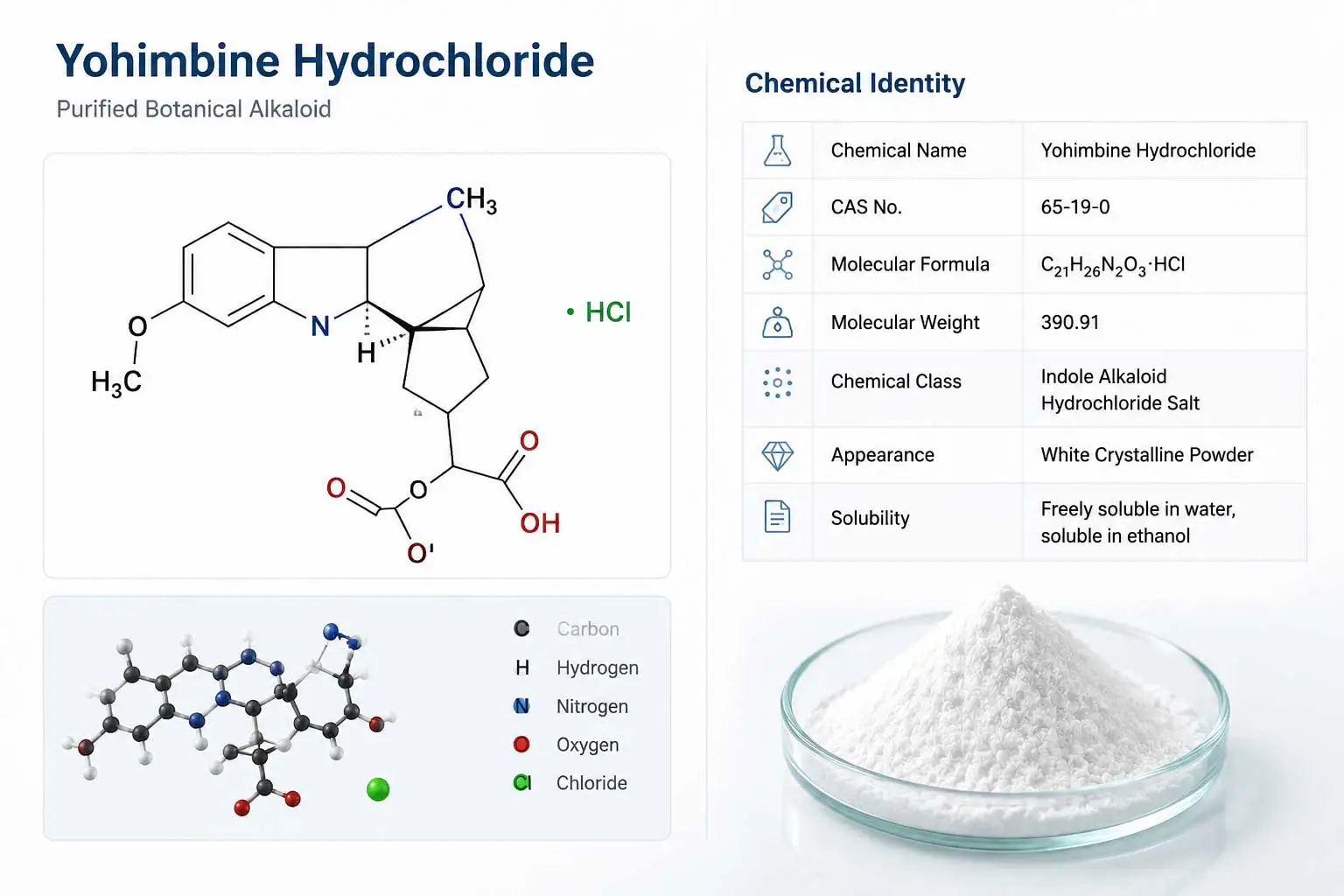
Chemical Structure, CAS Information, and Molecular Characteristics of Yohimbine HCL
For companies purchasing yohimbine hydrochloride powder, understanding the chemical identity of the ingredient is an essential part of supplier qualification. A professional buyer does not evaluate a raw material only by its product name; the material must be clearly identified through chemical information, analytical testing, and specification documents.
Yohimbine hydrochloride composition refers to the defined chemical structure of yohimbine in its hydrochloride salt form. The hydrochloride form is commonly supplied as a white crystalline powder with a controlled specification for industrial applications.
The basic chemical information of yohimbine hydrochloride includes:
|
Parameter |
Specification |
|
Product Name |
Yohimbine Hydrochloride |
|
CAS No. |
65-19-0 |
|
Molecular Formula |
C21H26N2O3·HCl |
|
Molecular Weight |
390.91 |
|
Chemical Classification |
Indole alkaloid hydrochloride salt |
|
Appearance |
White crystalline powder |
For international buyers, these specifications are not simply technical data. They are used during supplier approval, customs documentation, quality review, and internal material registration.
For example, when a manufacturer receives a new raw material, its quality team typically verifies whether the supplied ingredient matches the declared identity through:
•CAS number confirmation;
•analytical test results;
•specification comparison;
•batch documentation review.
This is why reliable yohimbine hydrochloride supplier companies provide complete technical information instead of only offering a product quotation.
Why Chemical Identity Matters When Purchasing Yohimbine HCL Raw Material
The chemical identity of a raw material determines how easily it can be controlled throughout the supply chain.
For purified ingredients such as yohimbine HCL, buyers usually expect a clearly defined specification because the material is purchased based on measurable characteristics rather than general botanical descriptions.
A complete specification sheet allows buyers to answer several practical questions before placing an order:
•Is the supplied material the correct compound?
•Does the purity meet the agreed requirement?
•Can the supplier provide batch-to-batch consistency?
•Are the analytical methods clearly defined?
For companies purchasing bulk yohimbine hydrochloride, these details reduce uncertainty during supplier qualification and help avoid problems caused by inconsistent documentation or unclear product standards.
A professional supplier should be able to provide: yohimbine hydrochloride specification together with supporting analytical information, allowing customers to evaluate the ingredient before commercial purchase.
Yohimbine Hydrochloride Purity Standards: What Buyers Should Know Before Sourcing
Understanding 98% Yohimbine HCL Purity and Analytical Verification
When buyers search for 98% yohimbine hydrochloride powder, purity is usually one of the first specifications they review. However, experienced ingredient purchasers understand that a purity number alone does not provide a complete quality assessment.
A reliable yohimbine hydrochloride manufacturer should define how purity is measured, which analytical method is used, and whether the result is supported by batch-specific documentation.
For commercial yohimbine HCL purity evaluation, buyers commonly focus on:
|
Quality Parameter |
Why It Matters |
|
Assay value |
Confirms the content of the target compound |
|
Analytical method |
Determines reliability of the test result |
|
Batch number |
Provides traceability |
|
Testing date |
Confirms quality status |
|
Specification limit |
Defines acceptance criteria |
A product described as “98% yohimbine hydrochloride” should ideally be supported by a Certificate of Analysis (COA) showing the actual analytical result from that production batch.
This distinction is important because two suppliers may both claim the same purity level, but their quality systems, testing procedures, and documentation standards may differ significantly.
For professional buyers, supplier evaluation should therefore include not only the stated purity but also:
•how the purity is tested;
•whether the testing method is consistent;
•whether records are available;
•whether the supplier can maintain the same specification over repeated orders.
Yohimbine HPLC Testing: How Purity and Identity Are Verified
Understanding HPLC Analysis for Yohimbine Hydrochloride Quality Control
Yohimbine HPLC testing is one of the most important analytical procedures used to evaluate the quality of yohimbine hydrochloride powder.
High-performance liquid chromatography (HPLC) is widely used in pharmaceutical and specialty ingredient industries because it can separate, identify, and quantify specific compounds within a sample.
For yohimbine hydrochloride purity verification, HPLC testing helps determine:
•whether the target compound content meets specification;
•whether the material has consistent analytical characteristics;
•whether the batch matches the supplier’s quality statement.
A professional yohimbine HCL supplier should be able to provide relevant analytical documentation, such as:
|
Document |
Purpose |
|
HPLC Report |
Shows purity testing result |
|
COA |
Confirms batch quality information |
|
Specification Sheet |
Defines product requirements |
|
SDS/MSDS |
Provides handling information |
For overseas buyers, these documents are especially important because they support internal approval procedures before importing raw materials.
A supplier who can provide transparent analytical records demonstrates stronger quality management compared with suppliers who only provide a product name and price.
How to Evaluate a Yohimbine Hydrochloride COA Before Purchasing
Key Information Buyers Should Check in a Certificate of Analysis
A yohimbine hydrochloride COA is one of the most important documents during supplier evaluation. However, many buyers focus only on the purity result and overlook other details that can affect material reliability.
A complete COA should normally include:
|
COA Information |
Buyer Purpose |
|
Product name |
Confirms material identity |
|
Batch number |
Enables traceability |
|
Manufacturing date |
Supports inventory management |
|
Test items |
Shows quality evaluation scope |
|
Test results |
Confirms specification compliance |
|
Testing method |
Ensures analytical transparency |
When reviewing a COA from a potential yohimbine powder supplier, buyers should compare the document with the product specification sheet to confirm that all requirements are aligned.
For example, if a customer requires 98% yohimbine hydrochloride, the COA should clearly indicate:
· the tested assay result;
· the analytical method;
· the acceptance standard.
This level of documentation is particularly important for distributors and manufacturers supplying international markets, where raw material traceability and quality records are often required.
Yohimbine Hydrochloride Manufacturing Process and Quality Control Considerations
From Botanical Source to Standardized Yohimbine HCL Powder
The production of yohimbine hydrochloride involves multiple controlled steps designed to transform a botanical source into a standardized ingredient.
Although specific manufacturing parameters vary between producers, a professional production process generally includes raw material identification, extraction, purification, conversion into hydrochloride form, crystallization, drying, and final analytical testing.
The overall process can be summarized as:
|
Production Stage |
Quality Focus |
|
Botanical raw material evaluation |
Source identification and material consistency |
|
Extraction process |
Efficient recovery of target alkaloid |
|
Purification |
Removal of unwanted components |
|
Hydrochloride formation |
Establishment of final chemical form |
|
Crystallization and drying |
Physical quality control |
|
Final testing |
Confirmation of specification compliance |
For buyers selecting a yohimbine hydrochloride manufacturer China, understanding production capability is important because manufacturing control directly affects final product consistency.
A reliable supplier should combine:
•controlled production procedures;
•analytical testing capability;
•experienced quality management;
•complete documentation support.
How to Choose a Reliable Yohimbine Hydrochloride Supplier: A Buyer’s Evaluation Guide
Selecting a reliable yohimbine hydrochloride supplier requires a broader evaluation than comparing product specifications or quotation prices. For specialty botanical-derived ingredients, the supplier’s manufacturing capability, technical understanding, communication efficiency, and ability to support long-term cooperation are equally important.
When companies source yohimbine hydrochloride powder for commercial projects, the main challenge is not simply finding a supplier that can provide the ingredient, but identifying a partner who can maintain consistent quality and provide reliable support throughout the purchasing process.
A professional supplier evaluation usually focuses on the following areas.
1. Evaluate Whether the Supplier Understands the Ingredient and Its Application Requirements
A qualified yohimbine hydrochloride manufacturer should understand that this ingredient is not a standard commodity where price is the only consideration. Because it is a specialty alkaloid raw material, buyers usually need accurate technical information before making purchasing decisions.
A capable supplier should be able to clearly communicate:
•product specifications;
•raw material characteristics;
•storage requirements;
•packaging options;
•documentation availability;
•suitable supply formats.
This technical understanding helps buyers avoid common sourcing problems, such as receiving incomplete information, unclear specifications, or inconsistent product descriptions between suppliers.
For companies purchasing yohimbine hydrochloride powder, supplier knowledge and responsiveness are often strong indicators of long-term cooperation potential.
2. Consider Manufacturing Capability and Supply Stability
For international buyers, selecting a yohimbine hydrochloride manufacturer China is not only about finding a lower-cost source. The more important question is whether the supplier can maintain stable production and support repeated orders over time.
A reliable manufacturing partner should have:
•controlled production procedures;
•experienced technical personnel;
•stable raw material sourcing channels;
•consistent quality management;
•the ability to support different order requirements.
This is particularly important for distributors and manufacturers who need a dependable bulk yohimbine hydrochloride supplier rather than a one-time transaction.
Supply stability directly affects inventory planning, customer delivery schedules, and the ability to maintain consistent finished products.
3. Assess the Supplier’s Ability to Support International Business Requirements
For overseas buyers, communication and export experience are important parts of supplier selection.
A professional yohimbine HCL supplier should understand the practical requirements involved in international ingredient purchasing, including:
•commercial documentation;
•export arrangements;
•packaging requirements;
•shipment coordination;
•technical communication across different time zones.
Many sourcing issues are not caused by the ingredient itself but by unclear communication during the purchasing process. A supplier who can respond efficiently and provide accurate information helps reduce unnecessary delays.
For global customers, reliable communication is often an important factor when choosing between similar suppliers.
4. Look for Flexible Supply Solutions Instead of One-Size-Fits-All Service
Different customers have different purchasing requirements. A research organization may need a small evaluation quantity, while a distributor may require regular bulk supply.
A professional yohimbine powder supplier should be able to support different project stages, including:
•sample evaluation;
•small-batch purchasing;
•regular commercial orders;
•customized packaging requirements.
Flexible supply capability allows customers to establish cooperation gradually and adjust purchasing plans according to market demand.
5. Evaluate Long-Term Cooperation Potential
The best supplier relationship is built on consistency rather than a single successful shipment.
When selecting a yohimbine hydrochloride supplier, buyers should consider whether the supplier can provide continuous support as their business develops.
Important factors include:
•stable product quality;
•professional technical communication;
•transparent business processes;
•reliable response after order placement.
For specialty ingredients, a long-term supplier relationship can reduce sourcing risks and improve supply chain efficiency.
CHEN LANG BIO TECH focuses on supplying standardized botanical-derived ingredients and supporting customers with practical technical information throughout the sourcing process. For companies evaluating bulk yohimbine hydrochloride supply, our team can provide product specifications, documentation support, and project-based sourcing assistance.
Documentation Support: What Buyers Should Request from a Yohimbine Powder Supplier
For global ingredient purchasing, documentation is an essential part of supplier qualification.
A professional yohimbine powder supplier should be prepared to provide technical documents that allow customers to evaluate the material before commercial cooperation.
Commonly requested documents include:
|
Document |
Purpose |
|
Certificate of Analysis (COA) |
Confirms batch-specific quality results |
|
HPLC report |
Provides analytical verification of purity |
|
Specification sheet |
Defines product parameters |
|
SDS/MSDS |
Provides handling and safety information |
|
Packaging information |
Supports logistics planning |
For distributors and manufacturers, complete documentation also helps maintain internal records and support downstream customers.
A supplier’s ability to provide accurate and consistent documents often reflects the maturity of its quality management system.
Bulk Yohimbine Hydrochloride Supply: Packaging, MOQ, and Logistics Considerations
For companies purchasing bulk yohimbine hydrochloride, supply conditions are another important part of supplier evaluation.
Before placing an order, buyers typically confirm:
|
Supply Factor |
Key Question |
|
MOQ |
Does the supplier support the required order quantity? |
|
Packaging |
Is the packaging suitable for international transportation? |
|
Lead time |
Can the supplier meet the required delivery schedule? |
|
Documentation |
Are export documents available? |
|
Communication |
Can technical questions be answered efficiently? |
A professional supplier should provide clear information regarding packaging, shipment preparation, and order coordination.
For specialty ingredients, a stable supply relationship is usually built through consistent communication and reliable quality rather than a single transaction.
Frequently Asked Questions About Yohimbine Hydrochloride Powder
What is yohimbine hydrochloride powder?
Yohimbine hydrochloride powder is a purified hydrochloride salt form of yohimbine, a botanical alkaloid originally derived from Pausinystalia yohimbe. It is supplied as a standardized raw material with defined specifications and analytical requirements.
What is the purity specification of 98% yohimbine hydrochloride powder?
Commercial 98% yohimbine hydrochloride powder is typically evaluated through analytical testing such as HPLC to confirm the assay value and ensure the material meets the agreed specification.
How is yohimbine hydrochloride tested?
Yohimbine HPLC testing is commonly used to verify purity and identity. Buyers should request batch-specific analytical data, including the testing method and results.
What documents should buyers request from a yohimbine HCL supplier?
When evaluating a supplier, buyers commonly request:
•COA;
•HPLC report;
•specification sheet;
•SDS/MSDS;
•packaging information.
These documents help confirm product quality and support supplier qualification.
Can manufacturers purchase yohimbine hydrochloride in bulk?
Yes. Qualified suppliers can provide bulk yohimbine hydrochloride according to customer requirements, including different order quantities, packaging options, and technical documentation support.
Conclusion: Selecting the Right Yohimbine Hydrochloride Supplier Based on Quality and Reliability
The value of yohimbine hydrochloride powder as a raw material is not determined only by its purity specification. For professional buyers, a reliable ingredient source requires a combination of standardized production, analytical verification, documentation support, and consistent supply capability.
When evaluating a yohimbine hydrochloride supplier, manufacturers and distributors should focus on measurable factors, including:
•clearly defined product specifications;
•reliable HPLC testing;
•complete COA documentation;
•stable production capability;
•professional technical communication.
Choosing the right supplier helps companies reduce quality risks and establish a more predictable raw material supply chain.
For customers evaluating 98% yohimbine hydrochloride powder, requesting technical documents, or discussing bulk supply requirements, CHEN LANG BIO TECH can provide product specifications, analytical information, and sourcing support.
You can contact our technical team for further information:
Email: admin@chenlangbio.com
WhatsApp: +86-17782478823
We are available to discuss raw material specifications, documentation requirements, and supply solutions based on your project needs.

Send Inquiry
Related Industry Knowledge
- How to Choose the Right Saw Palmetto Extract Supplier for Your Supplement Brand
- Hyaluronic Acid Powder for Joint Health: The Essential Ingredient for Your Supplement Formulations
- Top 6 Ways Grape Seed Extract Enhances Overall Wellness
- How Does Calcium Alpha-Ketoglutarate Monohydrate Support Bone Health?
- Can Chondroitin Sulfate Powder Improve Skin Health?
- Red Wine Extract Powder: Benefits and Uses
- Is Nitenpyram Safe for Pets
- Does Bakuchiol Build Collagen
- Regulate Immunity Pure Natural Quercetin
- What is Melatonin Extract Powder