What Is NAD Powder? Structure, Function, Properties and Commercial Applications
2026-08-17 10:56:22
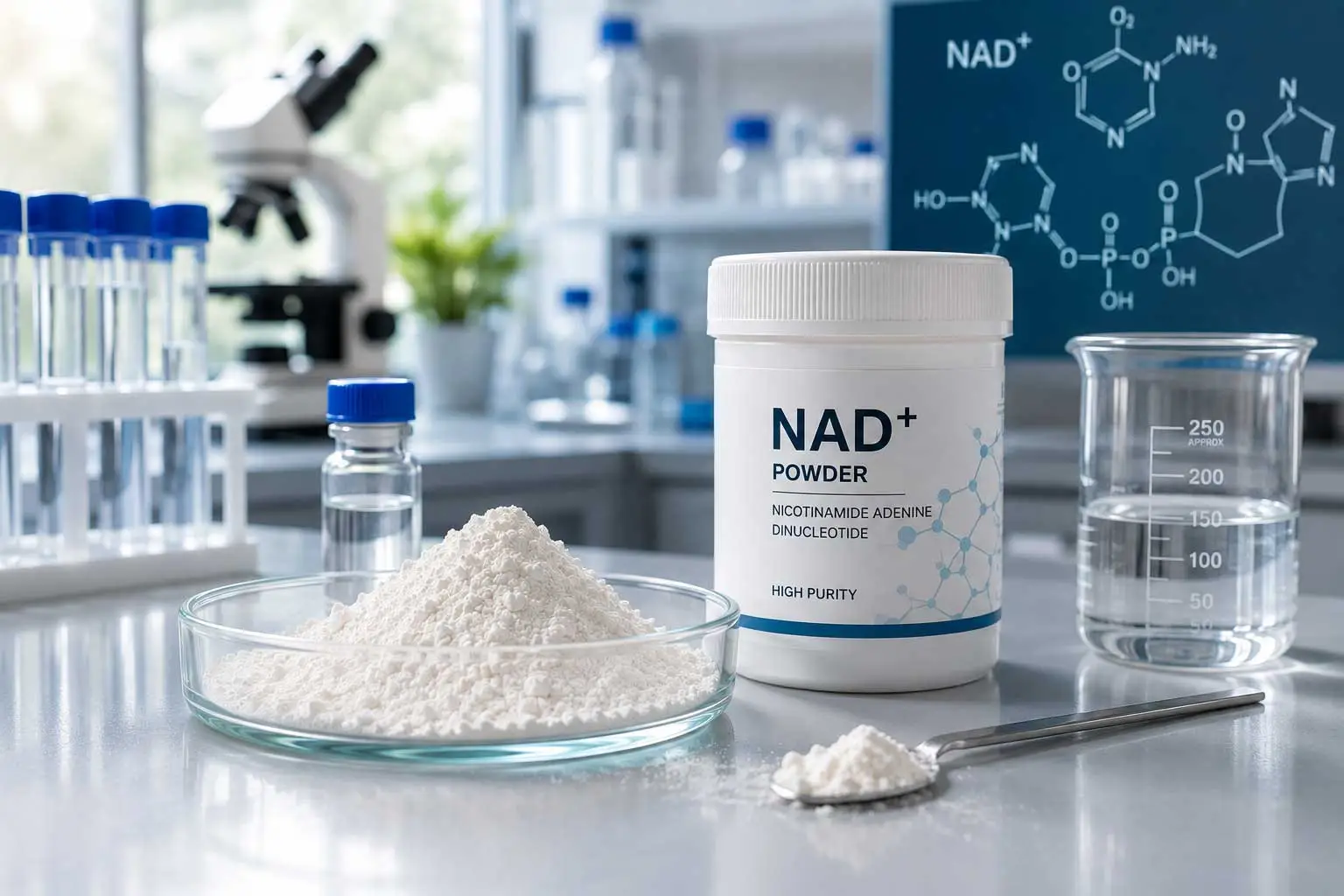
NAD powder is a powdered form of nicotinamide adenine dinucleotide, most commonly referring to the oxidized coenzyme NAD⁺ supplied as a defined raw material. At the biological level, NAD⁺ participates in redox reactions central to cellular metabolism. At the commercial level, however, NAD+ powder must be treated as a technical ingredient whose suitability depends on chemical identity, assay, chromatographic purity, impurity profile, moisture, stability, storage conditions and the requirements of the intended formulation.
That distinction matters to supplement manufacturers and ingredient buyers. Scientific information describing what NAD⁺ does inside cells does not establish whether a particular commercial batch is suitable for a capsule, tablet or other finished product. A manufacturer evaluating nicotinamide adenine dinucleotide powder therefore needs to understand both sides of the material: the chemistry and biological function of NAD⁺, and the quality characteristics that define a commercially usable NAD raw material.
What Is NAD Powder and How Is It Different from NAD⁺ in the Body?
To answer what is NAD powder, it helps to separate the molecule from the commercial ingredient. NAD is the common abbreviation for nicotinamide adenine dinucleotide, a coenzyme naturally present in living cells. NAD⁺ is its oxidized form, while NADH is the corresponding reduced form produced when NAD⁺ accepts reducing equivalents during metabolic reactions.
Commercial NAD powder, by contrast, is an isolated material manufactured and supplied for a defined application. It may contain NAD⁺ at a specified assay or purity level, but the product also has its own manufacturing process, specification, impurity profile, moisture characteristics, packaging and storage requirements.
|
Term |
Practical Meaning |
|
NAD |
General abbreviation for nicotinamide adenine dinucleotide |
|
NAD⁺ |
Oxidized form of the coenzyme |
|
NADH |
Reduced form of the NAD redox pair |
|
NAD powder |
Commercial powdered NAD material defined by its chemical form and quality specification |
For procurement purposes, the label “NAD” is therefore not enough. A buyer should establish the exact chemical form being purchased and then evaluate the corresponding specification. This is especially important when comparing an NAD ingredient from different sources because similar product descriptions do not necessarily mean equivalent analytical or quality standards.
NAD⁺ Chemical Structure and Molecular Properties
What Is the Chemical Structure of NAD⁺?
The NAD chemical structure consists of two nucleotide units joined through their phosphate groups. One contains adenine and the other contains nicotinamide, with ribose and phosphate groups forming the remainder of the dinucleotide structure.
For oxidized β-NAD⁺, PubChem identifies the molecular formula as C₂₁H₂₇N₇O₁₄P₂ and reports a molecular weight of approximately 663.4 g/mol. These values are useful for establishing chemical identity, but they should not be confused with a commercial raw-material specification. Molecular formula describes the compound; it does not tell a buyer the assay, water content or impurity profile of a particular production batch.
The nicotinamide portion of the NAD+ structure is particularly important to its redox chemistry because it is the part of the molecule that undergoes reversible reduction and oxidation between NAD⁺ and NADH.
Why NAD⁺ Structure Matters for Commercial Formulation
The molecular characteristics of NAD⁺ help explain why formulators need to consider aqueous behavior, pH, moisture and chemical stability rather than treating the material like an inert powder.
At the same time, molecular structure alone cannot predict the performance of a finished formulation. Commercial NAD powder chemical properties must be evaluated alongside measured raw-material characteristics and the conditions created by excipients, processing and packaging. This distinction prevents a common formulation mistake: taking a chemical property reported for isolated NAD⁺ and assuming that a multi-ingredient commercial product will behave identically.
How Does NAD⁺ Function? Redox Reactions and Cellular Metabolism
The best-established NAD function is its role as a redox coenzyme. NAD⁺ can accept reducing equivalents during metabolic reactions and is converted to NADH; NADH can subsequently participate in reactions in which those reducing equivalents are transferred and NAD⁺ is regenerated.
This reversible relationship is fundamental to the NAD NADH redox reaction and allows the coenzyme pair to connect multiple metabolic pathways.
NAD⁺ and NADH in Cellular Energy Metabolism
NAD⁺/NADH participates in pathways including glycolysis, the tricarboxylic acid cycle and oxidative metabolism. Rather than acting as an energy source itself, the coenzyme functions as an electron carrier that helps cells transfer reducing equivalents between biochemical reactions.
NAD⁺ also serves as a substrate for NAD-consuming enzymes, including sirtuins and poly(ADP-ribose) polymerases. These functions have made NAD metabolism an active area of biochemical and biomedical research.
For commercial ingredient evaluation, however, it is important not to convert biochemical mechanisms directly into finished-product claims. Understanding NAD cellular function establishes the scientific identity and relevance of the molecule; substantiating claims for a particular supplement is a separate regulatory and product-specific question.
NAD⁺ vs NADH Powder: What Is the Difference?
NAD+ vs NADH is fundamentally a distinction between two redox states of the nicotinamide adenine dinucleotide system.
|
Property |
NAD⁺ |
NADH |
|
Redox state |
Oxidized |
Reduced |
|
Basic redox role |
Accepts reducing equivalents |
Reduced electron carrier |
|
Chemical identity |
Oxidized NAD |
Reduced NAD |
|
Commercial specification |
NAD⁺-specific |
NADH-specific |
|
Interchangeable raw materials? |
No |
No |
Although NAD⁺ and NADH participate in the same biological redox system, they should not be treated as interchangeable commercial ingredients. Their chemical states differ, and each material requires its own analytical methods, stability assessment, specification and formulation evaluation.
Consequently, a buyer comparing NAD powder vs NADH powder should first decide which chemical form is intended for the product rather than comparing the two materials only by purity or price. The appropriate supplier documentation should explicitly identify the material being supplied.
What Are the Physical and Chemical Properties of NAD Powder?
Understanding NAD powder properties requires another distinction between intrinsic molecular characteristics and properties of a manufactured powder.
Appearance and Physical Form of Commercial NAD Powder
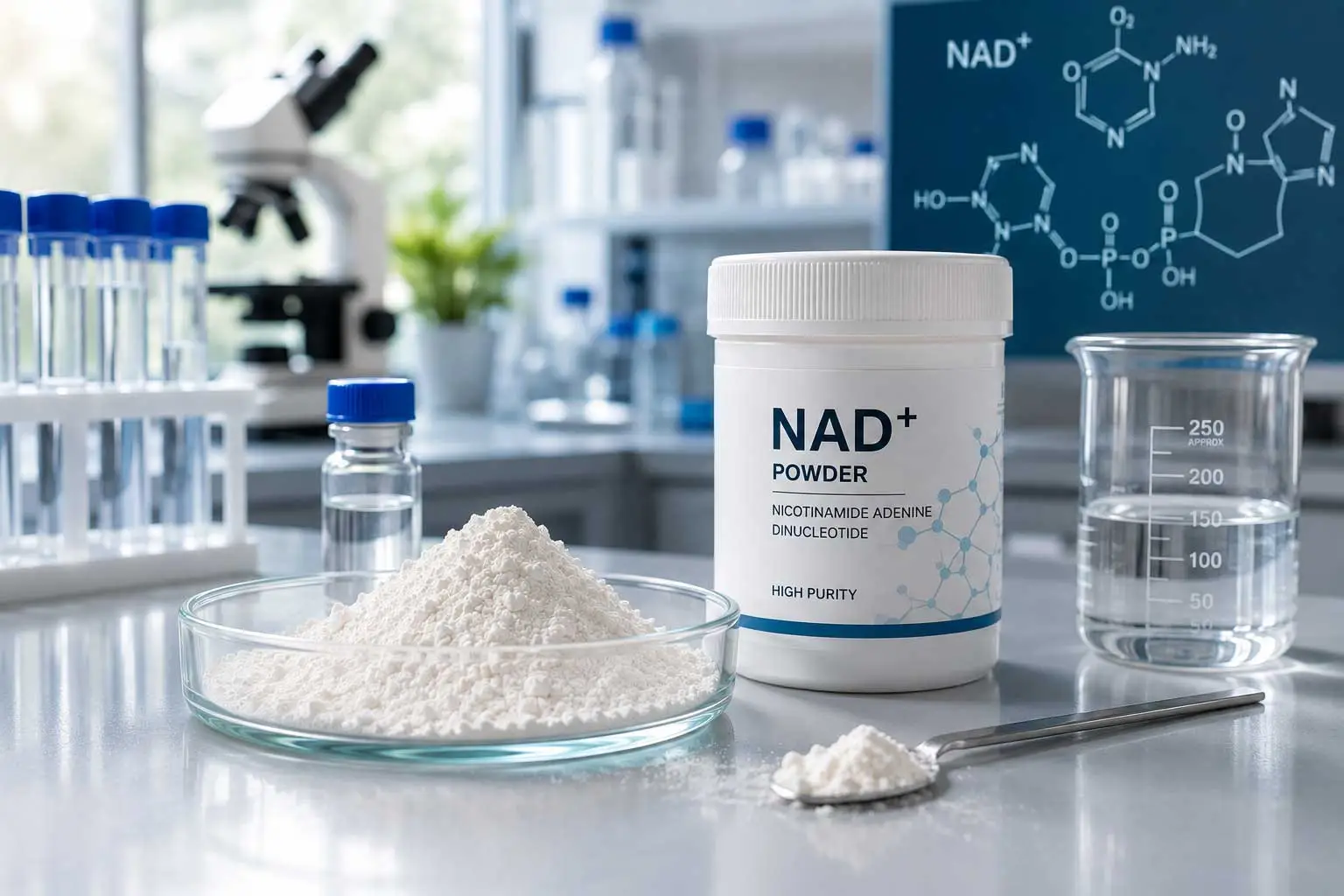
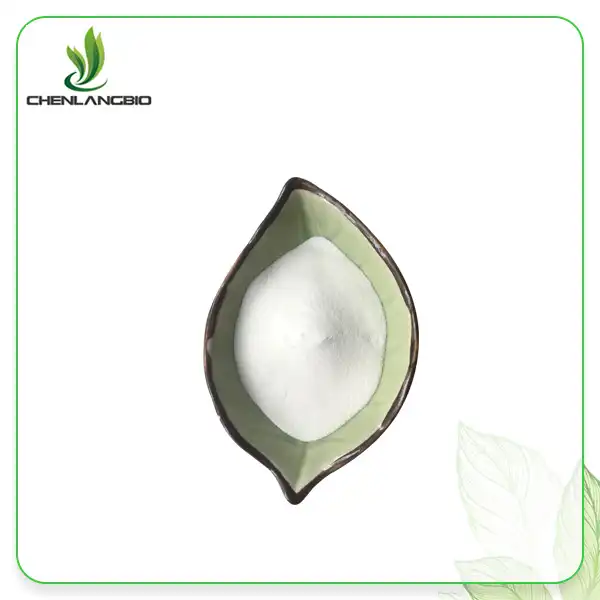
Commercial NAD⁺ is commonly supplied as a light-colored powder, but appearance should be evaluated against the supplier's actual specification rather than an internet photograph or generic description.
Properties such as particle-size distribution, bulk density, tapped density and flow behavior are characteristics of a particular commercial powder rather than fixed constants of the NAD⁺ molecule. They can become important during weighing, blending and encapsulation, especially when NAD represents a substantial proportion of the formulation.
This means that a manufacturer changing supplier may need to evaluate physical properties even when the new material meets a similar chemical purity specification.
Is NAD Powder Water Soluble?
The question is NAD powder water soluble is particularly relevant to formulators. NAD⁺ is a polar, hydrophilic molecule and is routinely handled in aqueous systems in biochemical applications. However, that fact should not be interpreted as evidence that NAD⁺ will remain stable in every water-based commercial formulation.
Practical NAD powder solubility can need evaluation at the intended concentration and under the actual formulation conditions, including pH, temperature, ionic environment and the presence of other ingredients.
In other words, raw-material solubility and finished-product compatibility are different questions.
NAD Powder Stability and Storage Characteristics
NAD powder stability is influenced by its environment. Dry material stored in sealed packaging can behave very differently from NAD⁺ after dissolution or incorporation into another formulation.
For a commercial buyer, the relevant NAD powder storage conditions are those established for the specific supplier grade. Temperature, moisture exposure, packaging and handling after opening should be considered together rather than assuming that all commercial NAD⁺ materials have identical storage requirements or shelf lives.
Commercial NAD Powder Specifications: What Do Purity and Assay Actually Mean?
A percentage printed beside a product name can be useful, but it is not enough to qualify an ingredient.
NAD Powder Purity vs Assay
When evaluating NAD powder purity, buyers should determine exactly what the reported number represents. Chromatographic purity may describe the relative distribution of peaks detected under an HPLC method, whereas assay is intended to quantify the amount of the target substance according to the specified analytical procedure.
These values may both appear as percentages, but they do not necessarily answer the same question.
An NAD powder HPLC result should therefore be interpreted in the context of the method, reference standard and reporting basis. Likewise, NAD powder assay should be reviewed together with identity and other relevant specification parameters.
This is why purchasing high purity NAD powder solely by comparing advertised percentages can be misleading. Two materials carrying similar headline purity figures may differ in assay basis, related-substance control, water content or other quality characteristics.
What Should Be Included in an NAD Powder Specification?
The appropriate NAD powder specification depends on the grade and intended application, but commercial buyers may expect to review parameters such as:
•identity;
•assay;
•chromatographic purity;
•related substances or impurity controls;
•water or moisture;
•residual solvents where relevant;
•heavy metals; and microbiological limits where applicable.
A useful NAD raw material specification defines acceptance criteria clearly enough for both supplier and buyer to understand what constitutes an acceptable batch. Requirements should ultimately be aligned with the intended formulation, applicable market and the manufacturer's own quality system.
How Is Commercial NAD Powder Quality Tested?
Effective NAD powder testing should answer specific quality questions rather than simply generate a long test list.
Identity, Assay and HPLC Testing for NAD Powder
Identity testing establishes whether the material is what it claims to be. Assay determines the amount of the target compound according to the specified method, while chromatography can be used to evaluate NAD⁺ and relevant related substances.
HPLC is particularly useful because NAD degradation can generate chemically related compounds that need to be distinguished analytically. Published work has described an RP-HPLC method capable of separating NAD from degradation products including ADP-ribose and nicotinamide, illustrating why analytical specificity matters when stability is being evaluated.
The test method is therefore part of the quality story. A result such as “≥99%” has limited technical value if a buyer does not know what was measured.
Why the COA Should Be Reviewed Batch by Batch
An NAD powder COA and a specification serve different functions.
The specification defines the acceptance criteria; the certificate of analysis reports results for an actual batch.
During initial supplier evaluation, a representative NAD powder certificate of analysis can help a buyer understand typical documentation. Once commercial material is ordered, however, the relevant COA should correspond to the supplied lot.
That connection between specification, batch identity and actual test results is considerably more meaningful than a generic purity statement on a product page.
What Are the Main Commercial Applications of NAD Powder?
The appropriate NAD powder applications depend on ingredient grade, formulation requirements and the regulatory framework of the destination market. Scientific use of NAD⁺ does not automatically establish permission for every food, supplement or therapeutic application.
NAD Powder for Dietary Supplement Formulations
One important commercial area is the evaluation of NAD powder for supplements. For a supplement manufacturer, the development question extends beyond biological function to whether the ingredient can be incorporated into a stable, manufacturable finished product.
Potential dosage formats may include capsules, tablets and powder systems, depending on the formulation and applicable regulatory requirements. Each introduces different considerations involving powder behavior, excipients, processing and stability.
An NAD supplement ingredient should consequently be qualified for the actual product being developed rather than selected only from general scientific information about NAD⁺.
NAD Powder for Capsules
NAD powder for capsules provides a useful example. Once a target active loading has been established, formulators need to consider bulk density, flow, fill volume, excipients, blend uniformity and the selected capsule shell.
A high assay does not establish good capsule-filling performance. Likewise, the shelf life of the original raw powder does not establish the shelf life of an NAD capsule formulation after encapsulation.
For commercial manufacturing, formulation trials and pilot-scale evaluation can therefore be valuable before a large raw-material commitment is made.
NAD Powder for Research and Other Technical Applications
NAD⁺ also has established laboratory and biochemical research uses. However, a research reagent and a commercial NAD raw material intended for another application should not be assumed equivalent simply because both contain NAD⁺.
Grade, manufacturing controls, specifications, documentation and intended use can differ substantially. Procurement teams should therefore source material according to the actual application rather than attempting to qualify a product on chemical name alone.
NAD Powder Formulation Considerations for Supplement Manufacturers
For NAD powder formulation, the raw material is only one component of a larger system.
|
Factor |
Commercial Formulation Question |
|
Dosage form |
Is the product a capsule, tablet or powder system? |
|
Solubility |
Does the formulation require NAD⁺ to dissolve? |
|
Excipients |
How do other components change the formulation environment? |
|
Moisture |
What exposure occurs during production and storage? |
|
Processing |
Are water, heat or extended hold times involved? |
|
Stability |
Does NAD⁺ remain within specification over shelf life? |
|
Packaging |
What barrier properties does the finished product require? |
These questions explain why NAD powder for supplement manufacturing should not be evaluated entirely from a raw-material COA. An ingredient can meet its incoming specification and still require formulation adjustments to achieve acceptable processing or finished-product stability.
This distinction becomes even more important in multi-ingredient products, where other materials can alter moisture, pH or physical characteristics. The practical objective of an NAD supplement formulation program is therefore to demonstrate that the complete product—not just the isolated active—performs as intended.
NAD Powder Packaging, Storage and Shelf Life
How Should Bulk NAD Powder Be Stored?
The first source for how to store NAD powder should be the storage instructions established for the specific commercial grade.
In general, raw-material handling should minimize unnecessary exposure to conditions that could compromise the material. Containers should be properly resealed after sampling or dispensing, and temperature, humidity and light conditions should follow the approved specification or supplier documentation.
For bulk NAD powder storage, packaging also matters. Barrier properties, closure integrity and the way the material is handled after opening can influence the actual storage environment.
What Determines NAD Powder Shelf Life?
An NAD powder shelf life should be tied to a specific material, packaging system and set of storage conditions supported by appropriate stability information.
This is why there is no technically responsible universal shelf-life number for every NAD powder sold commercially. Supplier grade, packaging and stability program can differ.
Manufacturers should also avoid transferring the raw-material shelf life directly to a finished supplement. Once NAD⁺ enters a capsule, tablet or multi-ingredient powder, a new formulation and packaging system has been created.
How Should Buyers Evaluate Commercial NAD Powder?
A useful procurement process for commercial NAD powder combines documentation review with application-specific qualification.
The buyer should first confirm the exact NAD form and chemical identity, then review the current specification and understand how assay and chromatographic purity are measured. A representative COA can provide an initial view of batch documentation, while impurity controls, moisture, storage conditions and shelf-life information help establish a broader quality profile.
The next step should reflect the intended use. If the material will enter a commercial supplement, requesting an NAD powder sample allows the formulation team to perform its own analytical and processing evaluation before committing to production quantities.
A practical qualification sequence is:
identity and specification review → COA assessment → sample evaluation → formulation trial → internal qualification → commercial supply approval
This approach makes NAD powder quality a combination of chemical conformity and fitness for the intended manufacturing process rather than a competition over the highest advertised purity number.
Choosing an NAD Powder Supplier for Commercial Applications
Once the technical requirements are established, supplier evaluation becomes considerably more meaningful.
What Documents Should an NAD Powder Supplier Provide?
A prospective NAD powder supplier should be able to provide the documentation needed to identify and evaluate the material. Depending on the project, this may include a current specification, representative COA, analytical information, safety data, packaging information, recommended storage conditions and stated shelf life.
A buyer comparing an NAD powder manufacturer or NAD raw material supplier should also consider batch consistency and the supplier's ability to support recurring demand. Reliable commercial sourcing is not simply a matter of receiving one acceptable sample; subsequent production lots need to remain within the agreed specification.
Documentation requirements may vary by destination market, so they are best discussed before commercial ordering rather than after material has been produced or shipped.
From NAD Powder Sample to Bulk Commercial Order
For a new project, the path to buy NAD powder in bulk should normally begin before price negotiation becomes the deciding factor. First establish that the grade is technically appropriate; then confirm sample performance and commercial requirements.
Once qualification is progressing, procurement can discuss expected volume, NAD powder MOQ, packaging, lead time, shipping arrangements and the basis of the NAD powder price. A meaningful NAD powder quotation should correspond to a defined grade, quantity and destination rather than an isolated price-per-kilogram figure with no supply context.
At CHEN LANG BIO TECH, discussions for new NAD⁺ projects typically begin with the intended application and technical requirements. Providing the approximate quantity and destination market allows us to supply relevant documentation and sample information before the project progresses toward a bulk NAD powder order.
FAQ About NAD Powder
What is NAD powder?
NAD powder is a powdered commercial form of nicotinamide adenine dinucleotide, commonly referring to NAD⁺. NAD⁺ is a naturally occurring cellular coenzyme involved in redox metabolism, while commercial powder is a manufactured raw material defined by specifications covering identity, assay, purity and other quality characteristics.
What is NAD powder made from?
At the molecular level, NAD⁺ contains nicotinamide and adenine nucleotide components connected through phosphate groups. Its molecular formula is C₂₁H₂₇N₇O₁₄P₂. The exact commercial composition of a supplied powder should be confirmed from its specification rather than inferred solely from the molecular formula of NAD⁺.
What is the difference between NAD⁺ and NADH?
NAD⁺ is the oxidized form of the coenzyme, while NADH is its reduced form. They participate in the same cellular redox system but are chemically distinct forms and should not be treated as interchangeable commercial raw materials.
Is NAD powder water soluble?
NAD⁺ is hydrophilic and is widely used in aqueous biochemical systems. However, NAD powder solubility in isolation does not establish stability or compatibility in a commercial liquid or multi-ingredient formulation. Those properties should be tested under the actual formulation conditions.
What is NAD powder used for commercially?
NAD powder uses include biochemical and research applications, and commercial NAD⁺ may also be evaluated as an ingredient for supplement formulations where appropriate for the intended market. Capsules, tablets and powder systems each require application-specific formulation and stability assessment.
How should NAD powder quality be evaluated?
Buyers should evaluate NAD powder purity together with identity, assay, chromatographic methods, relevant impurity controls, moisture, storage information and the NAD powder COA. A single headline purity percentage is not sufficient for complete raw-material qualification.
Can supplement manufacturers request an NAD powder sample before bulk purchasing?
Yes. An NAD powder sample allows manufacturers to review analytical quality and evaluate the material in the intended formulation before purchasing bulk NAD powder. For new supplier qualification, sample testing can reduce the risk of discovering compatibility or manufacturing issues after commercial quantities have already been ordered.
Understanding NAD Powder Beyond the Label
NAD powder is easy to describe by name, but much harder to evaluate properly as a commercial ingredient. For buyers, the meaningful differences are found in the details: the exact NAD⁺ form being supplied, how assay and purity are defined, which impurities are controlled, how the material should be stored, and whether the available documentation is sufficient for the intended formulation and market.
That is why two products both sold as “NAD powder” should not automatically be treated as equivalent. A useful technical review looks beyond the headline purity figure and considers the full specification, analytical methods, batch data and the way the material will actually be handled in production.
At CHEN LANG BIO TECH, we are happy to provide product specifications, representative COAs and sample information when a customer needs to evaluate NAD⁺ for a new project. Technical or purchasing questions can be sent to Email:admin@chenlangbio.com, preferably with the intended application and approximate quantity so that we can respond with information relevant to the material under consideration.

Send Inquiry
Related Industry Knowledge
- Rhodiola Rosea Extract Powder: Standardization, Active Markers, and Industrial Applications
- Ajuga turkestanica Extract Benefits for Muscle Growth and Recovery
- Ergothioneine Powder for Sports Nutrition: Benefits, Recovery Applications, and Supplier Guide
- Can Kaempferol Help with Inflammation?
- Is Kopexil Better Than Minoxidil for Hair Loss?
- How Long Does It Take to See Results with Minoxidil?
- What are the Benefits of Camellia Oleifera Seed Extract
- Should Green Tea Extract be Taken with Food
- Phenylethyl Resorcinol Skin Benefits
- China Phellinus Linteus Extract Powder Supplier