
Oyster Peptide vs Oyster Extract: Key Differences for Nutrition Applications
2025-12-26 19:43:15
In nutrition and supplement development, oyster-derived ingredients are often discussed as a single category, yet oyster peptide and oyster extract represent two distinctly different ingredient types. For formulators and buyers, understanding this difference is not simply a technical detail—it directly affects formulation performance, labeling clarity, and long-term product consistency.
From our experience working with international customers, questions around oyster peptide vs oyster extract usually arise during ingredient selection for supplements and functional foods. While both originate from oysters, they differ significantly in processing methods, composition, and how reliably they can be standardized. These differences become especially relevant when products are designed for repeated production and regulated markets.
As a manufacturer supplying oyster peptide ingredients for nutrition applications, we find that sourcing decisions are best made by looking beyond ingredient names. In this article, we compare oyster peptides and oyster extracts from a practical perspective, focusing on processing, composition, and application considerations. The goal is to provide a clear framework that helps brands and formulators choose the option that best fits their specific nutritional and production requirements.
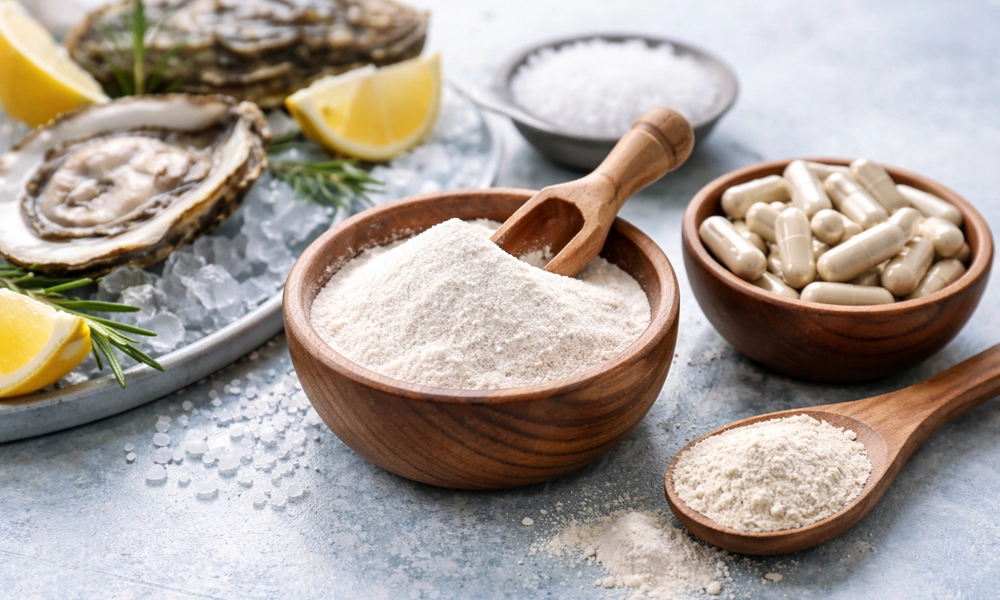
What Is Oyster Peptide Powder?
Oyster peptide powder is a functional ingredient produced by enzymatically breaking down edible oyster protein into short-chain peptides. Unlike whole oyster powder or broad-spectrum extracts, this process yields a material with a more defined peptide profile, which can be measured, standardized, and consistently reproduced across batches. For buyers asking what is oyster peptide powder, the key distinction lies in structure and process rather than origin alone.
From a production standpoint, oyster peptide powder is designed to deliver peptides within a controlled molecular weight range. This characteristic supports predictable behavior in formulation, including solubility and compatibility with other ingredients. As a result, low molecular weight oyster peptides are commonly specified in technical documentation for supplements and functional foods that require uniform performance.
Another important aspect for procurement teams is standardization. As an oyster peptide powder manufacturer, we see that peptide content, molecular distribution, and physical properties can be consistently defined when production is managed in-house under controlled conditions. This level of control allows buyers to evaluate the ingredient based on clear specifications rather than variable raw-material characteristics.
In practical terms, oyster peptide powder is best viewed as an ingredient format tailored for nutrition applications that prioritize repeatability and clarity. This makes it particularly suitable for brands and formulators who need reliable inputs for ongoing production, labeling accuracy, and quality management—considerations that often drive ingredient selection in regulated markets.
What Is Oyster Extract?
Oyster extract refers to an ingredient obtained by extracting soluble components from oyster raw material, typically using water or food-grade solvents. Unlike peptide ingredients, extracts are not designed to modify protein structure at the molecular level. For buyers asking what is oyster extract, it is best understood as a broader nutritional concentrate rather than a structurally defined ingredient.
In most cases, oyster extracts are produced through soaking, heating, or solvent-based processes that draw out a wide range of oyster-derived compounds. The resulting material may contain proteins, minerals, and other naturally occurring substances in varying proportions. Because this approach focuses on overall extraction rather than targeted breakdown, oyster extract powder often reflects greater variability between batches.
From a formulation perspective, oyster extracts are typically valued for their general nutritional profile rather than for precise functional characteristics. Their composition can be influenced by factors such as raw material quality, seasonal variation, and processing conditions. This variability is an important consideration when comparing oyster extract vs oyster peptide, especially for products that require consistent performance and labeling accuracy.
In practice, oyster extract is commonly used in applications where a broad-spectrum ingredient is acceptable and where exact standardization is less critical. Understanding these production and compositional differences helps buyers and formulators determine whether oyster extract aligns with their specific nutrition and manufacturing requirements.
Processing Differences: Enzymatic Hydrolysis vs Extraction
The fundamental difference between oyster peptide and oyster extract lies in how each ingredient is produced. While both originate from the same raw material, the processing approach determines whether the final ingredient can be precisely defined and consistently reproduced.
Oyster peptide manufacturing process is centered on enzymatic hydrolysis. In this approach, food-grade enzymes are applied under controlled conditions to break down oyster protein into shorter peptide chains. Parameters such as temperature, pH, and reaction time are carefully managed to achieve a targeted molecular weight range. This level of control allows manufacturers to produce peptides with predictable characteristics, including solubility and composition.
By contrast, the oyster extract production process is designed to recover soluble components rather than to modify protein structure. Extraction methods typically rely on water or solvents to concentrate a wide range of oyster-derived substances. Because proteins are not selectively broken down, the resulting extract retains a more complex and less defined composition. This makes standardization more challenging, particularly across multiple production batches.
From a practical standpoint, how oyster peptides are made directly affects their suitability for modern nutrition applications. Enzymatic hydrolysis enables manufacturers to specify peptide content and molecular distribution, which supports consistent formulation outcomes. Extraction, while effective for creating broad nutritional concentrates, offers less control over structural uniformity.
For buyers and formulators, these processing differences translate into real-world implications. Ingredients produced through controlled hydrolysis are generally easier to document, label, and scale in regulated markets. Understanding the distinction between enzymatic hydrolysis and extraction helps clarify why oyster peptide and oyster extract are not interchangeable, even when sourced from the same raw material.
Composition and Consistency: What You Can (and Can’t) Standardize
Differences in processing methods directly influence how oyster-derived ingredients can be defined and standardized. For nutrition applications that require consistency across batches, understanding these compositional distinctions is essential when comparing oyster peptide and oyster extract.
Because oyster peptides are produced through controlled enzymatic hydrolysis, their composition can be described using measurable parameters. Factors such as peptide content, molecular weight distribution, and solubility are commonly specified, making oyster peptide molecular weight and oyster peptide content meaningful indicators for quality assessment. This level of definition supports repeatable formulation outcomes and clearer communication between suppliers and buyers.
In contrast, oyster extracts typically contain a broader and less uniform mix of components. While they may provide a wide nutritional profile, the exact proportions of proteins, peptides, and other compounds can vary depending on raw material and extraction conditions. As a result, oyster extract composition is often described in more general terms, which may limit the degree of standardization achievable across production runs.
From a manufacturing and sourcing perspective, this difference affects more than just specifications. Ingredients with clearly defined composition are easier to integrate into quality management systems, particularly for products intended for long-term market supply. This is one reason why oyster peptides are frequently selected for applications where consistency and documentation are critical, while oyster extracts may be used in contexts where broader variability is acceptable.
Ultimately, the ability—or inability—to standardize an ingredient shapes how it is positioned within nutrition formulations. Recognizing what can be reliably controlled helps formulators align ingredient choice with product goals, regulatory expectations, and production scale.
Solubility and Formulation Performance in Nutrition Products
In practical formulation work, solubility and processing behavior often determine whether an ingredient is suitable for a specific nutrition product. Even when two ingredients share the same raw material origin, differences in structure and composition can lead to very different outcomes during manufacturing and use.
Because oyster peptides consist of shorter peptide chains, they generally exhibit more predictable dissolution behavior in water-based systems. This characteristic is particularly relevant for powdered blends, ready-to-mix beverages, and sachet products, where uniform dispersion is required. For formulators evaluating oyster peptide solubility, peptide-based ingredients are often easier to handle during mixing and reconstitution.
By comparison, oyster extracts may contain a wider range of molecular components, including intact proteins and other insoluble fractions. This can result in variability in oyster extract solubility, especially when applied in liquid or instant formats. While extracts may still be suitable for certain applications, additional processing or formulation adjustments are sometimes needed to achieve consistent results.
From a performance standpoint, formulation reliability becomes increasingly important as products scale from pilot batches to commercial production. Ingredients that dissolve consistently and behave predictably under standard processing conditions reduce the risk of batch variation. This is one reason why oyster peptides are frequently selected as oyster peptides for supplements where repeatability, stability, and ease of use are key formulation priorities.
For nutrition manufacturers, aligning ingredient choice with formulation requirements helps streamline development and supports long-term production efficiency. Understanding how solubility and performance differ between oyster peptides and oyster extracts allows teams to make informed decisions early in the product design process.
Which One Is Better for Supplements? Choosing Based on Your Use Case
When comparing oyster peptide and oyster extract for supplement use, the better option depends on the intended application rather than on the ingredient name alone. Each format serves a different purpose within nutrition product development, and understanding this distinction helps avoid unnecessary reformulation or supply challenges.
Oyster peptides are typically selected when consistency and clarity are priorities. Their defined peptide profile allows formulators to work with measurable specifications, making oyster peptide vs oyster extract for supplements a practical question of control versus breadth. In products where repeatable performance, solubility, and documentation are required, peptides often provide a more predictable foundation.
Oyster extracts, on the other hand, are more commonly used when a broad nutritional profile is acceptable and formulation flexibility allows for some variation. In these cases, the extract format may align with products positioned around general nutrition rather than precise functional targets. This difference explains why oyster extract supplement applications are often found in formulations where standardization is less critical.
For teams developing supplements intended for long-term production and international distribution, ingredient selection is closely tied to quality management. Choosing an oyster peptide supplement ingredient can simplify specification control and batch-to-batch consistency, while oyster extract may be more suitable for products with shorter production cycles or localized markets.
Ultimately, the decision should be guided by formulation goals, regulatory context, and supply requirements. Viewing oyster peptide and oyster extract as complementary rather than interchangeable options allows manufacturers to match ingredient format to use case with greater confidence.
Labeling, Safety, and Market Positioning Considerations
When oyster-derived ingredients are used in nutrition products, labeling and market positioning often influence ingredient choice as much as formulation performance. Differences between oyster peptide and oyster extract extend beyond processing and composition into how each ingredient is presented and managed within regulatory frameworks.
From a labeling perspective, ingredients with clearly defined composition offer greater transparency. Because oyster peptides are produced with controlled parameters, their specifications can be documented in a more precise manner, which supports consistent product labeling. This clarity is particularly relevant when addressing questions such as are oyster peptides safe, where safety is demonstrated through manufacturing standards and ingredient documentation rather than implied functionality.
Oyster extracts, by contrast, are typically described using broader ingredient terms. While this approach can suit certain market positions, it may limit how precisely composition and content can be communicated. For brands operating in multiple regions, this difference can affect compliance strategy, especially when safety and ingredient identity must be clearly supported. Reviewing oyster extract safety information within the context of intended use is therefore an important part of formulation planning.
Market positioning also plays a role. Products formulated with oyster peptides are often positioned around ingredient precision and formulation control, while oyster extract-based products may emphasize traditional or whole-source nutrition concepts. Understanding these distinctions allows brands to align ingredient choice with both regulatory expectations and product messaging.
For manufacturers and buyers, integrating labeling, safety, and positioning considerations early in development helps reduce downstream adjustments. Aligning ingredient format with compliance requirements and market goals ensures that oyster-derived ingredients are used responsibly and effectively across nutrition applications.
Conclusion — Making an Informed Choice Between Oyster Peptide and Oyster Extract
Oyster peptide and oyster extract are derived from the same marine source, yet they serve different purposes in nutrition product development. As this comparison shows, the distinction lies not in naming, but in processing approach, compositional control, and how each ingredient performs in real-world formulations.
Oyster peptides offer a more defined and standardized format, making them suitable for applications where consistency, documentation, and formulation reliability are essential. Oyster extracts, by contrast, provide a broader nutritional profile that may fit products where flexibility and traditional sourcing concepts are prioritized. Understanding these differences allows formulators and buyers to align ingredient choice with product goals rather than assumptions.
From a manufacturing perspective, informed ingredient selection reduces reformulation risk and supports long-term production stability. When oyster-derived ingredients are evaluated based on processing transparency, compositional clarity, and application requirements, the decision between peptide and extract becomes more straightforward and defensible.
Ultimately, neither format is universally better. The right choice depends on how the ingredient is expected to perform within a specific nutrition system. Approaching this decision with a clear technical framework supports responsible formulation and sustainable product development.
Call to Action
If you are evaluating oyster-derived ingredients for supplements or functional nutrition products and would like to review specifications, production details, or bulk supply options, our team is available to support your assessment.
As an experienced oyster peptide manufacturer, CHEN LANG BIO TECH works with international partners to provide consistent ingredients backed by clear documentation and manufacturing transparency. For technical inquiries, sample requests, or sourcing discussions related to oyster peptide powder, please contact us through our official website. We are ready to support your formulation and supply needs with reliable, production-driven solutions.
Email: admin@chenlangbio.com
Web: http://www.chenlangbio.com
Whatsapp: +86-17782478823

Send Inquiry
Related Industry Knowledge
- Is PQQ Supplementation Safe?
- Can Loratadine Cause Weight Gain
- Who Should Not Take Alpha-GPC
- What Is Lysozyme Powder
- Can Bakuchiol Help With Acne
- What Does Coenzyme Q10 Do for Your Body
- What Does Black Pepper Extract Do for Your Body
- Where to Buy High quality Argireline Powder
- Where to Buy Praziquantel Powder
- What Pure Nature Raspberry Ketone Good For