How to Choose a Reliable Zeaxanthin Powder Supplier?
2026-09-08 16:10:51
Choosing a zeaxanthin powder supplier is not simply a matter of comparing assay values and asking for the lowest quotation. A reliable supplier should be able to demonstrate that the product being offered is correctly identified, consistently manufactured, analytically verified, appropriately packaged and suitable for the customer’s intended formulation. For international ingredient buyers, the more important question is whether the supplier can reproduce the approved material from sample stage through repeated commercial orders.
That distinction is particularly important with zeaxanthin because commercial materials can differ substantially. A conventional concentrated powder, a standardized botanical ingredient and a CWS microencapsulated grade may all be sold under the general name “zeaxanthin powder,” yet they are not technically interchangeable. Their assay, carrier system, dispersibility, processing behavior and formulation suitability can be very different.
At CHEN LANG BIO TECH, we approach zeaxanthin supply as an integrated raw-material program rather than a simple trading transaction. Our work begins upstream with marigold sourcing and continues through extraction, production, quality control, analytical release, documentation and commercial delivery. For buyers, that structure provides a more useful basis for supplier qualification than marketing language alone.
Start with the Zeaxanthin Powder Specification, Not Marketing Claims
A zeaxanthin powder specification should be the starting point for any supplier comparison. Terms such as “premium quality,” “high purity” or “natural grade” have limited procurement value unless they are supported by clearly defined technical parameters.
The first task is to determine exactly what product is being quoted. A conventional high-assay zeaxanthin powder is not equivalent to a lower-assay microencapsulated product designed for aqueous dispersion. Likewise, a powder intended for capsules may not be the most appropriate choice for an instant beverage or solid drink.
A useful specification should define the active zeaxanthin content, physical form, assay basis and analytical method. For formulated grades, buyers should also understand whether carriers or wall materials are present and how those materials contribute to the finished powder.
Moisture, microbiological limits, heavy-metal requirements and other contaminant controls should be evaluated according to the intended market and application. Physical properties become more important when they affect manufacturing performance, particularly for CWS or microencapsulated products.
The central purchasing principle is simple:
A supplier cannot be compared meaningfully until the zeaxanthin grades being quoted are technically equivalent.
This prevents one of the most common sourcing mistakes: comparing two prices for materials that only share the same product name.
How Should Buyers Verify Zeaxanthin Assay and HPLC Testing?
A zeaxanthin HPLC assay provides more useful information than a visual assessment of powder color. Zeaxanthin is a carotenoid, and related xanthophylls can occur in botanical materials. Chromatographic analysis helps separate the target compound before quantitative determination.
The assay result should clearly indicate how much active zeaxanthin is present in the commercial ingredient. This becomes especially important with formulated products.
For example, a 5% CWS grade is not automatically a “lower-purity” version of a 20% conventional powder. The CWS product may intentionally contain carrier materials that create the required physical properties for dispersion and protection. Its 5% result represents the standardized active content of the finished ingredient.
This distinction is why zeaxanthin purity test terminology should be handled carefully. Assay, active content and chemical purity are related concepts, but they are not always interchangeable in a formulated delivery system.
When evaluating analytical information, buyers should ask whether the method is appropriate for the product and whether the COA clearly identifies the basis on which the assay is reported. The supplier should also be able to explain unusual values rather than simply repeating the number shown on the certificate.
At CHEN LANG BIO TECH, HPLC is part of our analytical quality-control capability for carotenoid ingredients. The objective is not simply to produce a certificate, but to connect the analytical result to a defined batch and an agreed product specification.
How to Read a Zeaxanthin COA Before Approving a Supplier
A zeaxanthin COA is one of the most important documents in supplier qualification, but it should not be read as a marketing brochure.
The specification establishes the acceptance criteria for the ingredient. The zeaxanthin certificate of analysis reports the results obtained for a specific batch.
That difference matters.
If the approved specification requires a minimum assay, the COA should report whether the batch meets that requirement. The lot or batch number should also correspond with the material supplied. Relevant manufacturing, release, expiry or retest information should be consistent with the supplier’s document-control system.
For food and supplement applications, the COA may also include microbiological and contaminant parameters according to the agreed specification. These results are most meaningful when numerical values are provided where appropriate, rather than relying entirely on generic “Pass” statements.
A useful rule for procurement teams is:
A specification tells you what a batch must meet; a COA tells you what the tested batch actually achieved.
The COA should therefore support batch approval, while the specification defines the product that the supplier has agreed to deliver.
Marigold Source and Traceability Matter When Choosing Natural Zeaxanthin
For a natural zeaxanthin supplier, raw-material control begins long before extraction.
Marigold, particularly Tagetes erecta, is an important botanical raw material for commercial carotenoid production. Agricultural sourcing introduces natural variability that does not exist to the same extent with a chemically uniform synthetic feedstock. Growing region, cultivar, harvest condition and post-harvest handling can all influence the incoming raw material.
CHEN LANG BIO TECH supports natural carotenoid production through a marigold cultivation and sourcing network covering more than 200,000 mu across Yunnan, India and Zambia.
The value of this scale is not simply acreage. Multiple growing regions support raw-material continuity and reduce dependence on one harvest location. A structured sourcing network also makes it easier to connect agricultural origin with processing records and finished-product traceability.
For buyers evaluating a marigold zeaxanthin supplier, this upstream control matters because batch consistency starts with the raw material entering the plant.
Traceability should therefore connect the supply chain in both directions: finished batch to production record, production record to incoming botanical material, and incoming material to an identifiable sourcing origin.
That relationship becomes particularly important when a customer requires repeated commercial supply rather than a one-time sample.
Manufacturer or Trader? Why Production Control Changes Supplier Risk
A zeaxanthin manufacturer and a distributor can both provide value, but they play different roles in the supply chain.
A competent distributor may offer local stock, regional logistics, language support or shorter domestic lead times. Those advantages can be important for many buyers.
Direct manufacturing control provides a different type of value. A manufacturer can usually access production records, investigate process-related changes, connect analytical results to specific manufacturing stages and respond more directly when a batch behaves differently from expectation.
For natural carotenoid processing, manufacturing scale also has to match agricultural supply.
CHEN LANG BIO TECH has developed continuous counter-current extraction equipment for large-scale botanical processing, with raw-material input capacity reaching up to 30 metric tons per day. Counter-current operation supports efficient mass transfer while allowing a continuous industrial processing model rather than relying solely on small batch extraction.
For procurement teams, the importance of this capacity is commercial continuity. A supplier may be able to provide a few kilograms for evaluation, but industrial buyers also need confidence that approved specifications can be reproduced when annual requirements increase.
Production control therefore reduces a different category of risk from logistics support: it helps the buyer understand how the ingredient itself is made and controlled.
Conventional vs CWS Zeaxanthin: Can the Supplier Recommend the Right Grade?
A technically capable supplier should be able to explain when microencapsulated zeaxanthin powder is useful and when it is unnecessary.
Conventional zeaxanthin is strongly lipophilic and does not behave like a freely water-soluble ingredient. In dry capsules, tablets or oil-compatible systems, that may not present a major formulation problem.
A beverage or instant powder creates a different requirement.
A water dispersible zeaxanthin powder uses a carrier or encapsulation system to improve wetting and distribution in an aqueous phase. This is commonly described commercially as CWS, or cold-water-dispersible functionality.
The important point is that CWS technology changes the delivery system, not the fundamental molecular identity of zeaxanthin.
A supplier should therefore ask where the material will be used before recommending a grade. A capsule manufacturer may prioritize assay and powder handling, while a solid-drink developer may care much more about reconstitution behavior.
The most useful formulation principle is:
The correct zeaxanthin grade is determined by the finished application, not by choosing the highest assay available.
This is one reason we discuss application requirements with customers before finalizing a specification.
What Stability Data Should a Zeaxanthin Supplier Be Able to Discuss?
Zeaxanthin stability data should correspond to the grade actually being purchased.
Carotenoids contain conjugated double-bond systems that can be affected by light, heat and oxygen. For commercial powders, moisture and the surrounding carrier system can also influence physical stability and powder handling.
A supplier should therefore be able to explain the recommended zeaxanthin storage conditions, packaging approach and declared shelf life for the selected product.
That does not mean every supplier must present the same stability-study format. It does mean that storage recommendations should have a technical basis and should not be copied indiscriminately from another grade.
A microencapsulated powder may behave differently from an unformulated high-assay material. Likewise, a sealed package in storage represents a very different environment from an open blending vessel during manufacturing.
For buyers, the important question is not simply “What is the shelf life?” but “What product form, packaging and storage conditions does that shelf-life statement represent?”
Certifications Are Useful, but They Do Not Replace Product-Level Evidence
Zeaxanthin supplier certification can help evaluate a company’s broader management systems, particularly when international food or supplement customers have formal vendor-approval requirements.
CHEN LANG BIO TECH’s wider quality and management systems include BRCGS, ISO 9001, ISO 22000, ISO 14001 and ISO 45001, together with KOSHER, HALAL, FAMI-QS and SEDEX-related programs. Our products are supplied to international markets across Europe, the Americas, Oceania, Africa and parts of Asia.
Those certifications are valuable, but they serve a different purpose from a batch COA.
A management-system certificate tells the buyer something about the company’s procedures and controls. It does not prove the zeaxanthin content of the specific drum being delivered.
For this reason:
Management-system certification supports supplier qualification, but the agreed specification and batch-level analytical results remain central to product approval.
That distinction gives certifications their proper role without turning them into marketing substitutes for technical evidence.
Why Batch-to-Batch Consistency Matters More Than One Excellent Sample
A zeaxanthin batch testing program is valuable because supplier qualification should extend beyond the first sample.
An excellent development sample may confirm that a grade is technically suitable, but the real commercial requirement is repeatability.
The tenth production batch should still meet the same approved specification. For CWS products, the requirement may also include comparable dispersion behavior. For conventional powders, assay, physical characteristics and relevant quality parameters should remain controlled within the approved range.
This is why zeaxanthin batch consistency matters more than one unusually impressive analytical result.
Normal manufacturing and analytical variation can occur, but that variation should remain within specification and should be understood by the supplier.
A useful supplier qualification principle is:
Supplier approval is not the approval of one sample; it is confidence that future commercial batches can reproduce the approved material.
This is where raw-material control, production records and batch-level QC become commercially important.
Why a Zeaxanthin Powder Sample Should Be Tested in the Actual Formulation
A zeaxanthin powder sample should be used to answer a formulation question, not merely to confirm that the powder looks orange.
For a capsule project, the customer may need to examine blending and content uniformity. Tablet development may introduce compression or granulation conditions. Gummies involve an aqueous matrix and heat exposure. Solid drinks require reconstitution testing.
For a CWS grade, visual dispersion in water can be useful, but the finished formula is more important than a glass of purified water. Acids, minerals, proteins, sweeteners or hydrocolloids can alter physical behavior.
A representative sample therefore helps connect documentation with actual application performance.
At CHEN LANG BIO TECH, we encourage customers to evaluate the selected grade under their intended process conditions before commercial scale-up. This reduces the risk of discovering formulation incompatibility after a larger order has already been placed.
Packaging Should Protect Zeaxanthin During International Supply
Zeaxanthin powder packaging is part of product protection, not simply shipping presentation.
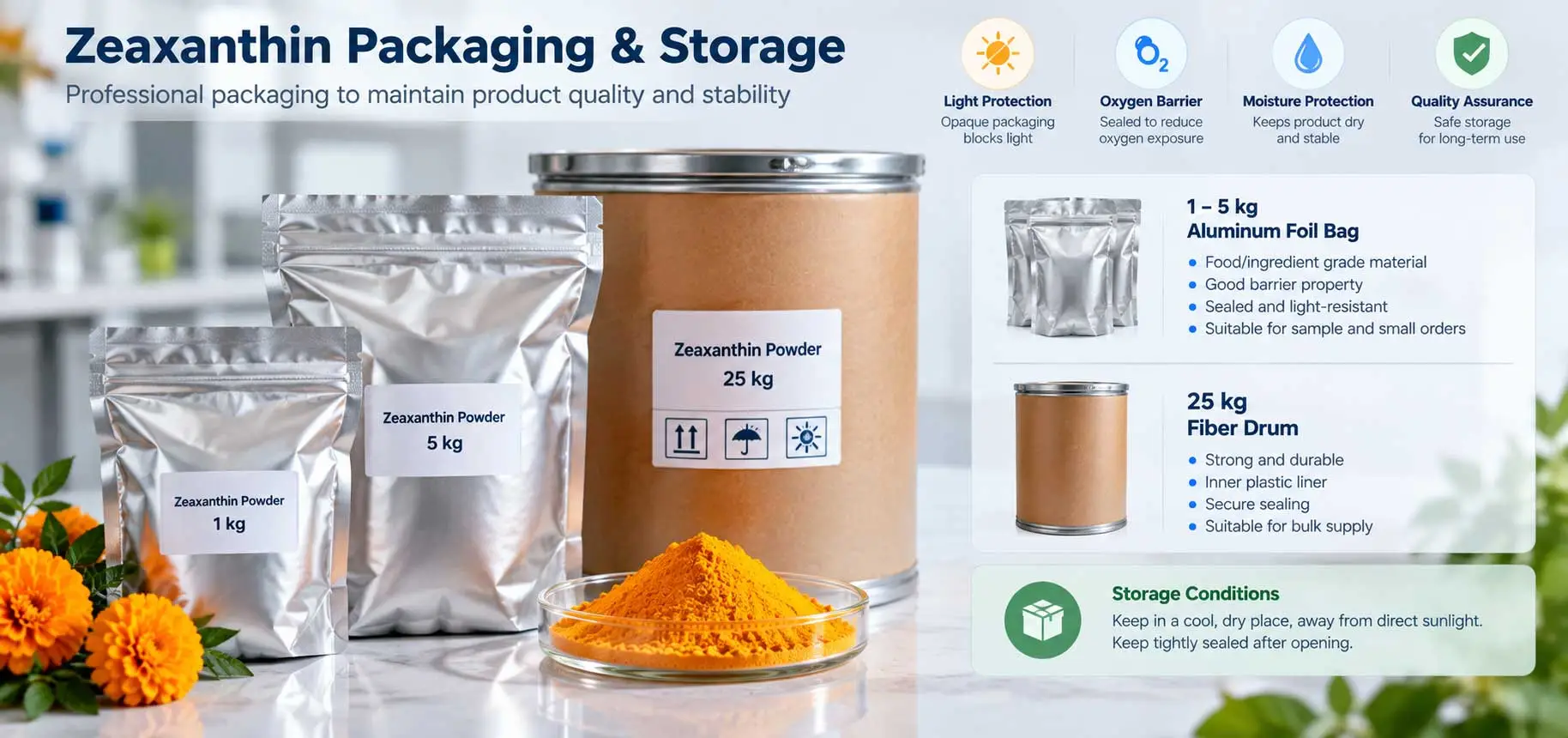
For our current commercial packaging, smaller quantities are available in 1–5 kg aluminum foil bags, while larger orders can be supplied in 25 kg fiber drums.
The packaging is designed for sealed storage and protection from unnecessary light exposure. After opening, the material should be resealed promptly and stored according to the product-specific recommendations.
For carotenoid ingredients, this matters because repeated exposure to light, air or an unsuitable environment can undermine the stability controls established during production.
Packaging configuration should also fit the customer’s usage pattern. A plant consuming only a small amount at a time may benefit from smaller units because repeated opening of a large package creates a different storage environment from an unopened container.
How to Evaluate Bulk Zeaxanthin Supply Capacity
When a project moves to bulk zeaxanthin powder, supplier qualification becomes a supply-chain question as well as a quality question.
Commercial buyers need to know whether raw material will remain available, whether processing capacity is sufficient, whether multiple production lots can remain within specification and whether documentation can be provided consistently as volume increases.
Our marigold sourcing network of more than 200,000 mu provides the agricultural foundation, while continuous extraction capacity of up to 30 metric tons of raw material per day supports downstream processing.
These figures matter because large-scale carotenoid production must balance two capacities: flower supply and factory throughput.
International experience is another consideration. Export projects require packaging, documentation and communication that remain reliable beyond the factory gate.
A supplier should therefore demonstrate that commercial scale is not simply a larger quotation for the same laboratory sample.
Zeaxanthin Powder Price: Compare Equivalent Grades Before Comparing Quotes
Zeaxanthin powder price should be compared only after technical equivalence has been established.
A 5% CWS grade and a 20% conventional product should not be compared simply by asking which costs less per kilogram. Their active loading and intended formulation functions are different.
A basic active-cost calculation can begin with:
Cost per unit of active zeaxanthin = ingredient price ÷ active fraction
But even this is incomplete when delivery technology matters.
A lower-assay formulated product may provide water dispersibility or processing functionality that a higher-assay conventional powder does not. Conversely, paying for CWS functionality may be unnecessary in a dry capsule or oil-based product.
The lowest price per kilogram is therefore not necessarily the lowest formulation cost.
Procurement teams should first confirm identity, assay, physical form and application suitability. Only then does price become a meaningful comparison.
MOQ Should Be Discussed After the Zeaxanthin Grade Is Qualified
Zeaxanthin MOQ becomes useful once the correct commercial grade has been identified.
Discussing minimum quantity too early can lead the purchasing process in the wrong direction. If the formulation later changes from a conventional grade to a CWS product, packaging and production conditions may also change.
A more efficient qualification sequence is:
sample evaluation → grade approval → specification confirmation → pilot production → commercial ordering.
Once those technical decisions are made, commercial quantity can be aligned with production needs.
This approach also avoids purchasing a larger quantity simply because it has a favorable unit price before application compatibility has been demonstrated.
What Documentation Should Be Ready Before an International Zeaxanthin Order?
Zeaxanthin supplier documentation should correspond to the actual product and purchasing stage.
The specification defines the ingredient. The COA reports a specific batch. A zeaxanthin TDS provides broader technical information, while an SDS addresses safe handling and hazard communication.
Depending on the customer and destination market, additional documentation may relate to certifications, origin, allergens, GMO status or other regulatory and quality requirements.
The important point is consistency.
The product name, grade and assay should not change from quotation to specification to COA without explanation. Certification documents should apply to the relevant manufacturing or management system rather than being presented without context.
For international procurement:
Documentation should match the product, grade, batch and intended market rather than being assembled as a generic certificate package.
Red Flags When Qualifying a Zeaxanthin Powder Supplier
Learning how to verify a zeaxanthin supplier is often easier when the buyer looks for inconsistencies rather than impressive claims.
A COA without meaningful batch information deserves clarification. An assay value without a clear basis is difficult to compare. A claim that conventional zeaxanthin is simply “water soluble” should lead to questions about what formulation technology is actually being used.
Another concern arises when the sample specification differs from the material quoted for commercial supply without a technical explanation.
The same applies when manufacturing origin cannot be identified or when repeated technical questions produce inconsistent answers from sales and quality teams.
Very low prices can also require investigation if they are achieved by changing assay or delivery form rather than by offering the same approved product more competitively.
The most important warning sign is therefore not one isolated document error:
The biggest supplier risk is often inconsistency between what is quoted, what is documented and what is ultimately delivered.
Frequently Asked Questions About Choosing a Zeaxanthin Powder Supplier
How do I find a reliable zeaxanthin powder supplier?
A reliable zeaxanthin powder supplier should provide a clear specification, representative sample, batch-level analytical documentation and information about manufacturing and raw-material traceability. Price can be evaluated after the buyer has confirmed that competing products are technically equivalent.
What should be included in a zeaxanthin COA?
A COA should identify the product and production lot and report the agreed batch-specific quality results. For zeaxanthin, active assay is particularly important, while microbiological, contaminant and physical parameters depend on the approved specification and intended application.
How can I verify zeaxanthin purity?
A zeaxanthin purity test or assay should use an appropriate analytical method, commonly chromatographic analysis such as HPLC. Buyers should confirm what the reported percentage represents, particularly for microencapsulated products where carrier materials are intentionally part of the finished powder.
Is CWS zeaxanthin better than conventional powder?
Not universally. A CWS grade is particularly useful where improved aqueous dispersion is required. Conventional material can be entirely appropriate in dry or lipid-compatible products. The application should determine the ingredient form rather than assuming that one technology is always superior.
Can I request a sample before I buy zeaxanthin powder?
Yes. Before deciding to buy zeaxanthin powder for commercial production, a representative sample allows formulation teams to evaluate the actual material. The sample should correspond to the grade and specification intended for later commercial supply.
What affects zeaxanthin powder price?
Active concentration, product form, microencapsulation or carrier technology, testing requirements, order volume and commercial terms can all influence pricing. Quotes should therefore be compared after the specification has been aligned rather than by product name alone.
What packaging is available for commercial zeaxanthin powder?
Our standard options include 1–5 kg aluminum foil bags for smaller quantities and 25 kg fiber drums for larger commercial requirements. The product should remain sealed, protected from unnecessary light exposure and stored according to the applicable product documentation.
Zeaxanthin Ingredient Supply from CHEN LANG BIO TECH
CHEN LANG BIO TECH supports international zeaxanthin projects through an integrated supply chain that connects marigold sourcing, industrial processing and analytical quality control. Our raw-material network covers more than 200,000 mu across Yunnan, India and Zambia, while continuous extraction capacity reaches up to 30 metric tons of raw material per day.
Customers can evaluate the appropriate conventional or CWS grade through product specifications, batch documentation and representative samples before commercial scale-up.
For a zeaxanthin specification, sample or project quotation, contact admin@chenlangbio.com

Send Inquiry
Related Industry Knowledge
- Is Piroctone Olamine Better Than Zinc Pyrithione?
- Can Centella Cause Acne?
- Bulk Dimethylmethoxy Chromanol: A Formulator’s Guide
- How Do You Administer Nitenpyram Powder
- How is Phellinus Linteus Extract Used
- Is Monobenzone Better than Hydroquinone
- Is Loratadine the Same as Pseudoephedrine
- What Are the Health Benefits of Roselle Extract
- Deoxyarbutin Powder Supplier
- Cheaper Skin Whitening Sepiwhite Powder