
How Pharmaceutical Grade DHEA Powder Is Manufactured and Quality Tested?
2026-05-29 14:56:25
Introduction
For international supplement manufacturers, sourcing pharmaceutical grade DHEA powder is no longer only about purity claims or pricing. Procurement teams increasingly evaluate how raw materials are manufactured, tested, packaged, and controlled throughout the supply chain before approving long-term suppliers.
This shift is largely driven by stricter quality expectations across the nutraceutical industry. Buyers want stable batches, transparent laboratory testing, consistent packaging systems, and suppliers capable of supporting commercial-scale production with reliable documentation.
As a result, terms such as DHEA powder manufacturing process, HPLC tested DHEA powder, and DHEA quality control are becoming increasingly important in global pharmaceutical intermediates procurement searches.
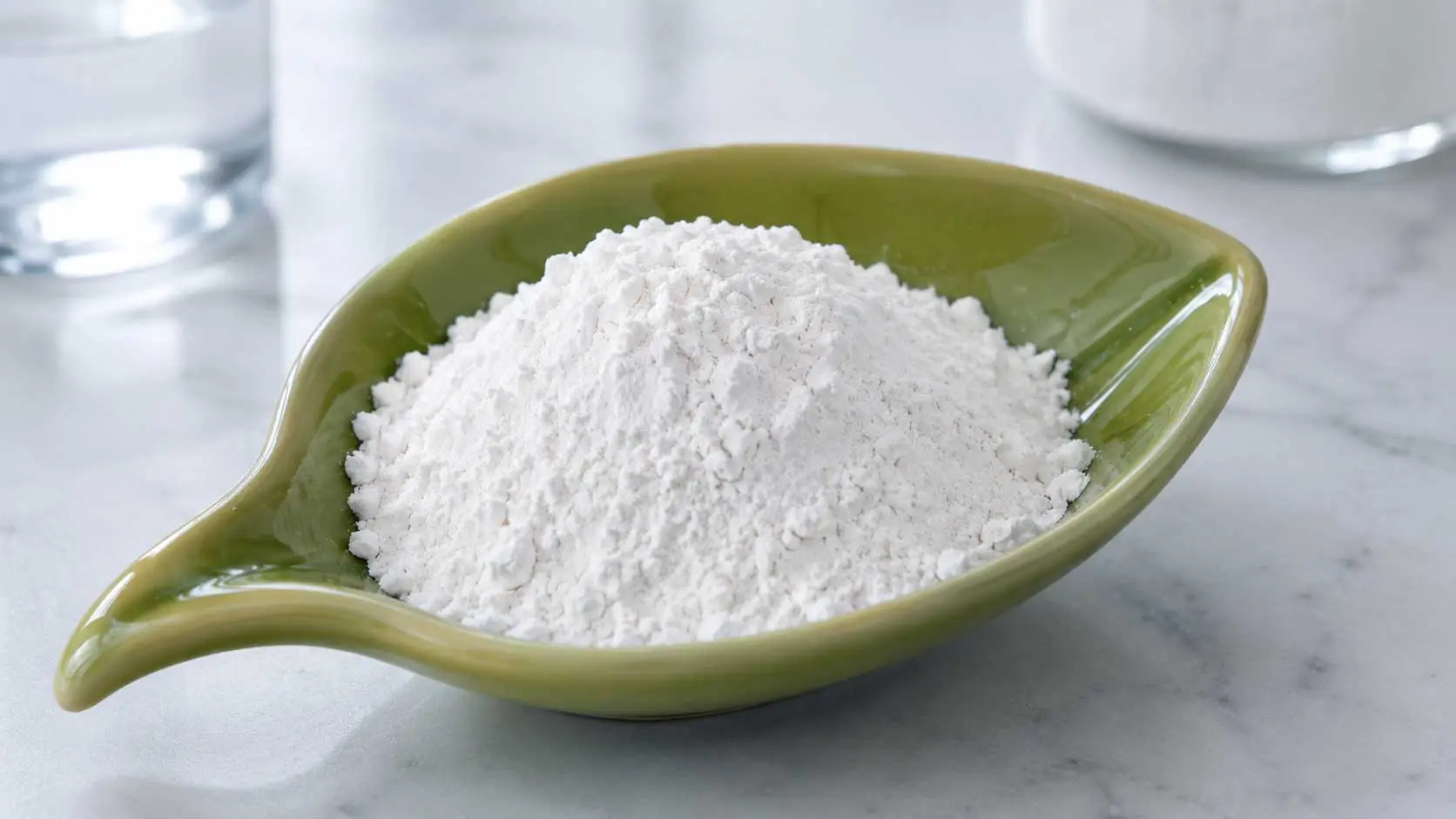
For manufacturers using DHEA in capsules, tablets, powders, or compounded formulations, inconsistent raw materials can create operational problems including:
•formulation instability
•assay variation
•poor powder flowability
•inconsistent blending performance
•inventory management issues
This is why experienced procurement teams often review far more than a simple COA before confirming bulk purchases.
Professional suppliers are now expected to maintain structured production systems that support:
•batch consistency
•impurity control
•laboratory verification
•moisture-protected packaging
•export-ready logistics
In the international market, buyers increasingly prefer suppliers that can clearly explain how bulk DHEA powder is manufactured and quality tested rather than simply promoting “high purity” marketing claims.
At CHEN LANG BIO TECH, many customers request additional details related to manufacturing controls, HPLC verification, export packaging, and warehouse management before proceeding with commercial procurement discussions. This reflects a broader trend within the nutraceutical industry: buyers are prioritizing production transparency and long-term supply reliability over low-cost sourcing alone.
Why Manufacturing Standards Matter in Pharmaceutical Grade DHEA Powder
For companies sourcing bulk DHEA powder, manufacturing standards directly affect product consistency, procurement reliability, and long-term formulation performance.
Even when two suppliers offer similar assay specifications, production quality can vary significantly depending on manufacturing controls, purification systems, laboratory procedures, and batch management practices.
This is why professional buyers increasingly evaluate whether suppliers operate structured DHEA GMP manufacturing systems capable of supporting stable commercial production.
Why International Buyers Evaluate Manufacturing Standards
International procurement teams are becoming far more selective when qualifying DHEA powder suppliers.
In many cases, buyers are not only evaluating the final product itself, but also the operational systems behind the product, including:
•manufacturing environment
•quality control procedures
•batch traceability
•laboratory capability
•packaging systems
•export handling standards
This is especially important for supplement brands operating in regulated markets where documentation consistency and supply chain transparency are closely tied to compliance requirements.
Reliable suppliers generally maintain structured production procedures designed to reduce variability between batches and improve long-term procurement stability.
For example, buyers sourcing pharmaceutical grade DHEA powder often review whether suppliers can consistently provide:
•batch-specific COAs
•HPLC assay reports
•packaging specifications
•stability guidance
•export documentation
Suppliers unable to provide clear technical information may create additional procurement risk, particularly for companies managing large-volume commercial manufacturing.
As a result, production transparency has become an increasingly important part of supplier qualification within the international nutraceutical market.
How Manufacturing Quality Affects Batch Consistency
Batch consistency is one of the most important indicators of manufacturing quality in DHEA powder production.
Even small variations during production or purification may affect:
•assay stability
•particle consistency
•blending performance
•formulation uniformity
•long-term inventory reliability
For supplement manufacturers operating commercial production lines, inconsistent batches can create downstream manufacturing issues including uneven mixing, inaccurate filling weights, and production delays.
Professional suppliers therefore implement controlled manufacturing systems designed to improve:
•process repeatability
•impurity control
•powder uniformity
•moisture stability
•packaging consistency
Reliable DHEA powder manufacturing processes also include structured monitoring procedures throughout production rather than relying solely on final inspection.
Procurement teams increasingly recognize that stable batch performance is closely connected to the maturity of the supplier’s operational systems.
Suppliers with well-controlled production environments generally maintain more consistent raw material characteristics across repeated commercial production cycles.
Why Production Transparency Builds Buyer Confidence
Within the international nutraceutical industry, supplier transparency has become closely tied to procurement trust.
Buyers increasingly expect suppliers to provide clear technical information regarding:
•production standards
•purification procedures
•HPLC testing methods
•packaging systems
•warehouse handling
•export preparation
This is particularly true for companies sourcing high-purity DHEA powder for long-term commercial manufacturing programs.
Transparent suppliers are generally viewed as lower-risk procurement partners because they can support technical review processes more efficiently during supplier qualification.
For example, many procurement teams now request:
•chromatogram reports
•manufacturing photos
•packaging specifications
•storage recommendations
•batch traceability documentation
before approving commercial orders.
We have observed that international customers increasingly prioritize suppliers capable of explaining their DHEA quality testing and manufacturing systems clearly and professionally. Buyers today are looking for long-term production reliability rather than generic marketing claims.
As global quality expectations continue evolving, manufacturing transparency is becoming an increasingly important part of supplier credibility, procurement stability, and long-term commercial cooperation within the nutraceutical raw material industry.
Raw Material Selection and Purification
The quality of pharmaceutical grade DHEA powder is heavily influenced by how raw materials are selected, purified, and controlled before final production. Buyers evaluating suppliers today are paying much closer attention to purification systems and impurity management because these factors directly affect batch consistency and long-term formulation performance.
For manufacturers using DHEA in capsules, tablets, or blended formulations, stable purity is essential. Even minor variations in raw material quality may create issues during mixing, filling, or dosage control.
This is why experienced buyers often review how suppliers manage the DHEA purification process rather than focusing only on the final assay percentage listed on a COA.
Selecting Raw Materials for Pharmaceutical Grade DHEA Powder
Consistent production starts with controlled raw material selection.
Reliable manufacturers generally operate with standardized sourcing and incoming material evaluation procedures designed to reduce variability before production begins. This helps improve long-term consistency across repeated commercial batches of high-purity DHEA powder.
Buyers increasingly evaluate whether suppliers maintain clear controls related to:
•raw material identity
•impurity screening
•batch traceability
•storage conditions
•handling procedures
These controls help reduce the risk of contamination or instability during later production stages.
For commercial supplement manufacturing, stable raw material quality supports:
•formulation consistency
•predictable blending performance
•stable assay values
•smoother production runs
Suppliers with inconsistent incoming material controls often experience greater variability during downstream processing and quality testing.
Purification and Impurity Removal Process
The purification stage is one of the most important parts of DHEA powder manufacturing because it directly affects assay consistency and impurity control.
Professional purification systems are designed to remove unwanted residual compounds while improving overall purity stability across production batches.
Buyers sourcing pharmaceutical grade DHEA powder increasingly review whether suppliers maintain structured purification controls capable of supporting:
•impurity reduction
•stable assay performance
•batch reproducibility
•consistent powder quality
Reliable purification procedures also help improve downstream manufacturing performance by reducing variability in particle behavior and formulation consistency.
For procurement teams, impurity control is especially important because unstable impurity profiles may affect:
•formulation stability
•shelf life consistency
•quality documentation
•long-term supply reliability
This is one reason why suppliers with transparent purification and testing systems are generally viewed as lower-risk sourcing partners.
Why Purity Consistency Matters for Supplement Manufacturers
For supplement manufacturers, purity consistency is not simply a laboratory target — it directly affects production efficiency.
Inconsistent bulk DHEA powder may create operational issues such as:
•uneven blending
•inconsistent capsule weights
•poor powder flowability
•unstable formulation performance
These issues become more noticeable during large-scale production where small material differences can affect thousands of units during a single manufacturing run.
Stable purity helps manufacturers maintain more predictable production conditions and reduces the need for process adjustments during formulation.
Procurement teams therefore increasingly prioritize suppliers capable of maintaining consistent analytical performance across repeated commercial batches.
Many buyers now request:
•batch-specific COAs
•HPLC reports
•impurity testing data
•storage recommendations
before approving long-term supply programs.
Clear purification standards and consistent quality systems help suppliers build stronger procurement confidence over time.
How Pharmaceutical Grade DHEA Powder Is Manufactured
The production of pharmaceutical grade DHEA powder requires more than achieving a target purity percentage. Commercial manufacturing depends on controlled processing systems capable of maintaining stable quality across repeated production batches.
Buyers evaluating bulk DHEA powder manufacturers increasingly look for suppliers that can demonstrate controlled production environments, consistent batch management, and structured quality monitoring throughout the manufacturing process.
Reliable production systems help improve:
•batch consistency
•powder uniformity
•assay stability
•moisture control
•long-term storage reliability
This is particularly important for supplement manufacturers operating commercial production lines where formulation consistency directly affects manufacturing efficiency.
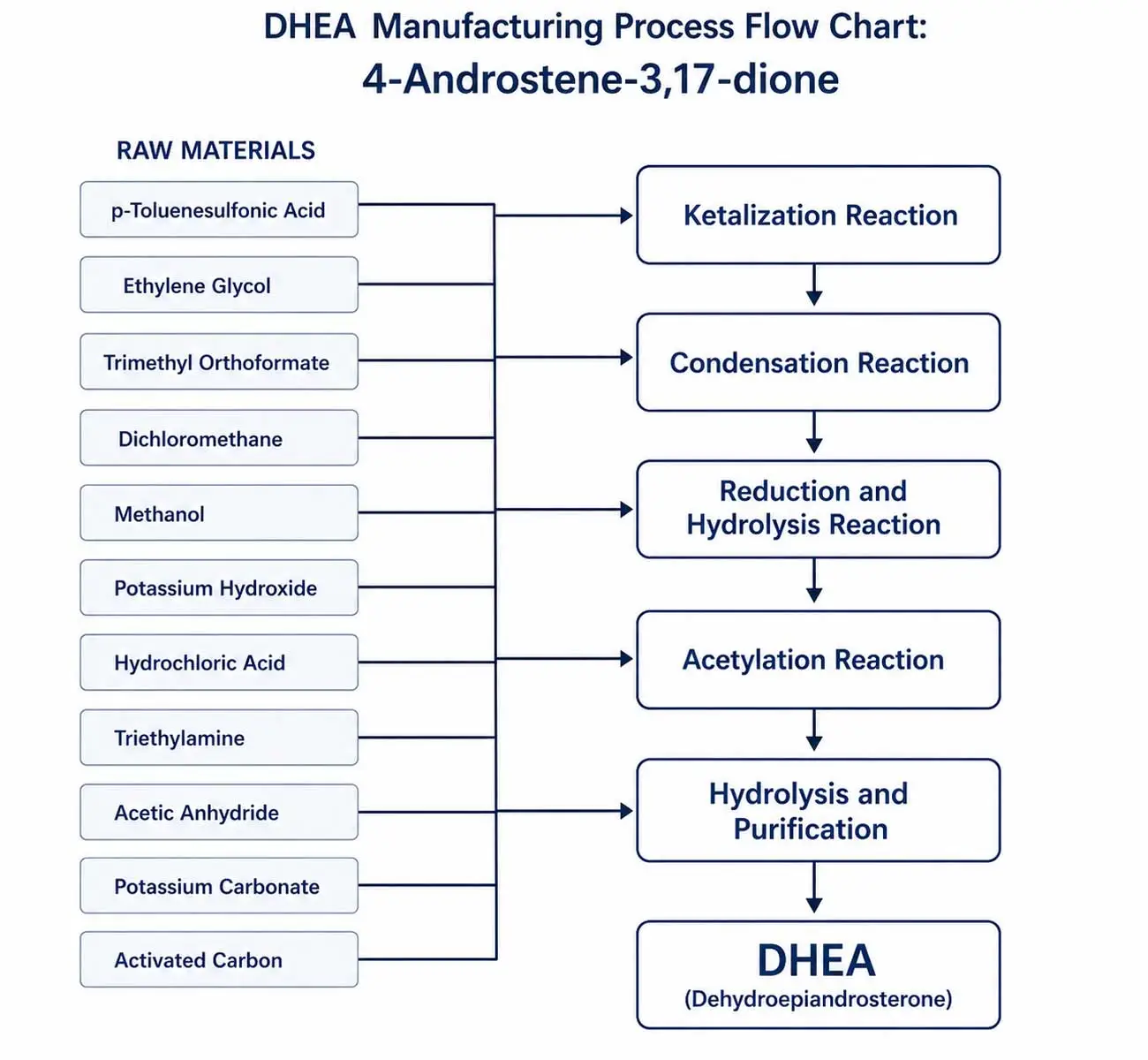
Production Environment and GMP Manufacturing Standards
Controlled production environments are essential for maintaining stable DHEA powder manufacturing processes.
Professional manufacturers typically operate with structured environmental controls designed to reduce contamination risk and improve production consistency throughout commercial processing.
Buyers increasingly evaluate whether suppliers maintain:
•clean production areas
•controlled handling procedures
•documented batch systems
•standardized operating procedures
•quality monitoring systems
These controls are closely connected to long-term batch reliability and procurement stability.
For companies sourcing pharmaceutical grade DHEA powder, production environment standards often influence supplier qualification decisions just as much as assay values themselves
Controlled Production and Batch Management
Batch management plays a major role in maintaining stable commercial production.
Reliable manufacturers generally operate with controlled processing systems designed to improve repeatability between production runs of bulk DHEA powder.
Professional batch management procedures commonly include:
•batch identification systems
•production monitoring
•in-process inspection
•material traceability
•controlled inventory handling
These systems help reduce variability during manufacturing and improve consistency across large-volume production cycles.
For procurement teams, stable batch management is often viewed as an indicator of operational maturity and long-term supply reliability.
Drying, Milling, and Powder Processing
After purification, controlled powder processing helps ensure stable physical characteristics before final packaging.
This stage may include:
•drying
•milling
•sieving
•powder standardization
These processes influence important production characteristics such as:
•particle consistency
•powder flowability
•blending performance
•handling stability
For supplement manufacturers, stable powder characteristics help improve production efficiency during capsule filling and formulation processing.
Buyers sourcing high-purity DHEA powder increasingly evaluate whether suppliers maintain consistent powder processing procedures because physical consistency directly affects downstream manufacturing performance.
Final Inspection Before Packaging
Before packaging, finished batches typically undergo final inspection and quality verification procedures.
Professional suppliers generally review:
•appearance consistency
•assay confirmation
•moisture condition
•packaging integrity
•batch documentation
This stage helps confirm that production batches meet specification standards before shipment preparation begins.
Reliable manufacturers also maintain structured packaging systems designed to improve storage stability and export protection during transportation.
For commercial shipments, 1kg–5kg aluminum foil bags are commonly used for smaller quantities, while larger orders are typically packed in 25kg fiber drums with inner protective liners to improve moisture resistance and long-distance shipping stability.
Many buyers now review packaging preparation and warehouse handling procedures alongside laboratory testing because long-term procurement reliability depends on both product quality and supply chain protection.
HPLC Testing and Quality Verification
For buyers sourcing pharmaceutical grade DHEA powder, laboratory testing is one of the most important parts of supplier evaluation.
Today, procurement teams rarely rely on specification sheets alone. Most supplement manufacturers want batch-specific testing data that confirms:
•assay consistency
•impurity control
•production stability
•documentation accuracy
This is why DHEA HPLC testing has become a standard requirement during supplier qualification.
Reliable testing systems help buyers verify whether production quality remains stable across repeated commercial batches rather than only meeting isolated purity targets.
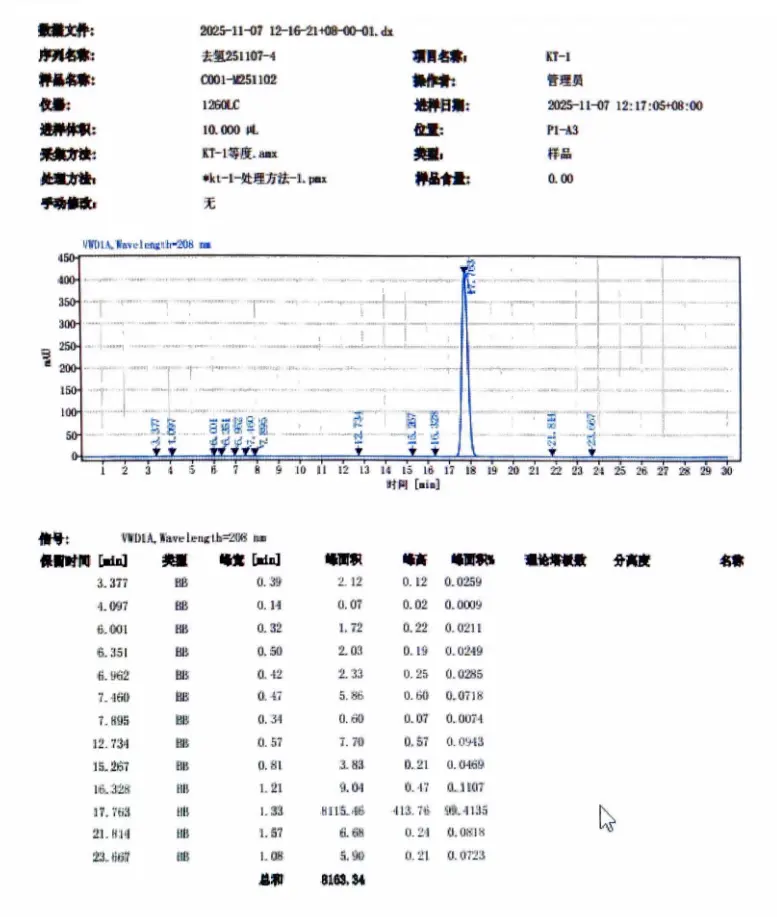
How HPLC Testing Verifies DHEA Purity
HPLC tested DHEA powder is typically evaluated through chromatographic analysis designed to confirm assay percentage and identify unwanted impurities.
For procurement teams, HPLC testing provides measurable verification of:
•purity consistency
•batch reproducibility
•analytical stability
•impurity levels
Buyers increasingly request HPLC reports because chromatogram data offers a clearer picture of production quality than simplified COA summaries alone.
Professional laboratory systems generally review:
•retention time
•assay values
•peak consistency
•impurity signals
Stable chromatographic performance across multiple batches usually indicates stronger manufacturing controls and more reliable purification systems.
This is particularly important for companies using bulk DHEA powder in commercial formulations where long-term consistency directly affects manufacturing efficiency.
Impurity Detection and Batch Analysis
Impurity control is a major part of DHEA quality testing.
Even when assay values appear acceptable, inconsistent impurity profiles may still create problems related to:
•formulation stability
•shelf life consistency
•production reliability
•inventory control
Professional suppliers therefore monitor both purity percentage and impurity behavior during batch analysis.
Reliable testing procedures help identify abnormal variation before products enter commercial shipment.
Procurement teams increasingly review whether suppliers maintain structured controls related to:
•batch-specific testing
•impurity screening
•laboratory documentation
•traceability systems
This helps reduce procurement risk and improves long-term supply consistency.
Many buyers now compare multiple batch reports during supplier evaluation rather than reviewing only a single COA.
Consistent analytical performance across repeated production cycles is often viewed as a stronger indicator of manufacturing reliability than isolated high assay values alone.
COA Documentation and Laboratory Transparency
A professional DHEA COA should support more than a basic purity claim.
Experienced buyers increasingly evaluate whether documentation includes:
•batch numbers
•assay values
•testing methods
•manufacturing dates
•storage recommendations
•laboratory references
Transparent documentation helps procurement teams assess whether suppliers maintain organized quality systems and stable manufacturing controls.
Buyers are also paying closer attention to consistency between:
•HPLC reports
•packaging labels
•specifications
•export documents
•batch records
Discrepancies between documents may create concerns regarding quality management and traceability.
For this reason, laboratory transparency has become an important part of supplier credibility.
Many supplement manufacturers now request:
•chromatograms
•batch-specific COAs
•packaging details
•storage guidance
before confirming larger commercial orders.
Clear documentation and stable testing systems help suppliers build stronger long-term procurement confidence
Packaging and Export Preparation
Packaging quality directly affects the long-term stability of bulk DHEA powder during storage and international transportation.
Even well-manufactured material may gradually experience stability issues if packaging systems are unable to protect products from:
•humidity exposure
•temperature fluctuation
•contamination
•transportation damage
This is why buyers increasingly evaluate export packaging systems alongside manufacturing and laboratory controls.
Reliable suppliers generally maintain structured packaging procedures designed to support:
•long-distance shipment
•warehouse handling
•moisture protection
•inventory stability
Standard Packaging for Bulk DHEA Powder
Commercial packaging formats usually depend on order quantity and transportation requirements.
For sample evaluation and smaller commercial orders, 1kg–5kg aluminum foil bags are commonly used because they provide strong moisture resistance and convenient handling.
For larger commercial shipments, products are typically packed in 25kg fiber drums with double inner PE liners designed to improve:
•humidity protection
•packaging durability
•transportation stability
•long-term storage consistency
Professional packaging systems also help reduce contamination risk during export handling and warehouse transfer.
Many buyers now request packaging photos and pallet details before shipment approval, especially for international ocean freight orders.
Moisture Protection and Export Stability
Moisture exposure remains one of the biggest risks affecting pharmaceutical grade DHEA powder during storage and shipment.
Professional export packaging systems are designed to reduce environmental exposure throughout transportation and warehouse handling.
Reliable suppliers commonly use:
•sealed foil packaging
•reinforced fiber drums
•pallet wrapping systems
•moisture-resistant inner liners
to improve export stability during sea freight and long-distance transportation.
This is particularly important for international shipments moving through multiple warehouse and customs handling stages.
Buyers increasingly evaluate whether suppliers maintain packaging systems capable of protecting product quality during extended transit periods.
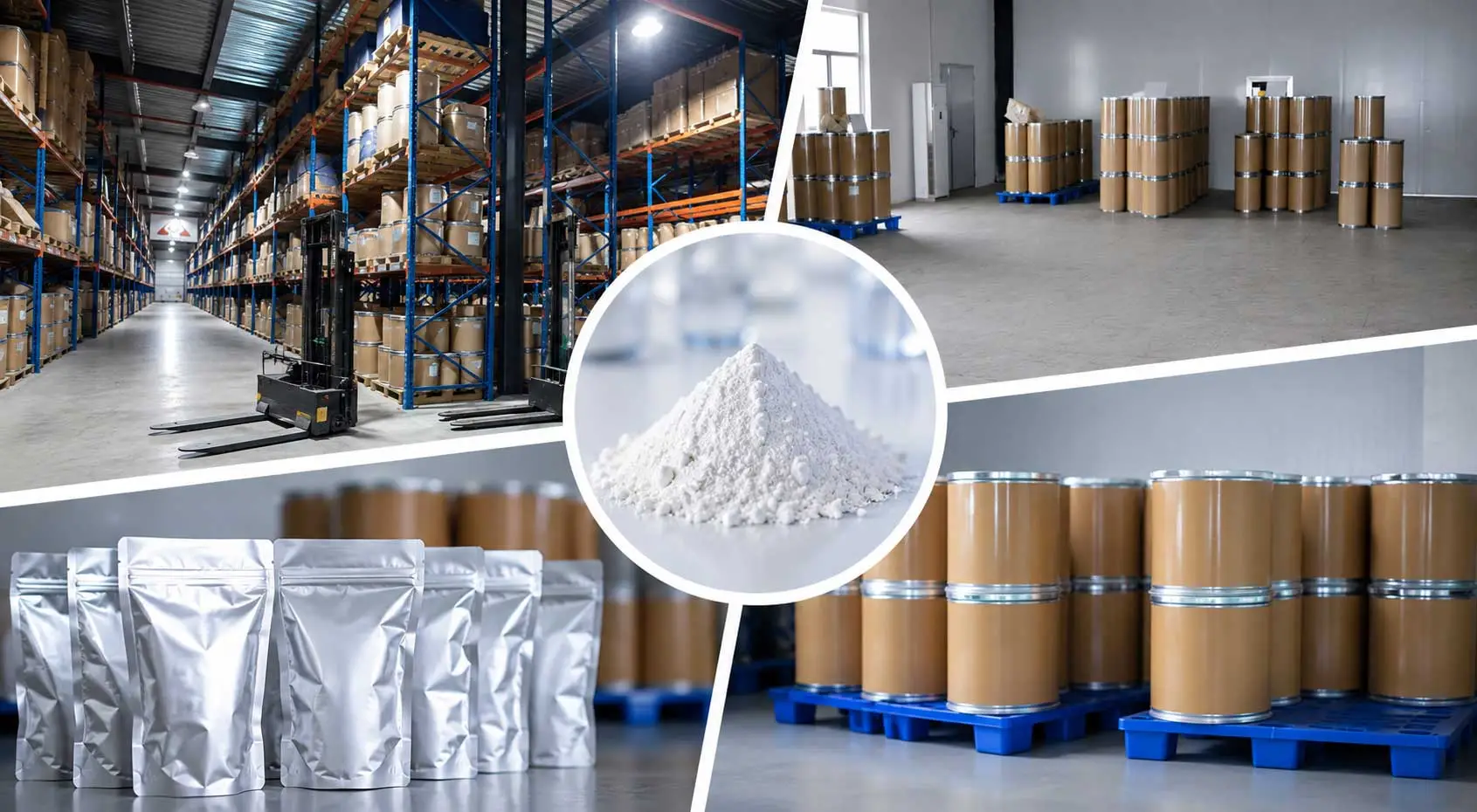
International Transportation and Warehouse Handling
Global shipments often involve:
•port transfers
•customs inspections
•temporary storage
•pallet movement
•climate variation
Packaging systems therefore need to support both transportation durability and warehouse stability.
Professional suppliers generally prepare export shipments using reinforced pallet structures and organized loading procedures designed to reduce handling stress during transportation.
Many supplement manufacturers now review warehouse handling procedures and export preparation standards during supplier qualification because stable logistics management directly affects inventory reliability.
For long-term supply programs, buyers increasingly prefer suppliers capable of combining:
•stable manufacturing
•transparent testing
•reliable packaging
•organized export handling
rather than focusing only on pricing or assay values alone.
Batch Consistency and Storage Control
For companies sourcing bulk DHEA powder on a long-term basis, batch consistency is just as important as purity itself.
Even when assay values meet specification targets, differences in powder behavior, moisture condition, or packaging quality between batches may still create production issues during large-scale manufacturing.
This is why experienced buyers increasingly evaluate whether suppliers maintain controlled production and storage systems capable of supporting stable commercial supply.
Reliable manufacturers generally operate with structured controls related to:
•batch traceability
•warehouse management
•packaging consistency
•inventory rotation
•environmental monitoring
These systems help reduce variability during storage and transportation while improving long-term procurement reliability.
Why Batch Consistency Matters for Procurement
Stable batches help manufacturers maintain predictable production performance.
Inconsistent pharmaceutical grade DHEA powder may affect:
•blending uniformity
•capsule filling efficiency
•dosage consistency
•formulation stability
•production scheduling
For commercial supplement manufacturing, even small differences between batches can create additional process adjustments during production.
This is one reason why many buyers request multiple batch COAs and HPLC reports before approving larger procurement programs.
Reliable suppliers generally maintain standardized processing and quality monitoring procedures designed to improve repeatability across commercial production cycles.
Procurement teams increasingly prioritize suppliers capable of maintaining:
•stable assay values
•consistent particle characteristics
•organized batch documentation
•repeatable packaging standards
rather than simply offering high purity percentages on isolated batches.
Warehouse Storage and Inventory Protection
Storage management plays a major role in maintaining the stability of high-purity DHEA powder after production.
Professional warehouse systems are typically designed to reduce exposure to:
•humidity
•excessive heat
•direct sunlight
•packaging damage
•contamination risk
Reliable suppliers usually recommend storing products in cool, dry warehouse environments with controlled inventory handling procedures.
For export shipments, reinforced packaging systems and pallet protection help maintain product stability during long-distance transportation and temporary storage stages.
Many buyers now evaluate warehouse conditions and inventory management practices during supplier qualification because long-term storage performance directly affects procurement reliability.
Consistent storage systems also help improve:
•shelf life stability
•packaging integrity
•batch protection
•shipment consistency
For international procurement programs, stable inventory control has become an increasingly important part of long-term supply chain management.
Frequently Asked Questions About Pharmaceutical Grade DHEA Powder Manufacturing
How Is Pharmaceutical Grade DHEA Powder Manufactured?
The production of pharmaceutical grade DHEA powder typically involves raw material selection, purification, controlled powder processing, quality verification, and export packaging preparation.
Reliable manufacturers maintain structured production systems designed to improve batch consistency, impurity control, and long-term supply stability. Please contact us to get manufacturing process.
What Testing Methods Are Used for DHEA Powder?
We always use HPLC testing to verify assay purity, impurity levels, and batch consistency.
Buyers often request HPLC reports and batch-specific COAs during supplier qualification to evaluate analytical reliability and production consistency.
Why Is HPLC Testing Important for DHEA Powder?
DHEA HPLC testing helps confirm:
•purity consistency
•impurity control
•assay verification
•batch reproducibility
This improves procurement transparency and helps reduce sourcing risk during commercial manufacturing.
What Packaging Is Used for Bulk DHEA Powder Export?
Smaller quantities are commonly packed in 1kg–5kg aluminum foil bags, while larger commercial orders are typically shipped in 25kg fiber drums with inner protective liners.
These packaging systems help improve moisture protection and transportation stability during export shipment.
How Do Suppliers Maintain Batch Consistency?
Reliable suppliers generally maintain structured controls related to:
•production monitoring
•laboratory testing
•packaging systems
•warehouse storage
•batch traceability
These procedures help improve long-term manufacturing consistency and procurement reliability.
Conclusion: Manufacturing Quality and Long-Term Procurement Reliability
For global manufacturers sourcing pharmaceutical grade DHEA powder, stable manufacturing systems, transparent quality testing, and reliable packaging standards are all important parts of long-term procurement success.
Today, buyers increasingly evaluate how materials are manufactured, tested, stored, and prepared for export before approving long-term supply relationships.
Consistent batch quality, structured HPLC verification, moisture-protected packaging, and organized warehouse handling all contribute to stronger supply reliability and smoother commercial production performance.
For additional information regarding bulk DHEA powder, HPLC reports, packaging specifications, or storage guidance, buyers can contact the technical team at admin@chenlangbio.com for product documentation and procurement support.

Send Inquiry
Related Industry Knowledge
- Hyaluronic Acid Powder for Wrinkle Reduction: A Reliable Supplier for Your Anti-Aging Formulations
- What Precautions Should be Taken When Handling D-Luciferin Potassium Salt?
- What is Bulk Dimethylmethoxy Chromanol? Benefits & Uses
- What is the Recommended Dosage of Glabridin Powder
- How Does Nitenpyram Work
- How is loratadine Absorbed
- What Happens If a Human Takes Praziquantel
- Does Praziquantel Treat Tapeworms
- How Can Dehydroepiandrosterone DHEA benefit Your Health
- Resveratrol Antioxidant