
Ethyl Ascorbic Acid and Retinol: Can They Be Formulated Together?
2026-10-26 10:25:40
Ethyl ascorbic acid and retinol can potentially be formulated together, but combining them successfully requires more than selecting two compatible skincare actives. Their different solubility characteristics, sensitivity to processing conditions, and stability requirements make the formulation vehicle particularly important.
3-O-Ethyl Ascorbic Acid is a vitamin C derivative used in cosmetic products targeting antioxidant protection and uneven-looking skin tone. Retinol, a vitamin A derivative, is widely used in skin-renewal and anti-aging formulations, although its sensitivity to light and oxygen presents substantial formulation challenges.
For cosmetic manufacturers, the central question is not whether these ingredients can appear on the same INCI list. It is whether both remain chemically stable, uniformly distributed, and compatible with the finished product throughout its intended shelf life.
This guide examines ethyl ascorbic acid retinol formulation strategies, including solvent selection, emulsion design, oxidation control, manufacturing conditions, analytical testing, and raw material qualification.
Ethyl Ascorbic Acid and Retinol Compatibility in Cosmetic Formulations
Ethyl ascorbic acid retinol compatibility depends on the complete formulation rather than a simple interaction between two isolated molecules. Their concentrations, physical states, surrounding ingredients, and exposure to environmental stress all influence the final result.
Chemical Compatibility Between 3-O-Ethyl Ascorbic Acid and Retinol
3-O-Ethyl Ascorbic Acid has a molecular formula of C₈H₁₂O₆ and a molecular weight of approximately 204.18 g/mol. Its ethyl ether substitution at the 3-position distinguishes it from L-Ascorbic Acid and influences its physicochemical behavior.
Retinol has a molecular formula of C₂₀H₃₀O and a molecular weight of approximately 286.45 g/mol. Its conjugated polyene structure contributes to its susceptibility to photoisomerization and oxidative degradation.
There is no sound basis for assuming that the two ingredients necessarily react with each other simply because they are combined. Equally, the absence of an obvious immediate reaction does not establish 3-o-ethyl ascorbic acid retinol compatibility over time.
The relevant question is whether either ingredient's degradation profile changes in the presence of the other under the proposed formulation conditions.
Can Ethyl Ascorbic Acid and Retinol Be Used in the Same Serum?
An ethyl ascorbic acid retinol serum may be developed using an emulsion, a structured multiphase vehicle, or another appropriately designed delivery system.
A conventional aqueous serum is more challenging because retinol has very limited water solubility. Simply adding retinol powder to a water-based vitamin C derivative serum is unlikely to produce a reliably homogeneous product.
Commercial retinol dispersions or encapsulated grades may offer alternative approaches, provided their carrier systems are compatible with the formulation.
Ingredient Compatibility vs Finished Product Stability
Compatibility should be evaluated at three levels: chemical integrity, physical stability, and microbiological quality.
A serum may remain visually uniform while losing a significant portion of its retinol content. Conversely, both actives may remain analytically detectable while the emulsion develops phase separation or unacceptable viscosity changes.
Only finished-product testing can establish whether the selected ingredients and vehicle perform together satisfactorily.
Ethyl Ascorbic Acid vs Retinol Solubility: Water Phase, Oil Phase and Solvent Selection
The solubility difference between these two ingredients is one of the most important design considerations for a dual-active cosmetic product.
3-O-Ethyl Ascorbic Acid Solubility in Water-Based Cosmetic Systems
Ethyl ascorbic acid solubility is influenced by solvent composition, concentration, temperature, and other formulation conditions.
The molecule contains several hydroxyl groups and is commonly developed in aqueous or mixed-solvent cosmetic systems. However, its behavior should not be reduced to a universal solubility value independent of formulation conditions.
Published research on 3-O-Ethyl-L-Ascorbic Acid has investigated its behavior in individual and complex solvent systems, illustrating why solvent selection must be assessed experimentally.
During development, formulators should establish whether the intended concentration dissolves completely and remains dissolved after temperature cycling and prolonged storage.
Retinol Oil Solubility and Carrier Selection
Retinol oil solubility reflects its predominantly lipophilic structure. It is generally incorporated through an appropriate oil phase, solvent carrier, or commercially stabilized delivery system.
Carrier selection influences retinol distribution, oxygen exposure, sensory characteristics, and compatibility with other formulation components.
A retinol ingredient supplied as a solution or encapsulated dispersion must be evaluated according to its complete composition, not only its declared retinol concentration.
Choosing a Vehicle for Dual-Active Vitamin C and Retinol Formulations
A vitamin c derivative and retinol formulation should begin with vehicle selection rather than with a predetermined ingredient addition sequence.
|
Formulation system |
Main technical consideration |
Development implication |
|
Water-based serum |
Retinol has limited aqueous solubility |
Requires a suitable delivery or solubilization strategy |
|
Oil-in-water emulsion |
Actives may occupy different phases |
Evaluate partitioning, emulsion stability, and oxidation |
|
Gel-cream |
Polymer and emulsifier interactions |
Monitor viscosity, uniformity, and active recovery |
|
Anhydrous system |
Ethyl ascorbic acid solubilization |
Verify dissolution, dispersion, and physical stability |
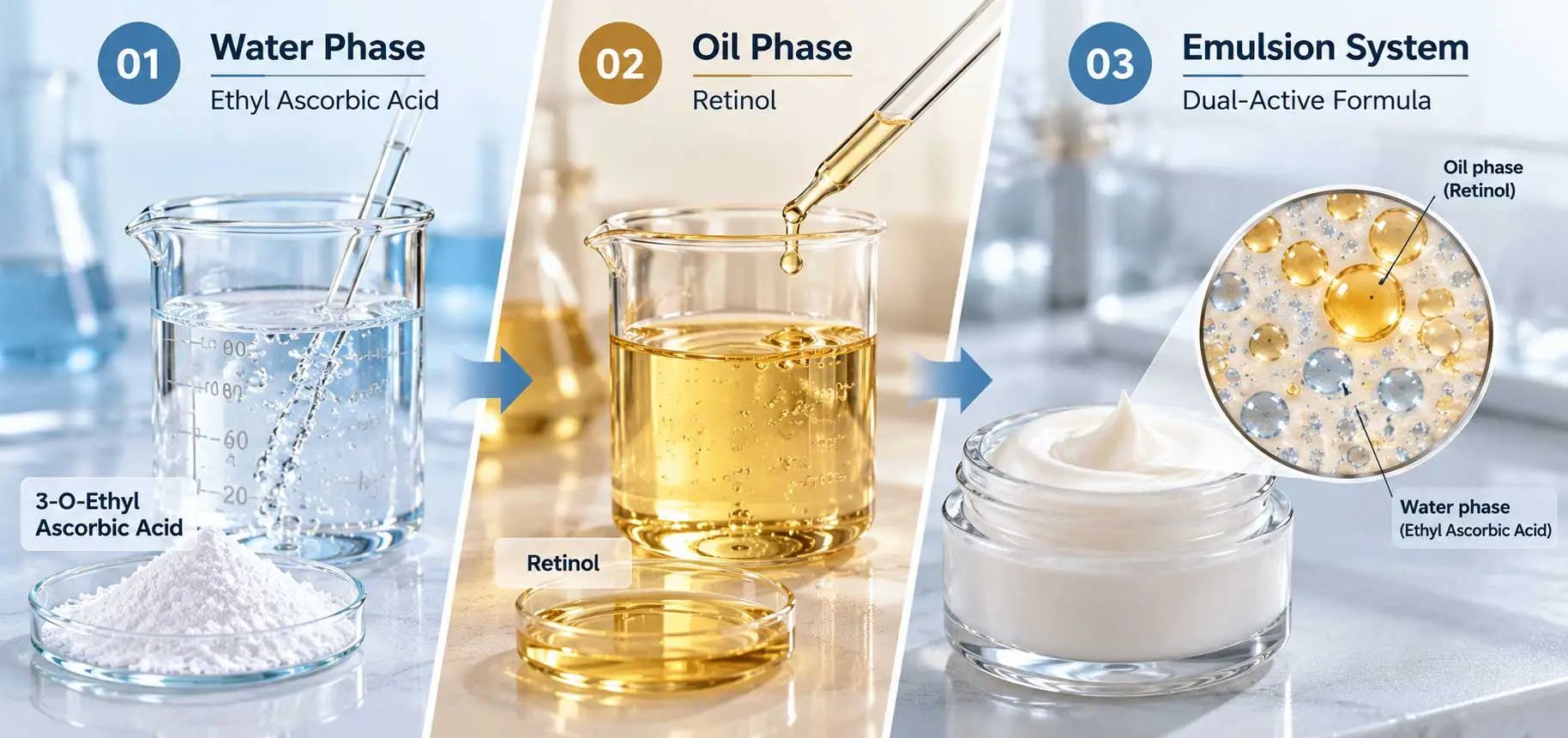
For many development projects, a retinol emulsion formulation provides a practical starting point because it allows different ingredient environments within one finished product.
Nevertheless, the presence of separate phases does not automatically prevent chemical migration or degradation.
Ethyl Ascorbic Acid and Retinol Stability: Oxidation, Light Exposure and pH
Ethyl ascorbic acid and retinol stability must be assessed independently for each active and then verified in the combined formulation. Retinol often presents the more demanding light- and oxygen-management requirements.
•Retinol Oxidation and Photodegradation in Cosmetic Formulations
Retinol oxidation in cosmetics is associated with the sensitivity of its conjugated molecular structure to oxygen and environmental stress.
Light exposure can also promote retinol isomerization and degradation. Published photochemical research has shown that retinoid behavior depends on irradiation conditions, solvent environment, and the surrounding formulation matrix.
Consequently, retinol photostability cannot be established from a single ingredient's nominal concentration.
Development teams should evaluate the effects of processing light, dissolved oxygen, package headspace, and storage conditions.
A product that contains the correct retinol concentration immediately after manufacture may not retain that concentration during distribution and consumer use.
•3-O-Ethyl Ascorbic Acid Stability in Water-Based Systems
3-O-Ethyl Ascorbic Acid differs structurally from L-Ascorbic Acid because the hydroxyl group at the 3-position is etherified.
This structural modification affects its chemical behavior, but it does not make the ingredient universally resistant to degradation.
Stability still depends on the solvent system, formulation composition, storage conditions, and potential interactions with other ingredients.
Formulators should therefore avoid applying stability data for L-Ascorbic Acid directly to 3-O-Ethyl Ascorbic Acid.
Likewise, evidence that the vitamin C derivative remains stable alone does not establish its stability in a retinol-containing formulation.
•Ethyl Ascorbic Acid and Retinol pH Compatibility
There is no scientifically defensible universal ethyl ascorbic acid retinol pH that guarantees stability across all cosmetic systems.
In aqueous formulations, pH can influence ingredient ionization, hydrolytic reactions, emulsifier performance, preservative effectiveness, and overall chemical stability.
Retinol itself is not simply governed by the same aqueous pH considerations as water-soluble ingredients. Its degradation behavior also depends strongly on the surrounding vehicle and exposure to light and oxygen.
For anhydrous systems, conventional aqueous pH measurements may not be meaningful.
The appropriate pH should be selected from experimental compatibility and stability data for the complete formulation.
•Antioxidants, Chelating Agents and Oxygen Control
Retinol antioxidant stabilization may involve antioxidant systems, suitable chelating agents, controlled processing conditions, and protective packaging.
These approaches address different risks. Antioxidants may help manage oxidative reactions, while chelating agents can reduce the catalytic contribution of certain trace metals where relevant.
However, antioxidant selection must be supported by formulation testing. An antioxidant that performs well in one oil phase may not provide the same protection in another system.
Reducing unnecessary air incorporation during processing and limiting oxygen exposure during filling are also worthwhile development considerations.
Retinol Emulsion Formulation with 3-O-Ethyl Ascorbic Acid
A successful retinol emulsion formulation must maintain the physical structure of the product while protecting both active ingredients. This requires coordinated decisions about phase composition, emulsification, ingredient carriers, and preservative compatibility.
Oil-in-Water Emulsions for Ethyl Ascorbic Acid and Retinol
Oil-in-water emulsions provide a continuous aqueous phase and dispersed oil droplets, making them a useful platform for ingredients with different solubility characteristics.
3-O-Ethyl Ascorbic Acid may be incorporated into an appropriate aqueous or mixed-solvent environment, while retinol can be introduced through a compatible lipophilic carrier.
However, phase separation at the microscopic level does not guarantee chemical isolation. Ingredients and dissolved oxygen may move between phases or accumulate near the oil–water interface.
Emulsifier selection should therefore consider droplet stability, interfacial properties, electrolyte tolerance, and interactions with the selected active ingredient grades.
Droplet-size distribution, viscosity, and active recovery should be monitored during development and scale-up.
Encapsulated Retinol and Controlled Ingredient Release
An encapsulated retinol formulation may use lipid-based carriers, polymeric particles, or other delivery technologies intended to improve ingredient handling, distribution, or stability.
Encapsulation can reduce direct exposure to certain destabilizing conditions, but its performance depends on carrier composition, encapsulation efficiency, particle characteristics, and the finished formulation.
Not all encapsulated retinol ingredients provide equivalent protection.
Before selecting a commercial grade, formulators should review its retinol content, carrier ingredients, recommended processing conditions, and available stability data.
The delivery system must also remain compatible with the aqueous phase containing 3-O-Ethyl Ascorbic Acid.
Retinol Compatibility with Emulsifiers, Polymers and Preservatives
Emulsifiers and rheology modifiers determine much of a serum's physical stability and sensory behavior.
Some polymers are sensitive to pH, electrolytes, or solvent concentration. Changes in these conditions may alter viscosity or compromise the intended product texture.
Preservative effectiveness also depends on formulation composition and the distribution of antimicrobial ingredients between phases.
A suitable preservative system should be evaluated in the actual finished product rather than selected solely from the supplier's recommended use range.
Designing a Stable Dual-Active Cosmetic Serum
Developing a serum containing 3-O-Ethyl Ascorbic Acid and Retinol begins with selecting suitable ingredient grades and establishing a compatible solvent system. Formulators must then determine how each active will be incorporated into the formulation, considering its solubility, carrier composition, and sensitivity to processing conditions.
Once the formulation structure is established, attention should shift to oxidation control, ingredient stability, and protective packaging. The finished product must undergo appropriate analytical and stability testing to verify active ingredient retention, physical consistency, and packaging compatibility before commercial production.
Retinol Processing Temperature, Ingredient Addition and Protective Packaging
Manufacturing conditions can influence the stability of both active ingredients, particularly when transferring a laboratory formulation to commercial equipment.
Processing Temperature and Retinol Addition During Manufacturing
The appropriate retinol processing temperature depends on the ingredient grade, carrier system, and manufacturer's technical recommendations.
Retinol may be exposed to unnecessary thermal stress if it is incorporated during high-temperature emulsification without considering its stability.
For this reason, the retinol addition temperature should be established through ingredient-specific guidance and process validation rather than a universal numerical limit.
Manufacturers should also assess mixing duration, oxygen incorporation, and light exposure during production.
Incorporating Ethyl Ascorbic Acid into the Selected Phase
Ethyl ascorbic acid incorporation should begin with verification of its solubility in the selected phase.
Pre-dissolution may help achieve uniform distribution, provided the chosen solvent system is suitable for the formulation.
During scale-up, mixing efficiency, local concentration gradients, and temperature differences can influence dissolution and potential crystallization.
A clear laboratory batch should therefore be evaluated again under representative manufacturing conditions.
Airless Packaging and Light Protection for Retinol Serums
Airless packaging for retinol serum products may help limit repeated air exposure during dispensing, but an airless design does not necessarily provide a complete oxygen barrier.
Opaque or otherwise light-protective containers may reduce exposure to damaging wavelengths.
Packaging evaluation should include oxygen permeability, closure integrity, compatibility with the formulation, and changes in active content during storage.
The final package should be included in stability testing because results obtained in laboratory glass containers may not represent commercial packaging performance.
Stability Testing for Ethyl Ascorbic Acid and Retinol Cosmetic Serums
A robust ethyl ascorbic acid retinol stability testing program should measure both chemical and physical changes. Neither visual appearance nor an initial assay result is sufficient to establish shelf life.
HPLC Assay for Ethyl Ascorbic Acid and Retinol Content
Analytical methods should quantify the two active ingredients without interference from excipients or relevant degradation products.
A suitable retinol HPLC assay must account for retinol's potential isomers, degradation behavior, and sensitivity during sample preparation.
Depending on the formulation and detection conditions, separate chromatographic methods may be more appropriate than attempting to measure both compounds in a single analytical run.
Sample extraction should demonstrate acceptable recovery from the actual product matrix. Analytical validation should address specificity, precision, accuracy, and the intended concentration range.
Where feasible, stability-indicating methods should distinguish loss of the parent compound from changes caused by analytical interference.
Accelerated Stability and Real-Time Shelf-Life Studies
Cosmetic serum accelerated stability testing can help identify potential failure mechanisms, but accelerated conditions do not automatically predict a precise commercial shelf life.
A suitable program should include real-time storage, justified accelerated conditions, and light-exposure assessment where relevant.
Testing should be performed in the proposed commercial packaging.
The following experimental matrix can help distinguish individual ingredient behavior from effects associated with co-formulation.
|
Test sample |
Main evaluation purpose |
|
Base formulation |
Establish vehicle stability |
|
Ethyl ascorbic acid only |
Assess vitamin C derivative stability |
|
Retinol only |
Assess retinol stability |
|
Combined formulation |
Identify changes associated with co-formulation |
The comparison should use appropriately matched vehicle compositions wherever possible. Otherwise, differences in solvent or emulsifier content may complicate interpretation.
Monitoring Color, Odor, Viscosity and Phase Separation
Physical testing should include appearance, color, odor, viscosity, and evidence of separation or crystallization.
Where relevant, droplet-size measurements can provide additional information about emulsion stability.
Chemical testing remains essential because a formulation can retain an acceptable appearance despite substantial active ingredient degradation.
Acceptance criteria should be defined before the study and related to product quality and intended performance.
Preservative Efficacy and Packaging Compatibility Testing
Water-containing cosmetic products require an appropriate microbiological risk assessment.
Preservative effectiveness can be evaluated using suitable challenge-test procedures, such as those described in ISO 11930 where applicable.
Retinol packaging compatibility should also be assessed for material interactions, container integrity, dispensing performance, and potential changes in active content.
Together, these studies provide a more reliable basis for commercial release than accelerated appearance testing alone.
Cosmetic-Grade Ethyl Ascorbic Acid Specifications and Bulk Ingredient Sourcing
Raw material selection is an important part of developing a reproducible dual-active formulation. Consistent identity, assay, and impurity control allow formulation teams to distinguish ingredient variability from changes caused by the finished product.
3-O-Ethyl Ascorbic Acid 99% Specifications and COA Requirements
CHEN LANG BIO TECH supplies cosmetic grade ethyl ascorbic acid for skincare formulation and commercial manufacturing.
Our 3-o-ethyl ascorbic acid 99% grade has the following product specifications:
|
Parameter |
Specification |
|
INCI name |
3-O-Ethyl Ascorbic Acid |
|
CAS number |
86404-04-8 |
|
Molecular formula |
C₈H₁₂O₆ |
|
Molecular weight |
204.18 g/mol |
|
Appearance |
White to off-white crystalline powder |
|
Assay |
≥99% |
|
Packaging |
1–5 kg aluminum foil bags; 25 kg paper drums |
|
Documentation |
COA, TDS and SDS, as applicable |
For commercial qualification, buyers should review a batch-specific certificate of analysis and confirm the assay method, reporting basis, and applicable impurity specifications.
Choosing an Ethyl Ascorbic Acid Supplier for Cosmetic Manufacturing
A reliable ethyl ascorbic acid supplier should provide consistent product specifications, traceable batches, and clear technical documentation.
When sourcing ingredients for retinol formulations, buyers should also request available solubility and storage information.
A representative ethyl ascorbic acid sample can support initial formulation screening, but commercial batches should still undergo appropriate incoming quality control.
Bulk Ethyl Ascorbic Acid Price, Samples and Commercial Orders
For bulk ethyl ascorbic acid powder, purchasing decisions should consider analytical quality, packaging, shipment requirements, and supply continuity.
The ethyl ascorbic acid price per kg depends on order quantity, specifications, packaging, and commercial delivery terms.
Customers can request a quotation by providing the required quantity, destination country, and relevant technical requirements.
For product documentation, sample availability, or commercial sourcing inquiries, contact admin@chenlangbio.com.

Frequently Asked Questions About Ethyl Ascorbic Acid and Retinol
Can ethyl ascorbic acid and retinol be used in the same cosmetic formulation?
Yes. Both ingredients can potentially be incorporated into the same cosmetic product using an appropriately designed vehicle. Their different solubility and stability requirements must be addressed, and the finished formulation should undergo chemical, physical, and microbiological evaluation.
Does ethyl ascorbic acid destabilize retinol?
There is insufficient basis to conclude that ethyl ascorbic acid inherently destabilizes retinol in every formulation. Retinol degradation depends on the surrounding vehicle, oxygen, light, temperature, and other ingredients. Comparative stability testing is necessary to determine whether co-formulation changes retinol retention.
What pH is suitable for ethyl ascorbic acid and retinol serums?
No single pH is suitable for every formulation. The appropriate range depends on the aqueous phase, ingredient grades, preservative system, and stability results. For anhydrous formulations, conventional aqueous pH measurements may not be applicable.
Is encapsulated retinol better for dual-active formulations?
Encapsulated retinol may offer handling or stability advantages in certain systems, but performance depends on the delivery technology and finished formulation. Buyers should evaluate encapsulation efficiency, carrier composition, processing requirements, and stability evidence rather than assuming all encapsulated grades perform equally.
What should buyers check before purchasing ethyl ascorbic acid for retinol formulations?
Buyers should verify chemical identity, assay, impurity controls, batch-specific COA, and available technical documentation. They should also confirm sample availability, packaging, and commercial supply terms. Final compatibility must be established through testing in the intended retinol formulation.
Conclusion: Developing Stable Ethyl Ascorbic Acid and Retinol Formulations
Combining ethyl ascorbic acid and retinol is technically possible, but commercial success depends on solvent selection, phase distribution, oxidation control, manufacturing conditions, and validated stability.
For cosmetic manufacturers developing dual-active products, consistent raw material quality provides an essential foundation.
CHEN LANG BIO TECH supplies 99% 3-O-Ethyl Ascorbic Acid for cosmetic formulation applications.
Request product specifications, COA, sample availability, or bulk pricing: admin@chenlangbio.com.
References
1. Iliopoulos, F., et al. (2019). 3-O-Ethyl-L-Ascorbic Acid: Characterisation and Investigation of Single Solvent Systems for Delivery to the Skin. International Journal of Pharmaceutics: X, 1, 100025. DOI: 10.1016/j.ijpx.2019.100025.
2. Iliopoulos, F., et al. (2020). Topical Delivery of 3-O-Ethyl-L-Ascorbic Acid from Complex Solvent Systems. Scientia Pharmaceutica, 88(2), 19. DOI: 10.3390/scipharm88020019.
3. Temova Rakuša, Ž., Škufca, P., Kristl, A., and Roškar, R. (2021). Retinoid Stability and Degradation Kinetics in Commercial Cosmetic Products. Journal of Cosmetic Dermatology, 20(7), 2350–2358. DOI: 10.1111/jocd.13852.
4. International Organization for Standardization. ISO/TR 18811:2018 — Cosmetics — Guidelines on the Stability Testing of Cosmetic Products.
5. International Organization for Standardization. ISO 11930:2019 — Cosmetics — Microbiology — Evaluation of the Antimicrobial Protection of a Cosmetic Product.
6. International Council for Harmonisation. ICH Q2(R2): Validation of Analytical Procedures. 2023. General analytical validation principles; not a mandatory cosmetic-specific standard.
7. International Organization for Standardization. ISO 22716:2007 — Cosmetics — Good Manufacturing Practices (GMP) — Guidelines on Good Manufacturing Practices.

Send Inquiry
Related Industry Knowledge
- Hydrolyzed Keratin vs Keratin: Which is Better for Your Hair Care Formulations
- How to Choose a Reliable Quaternium-73 Supplier
- Bulk Tadalafil Powder Usage Guidelines for Pharmaceutical Manufacturing
- Spermidine and Autophagy: Benefits, Mechanism and Cellular Health Explained
- Can Liposomal Glutathione Cause Weight Gain
- Zeaxanthin Powder and Blue Light Protection: A Perfect Match
- What Are the Top Uses of Natural Daidzein Powder in Cosmetics and Health Products?
- What Does Centella Asiatica Extract Do for Skin
- Top 5 Benefits of Witch Hazel Leaf Extract for Skin
- External Standard Method Fisetin Powder Factory