
Ergothioneine vs Resveratrol: Which Antioxidant Offers Better Value for Supplement Manufacturers?
2026-06-17 23:00:06
Resveratrol Is Still Dominant on the Shelf, But Formulators Are Starting to Question Its Practical Limitations
Resveratrol continues to hold a strong position in the global anti-aging and cardiovascular supplement market, especially in premium nutraceutical ingredient formulations targeting longevity and metabolic health. Its association with polyphenol-rich plant sources and the well-known SIRT1 activation pathway has made it a long-standing reference compound in antioxidant supplement ingredient systems.
However, in real formulation environments, many supplement developers are beginning to reassess its practical limitations. Issues such as oxidation sensitivity, low water solubility, and variability in botanical extraction sources are increasingly affecting manufacturing consistency. These factors directly influence production yield and stability in finished dosage forms, particularly in capsules and functional beverage systems.
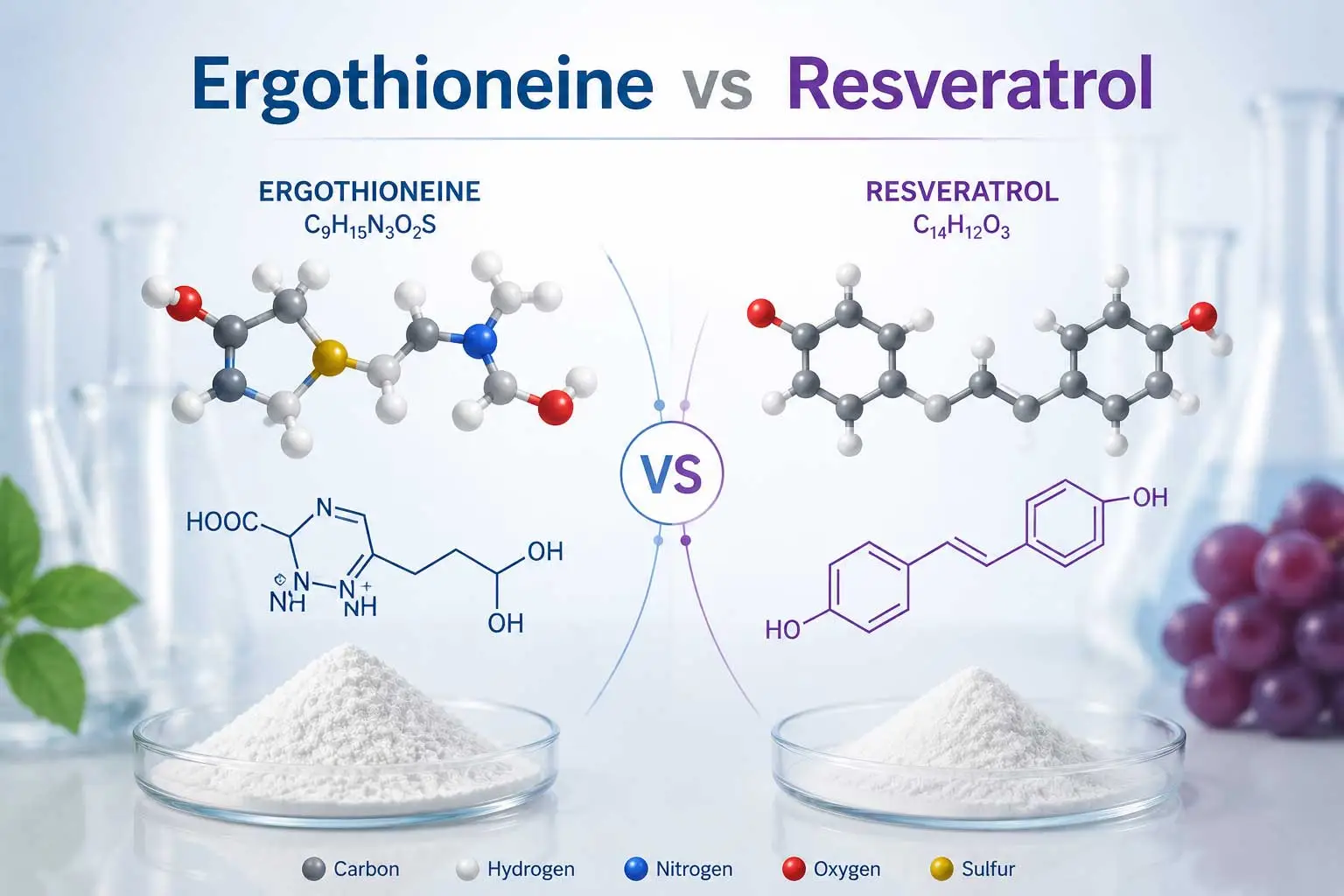
At the same time, demand for more stable and formulation-friendly alternatives is rising. This is where ergothioneine vs resveratrol comparisons have become highly relevant for supplement manufacturers evaluating next-generation antioxidant systems.
Unlike resveratrol, which is primarily plant-derived and subject to seasonal variability, ergothioneine is produced through controlled fermentation systems, offering a more consistent supply profile. This shift is particularly important for brands sourcing from a bulk ergothioneine powder supplier, where batch-to-batch uniformity and regulatory documentation are critical for global distribution.
The Real Challenge Is Not Antioxidant Strength, But How These Ingredients Behave Inside Actual Supplement Formulations
In modern supplement development, the comparison between ergothioneine vs resveratrol is no longer centered only on antioxidant potency. Instead, formulators are increasingly focused on how each ingredient behaves under real manufacturing conditions, including heat exposure, pH variation, and delivery system compatibility.
Resveratrol, despite its strong biological positioning as a polyphenol antioxidant, presents notable formulation challenges. It has limited water solubility and is highly sensitive to light and oxidation, which can lead to degradation during processing and storage. As a result, manufacturers often require encapsulation technologies or lipid-based systems to maintain stability in finished products.
By contrast, ergothioneine powder for supplement applications demonstrates high water solubility and strong chemical stability, allowing it to be directly integrated into capsules, powders, and functional beverage formulations without complex delivery systems. This significantly reduces formulation complexity for supplement ingredient manufacturers working on scalable production lines.
From an industrial perspective, this difference in formulation behavior has become a key decision factor. Many nutraceutical ingredient suppliers now evaluate antioxidants not only by biological activity but by processing efficiency, stability loss rate, and compatibility with multi-ingredient systems.
Procurement Decisions Are Shifting From Raw Material Pricing to Cost Per Functional Dose in Finished Products
In commercial procurement, the evaluation of ergothioneine vs resveratrol is increasingly based on cost efficiency at the finished product level rather than raw material price per kilogram. This shift reflects a broader transformation in how supplement manufacturers assess antioxidant ingredient value chains.
Resveratrol may appear cost-effective at the raw material stage, but its instability and processing requirements often lead to losses during formulation. These losses increase the effective cost per finished capsule or serving, particularly in high-potency anti-aging formulations where dosage consistency is critical.
Ergothioneine, while positioned as a higher-value ingredient in some markets, offers improved formulation efficiency due to its stability and direct solubility. This reduces processing steps and minimizes material loss, which can significantly improve overall cost-performance ratio in large-scale production.
For brands working with a bulk ergothioneine powder supplier, this efficiency becomes particularly important when scaling production across multiple product categories such as longevity supplements, sports recovery formulations, and functional wellness beverages.
As a result, procurement teams are increasingly shifting evaluation models toward total system cost, rather than isolated ingredient pricing, when selecting between bulk resveratrol powder suppliers and fermentation-based antioxidant sources.
In Real Product Development, Resveratrol and Ergothioneine Are No Longer Competing — They Are Being Used in Different Functional Layers
In current supplement innovation pipelines, the comparison of ergothioneine vs resveratrol is less about substitution and more about functional positioning within multi-layer antioxidant systems.
Resveratrol continues to be widely used in traditional anti-aging formulations, particularly in products targeting cardiovascular support and metabolic health. Its role is often associated with gene expression pathways and systemic longevity signaling, making it a core component in established anti-aging supplement formulations.
Ergothioneine, however, is increasingly positioned as a cellular-level antioxidant designed to support intracellular oxidative stress balance. Its ability to accumulate in high-stress tissues such as brain, liver, and mitochondria-rich organs makes it particularly relevant for next-generation cellular health supplement ingredient systems.
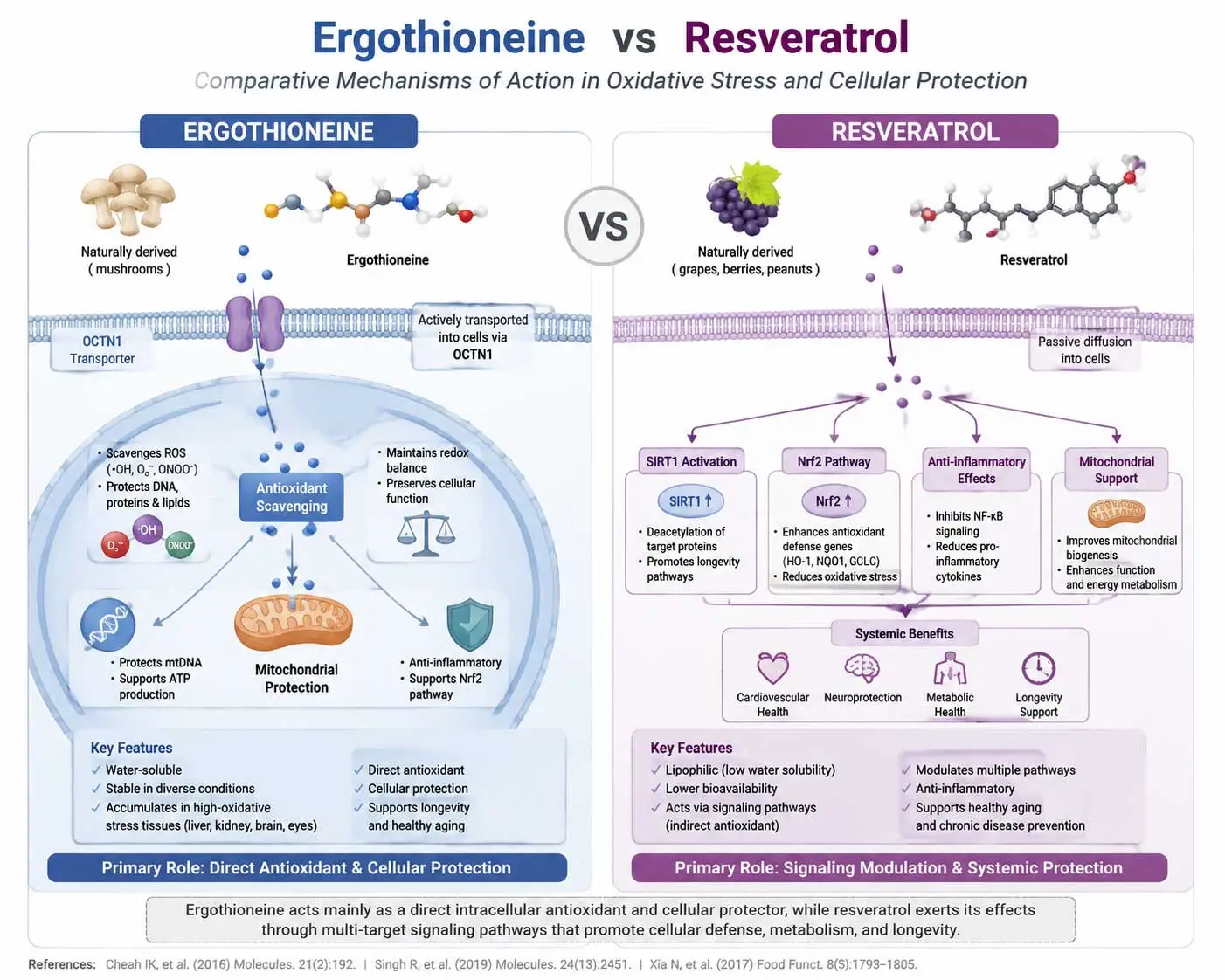
In practice, many modern supplement brands are no longer choosing between these two ingredients. Instead, they are combining them in layered systems where resveratrol supports systemic signaling pathways while ergothioneine enhances intracellular antioxidant defense.
This approach reflects a broader shift in the industry toward multi-functional nutraceutical ingredient formulation strategies, where ingredients are selected not as direct competitors but as complementary components in advanced product design.
From a supply perspective, CHEN LANG BIO TECH supports this evolving formulation trend by providing high-purity fermentation-derived ergothioneine powder, enabling manufacturers to integrate stable cellular antioxidants into complex multi-ingredient systems without compromising processing efficiency or batch consistency.
Supply Chain Structure Is Quietly Redefining How Antioxidants Like Resveratrol and Ergothioneine Are Evaluated
In the current global nutraceutical supply chain, the comparison between ergothioneine vs resveratrol is increasingly influenced by production architecture rather than only biochemical properties. For supplement manufacturers, supply chain predictability has become as important as functional efficacy when selecting antioxidant ingredient suppliers.
Resveratrol is primarily sourced through plant extraction, most commonly from Polygonum cuspidatum or grape-derived materials. While this botanical origin supports its “natural” positioning, it also introduces variability in raw material quality, seasonal yield fluctuations, and purification inconsistency. These factors can create challenges for manufacturers requiring stable input materials for large-scale nutraceutical ingredient manufacturing.
Ergothioneine, in contrast, is produced through controlled fermentation processes. This production method allows for consistent molecular output, predictable purity levels, and scalable industrial manufacturing. For companies managing global distribution, this consistency is a critical factor when evaluating a bulk ergothioneine powder supplier, particularly in regulated supplement markets such as the EU and North America.
From a supply chain resilience perspective, fermentation-derived ingredients are increasingly preferred because they reduce dependence on agricultural variability and geopolitical sourcing risks. This structural difference is one of the key reasons why ergothioneine is gaining traction among functional ingredient suppliers focused on long-term supply stability.
The Real Cost Comparison Is Not Ingredient Price, But Formulation Efficiency and Loss Reduction Across Production Cycles
When evaluating ergothioneine vs resveratrol, experienced supplement manufacturers rarely rely on raw material pricing alone. Instead, they assess total system efficiency, including formulation loss rate, processing complexity, and finished product yield.
Resveratrol, despite being widely available in the market, often requires additional formulation steps such as encapsulation, solubilization, or lipid-based delivery systems. These steps introduce additional manufacturing costs and can lead to active ingredient degradation during processing. In high-volume production environments, even small efficiency losses can significantly impact overall profitability.
Ergothioneine presents a different cost structure. Due to its high water solubility and thermal stability, it can be directly integrated into a wide range of delivery systems, including capsules, powders, and functional beverages. This reduces processing steps and minimizes active ingredient loss during manufacturing.
As a result, the effective cost per finished dose often becomes more favorable for ergothioneine-based formulations, particularly in multi-functional cellular health supplement ingredient systems. This is a critical factor for brands scaling production across multiple product lines, where consistency and yield optimization directly affect margin structure.
For procurement teams evaluating bulk ergothioneine powder, the focus is therefore shifting toward total formulation efficiency rather than isolated ingredient pricing metrics.
Market Demand Is Moving Toward Multi-Pathway Antioxidant Systems Instead of Single-Mechanism Ingredients
The evolving nutraceutical market is no longer driven by single-function antioxidant positioning. Instead, demand is shifting toward multi-pathway systems that integrate both systemic and cellular-level protection mechanisms.
Resveratrol continues to hold a strong position in traditional anti-aging supplement formulations, particularly those targeting cardiovascular health and metabolic longevity pathways. Its role in SIRT1 activation remains a key scientific reference point in polyphenol research and longevity nutrition.
However, ergothioneine is emerging as a complementary ingredient in next-generation formulations focused on intracellular oxidative stress regulation. Its unique transporter-mediated uptake mechanism (OCTN1) allows it to accumulate in tissues exposed to high oxidative stress, making it particularly relevant in cellular protection antioxidant ingredient systems.
In practical product development, many supplement brands are now designing hybrid systems where resveratrol contributes to systemic signaling pathways, while ergothioneine supports intracellular antioxidant defense. This layered approach is increasingly common in premium functional ingredient formulation strategies across longevity, sports nutrition, and wellness categories.
From a market perspective, this shift reflects a broader industry transition from single-ingredient positioning to system-based formulation design.
Frequently Asked Questions (FAQ)
Is ergothioneine a replacement for resveratrol in supplement formulations?
Not directly. In modern formulation strategies, ergothioneine vs resveratrol is not a replacement scenario but a complementary system approach. Resveratrol supports systemic signaling pathways, while ergothioneine focuses on intracellular antioxidant protection.
Why are manufacturers considering ergothioneine for new product development?
Because ergothioneine powder for supplement manufacturing offers high stability, water solubility, and scalability, making it easier to integrate into capsules, powders, and functional beverages without complex delivery systems.
How does resveratrol compare in formulation performance?
Resveratrol is effective biologically but requires additional processing such as encapsulation or lipid carriers due to low solubility and stability challenges in manufacturing environments.
What should buyers consider when sourcing bulk ergothioneine?
Key factors include production method (fermentation), batch consistency, regulatory documentation (COA, MSDS, TDS), and supplier reliability within global nutraceutical ingredient supply chains.
Conclusion: Value in Modern Supplement Formulation Is Defined by System Performance, Not Individual Ingredient Strength
The comparison between ergothioneine vs resveratrol highlights a broader structural shift in modern supplement formulation. Ingredient selection is no longer driven solely by isolated biological potency, but increasingly by system-level performance, including formulation stability, supply chain consistency, and overall manufacturing efficiency.
Resveratrol continues to serve as a foundational antioxidant supplement ingredient, particularly in traditional anti-aging and cardiovascular health formulations. Its established scientific background ensures continued use in premium nutraceutical products. However, formulation challenges such as solubility limitations and oxidative instability continue to influence manufacturing efficiency, especially in large-scale production environments.
Ergothioneine, on the other hand, represents a newer generation of cellular health supplement ingredients designed for intracellular antioxidant protection and long-term oxidative stress regulation. Its fermentation-based production, high water solubility, and strong stability profile make it particularly suitable for modern multi-functional supplement systems, including longevity, sports recovery, and functional beverage applications.
From a supply chain perspective, manufacturers are increasingly prioritizing suppliers that can ensure consistent quality, scalable production capacity, and complete technical documentation support (including COA, TDS, and MSDS). This is especially important for brands working across regulated markets in Europe and North America, where compliance and batch consistency are critical.
For formulation teams and procurement departments evaluating bulk ergothioneine powder supplier options, technical coordination is often required to ensure compatibility with existing production systems and product positioning strategies.
In such cases, communication is typically handled through direct technical channels rather than standard commercial inquiry systems. For example, ingredient specifications, sample requests, or formulation support discussions are usually coordinated with the manufacturing side to ensure accuracy and regulatory alignment.
For technical inquiries or bulk ergothioneine powder supply coordination, procurement teams can reach out directly via:
Email: admin@chenlangbio.com
This channel is primarily used for formulation discussions, specification confirmation, and bulk ingredient sourcing alignment rather than promotional communication, ensuring that both R&D teams and buyers can efficiently evaluate ergothioneine vs resveratrol integration options in their product development pipelines.

Send Inquiry

Related Industry Knowledge
- Is Bifida Ferment Lysate Good for Skin?
- How Ivermectin Powder Works for Animals: Dosage, Benefits, and Application Guide
- Is Piroctone Olamine Safe to Use?
- What is the Solubility of D-Luciferin Sodium Salt?
- Can Kopexil Be Used with Other Hair Growth Treatments?
- Does Bakuchiol have Any Side Effects
- Is Ectoin Powder Effective For Treating Allergies or Asthma?
- Can Icariin Increase Testosterone
- Fisetin Powder Manufacturing Process
- What Benefits and Side Effects of the Curcumin Turmeric Extract Powder