
Berberine HCl vs Berberine Sulfate: Key Differences for Supplement Manufacturers
November 16, 2026
Berberine HCl vs Berberine Sulfate is an important raw material comparison for supplement manufacturers evaluating berberine salts for commercial production. Both contain the same berberine cation, but their counterions, chemical composition, molecular weight, and theoretical berberine content differ. These distinctions affect how manufacturers interpret assay results, compare supplier specifications, calculate ingredient requirements, and qualify materials for production.
For ingredient buyers, the practical question is not simply which salt has a higher advertised purity. A meaningful comparison requires confirmation of the exact chemical form, the analytical basis used to report potency, and the physical properties relevant to the intended formulation.
This guide examines the differences between berberine hydrochloride and berberine sulfate from a manufacturing and procurement perspective, including chemical identity, HPLC testing, solubility, capsule and tablet applications, and commercial sourcing considerations.
Berberine HCl vs Berberine Sulfate: Chemical Forms and Molecular Structure
Berberine is a quaternary ammonium alkaloid whose positively charged molecular structure can be associated with different counterions. In commercial ingredient specifications, those counterions form part of the material's chemical identity.
Although the berberine cation remains the same, changing the counterion changes the overall composition of the salt. Consequently, manufacturers must distinguish between the identity of the berberine molecule and the identity of the supplied raw material.
Berberine Hydrochloride Chemical Formula, CAS Number and Properties
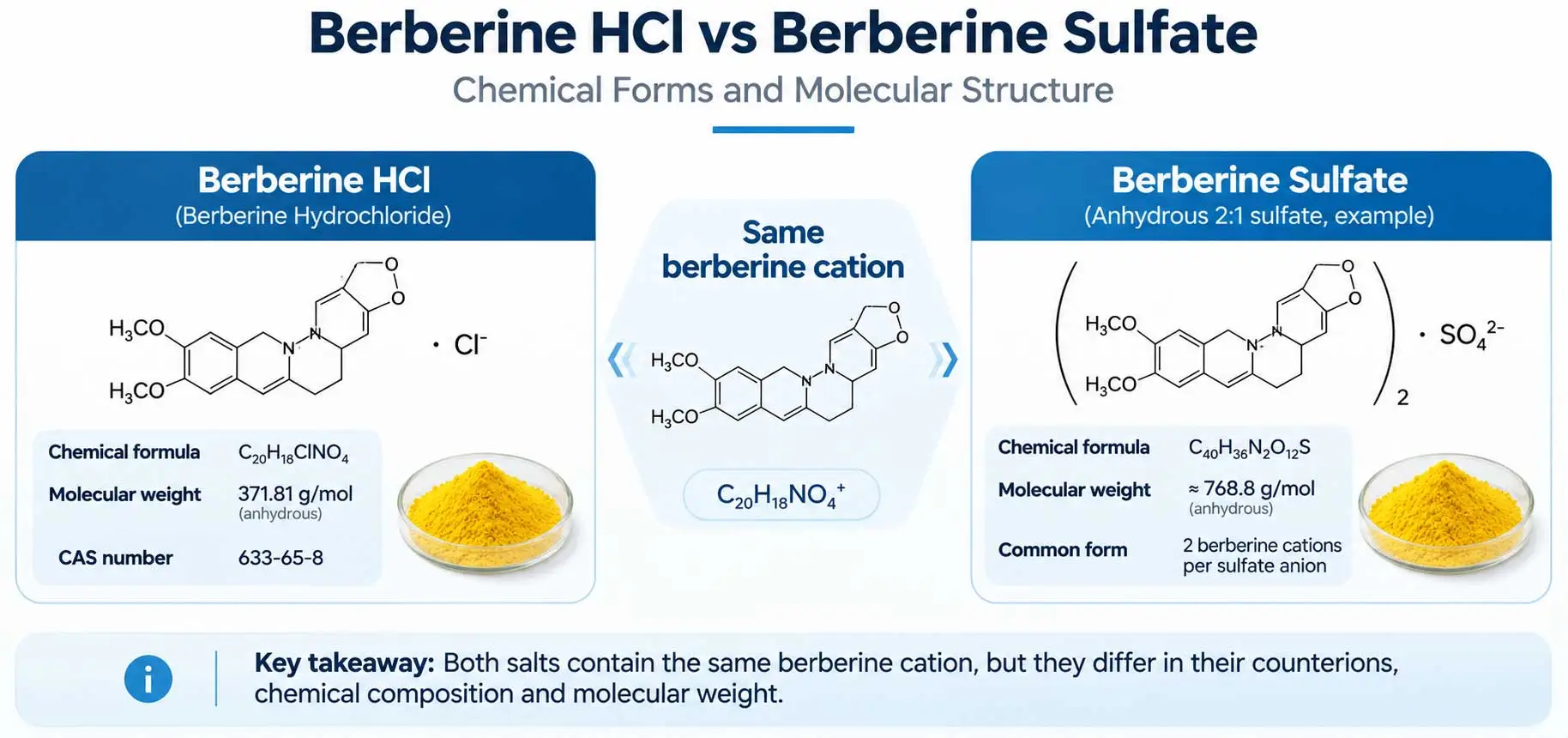
Berberine hydrochloride, commonly sold as berberine hcl powder, is a chloride salt of berberine.
The commonly referenced anhydrous form has the following characteristics:
Molecular formula: C₂₀H₁₈ClNO₄
Molecular weight: approximately 371.81 g/mol
CAS number: 633-65-8
Appearance: typically yellow to yellow-orange crystalline powder
The chloride counterion balances the positive charge of the berberine cation. It does not alter the fundamental structure of the berberine cation itself.
However, the anhydrous form must be distinguished from berberine hydrochloride hydrates. Water incorporated into a crystalline material contributes to its molecular weight and can affect how assay results are expressed.
Therefore, when reviewing a supplier's specification, buyers should confirm whether the material is described as anhydrous, hydrated, or tested on a dried basis.
Berberine Sulfate Chemical Formula and Salt Stoichiometry
Berberine sulfate requires additional attention because the commercial name does not always provide sufficient information about the exact chemical composition.
For example, an anhydrous sulfate salt containing two berberine cations per sulfate anion has the molecular formula C₄₀H₃₆N₂O₁₂S and a molecular weight of approximately 768.8 g/mol.
Other sulfate-containing forms, including hydrogen sulfate salts and hydrates, have different compositions.
This distinction matters because the molecular formula determines the theoretical proportion of berberine in the material.
A buyer evaluating berberine sulfate chemical formula information should request the complete chemical identity rather than relying on the product name alone.
Berberine Sulfate vs Hydrochloride: Chemical Identity Comparison
|
Property |
Berberine HCl |
Berberine Sulfate |
|
Berberine component |
Berberine cation |
Berberine cation |
|
Counterion |
Chloride |
Sulfate or hydrogen sulfate, depending on the salt |
|
Representative formula |
C₂₀H₁₈ClNO₄ |
C₄₀H₃₆N₂O₁₂S for the anhydrous 2:1 sulfate |
|
Representative molecular weight |
371.81 g/mol |
Approximately 768.8 g/mol for the anhydrous 2:1 sulfate |
|
Hydrated forms |
Must be distinguished from anhydrous material |
Must be distinguished from anhydrous material |
|
Purchasing priority |
Confirm identity and assay basis |
Confirm exact sulfate form, stoichiometry and assay basis |
The essential berberine hcl and berberine sulfate difference is chemical composition, not the identity of the underlying berberine cation.
For commercial procurement, this distinction should be established before comparing purity specifications, pricing, or formulation performance.
Berberine HCl vs Berberine Sulfate Molecular Weight and Berberine Content
One of the most consequential differences between these salts is the proportion of berberine cation present in a given mass of material.
This becomes particularly important when manufacturers compare raw materials using nominal purity percentages or evaluate ingredient costs against formulation targets.
Why Berberine Salt Molecular Weight Matters
The molecular weight of a salt includes its counterion and any water of crystallization.
Consequently, one kilogram of a berberine salt does not consist entirely of berberine cations, even when the salt is chemically pure.
For the anhydrous chloride salt, the molecular weight of the berberine cation is approximately 336.36 g/mol, compared with 371.81 g/mol for the complete salt.
The theoretical berberine cation fraction is therefore approximately 90.5%.
For the anhydrous 2:1 sulfate salt, two berberine cations contribute approximately 672.72 g/mol to a total molecular weight of 768.8 g/mol, giving a theoretical fraction of approximately 87.5%.
These percentages represent chemical composition, not measured commercial purity.
Berberine Content Calculation: HCl vs Sulfate
The theoretical berberine fraction can be calculated using:

Here, \(n\) represents the number of berberine cations in the specified salt formula.
|
Anhydrous salt form |
Theoretical berberine cation content |
|
Berberine HCl |
Approximately 90.5% |
|
Berberine sulfate, 2:1 form |
Approximately 87.5% |
These values assume the stated chemical forms are pure and anhydrous. They are not interchangeable with supplier assay results.
For example, a certificate reporting 98% berberine hydrochloride may be expressing the percentage of the specified salt rather than the percentage of free berberine cation.
Before converting an assay value, the buyer must establish what the analytical method measures and how the result is calculated.
Comparing 97% and 98% Berberine Salt Assay Results
A berberine hcl vs berberine sulfate purity comparison cannot be made reliably from two percentages alone.
The first supplier may report assay as berberine hydrochloride on a dried basis, while the second may express results as berberine, a sulfate salt, or another defined reference.
Furthermore, moisture corrections and analytical reference standards can affect reported values.
Procurement teams should therefore request the assay method, reference standard, calculation basis, and moisture specification before treating two certificates as equivalent.
For manufacturing purposes, the relevant specification is the one that accurately defines the material and supports the intended formulation calculation.
Berberine HCl vs Berberine Sulfate Purity, HPLC Assay and Quality Standards
Raw material qualification requires more than a high assay percentage. Manufacturers must establish that the material has the expected chemical identity, meets defined impurity limits, and remains consistent between production batches.
These requirements apply to both berberine hydrochloride and berberine sulfate.
•Understanding Berberine HCl and Berberine Sulfate Assay Specifications
High-performance liquid chromatography is commonly used to quantify berberine-related components.
However, an berberine hcl hplc assay result must be interpreted in the context of the analytical method.
HPLC may quantify the berberine chromophore, while the reported result is calculated using a specified reference standard and conversion basis. A chromatographic peak alone does not establish which counterion is present.
Therefore, identity testing and assay testing should not be treated as interchangeable.
Where salt identity is critical, an appropriate orthogonal method may be needed to verify the counterion or confirm the chemical form.
•Berberine Sulfate COA vs Berberine HCl COA
A berberine sulfate coa should provide sufficient information to identify the supplied salt and interpret its assay correctly.
The same principle applies to berberine hydrochloride.
|
COA parameter |
What the buyer should verify |
|
Product identity |
Exact chemical name, salt form and applicable CAS |
|
Assay |
Analytical method, reference standard and reporting basis |
|
Identification |
Evidence supporting berberine identity and, where required, salt identity |
|
Water or loss on drying |
Moisture specification and assay correction |
|
Related substances |
Defined impurity limits and test method |
|
Heavy metals |
Applicable elemental impurity limits and analytical results |
|
Microbiology |
Limits appropriate to the intended supplement application |
|
Batch traceability |
Batch number, manufacturing information and release status |
An assay result without an identified method or reporting basis may be insufficient for qualification, even if the percentage appears acceptable.
•Berberine Raw Material Specifications for Commercial Production
For commercial manufacturing, berberine raw material specifications should be agreed upon before the first production order.
The purchasing specification should define identity, assay, impurity limits, moisture, physical properties, packaging, and required documentation.
Furthermore, specifications should reflect the intended market and finished-product requirements rather than relying exclusively on a supplier's standard COA.
A sample that passes initial testing is useful, but it does not replace a documented supplier qualification process or ongoing batch verification.
Manufacturers should also establish how deviations, analytical discrepancies, and changes to manufacturing or testing methods will be communicated.
Berberine HCl vs Berberine Sulfate Solubility and Formulation Considerations
Solubility is frequently discussed when comparing berberine salts, but it is also an area where unsupported assumptions can lead to poor formulation decisions.
Although different counterions may influence crystal properties and dissolution behavior, berberine hcl vs berberine sulfate solubility cannot be evaluated reliably without specifying the test conditions and the exact chemical forms being compared.
Berberine HCl vs Berberine Sulfate Water Solubility
Berberine hydrochloride is generally described as having limited aqueous solubility. However, published values may differ because of variations in temperature, pH, experimental methods, and the material tested.
For berberine sulfate, the situation requires particular care because the term may refer to different sulfate-containing forms.
A meaningful comparison of berberine sulfate water solubility should therefore use authenticated materials tested under identical conditions.
The evaluation should specify temperature, medium composition, pH, equilibration time, analytical method, and whether the reported concentration refers to the complete salt or berberine itself.
Without these details, a numerical comparison may be misleading.
Berberine Salt Dissolution, Particle Size and Powder Properties
Solubility and dissolution are related but distinct properties.
Solubility describes the equilibrium concentration achievable under defined conditions, whereas dissolution describes the process by which a solid enters solution.
For capsule and tablet manufacturing, dissolution behavior may also depend on particle size distribution, crystal characteristics, wetting, excipients, and processing conditions.
A smaller particle size can increase exposed surface area, but it does not automatically guarantee better powder flow or finished-product performance.
Consequently, berberine salt formulation development should consider both chemical and physical material characteristics.
Berberine Salt Selection for Supplement Formulation
Manufacturers considering a change from one salt to another should not assume that equivalent nominal assay percentages will produce equivalent formulations.
A salt substitution may affect ingredient weight calculations, dissolution performance, compatibility, and the basis used to declare the ingredient in the finished product.
Before approving a replacement, the formulation team should evaluate identity, assay equivalence, physical properties, stability, and the applicable regulatory requirements.
The appropriate choice depends on documented performance in the intended product, not an unsupported assumption that one salt is inherently superior.
Berberine HCl vs Berberine Sulfate for Capsule and Tablet Manufacturing
In commercial supplement production, raw material selection must account for more than chemical purity.
The powder must also be suitable for the equipment, processing conditions, and quality requirements of the finished dosage form.
Berberine HCl Powder for Capsule Manufacturing
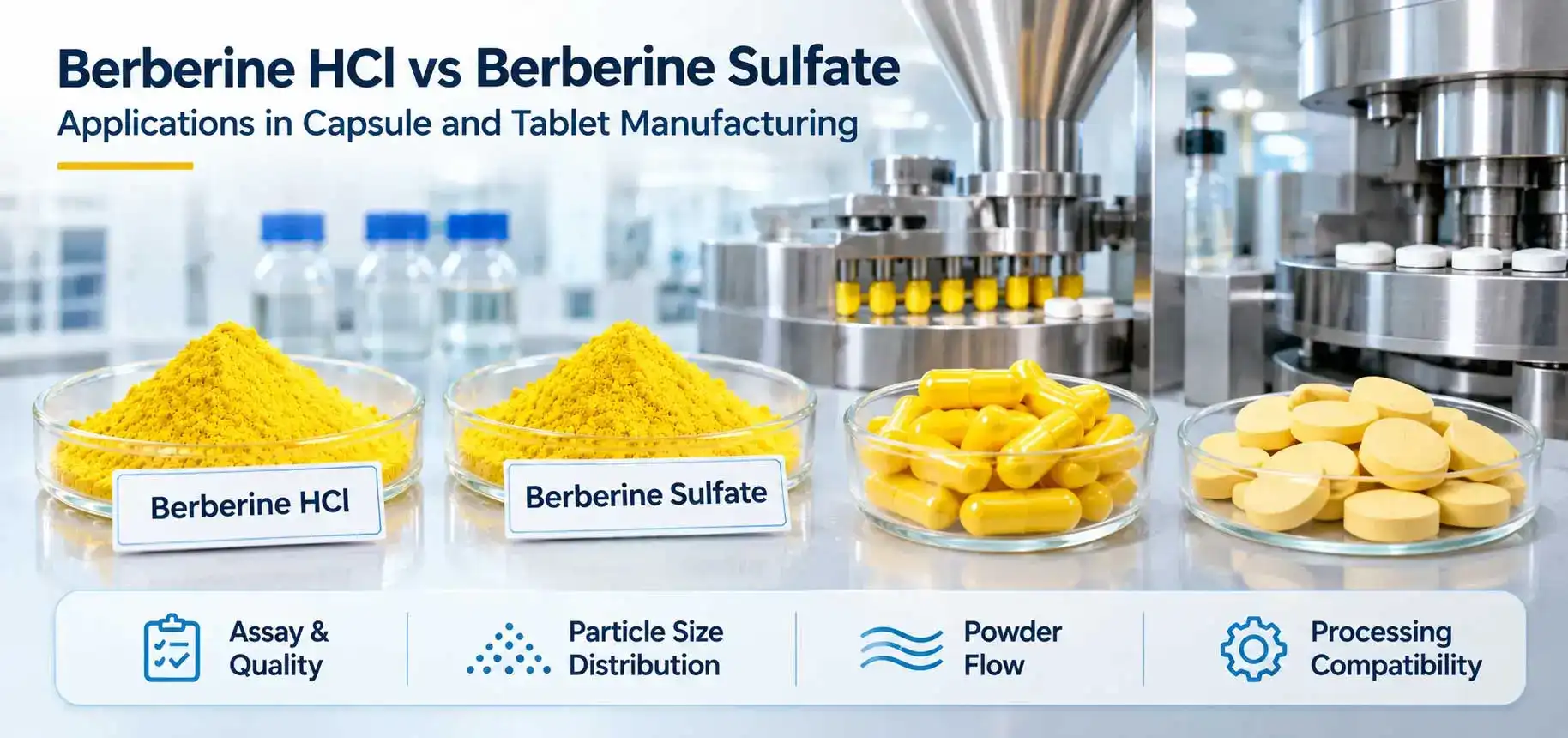
When evaluating berberine hcl powder for capsules, manufacturers should review particle size distribution, bulk density, tapped density, moisture, and flow behavior.
These characteristics influence hopper feeding, powder transfer, filling consistency, and the volume required to achieve the target fill weight.
For example, two batches with comparable HPLC assay results may behave differently during capsule filling if their particle size distributions or bulk densities differ substantially.
A material with poor flow may require additional formulation work or processing adjustments.
Therefore, qualification should include representative manufacturing trials rather than relying entirely on analytical purity.
Berberine Sulfate in Tablet Formulation Development
For berberine sulfate formulation, tablet manufacturers should assess compressibility, compactibility, powder flow, moisture sensitivity, and compatibility with the selected excipients.
A salt change can also alter the amount of raw material required to achieve a defined berberine-equivalent target.
However, neither berberine hydrochloride nor berberine sulfate should be assumed to have superior tableting properties without comparative testing.
Trial batches can help establish whether direct compression is feasible or whether additional processing is required.
Evaluating Berberine Salt Consistency Between Production Batches
Batch consistency becomes increasingly important as manufacturing volumes increase.
Manufacturers should monitor critical attributes such as assay, moisture, particle size, bulk density, and relevant impurity results.
Where these attributes affect finished-product performance, agreed acceptance ranges should be incorporated into the raw material specification.
A dependable ingredient supply is not simply one that repeatedly meets a nominal purity claim. It must also deliver material that performs consistently under established manufacturing conditions.
Berberine HCl vs Berberine Sulfate Bulk Sourcing and Commercial Specifications
Once the technical differences have been established, procurement teams can evaluate commercial supply.
For supplement manufacturers, the objective is to purchase a correctly identified, qualified raw material at a sustainable total cost while maintaining predictable production schedules.
Bulk Berberine HCl Powder and Berberine Sulfate Supply Requirements
When sourcing bulk berberine hcl powder, buyers should provide the intended application, required assay, anticipated purchasing volume, and destination market.
The same information is necessary when evaluating berberine sulfate bulk powder, although sulfate specifications should additionally identify the exact chemical form.
A useful purchasing specification should cover analytical requirements, physical characteristics, documentation, packaging, and batch traceability.
Before committing to commercial quantities, manufacturers should obtain representative samples and verify that the material meets their internal acceptance criteria.
This reduces the risk of discovering specification differences after a production order has been placed.
Comparing Berberine HCl and Berberine Sulfate Price per kg
A direct comparison of berberine hcl wholesale price and berberine sulfate price per kg can be misleading if the quotations refer to different chemical forms, assay bases, or delivery conditions.
For example, the theoretical berberine cation content differs between anhydrous berberine hydrochloride and anhydrous 2:1 berberine sulfate.
Accordingly, procurement teams may calculate an indicative cost per unit of berberine cation, provided that both products have verified identities and compatible assay data.
However, theoretical content is only one purchasing consideration.
Testing costs, formulation adjustments, packaging, freight, import requirements, and supplier reliability can all influence the total cost of an approved material.
The lowest quoted price per kilogram is not necessarily the lowest manufacturing cost.
Berberine Salt MOQ, Sample Orders and International Shipping
Commercial quotations should clearly state the minimum order quantity, available packaging, production or dispatch lead time, shipping terms, and documentation included.
For international orders, buyers should also confirm the destination country's import requirements before shipment.
A supplier may be able to provide a technically suitable material while the intended application remains subject to additional regulatory review.
For this reason, purchasing approval should consider both product qualification and market eligibility.
Selecting a Berberine HCl Powder Supplier for Supplement Manufacturing
Selecting a berberine hcl powder supplier involves assessing whether the supplier can consistently deliver the required material with sufficient technical documentation and commercial support.
Buyers should prioritize verified chemical identity, appropriate analytical testing, batch traceability, and transparent communication about specifications.
Berberine HCl Powder Supplier Qualification
An effective qualification process should include a review of the supplier's manufacturing or sourcing arrangements, quality procedures, documentation, and sample performance.
Where necessary, buyers may also request information about manufacturing controls, change management, and third-party testing.
A reliable berberine raw material manufacturer or supplier should be able to explain how its product specifications are established and how batch quality is verified.
Berberine HCl Bulk Supply from CHEN LANG BIO TECH
At CHEN LANG BIO TECH, we understand that supplement manufacturers require more than a competitive raw material quotation. Accurate specifications, consistent quality, and responsive documentation support are essential to successful commercial purchasing.
We supply berberine hcl powder for customers evaluating ingredient sourcing and commercial manufacturing requirements. Buyers can contact our team to discuss product specifications, available quality documents, sample requirements, and bulk quotations.
For further information, please contact our Email: admin@chenlangbio.com.
Frequently Asked Questions About Berberine HCl vs Berberine Sulfate
Is Berberine HCl the Same as Berberine Sulfate?
No. Both contain the same berberine cation, but they have different counterions and chemical compositions. Berberine hydrochloride contains chloride, whereas berberine sulfate contains a sulfate-related counterion. The precise sulfate form must be identified before comparing specifications or calculating berberine content.
What Is the Difference Between Berberine HCl and Berberine Sulfate Purity?
Purity percentages cannot be compared reliably without knowing the analytical reporting basis. A 98% assay expressed as berberine hydrochloride is not necessarily equivalent to a 98% assay expressed as a sulfate salt. Buyers should verify the test method, reference standard, moisture correction, and chemical form.
Does Berberine Sulfate Contain the Same Amount of Berberine as Berberine HCl?
Not necessarily. The theoretical berberine cation fraction depends on the salt's molecular composition. Anhydrous berberine hydrochloride contains approximately 90.5% berberine cation by mass, while anhydrous 2:1 berberine sulfate contains approximately 87.5%. Actual commercial material content depends on assay and other specifications.
Is Berberine HCl or Berberine Sulfate More Soluble in Water?
A reliable comparison requires experimental data for the exact salt forms under identical conditions. Temperature, pH, medium composition, and test methodology can influence reported results. Manufacturers should request suitable solubility data rather than assuming that one salt is consistently more soluble.
Can Berberine Sulfate Replace Berberine HCl in Supplement Formulations?
A substitution should be treated as a formulation change requiring evaluation. Manufacturers must consider chemical identity, berberine-equivalent content, powder characteristics, dissolution, stability, labeling, and applicable regulatory requirements. Equivalent nominal purity does not establish interchangeability in a finished supplement.
What Should Buyers Check Before Ordering Berberine HCl Powder in Bulk?
Buyers should verify the chemical form, assay method, COA, impurity limits, moisture specification, particle size requirements, and packaging. They should also confirm sample availability, batch traceability, minimum order quantity, shipping terms, and documentation before approving a berberine hcl bulk order.
Conclusion — Choosing Berberine HCl or Berberine Sulfate for Supplement Production
The choice between berberine hcl vs berberine sulfate should be based on verified chemical identity, correctly interpreted assay results, formulation requirements, and dependable raw material quality.
For supplement manufacturers, understanding these differences helps prevent specification errors, supports consistent production, and enables more meaningful supplier comparisons.
If you are planning to buy berberine hcl powder in bulk, contact CHEN LANG BIO TECH to request available specifications, quality documentation, sample information, and a commercial quotation.
References
1. National Center for Biotechnology Information. PubChem Compound Summary: Berberine Chloride.
2. National Center for Biotechnology Information. PubChem Compound Summary: Berberine.
3. National Center for Biotechnology Information. PubChem chemical records for berberine sulfate forms.
4. United States Food and Drug Administration. 21 CFR Part 111 — Current Good Manufacturing Practice in Manufacturing, Packaging, Labeling, or Holding Operations for Dietary Supplements.
5. United States Pharmacopeia. General Chapter <621>, Chromatography.
6. United States Pharmacopeia. General Chapter <616>, Bulk Density and Tapped Density of Powders.
7. International Council for Harmonisation. ICH Q9(R1), Quality Risk Management.

Send Inquiry
Related Industry Knowledge
- Berberine HCl for Capsules and Tablets: Formulation Guide
- Is Shilajit Good for Pennis?
- Helichrysum Arenarium: Nature’s Hidden Gem
- Is Sodium Ascorbyl Phosphate the Same As Ascorbic Acid?
- What Does Andrographolide Do for Your Skin
- Is Ectoin Better Than Hyaluronic Acid
- Is Ectoin Good for Eczema
- What is Quaternium 73 in Skincare
- What Are The Benefits Of Coenzyme Q10 Powder
- Premium Haematococcus Pluvialis Extract for Optimal Health Benefits