3% Rosavins vs 5% Salidroside: How to Choose the Right Rhodiola Extract Specification
2026-02-28 16:05:11
When supplement manufacturers evaluate rhodiola extract 3% rosavins 1% salidroside versus rhodiola extract 5% salidroside, the decision is rarely about which percentage appears higher on paper. The real consideration lies in marker balance, botanical specificity, manufacturing feasibility, and long-term supply consistency.
Both specifications represent standardized forms of Rhodiola rosea extract powder, yet they reflect different technical priorities. A 3% rosavin standard emphasizes the phenylpropanoid complex characteristic of Rhodiola rosea, while a 5% salidroside specification prioritizes a single phenylethanoid glycoside that is easier to quantify but not exclusive to one species.
For procurement teams, the practical questions include:
Does the marker profile align with the intended formulation strategy?
Is the botanical source verified as Rhodiola rosea L.?
Can the supplier demonstrate consistent chromatographic performance across batches?
How does the chosen specification influence cost structure and yield stability?
Selecting the right specification is therefore a strategic formulation decision—not a marketing comparison of numbers.
Understanding Active Ingredients in Rhodiola Rosea
To evaluate specification differences properly, it is essential to understand the role of active markers in standardized rhodiola extract production.
The Rosavin Complex
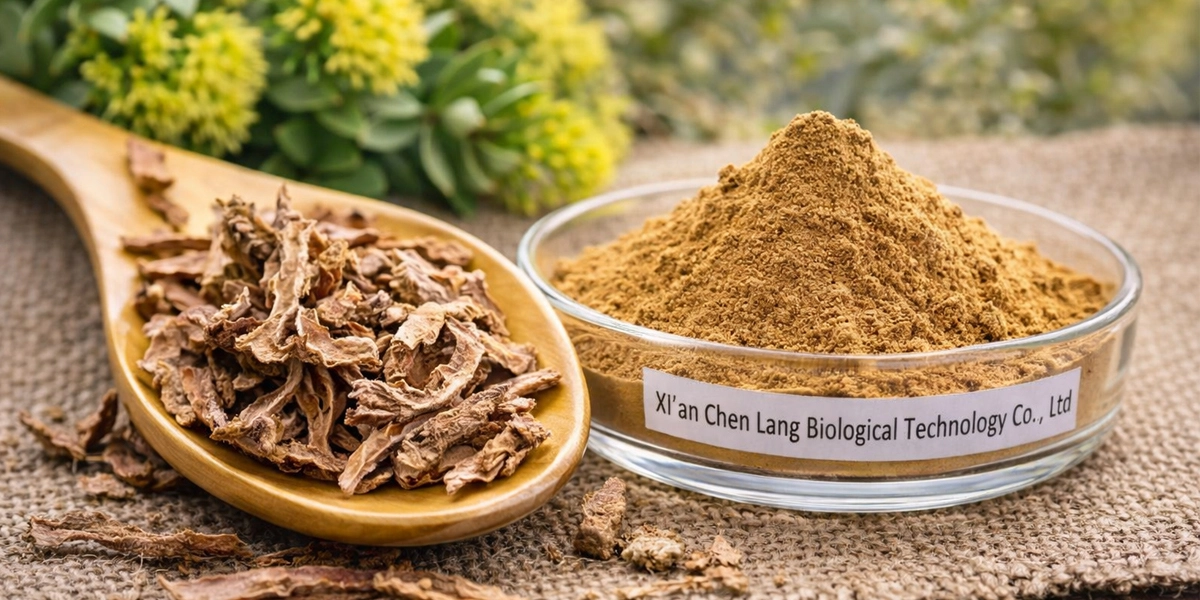
Rosavins are a group of cinnamyl alcohol glycosides consisting primarily of rosavin, rosarin, and rosin. These compounds are considered chemically characteristic of Rhodiola rosea and are often used as species-specific markers in botanical authentication.
In a typical rhodiola extract 3% rosavins 1% salidroside specification, rosavins represent the primary standardization focus. Their presence supports botanical identity verification, since they are not found in significant amounts in certain other Rhodiola species.
From a manufacturing standpoint, maintaining a stable rosavin concentration requires careful control of:
Raw root quality;
Extraction solvent composition;
Temperature parameters;
Concentration cycles.
Rosavin stability can be influenced by over-processing, which is why extraction control is critical.
Salidroside as a Quantitative Marker
Salidroside is widely used as a quantifiable compound due to its structural stability and ease of chromatographic detection. It is present in Rhodiola rosea, but also occurs in other Rhodiola species.
A rhodiola extract 5% salidroside specification focuses on achieving a higher concentration of this single marker. From an analytical perspective, salidroside is straightforward to standardize. However, it does not independently confirm botanical exclusivity.
For experienced procurement professionals, understanding this distinction is central to specification selection.
What Does 3% Rosavins Actually Represent?
A rhodiola extract 3% rosavins 1% salidroside specification is often regarded as the traditional benchmark within the global supplement industry. However, the numbers themselves require context.
Standardization vs. Extract Ratio
Standardization refers to adjusting and verifying extract composition to achieve consistent marker levels across production batches. It differs fundamentally from extract ratio claims such as “10:1,” which indicate concentration relative to raw plant material but do not confirm active compound content.
In a properly standardized product:
•Rosavin peaks should appear clearly separated in HPLC chromatograms
•Marker ratios should remain stable across batch archives
•Assay tolerances should fall within defined analytical ranges
Maintaining rosavin stability requires precise solvent polarity control and careful concentration steps. Over-aggressive evaporation can degrade delicate phenylpropanoid glycosides, resulting in fluctuating assay values.
Botanical Authenticity
Because rosavins are characteristic of Rhodiola rosea, a 3% rosavin specification reinforces botanical authenticity. For brands positioning products around traditional Rhodiola rosea identity, this specification often aligns well with marketing and formulation narratives.
However, achieving stable rosavin content is dependent on raw root composition, which can vary by altitude, harvest season, and post-harvest processing.
What Does 5% Salidroside Indicate?
A rhodiola extract 5% salidroside specification reflects a different technical emphasis. Rather than prioritizing the rosavin complex, this approach concentrates on increasing the salidroside fraction.
Analytical Efficiency
Salidroside is comparatively stable and easier to quantify with high reproducibility. From a manufacturing perspective, achieving 5% salidroside may involve selective concentration or fractionation steps that isolate this compound more efficiently.
However, increasing salidroside concentration does not necessarily increase rosavin levels proportionally. In some cases, rosavin content may remain lower than in traditional 3% rosavin extracts.
Market Positioning
Certain formulations prefer higher salidroside levels due to simplified standardization and consistent assay performance. In cost-sensitive production environments, the yield stability of salidroside-focused extraction may offer predictable manufacturing economics.
Yet it is important to note that salidroside alone does not uniquely define Rhodiola rosea identity.
For brands prioritizing species authenticity, rosavin presence remains a distinguishing factor.
Technical Comparison: 3% Rosavins vs 5% Salidroside
When evaluating rhodiola extract 3% rosavins 1% salidroside and rhodiola extract 5% salidroside, decision-making should be based on technical alignment rather than perceived potency. Below is a structured comparison framework designed for procurement and formulation teams.
Specification Comparison Matrix
|
Evaluation Criteria |
3% Rosavins / 1% Salidroside |
5% Salidroside |
|
Primary Standardization Focus |
Rosavin complex (rosavin, rosarin, rosin) |
Salidroside |
|
Botanical Specificity |
High – rosavins are characteristic markers of Rhodiola rosea |
Moderate – salidroside occurs in multiple Rhodiola species |
|
Species Authentication Value |
Strong support for Rhodiola rosea identity |
Requires additional botanical verification |
|
Analytical Stability |
Moderate – rosavin levels can vary with raw material quality |
High – salidroside is analytically stable and reproducible |
|
Manufacturing Sensitivity |
Requires careful solvent control and temperature management |
More straightforward assay targeting |
|
Batch-to-Batch Consistency Risk |
Influenced by root composition and harvest variability |
Generally more predictable under controlled extraction |
|
Market Recognition |
Widely recognized traditional benchmark specification |
Growing market adoption in standardized extract applications |
|
Typical Application Strategy |
Formulas emphasizing traditional Rhodiola identity |
Formulas prioritizing measurable marker concentration |
|
Impact on Raw Material Selection |
Requires rosavin-rich root sourcing |
Focused on overall salidroside yield efficiency |
|
Price Structure Influences |
Sensitive to rosavin yield and seasonal raw root variation |
Influenced by concentration efficiency and purification steps |
A rhodiola extract 3% rosavins 1% salidroside specification may be preferable when botanical authenticity and traditional species positioning are central to the formulation concept. The presence of the rosavin complex reinforces identity verification.
A rhodiola extract 5% salidroside specification may offer advantages in analytical reproducibility and standardized marker control, particularly in large-scale production environments requiring strict assay uniformity.
From a manufacturing perspective, each approach presents distinct challenges. Rosavin stabilization requires careful extraction parameter control, while higher salidroside levels may involve targeted concentration processes.
For procurement teams sourcing bulk rhodiola rosea extract powder, the selection should align with formulation positioning, regulatory expectations, and long-term supply stability rather than numerical comparison alone.
Application Scenarios: Which Specification Fits Your Formula?
In practical formulation development, the decision between rhodiola extract 3% rosavins 1% salidroside and rhodiola extract 5% salidroside should be guided by positioning strategy, dosage architecture, regulatory context, and cost modeling.
Specification selection is rarely a laboratory-only decision. It is a strategic choice that affects labeling clarity, marketing communication, and long-term procurement planning.
Below is a structured application analysis designed for supplement manufacturers and R&D teams.
Traditional Adaptogen Positioning
For brands positioning products around classical Rhodiola rosea identity and botanical heritage, maintaining the rosavin complex can be strategically aligned.
A rhodiola extract 3% rosavins 1% salidroside specification:
•Reinforces species authenticity
•Aligns with historically referenced standardization benchmarks
•Supports formulations emphasizing full-spectrum marker balance
Because rosavins are characteristic to Rhodiola rosea, their inclusion strengthens botanical credibility in formulations where ingredient origin transparency is central to brand identity.
This approach is often preferred in premium adaptogen blends where botanical story and species verification carry marketing weight.
High-Assay Marker Standardization
In certain formulation environments, precision standardization may be prioritized over botanical narrative.
A rhodiola extract 5% salidroside specification offers:
•Higher quantifiable marker concentration
•Analytical reproducibility
•Potentially simplified assay validation
For large-scale production runs where batch uniformity is critical, salidroside-focused extracts may offer practical advantages in consistency management.
However, procurement teams should ensure botanical identity verification remains robust, as salidroside presence alone does not confirm exclusive Rhodiola rosea sourcing.
Multi-Ingredient Adaptogen Blends
In compound formulations combining ingredients such as Ashwagandha, Ginseng, or other botanical extracts, specification selection may depend on balance rather than dominance.
When Rhodiola is one component within a broader matrix, decision factors include:
•Total marker load within the formula
•Target capsule or tablet weight
•Interaction with other standardized extracts
A standardized rhodiola extract with balanced rosavins and salidroside may integrate more harmoniously in formulations designed around botanical synergy rather than single-marker concentration.
In contrast, if the formulation strategy emphasizes clearly defined assay numbers per serving, higher salidroside content may simplify labeling structure.
Dosage Architecture and Capsule Economics
Specification choice also impacts finished dosage form efficiency.
If a formulation targets lower capsule weight while maintaining a defined marker claim, a higher concentration rhodiola extract 5% salidroside may reduce required extract mass per serving.
However, if the product concept emphasizes traditional marker balance rather than single-compound emphasis, the 3% rosavin standard may align better—even if slightly higher extract weight is required.
Procurement teams should consider:
•Capsule size constraints
•Target daily intake
•Ingredient stacking density
•Cost per finished unit
Specification decisions influence manufacturing economics at the final dosage level, not only at raw material purchase stage.
Regulatory and Documentation Considerations
In certain regulatory environments, documentation clarity and marker traceability influence approval processes.
Because rosavins are characteristic markers of Rhodiola rosea, a rhodiola extract 3% rosavins 1% salidroside specification may provide stronger botanical identity documentation support.
Conversely, when regulatory focus is placed on quantifiable assay reproducibility, higher salidroside concentration may simplify analytical validation.
Procurement strategy should therefore integrate regulatory consultation rather than relying solely on assay percentage comparisons.
Cost Modeling Over Product Lifecycle
Short-term price differences between specifications can be misleading. When sourcing bulk rhodiola rosea extract powder, cost modeling should evaluate:
•Long-term availability of rosavin-rich raw roots
•Stability of salidroside concentration yields
•Batch rejection risk
•Reformulation probability
In some supply environments, rosavin-focused extracts may show more seasonal variability. In others, salidroside-focused extracts may require additional concentration steps that increase processing costs.
The correct specification is the one that aligns with sustainable supply and consistent finished product economics.
Pricing & Manufacturing Considerations
In industrial procurement, pricing comparisons between rhodiola extract 3% rosavins 1% salidroside and rhodiola extract 5% salidroside must be grounded in production economics rather than surface-level assay percentages.
Understanding how extraction yield, raw material composition, and process control influence rhodiola extract price per kg allows supplement manufacturers to make rational long-term sourcing decisions.
Raw Material Composition and Marker Yield
The concentration of rosavins and salidroside in raw Rhodiola roots varies depending on:
•Geographic origin
•Altitude
•Harvest timing
•Drying methods
•Storage conditions prior to extraction
Rosavin-rich roots are not uniformly distributed across all harvest lots. Achieving a stable 3% rosavin standard often requires careful raw material selection and blending to maintain target assay levels.
In contrast, salidroside concentration may exhibit more predictable extraction yield in certain supply environments. However, increasing salidroside concentration to reach a 5% salidroside specification can require selective enrichment or additional concentration cycles.
These upstream variables directly impact manufacturing cost and final quotation stability.
Extraction Efficiency and Yield Loss
In botanical extraction, higher marker concentration frequently correlates with lower overall yield.
For example:
Increasing rosavin concentration beyond natural extract equilibrium may require discarding fractions with lower marker density.
Concentrating salidroside to higher percentages may involve additional solvent recovery and evaporation cycles.
Each additional processing step increases:
•Energy consumption
•Labor input
•Equipment utilization
•Quality control workload
When evaluating bulk rhodiola rosea extract powder, procurement teams should understand that unusually low pricing for high-assay specifications may signal compromised yield control or inconsistent blending practices.
Batch Rejection Risk and Cost Stability
Marker variability introduces a hidden cost factor rarely discussed openly: batch rejection risk.
If a manufacturer produces extract that narrowly misses assay specifications, options include:
•Reprocessing
•Blending
•Downgrading specification
•Discarding the batch
Rosavin-based standardization can be more sensitive to raw material variability, potentially increasing reprocessing frequency. Salidroside-focused extracts may show narrower assay fluctuation ranges under controlled extraction.
For companies purchasing bulk rhodiola extract specification grades, understanding how a supplier manages off-spec material is critical. Transparent quality systems reduce unexpected supply disruptions and cost volatility.
Seasonal Supply Dynamics
The Rhodiola supply chain is influenced by environmental and regulatory factors. Wild harvesting controls and sustainability measures can affect availability of rosavin-rich roots in certain regions.
This dynamic can influence:
•Short-term rhodiola extract price per kg fluctuations
•Lead time variability
•Specification availability
Manufacturers with established raw material sourcing networks and buffer inventory systems are generally better positioned to maintain stable pricing across seasonal cycles.
Long-term contracts often provide greater economic predictability than spot purchases.
Documentation and Compliance Cost
Producing export-ready standardized rhodiola extract requires compliance testing that extends beyond assay confirmation.
Typical compliance expenses include:
•Heavy metal analysis
•Microbiological testing
•Residual solvent verification
•Stability monitoring
•Documentation preparation
While these factors may not appear in raw extract pricing discussions, they contribute to total production cost.
Suppliers investing in structured quality systems tend to reflect these operational realities in their quotations. However, this investment translates into lower regulatory risk for finished product manufacturers.
Manufacturing Infrastructure and Scale
Production scale influences cost stability. A facility equipped with:
•Dedicated extraction systems
•In-house HPLC laboratories
•Independent clean production areas
•Controlled drying and packaging lines
can manage larger production volumes with consistent process control.
Manufacturers operating as integrated producers of rhodiola rosea extract powder generally maintain stronger oversight of batch uniformity compared to intermediaries sourcing partially processed extract.
For procurement teams evaluating rhodiola extract manufacturers, production scale and infrastructure maturity are as important as assay specification.
Long-Term Cost Perspective
Short-term price comparison between 3% rosavins 1% salidroside and 5% salidroside does not capture total lifecycle cost.
Considerations should include:
•Reformulation probability if specification fluctuates
•Label revision risk
•Finished product recall exposure
•Supply interruption impact
The economically sound decision is not necessarily the lowest quotation, but the most stable and technically reliable supply relationship.
Supplier Evaluation Framework: How to Verify Specification Integrity
When choosing between rhodiola extract 3% rosavins 1% salidroside and rhodiola extract 5% salidroside, the specification itself is only part of the decision. The credibility of the supplier behind that specification is equally critical.
In the global market, different suppliers may offer identical assay numbers while operating under vastly different quality standards. A structured evaluation framework helps procurement teams separate reliable manufacturing partners from opportunistic traders.
Below is a practical, industry-oriented assessment model.
Botanical Identity Verification
Before reviewing assay percentages, confirm botanical authenticity.
For any standardized rhodiola extract, buyers should request:
•Confirmation that the raw material is Rhodiola rosea L.
•Information on sourcing regions
•Documentation of raw material inspection procedures
Since salidroside occurs in multiple Rhodiola species, a rhodiola extract 5% salidroside specification alone does not confirm species identity. In contrast, the presence of rosavins supports Rhodiola rosea authentication—but this should still be documented.
Professional manufacturers maintain traceability records linking finished extract batches to raw material intake lots.
Analytical Transparency
A reliable rhodiola extract manufacturer provides more than a summary COA.
Procurement teams should evaluate:
•Full HPLC chromatograms
•Peak identification labeling
•Calibration curve validation
•Assay method reference standards
For rhodiola extract 3% rosavins 1% salidroside, chromatograms should clearly display distinct rosavin peaks rather than broad or merged signals.
For rhodiola extract 5% salidroside, retention time consistency across batches is a strong indicator of assay reliability.
Suppliers unable to provide chromatographic documentation should be approached cautiously.
Batch Consistency History
One batch can meet specification by chance. Long-term consistency requires controlled production systems.
Request:
•COAs from multiple production lots
•Historical assay ranges
•Defined internal acceptance tolerances
In stable manufacturing environments, assay variation should remain within narrow, predictable limits.
Companies sourcing bulk rhodiola rosea extract powder for continuous production cycles benefit from suppliers who maintain retention samples and archived batch records.
Manufacturing Infrastructure Assessment
The operational structure of a supplier influences specification reliability.
Key indicators of a mature rhodiola extract supplier include:
•Dedicated extraction equipment
•Controlled solvent recovery systems
•Independent quality control laboratories
•Segregated production zones
•Documented SOPs for extraction and drying
Suppliers operating only as intermediaries may lack visibility into upstream processing variables, increasing specification fluctuation risk.
Integrated manufacturing oversight strengthens assay stability.
Compliance and Documentation Readiness
For companies exporting finished supplements, documentation reliability is critical.
A qualified supplier of bulk rhodiola extract specification grades should be able to provide:
•COA
•MSDS
•Technical Data Sheet
•Heavy metal test report
•Microbiological analysis
•Residual solvent report
Clear documentation reduces regulatory friction and shortens product launch timelines.
Ethical and Sustainability Considerations
Rhodiola sourcing may involve wild harvesting. Responsible suppliers demonstrate awareness of:
•Sustainable sourcing practices
•Regional harvesting regulations
•Raw material replenishment programs
While not always directly reflected in assay numbers, sustainability practices influence long-term supply viability and brand reputation.
Strategic Recommendation for Supplement Manufacturers
From a strategic standpoint, specification selection should align with product architecture rather than isolated assay comparison.
If your brand emphasizes botanical authenticity and traditional Rhodiola identity, a rhodiola extract 3% rosavins 1% salidroside specification may provide stronger species credibility.
If your formulation strategy prioritizes clearly defined, high-concentration marker content and analytical reproducibility, a rhodiola extract 5% salidroside approach may offer practical advantages.
However, the most important factor is consistency.
In professional manufacturing environments, stability over time protects:
•Label integrity
•Consumer confidence
•Production planning efficiency
•Regulatory compliance
A technically capable rhodiola extract manufacturer supports specification customization, transparent assay verification, and scalable production volumes.
Specification choice should therefore be viewed as part of a broader manufacturing partnership strategy rather than a single purchasing transaction.
Conclusion: Specification Is a Strategy, Not a Number
The comparison between 3% rosavins 1% salidroside and 5% salidroside is not a hierarchy of strength or quality. It is a reflection of different standardization priorities and formulation objectives.
Professional procurement teams evaluate:
•Marker composition
•Botanical specificity
•Analytical transparency
•Manufacturing stability
•Long-term supply economics
In the evolving global market for rhodiola rosea extract powder, reliable standardization is achieved through disciplined production control rather than numerical marketing claims.
At CHEN LANG BIO TECH, we approach standardized rhodiola extract manufacturing with a focus on raw material verification, controlled extraction parameters, in-house chromatographic testing, and structured quality documentation.
We support both rhodiola extract 3% rosavins 1% salidroside and rhodiola extract 5% salidroside specifications, with production traceability and technical transparency aligned to global supplement manufacturing requirements.
For detailed technical specifications, chromatographic documentation, or bulk supply inquiries regarding bulk rhodiola rosea extract powder, our team is available for direct consultation.
CHEN LANG BIO TECH
Email: admin@chenlangbio.com
Website: www.chenlangbio.com
We welcome long-term cooperation with supplement manufacturers seeking stable, professionally produced Rhodiola extract specifications.

Send Inquiry
Related Industry Knowledge
- 3% Rosavins vs 5% Salidroside: How to Choose the Right Rhodiola Extract Specification
- How Saw Palmetto Extract Works: Mechanism Behind Its Health Effects
- Is Cactus Extract Powder Safe to Consume?
- Is Loratadine Safe for the Heart
- Is loratadine Soluble in Water
- Can Humans Take Praziquantel for Tapeworm
- How Long Does It Take Green Tea Extract to Work
- What Does Bakuchiol Do to Skin
- What is the Role of Aminolevulinic Acid
- Does Naringin Powder Lower Cholesterol