
Natural Extraction vs Fermentation Ergothioneine: Which Is Better for Bulk Buyers and High-Purity Applications
2026-06-10 15:17:20
Why the Source of Ergothioneine Matters More Than Ever
For international buyers and formulation teams, the source of ergothioneine is no longer a secondary consideration. With bulk ergothioneine powder increasingly integrated into dietary supplements, functional foods, cosmetics, and research products, the production method directly affects purity, bioactivity, and batch consistency.
Natural extraction, chemical synthesis, and fermentation each present unique advantages and limitations. Natural ergothioneine may appeal to brands seeking consumer-facing “naturally sourced” positioning, but it often suffers from low yield and batch variability, making it less suitable for large-scale operations. In contrast, fermentation-derived ergothioneine combines high-purity output with scalable production, offering a more reliable solution for bulk buyers who require consistent quality across multiple lots.
From a commercial perspective, procurement teams prioritize manufacturing transparency. Suppliers able to provide detailed documentation—including COAs, stability reports, and process overviews—signal operational rigor and supply reliability. This is particularly critical for international orders, where regulatory compliance, traceability, and long-term availability are essential.
In addition, sustainability is increasingly important. Brands sourcing ergothioneine must consider environmental impact, energy efficiency, and responsible raw material usage. Suppliers utilizing fermentation production typically demonstrate stronger sustainability credentials, aligning with global trends and regulatory expectations.
Understanding the source is therefore not just a technical consideration; it is a business-critical factor that affects cost, scalability, supply security, and ultimately the brand’s credibility in the marketplace.
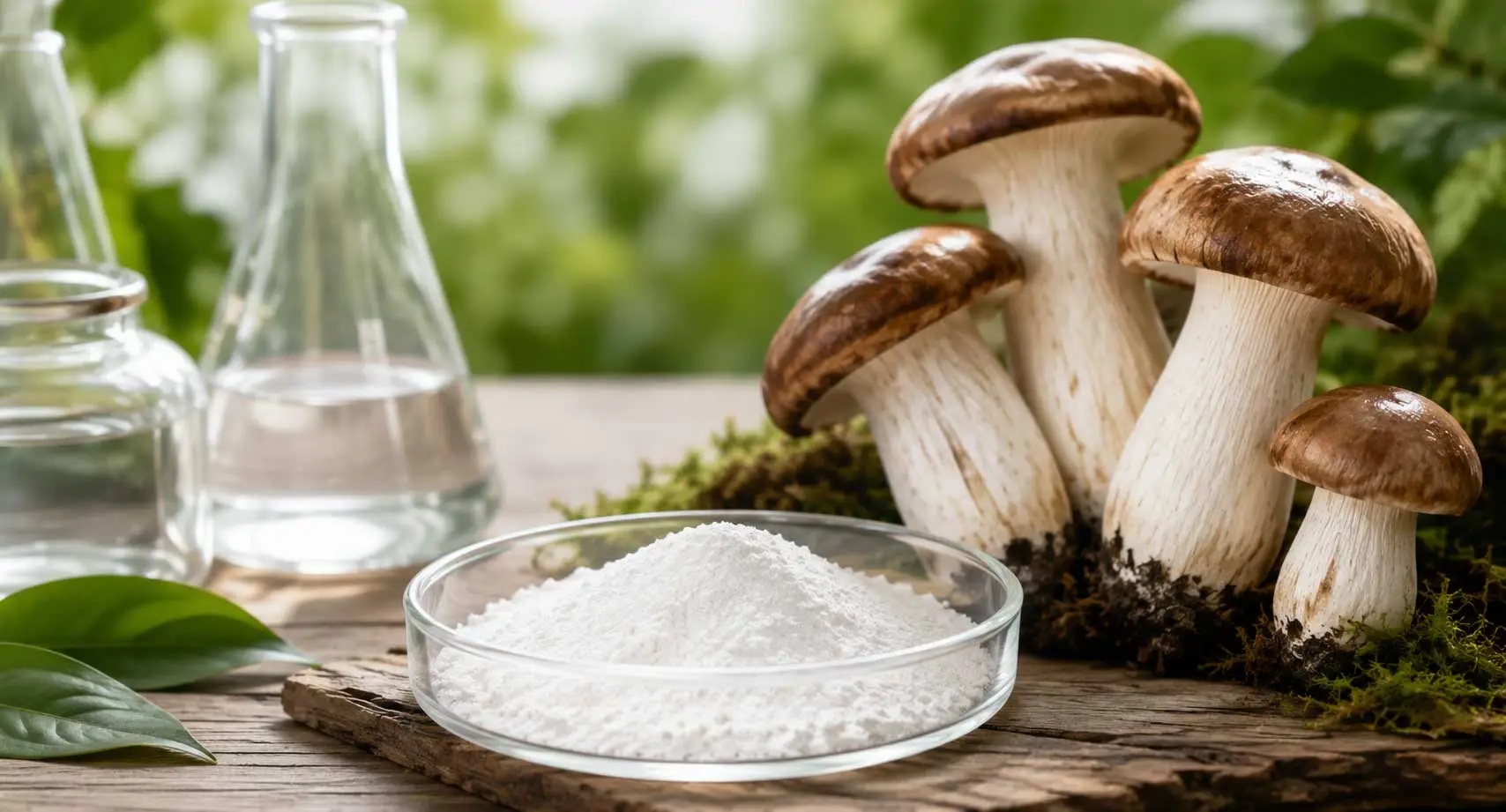
What Are the Main Production Methods for Ergothioneine?
The global production of ergothioneine relies primarily on three methods: natural extraction, chemical synthesis, and microbial fermentation. Each method differs in yield, purity, scalability, and commercial feasibility, all of which are crucial for bulk procurement.
Natural Extraction
Natural extraction derives ergothioneine from mushrooms or other natural sources. While this method aligns with “naturally sourced” branding, it is limited by low yield and potential batch-to-batch variability. For buyers seeking high-purity ergothioneine in bulk, this method may be less practical due to production constraints. Additionally, the cost of scaling natural extraction to meet international bulk orders can be prohibitive.
Chemical Synthesis
Chemical synthesis allows for large-scale production of ergothioneine, but may yield racemic mixtures or require extensive downstream purification. While synthetic ergothioneine powder can satisfy volume requirements, some formulations—particularly nutraceutical or cosmetic applications—require the bioactive L-ergothioneine, making rigorous COA verification critical for buyers.
Fermentation Production
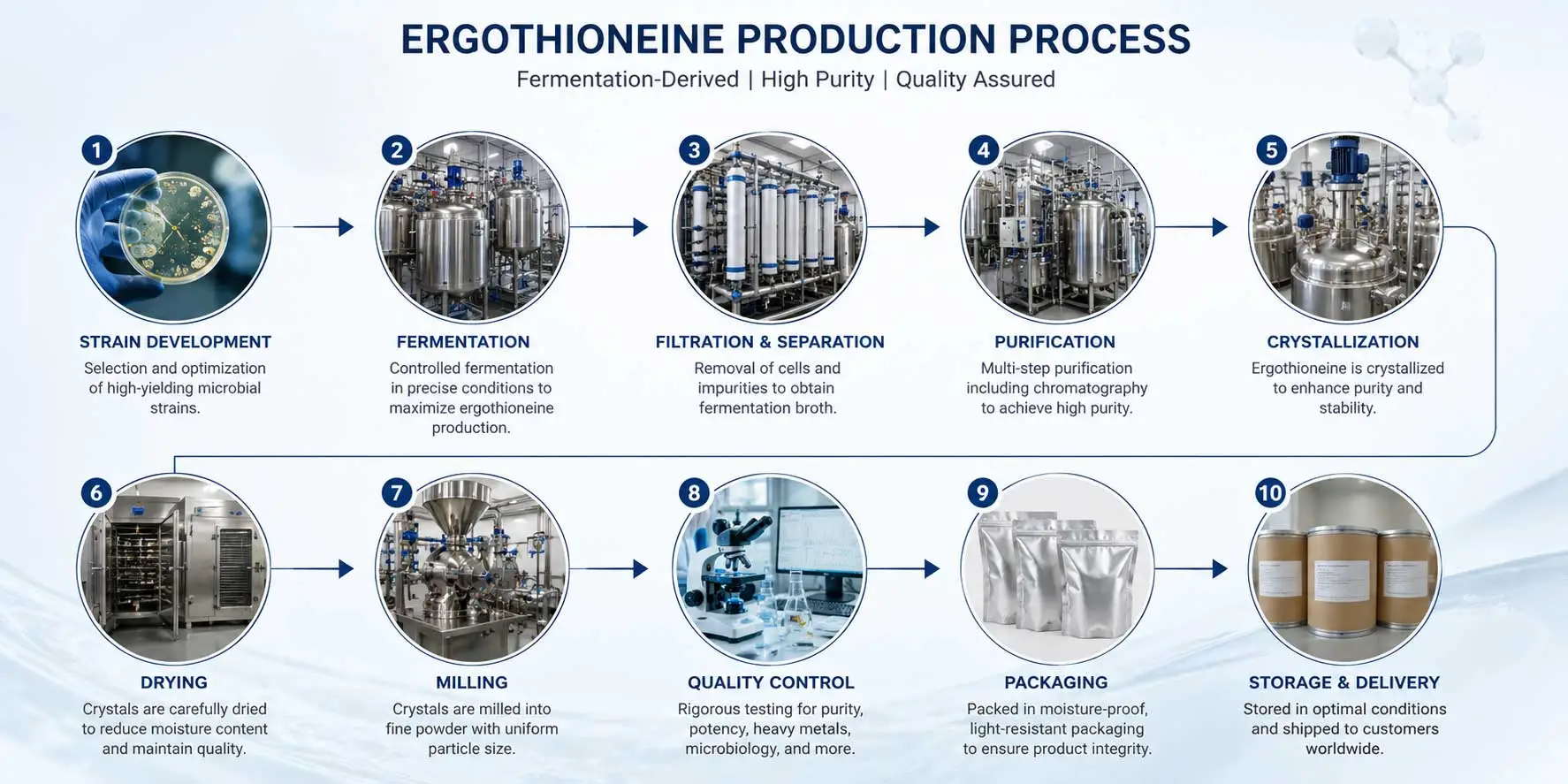
Modern manufacturing increasingly favors fermentation-derived ergothioneine. Microbial strains are optimized to produce high yields of L-ergothioneine, providing both batch consistency and scalability. Controlled fermentation conditions, combined with downstream purification, ensure high-purity powder suitable for diverse applications. For international buyers, fermentation offers the predictability required for bulk orders, regulatory compliance, and long-term supplier reliability.
Natural Extraction Ergothioneine: Benefits and Limitations
Natural extraction remains valued for its consumer perception, especially for brands emphasizing natural sourcing. The ingredient is directly derived from edible mushrooms, which can enhance market positioning in regions where natural labeling carries weight.
Advantages include:
•Perceived natural origin, enhancing consumer appeal
•Alignment with clean-label trends in dietary supplements and functional foods
Limitations include:
•Low yield per kilogram of source material, leading to higher cost per batch
•Batch-to-batch variability, which can complicate formulation consistency
•Limited scalability, making it challenging to fulfill bulk ergothioneine powder orders
•Longer lead times and potential supply constraints
From a commercial perspective, while natural extraction may suit niche high-value products, it is generally less compatible with industrial-scale production or high-purity applications that demand strict consistency.
Fermentation Ergothioneine: Why It Has Become the Industry Standard
Fermentation-derived ergothioneine has emerged as the preferred method for commercial production due to its combination of high purity, batch consistency, and scalable output.
Key advantages include:
1. Consistent Purity
Microbial fermentation enables precise control over growth conditions, ensuring each batch achieves target ergothioneine assay values. This consistency is crucial for bulk buyers and brands requiring reliable performance in supplement and cosmetic formulations.
2. Scalability
Fermentation allows for large-scale production that can meet growing global demand. Suppliers can adjust production volumes efficiently, reducing lead times and ensuring reliable bulk supply.
3. Sustainability
Compared to natural extraction or chemical synthesis, fermentation is more environmentally friendly, reducing resource consumption and waste. This aligns with sustainability requirements increasingly valued by international buyers.
4. Regulatory Acceptance
Fermentation-derived ergothioneine powder is widely accepted in global markets, supported by comprehensive COA documentation, stability data, and quality control testing. This reduces sourcing risk for bulk orders and long-term contracts.
5. Economic Efficiency
While initial setup requires investment in microbial culture and fermentation equipment, the cost per kilogram of high-purity ergothioneine powder is generally lower than large-scale natural extraction.
Overall, for procurement teams evaluating ergothioneine suppliers, fermentation production offers the strongest combination of commercial feasibility, product quality, and supply security. It has become the de facto standard for brands seeking high-purity, scalable, and reliable ergothioneine.
Natural Extraction vs Fermentation Ergothioneine: A Side-by-Side Comparison
When evaluating ergothioneine production methods, many buyers quickly discover that both natural extraction and fermentation can produce high-quality ingredients.
However, the practical differences become much more apparent when factors such as scalability, consistency, supply security, and cost are considered.
For supplement brands, contract manufacturers, and ingredient distributors, the most suitable production method is often determined by business requirements rather than theoretical advantages.
The table below summarizes some of the most important considerations when comparing natural extraction ergothioneine and fermentation-derived ergothioneine.
|
Factor |
Natural Extraction |
Fermentation Production |
|
Source |
Mushrooms and natural materials |
Microbial fermentation |
|
Purity |
Moderate to High |
High |
|
Batch Consistency |
Variable |
Excellent |
|
Scalability |
Limited |
Excellent |
|
Supply Reliability |
Moderate |
High |
|
Production Cost |
High |
Competitive |
|
Sustainability |
Moderate |
Strong |
|
Commercial Availability |
Limited |
Widely Available |
|
Suitability for Bulk Orders |
Limited |
Excellent |
For niche applications where natural sourcing is a primary marketing objective, extraction-based ingredients may provide branding advantages.
However, for most commercial applications, fermentation ergothioneine offers a stronger balance of quality, scalability, and economic feasibility.
This is one reason why many global nutraceutical companies have increasingly adopted fermentation-derived ergothioneine as their preferred ingredient source.
In practice, consistency often proves more valuable than theoretical purity differences.
A supplier capable of delivering the same quality across multiple production batches may provide greater long-term value than a source offering occasional premium-grade material with inconsistent availability.
For buyers managing product launches, manufacturing schedules, and inventory planning, supply reliability is frequently a decisive factor.
As demand for bulk ergothioneine powder continues to grow worldwide, the ability to secure consistent long-term supply has become increasingly important.
Which Production Method Is Better for Bulk Buyers?
For procurement teams sourcing bulk ergothioneine powder, the answer is often straightforward. The primary objective is not simply obtaining the ingredient itself but ensuring long-term access to consistent quality, predictable pricing, and dependable supply.
These requirements strongly favor fermentation-derived ergothioneine.
♦Supply Security Matters More Than Ever
One of the biggest challenges facing supplement manufacturers is supply uncertainty.
Natural extraction depends heavily on agricultural production and raw material availability.
Variations in harvest conditions, sourcing regions, and extraction efficiency can all influence supply stability.
By contrast, microbial fermentation operates within a controlled manufacturing environment.
Production schedules can be planned, scaled, and repeated with a high degree of consistency.
For companies placing recurring bulk orders, this provides a significant advantage.
Reliable access to raw materials helps prevent production interruptions and supports long-term business planning.
♦Consistent Specifications Simplify Manufacturing
Manufacturing efficiency depends heavily on ingredient consistency.
Variations in purity, moisture content, particle size, or microbiological quality may create formulation challenges and increase production costs.
This is particularly important for brands producing:
•Capsules
•Tablets
•Functional beverages
•Nutritional powders
Consistent ergothioneine powder specifications allow manufacturers to streamline quality control procedures and maintain stable product performance.
Fermentation production is generally better positioned to achieve this level of consistency.
♦Cost Efficiency at Commercial Scale
While procurement decisions should never be based solely on price, cost remains an important consideration.
Natural extraction is often associated with higher production costs due to:
•Low extraction yields
•Complex processing
•Limited scalability
Fermentation production typically offers better economics at industrial scale.
This allows buyers to achieve competitive pricing while maintaining high quality standards.
For companies sourcing bulk ergothioneine powder on an ongoing basis, the long-term cost advantages can be substantial.
Better Fit for International Supply Chains
International buyers frequently require:
•Stable lead times
•Export documentation
•Quality records
•Regulatory support
Manufacturers specializing in fermentation ergothioneine are often better equipped to provide these services due to their larger production infrastructure and established export experience.
For this reason, fermentation has become the dominant production method across many commercial markets.
Which Production Method Is Better for High-Purity Applications?
While scalability is important, some applications place an even greater emphasis on purity.
This is particularly true for premium formulations where ingredient performance directly affects product value.
In these situations, buyers frequently ask:
Which source delivers the highest purity and consistency?
The answer increasingly points toward fermentation-derived ergothioneine.
Dietary Supplement Applications
The dietary supplement sector represents one of the largest markets for ergothioneine powder.
Brands developing:
•Healthy aging supplements
•Cognitive support products
•Antioxidant formulations
often prioritize high assay values and strict quality specifications.
Fermentation production offers a significant advantage because process parameters can be tightly controlled throughout manufacturing.
This helps support consistently high purity levels across multiple production lots.
Functional Food Applications
Food applications introduce additional challenges related to ingredient stability and formulation compatibility.
Manufacturers frequently seek ingredients with predictable performance characteristics and reliable quality documentation.
Consistent fermentation ergothioneine is often preferred because it simplifies product development and reduces variability during commercial production.
Cosmetic Applications
The cosmetic industry has shown growing interest in ergothioneine due to its antioxidant properties and potential skin protection benefits.
For cosmetic formulators, purity and traceability are particularly important.
Many premium skincare brands prefer suppliers capable of providing comprehensive quality documentation and validated manufacturing controls.
Research and Advanced Formulation Applications
Universities, research institutions, and advanced formulation developers often require exceptionally pure material for analytical and experimental purposes.
In these environments, even small variations in ingredient quality may influence study outcomes.
High-purity fermentation-derived ergothioneine frequently becomes the preferred option due to its reproducibility and controlled production process.
Purity Is Only Part of the Story
While purity remains important, experienced buyers understand that quality involves more than a single specification.
Factors such as:
•Stability
•Documentation
•Batch consistency
•Supply reliability
must also be considered.
When evaluated across all these criteria, fermentation production often provides the strongest overall value proposition for commercial users.
How Buyers Can Evaluate a Fermentation Ergothioneine Supplier
Once buyers decide to source fermentation ergothioneine, the next challenge becomes identifying the right supplier. Not all manufacturers operate at the same level of quality, transparency, or technical capability. A thorough supplier evaluation process can help reduce risk and support long-term sourcing success.
Review Manufacturing Capability
A reliable ergothioneine manufacturer should be able to clearly explain:
•Production methods
•Fermentation technology
•Quality systems
•Production capacity
Manufacturing transparency is often one of the strongest indicators of supplier credibility.
Request Quality Documentation
Professional suppliers should provide documentation such as:
•COA
•TDS
•SDS
•Stability Reports
These records help buyers verify product quality and regulatory compliance.
Evaluate Batch Consistency
Historical quality data can provide valuable insight into process control and manufacturing performance.
Consistency across multiple batches is often more meaningful than a single exceptional result.
Assess Packaging and Logistics Support
For international buyers, packaging quality and export experience are important considerations.
Reliable suppliers should be capable of supporting:
•1 kg packaging
•5 kg packaging
•25 kg fiber drum packaging
•International shipping documentation
Strong logistics support often reflects broader operational maturity.
Frequently Asked Questions About Natural and Fermentation Ergothioneine
Q1: Is natural ergothioneine better than fermentation-derived ergothioneine?
While natural extraction ergothioneine may appeal to brands emphasizing “naturally sourced” ingredients, fermentation ergothioneine typically provides higher purity, batch consistency, and scalability, making it more suitable for bulk orders and commercial applications.
Q2: Why is fermentation preferred for commercial production?
Fermentation allows controlled production conditions, delivering consistent L-ergothioneine powder at scale. This method reduces variability, supports quality assurance, and aligns with international sourcing requirements.
Q3: Which form offers higher purity?
Answer: Fermentation-derived ergothioneine powder consistently achieves higher assay values and lower impurity levels compared to natural extraction. This is particularly important for dietary supplements, functional foods, and cosmetic applications.
Q4: Is fermentation-derived ergothioneine considered natural?
Fermentation uses microbial processes to produce the bioactive L-ergothioneine. While technically “microbially produced,” it is widely accepted in regulatory frameworks as a natural or biologically derived ingredient, especially when compared to chemical synthesis.
Q5: Which option is more sustainable?
Fermentation generally has a lower environmental footprint than natural extraction, which relies on large volumes of raw mushroom material, or chemical synthesis, which requires synthetic reagents and energy-intensive purification.
Q6: What do bulk buyers typically choose?
Global bulk buyers tend to prefer fermentation-derived ergothioneine for its consistency, supply reliability, and scalability. This method allows suppliers to provide predictable lead times, supporting international operations.
Conclusion: Fermentation Has Become the Preferred Choice for Commercial Ergothioneine Supply
The comparison of natural extraction vs fermentation ergothioneine highlights why microbial fermentation has emerged as the industry standard for bulk buyers and high-purity applications.
Fermentation offers:
•Consistent high purity
•Batch-to-batch reliability
•Scalable commercial production
•Sustainable manufacturing practices
•Regulatory acceptance for international markets
By understanding the strengths and limitations of each production method, procurement teams can make informed decisions that reduce risk, ensure supply stability, and support long-term product quality.
For companies seeking additional technical information, including COA review, stability documentation, packaging specifications, or sample requests, our team at CHEN LANG BIO TECH can be reached at admin@chenlangbio.com. This contact provides access to verified technical data and supports professional procurement decisions without commercial marketing pressure.

Send Inquiry
Related Industry Knowledge
- Can L-Ergothioneine Support Cognitive Health?
- Is L-Ergothioneine Safe for Consumption?
- What is Ergothioneine Powder Used for?
- How Does Ergothioneine Benefit Health?
- Is Ergothioneine A Longevity Vitamin
- Could Ergothioneine Cure Alzheimer's Disease
- What is Ergothioneine in Skin Care
- What Foods are High in Ergothioneine and Glutathione
- What is Ergothioneine Good for
- What is the Function of Ergothioneine