
Ethyl Ascorbic Acid and Niacinamide: Can They Be Used Together?
2026-10-21 15:04:23
Ethyl ascorbic acid and niacinamide can be considered for use together in skincare formulations, including facial serums, emulsions, and other cosmetic products. However, combining two established skincare ingredients does not automatically guarantee chemical compatibility, long-term stability, or improved performance in the finished product.
3-O-Ethyl Ascorbic Acid is a modified vitamin C derivative, while niacinamide is an amide form of vitamin B3. Their different chemical structures allow formulators to explore complementary skincare applications, but concentration, pH, solvent composition, manufacturing temperature, and packaging must be evaluated together.
For cosmetic manufacturers, the practical question is not simply whether these ingredients can coexist. It is whether a specific formula can maintain both ingredients within justified quality specifications throughout its intended shelf life.
This guide examines the formulation science behind their compatibility, explains how to develop a dual-active serum, and outlines the analytical and purchasing requirements for commercial production.
Can Ethyl Ascorbic Acid Be Used with Niacinamide in Skincare?
Yes. Ethyl ascorbic acid niacinamide compatibility can be evaluated through conventional cosmetic formulation development. There is no scientific basis for assuming that these two ingredients must always be kept in separate skincare products.
Nevertheless, successful formulation depends on the complete product rather than ingredient identity alone.
Are Ethyl Ascorbic Acid and Niacinamide Compatible in One Serum?
Both ingredients can be incorporated into aqueous or water-containing cosmetic systems, provided that the finished formulation supports their dissolution and stability.
Published research has characterized the solubility and skin delivery of 3-O-ethyl-L-ascorbic acid in different solvent systems. Niacinamide is also widely used in water-based cosmetic formulations.
These properties make a combined serum technically plausible, but they do not establish the stability of a particular commercial formula.
Can Ethyl Ascorbic Acid and Niacinamide Be Mixed Without Degradation?
When evaluating whether ethyl ascorbic acid can be used with niacinamide, manufacturers should distinguish initial mixing compatibility from chemical stability during storage.
A freshly prepared serum may appear clear and homogeneous even if one ingredient subsequently degrades.
The appropriate assessment involves measuring both active ingredients over time, monitoring pH and appearance, and comparing the combined formulation with suitable controls.
Why Do Cosmetic Manufacturers Combine Vitamin C Derivatives with Niacinamide?
Skincare brands frequently develop products addressing uneven skin tone, dull-looking skin, and skin barrier care.
Ethyl ascorbic acid is used in vitamin C-based cosmetic formulations, while niacinamide has been investigated for its effects on skin appearance and barrier-related functions.
Their combination offers a commercially relevant formulation concept. However, claims of enhanced or synergistic performance require evidence from the actual combination rather than separate studies of the individual ingredients.
Ethyl Ascorbic Acid vs Niacinamide: What Chemical Properties Affect Compatibility?
The formulation behavior of these ingredients is influenced by their molecular structures, acid-base properties, and interactions with the surrounding vehicle.
How Does the 3-O-Ethyl Structure Affect Ascorbic Acid Stability?
3-O-Ethyl Ascorbic Acid contains an ethyl ether modification at the 3-O position of the ascorbic acid molecule.
In a published physicochemical study, Iliopoulos and colleagues reported a pKa of 7.72 ± 0.01 and a log P of −1.07 ± 0.03 for 3-O-ethyl-L-ascorbic acid.
The negative log P indicates relatively hydrophilic partitioning behavior under the reported measurement conditions. The pKa describes an acid-base equilibrium, not an experimentally established optimal formulation pH.
These data help explain why 3-o-ethyl ascorbic acid chemical stability must be considered in relation to the solvent system and formulation environment.
How Does Niacinamide Behave in Aqueous Cosmetic Formulations?
Niacinamide, also known as nicotinamide, is a water-soluble compound containing a pyridine ring and a carboxamide group.
Its molecular formula is C₆H₆N₂O, with a molecular weight of approximately 122.13 g/mol.
Under sufficiently demanding chemical conditions, amide hydrolysis can produce nicotinic acid. However, the possibility of hydrolysis should not be confused with proof that significant conversion occurs in an ordinary skincare serum.
Temperature, pH, exposure time, and the surrounding formulation determine whether this reaction becomes relevant.
Does Ethyl Ascorbic Acid React Directly with Niacinamide?
A direct adverse reaction between the two ingredients should not be assumed merely because they belong to different vitamin families.
Claims that vitamin C and niacinamide are universally incompatible often fail to distinguish L-ascorbic acid from its derivatives or controlled laboratory conditions from ordinary cosmetic use.
To establish an interaction, formulators need analytical evidence showing that the combined system behaves differently from appropriate single-active controls.
What pH Is Suitable for an Ethyl Ascorbic Acid and Niacinamide Serum?
Selecting a common pH is one of the most important decisions in ethyl ascorbic acid niacinamide ph development.
The objective is to find a range compatible with both ingredients, the preservative system, other formulation components, and the finished product's safety and stability requirements.
•What Is the Recommended pH for Ethyl Ascorbic Acid and Niacinamide?
There is no single universally validated optimal pH for every serum containing these two ingredients.
A supplier's suggested pH range can provide a useful starting point, but the final choice should be supported by formulation-specific stability testing.
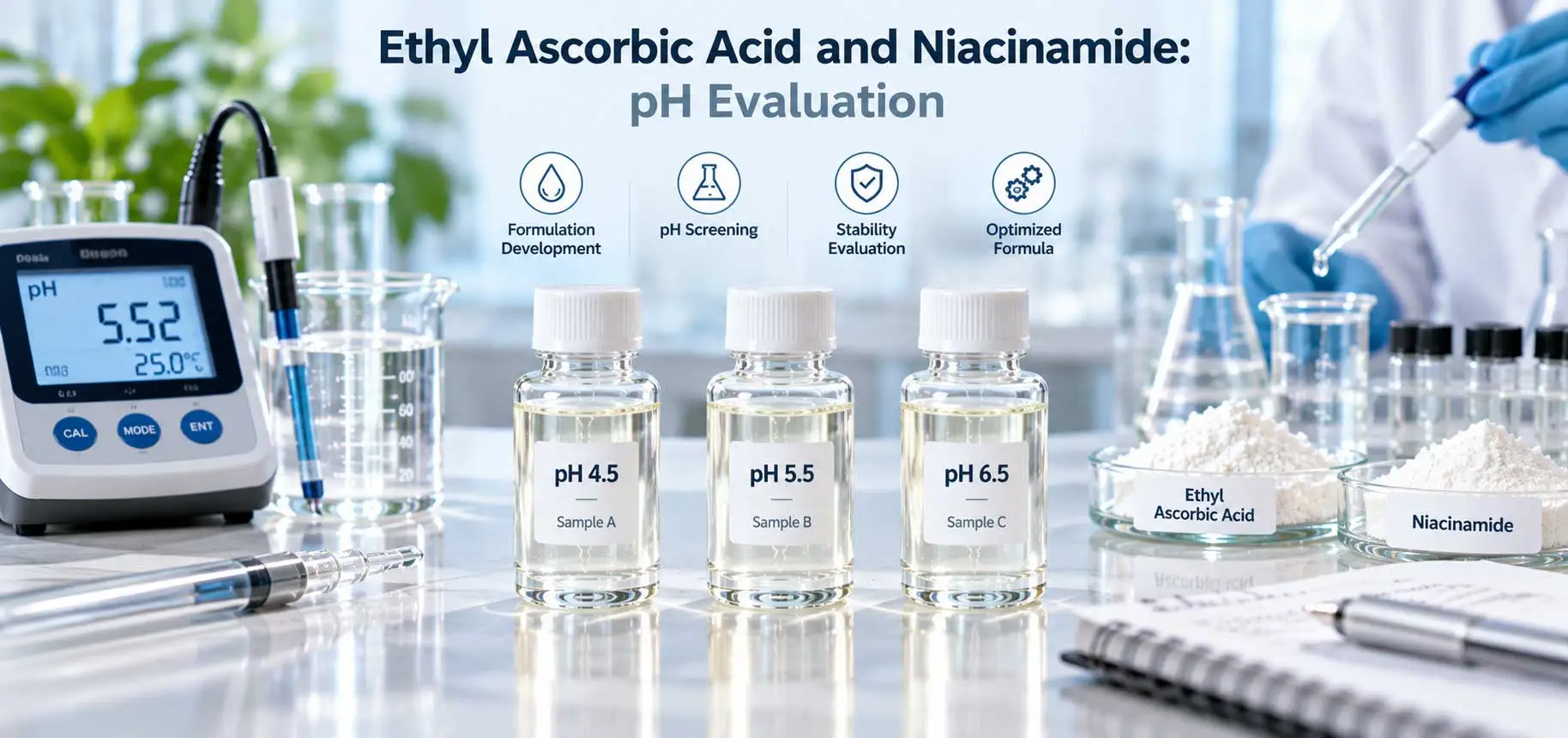
For development purposes, a laboratory might compare samples adjusted to pH 4.5, 5.5, and 6.5. These values represent illustrative screening conditions, not proven optimal conditions.
•Does Ethyl Ascorbic Acid Require the Same Low pH as L-Ascorbic Acid?
No assumption should be made that an ethyl ascorbic acid formula requires the same acidic environment as a conventional L-ascorbic acid serum.
In a frequently cited skin-absorption study, Pinnell and colleagues investigated topical L-ascorbic acid and found that absorption depended on formulation pH under the conditions studied.
Those findings concern L-ascorbic acid and cannot establish the required pH of its 3-O-ethyl derivative.
The ethyl ascorbic acid ph range should therefore be determined using evidence relevant to the derivative and the actual finished product.
•Can Niacinamide Become Nicotinic Acid at Low pH?
Niacinamide can undergo hydrolysis under suitable chemical conditions, potentially forming nicotinic acid.
However, reaction rates depend on more than pH alone. Temperature and duration are also important.
Manufacturers concerned about conversion should evaluate the finished formula using an analytical method capable of distinguishing niacinamide from nicotinic acid.
It would be misleading to claim that a mildly acidic serum necessarily causes substantial conversion during normal storage.
•How Should Formulators Select a Common Serum pH?
A practical niacinamide ph stability study begins with matched formulations prepared at several relevant pH values.
Each sample should be assessed for active ingredient retention, pH drift, visible changes, and preservative suitability.
The selected pH should reflect the overall formulation's performance rather than a theoretical value associated with only one ingredient.
What Percentage of Ethyl Ascorbic Acid and Niacinamide Should You Use?
Ingredient concentration affects solubility, formulation economics, analytical requirements, and the evidence needed to support product claims.
The correct percentages should be selected through a structured development program.
What Is the Recommended Ethyl Ascorbic Acid Percentage with Niacinamide?
For initial cosmetic formulation development, CHEN LANG BIO TECH suggests evaluating 3-O-Ethyl Ascorbic Acid at 0.5%–2%.
This is a supplier-recommended starting range, not a universal regulatory maximum or a clinically established optimal concentration.
The appropriate ethyl ascorbic acid percentage with niacinamide should be confirmed through stability and performance testing.
What Niacinamide Concentration Should Formulators Evaluate?
Niacinamide concentrations should reflect the product concept and available supporting evidence.
A development team might investigate 2%, 4%, and 5% niacinamide in controlled prototypes. These are illustrative screening levels, not mandatory concentrations for all skincare products.
Higher loading may increase material consumption and alter formulation characteristics without necessarily producing proportional benefits.
How to Compare 1% Ethyl Ascorbic Acid with 4% Niacinamide in a Serum
An illustrative dual-active prototype could contain:
|
Ingredient |
Experimental addition |
|
3-O-Ethyl Ascorbic Acid |
1.0% |
|
Niacinamide |
4.0% |
|
Other formulation ingredients |
Quantity sufficient to 100% |
For a 100 kg batch, these percentages correspond to 1 kg of ethyl ascorbic acid raw material and 4 kg of niacinamide raw material.
This is a dosage calculation, not a validated commercial formula. The complete composition still requires development, preservation testing, stability assessment, and safety evaluation.
Can Ethyl Ascorbic Acid and Niacinamide Cause Serum Yellowing?
Discoloration is a common concern during dual-active serum development, particularly when a brand expects a transparent, nearly colorless product.
However, ethyl ascorbic acid niacinamide discoloration should be investigated as a formulation issue rather than attributed automatically to a reaction between the two ingredients.
Does Combining Ethyl Ascorbic Acid and Niacinamide Cause Discoloration?
The presence of both ingredients does not establish that yellowing will occur.
Color changes may involve other formulation components, trace impurities, packaging interactions, or changes occurring during storage.
A transparent serum can also undergo chemical changes without visible discoloration. Appearance and ingredient retention should therefore be evaluated separately.
Is Yellowing Evidence of Ethyl Ascorbic Acid Oxidation?
No. Yellowing alone does not prove ethyl ascorbic acid oxidation.
A small amount of a colored compound may change the appearance of the entire serum, even when the parent ingredient remains within its assay specification.
Conversely, a decline in active ingredient content may occur without a noticeable color shift.
How Can Manufacturers Identify Which Ingredient Causes Color Changes?
Prepare matched control formulas containing ethyl ascorbic acid alone, niacinamide alone, both ingredients, and neither ingredient.
Compare appearance and instrumental color measurements over time. If yellowing occurs only in the combined formula, further investigation is warranted.
The result may suggest an interaction, but analytical identification is needed before assigning a specific chemical mechanism.
How to Formulate an Ethyl Ascorbic Acid and Niacinamide Serum
Developing an ethyl ascorbic acid and niacinamide serum requires coordinated control of ingredient dissolution, addition order, temperature, pH, and preservation.
The following approach provides a practical laboratory development framework rather than a ready-to-market formula.
How to Dissolve Ethyl Ascorbic Acid and Niacinamide in the Water Phase
Begin by reviewing each raw material's technical specifications and selecting a solvent system appropriate for the intended concentrations.
Research on 3-O-ethyl-L-ascorbic acid found saturation solubility values of approximately 463.6–801.1 mg/mL across the hydrophilic solvents investigated, compared with approximately 0.6–56.6 mg/mL across selected lipophilic solvents.
These are measurements from specific solvent systems, not guaranteed solubility limits in a complex cosmetic serum.
For an initial laboratory trial, separately dissolving the ingredients in suitable portions of the water phase may help identify dissolution problems before the phases are combined.
What Processing Temperature Is Suitable for Ethyl Ascorbic Acid Serum?
Our preliminary manufacturing recommendation is to incorporate ethyl ascorbic acid below 40°C, where practical.
This is a processing recommendation, not a scientifically established universal degradation threshold.
Formulators should also consider the temperature sensitivity of niacinamide, preservatives, polymers, and other formulation components.
Temperature records should be maintained during scale-up to ensure that commercial batches reproduce the conditions established during laboratory development.
How to Select Preservatives, Humectants, and Packaging
Humectants such as glycerin and propylene glycol may influence solvent properties and finished-product characteristics.
Preservative effectiveness depends on the complete formulation, including pH, water activity, packaging, and other ingredients.
Packaging selection should account for light exposure, oxygen contact, material compatibility, and dispensing conditions.
A dual-active serum requires a suitable preservation strategy and relevant microbiological testing before commercialization.
How to Prevent Crystallization and pH Drift in a Dual-Active Serum
An initially clear serum does not guarantee long-term physical stability.
Evaluate ethyl ascorbic acid solubility in serum after low-temperature storage, temperature cycling, and other conditions relevant to the intended product.
If crystals appear, determine whether they originate from ethyl ascorbic acid, another dissolved ingredient, or a change in the solvent system.
Monitor pH at consistent temperatures and use a suitable buffering approach only after assessing its effect on ingredient stability and preservation.
How to Test Ethyl Ascorbic Acid and Niacinamide Compatibility Before Production
A robust ethyl ascorbic acid niacinamide stability testing program should determine whether the combination affects either ingredient's retention or the finished formula's critical quality attributes.
How to Measure Ethyl Ascorbic Acid and Niacinamide by HPLC
HPLC can be used to quantify the two ingredients when an appropriate analytical method has been developed and validated for the formulation.
Published research has described an HPLC method for 3-O-ethyl-L-ascorbic acid, while analytical studies have used HPLC-DAD to investigate niacinamide and other B vitamins in cosmetic products.
These methods demonstrate analytical feasibility but are not automatically interchangeable.
If both ingredients are measured using one method, the laboratory should establish suitable specificity, resolution, linearity, precision, accuracy, and sample recovery.
Where nicotinic acid formation is a concern, the method should also be capable of distinguishing it from niacinamide.
What Stability Testing Conditions Should Cosmetic Manufacturers Use?
An initial screening study might include storage at 5°C, 25°C, and 40°C, with measurements at predefined intervals.
These are example development conditions, not universal requirements.
ISO/TR 18811:2018 provides a technical framework for cosmetic stability testing but does not prescribe one set of temperatures, durations, or acceptance criteria for all products.
Manufacturers should establish a justified protocol reflecting their product, packaging, distribution conditions, and intended shelf life.
How to Design a Niacinamide and Ethyl Ascorbic Acid Compatibility Study
A four-formula experimental design is useful:
|
Test formula |
Ethyl ascorbic acid |
Niacinamide |
|
Base control |
No |
No |
|
Formula A |
Yes |
No |
|
Formula B |
No |
Yes |
|
Formula C |
Yes |
Yes |
Keep the base composition, manufacturing process, and storage conditions as consistent as possible.
Where removing an ingredient changes water content or other formula properties, adjust the controls appropriately and document the differences.
This cosmetic formulation compatibility testing approach helps determine whether the combined system behaves differently from either ingredient alone.
What Results Should Be Reviewed Before Commercial Scale-Up?
Before approving a formulation, manufacturers should review:
-
Quantitative retention of both ingredients and relevant impurity trends.
-
pH changes, color, odor, and visible precipitation.
-
Physical stability and packaging compatibility.
-
Microbiological quality and preservative effectiveness.
-
Product-specific safety and claim substantiation.
Acceptance criteria should be established before interpreting the results. A clear appearance or acceptable initial assay alone is insufficient to support commercial shelf-life claims.
Cosmetic-Grade Ethyl Ascorbic Acid 99%: What Should Ingredient Buyers Check?
Selecting cosmetic grade ethyl ascorbic acid requires more than comparing the headline purity stated in supplier quotations.
The material should meet an agreed specification, with documentation that supports incoming quality control and repeat commercial production.
What Specifications Matter When Buying 3-O-Ethyl Ascorbic Acid 99%?
Key identification and specification details include:
|
Parameter |
Product information |
|
INCI |
3-O-Ethyl Ascorbic Acid |
|
CAS Number |
86404-04-8 |
|
Molecular formula |
C₈H₁₂O₆ |
|
Molecular weight |
Approximately 204.18 g/mol |
|
Appearance |
White to off-white crystalline powder |
|
Assay |
≥99%, subject to the agreed specification |
Buyers should confirm whether the assay is expressed on an as-is or another defined basis and which analytical method is used.
What Should an Ethyl Ascorbic Acid COA Include?
An ethyl ascorbic acid coa should identify the batch, relevant specifications, analytical results, and applicable test methods.
The buyer should review identity, assay, appearance, and any specified impurities or other quality parameters.
An HPLC area percentage should not automatically be interpreted as a quantitative weight-based assay unless the method supports that calculation.
Why Does Raw Material Quality Matter for Dual-Active Serum Stability?
Consistent raw material quality reduces uncertainty during formulation development.
Changes in impurity profile, moisture, or other material characteristics may complicate comparisons between experimental batches.
However, a 99% assay alone does not guarantee that a serum containing niacinamide will remain chemically or physically stable. Finished-product testing remains necessary.
How to Source Bulk Ethyl Ascorbic Acid for Niacinamide Serum Manufacturing
For procurement teams, selecting a reliable source of bulk ethyl ascorbic acid powder involves technical qualification, commercial terms, and supply continuity.
A competitive quotation is useful only when the material meets the required specification and can be delivered under suitable conditions.
What Should Buyers Expect from an Ethyl Ascorbic Acid Manufacturer?
An ethyl ascorbic acid manufacturer should provide clear product identification, consistent specifications, relevant quality documentation, and reliable communication regarding batch availability.
Buyers should also confirm sample availability, lead times, packaging, and the process for addressing quality questions.
Where multiple suppliers are being evaluated, compare documentation and test results against the same purchasing specification.
How Do Order Quantity and Packaging Affect Ethyl Ascorbic Acid Price per Kg?
The ethyl ascorbic acid price per kg may vary with order volume, packaging configuration, analytical requirements, freight arrangements, and destination.
Our standard packaging options include 1–5 kg aluminum foil bags and 25 kg paper drums.
For a commercial serum containing 1% ethyl ascorbic acid, a 1,000 kg finished-product batch requires approximately 10 kg of raw material, excluding manufacturing losses.
Procurement planning should also account for development samples, qualification testing, and anticipated production demand.
How to Request an Ethyl Ascorbic Acid Sample and Bulk Quotation
When requesting an ethyl ascorbic acid sample, provide the planned product format, target ingredient concentration, and relevant testing requirements.
For an ethyl ascorbic acid quotation, include the expected order quantity, destination country, packaging preference, and anticipated purchasing schedule.
CHEN LANG BIO TECH supplies 3-O-Ethyl Ascorbic Acid 99% for cosmetic formulation development and commercial manufacturing. We welcome inquiries from skincare brands, contract manufacturers, and ingredient distributors seeking consistent raw material quality and technical documentation.
Email: admin@chenlangbio.com
Frequently Asked Questions About Ethyl Ascorbic Acid and Niacinamide
Can Ethyl Ascorbic Acid and Niacinamide Be Used in the Same Serum?
Yes. Both ingredients can be considered for the same serum, but compatibility must be demonstrated through testing of the complete finished formulation.
What pH Is Best for Ethyl Ascorbic Acid and Niacinamide?
There is no universally established optimal pH for every combination. Formulators should evaluate relevant pH conditions and select one supported by finished-product stability results.
Does Niacinamide Make Ethyl Ascorbic Acid Less Stable?
Not necessarily. A controlled comparison between single-active and combined formulations is needed to determine whether niacinamide affects ethyl ascorbic acid retention.
Can Ethyl Ascorbic Acid and Niacinamide Cause Yellowing?
Yellowing may occur in some formulations, but the presence of both ingredients does not prove a direct chemical reaction. Analytical testing is needed to identify the cause.
What Percentage of Ethyl Ascorbic Acid Works with Niacinamide?
Our suggested initial ethyl ascorbic acid development range is 0.5%–2%. The final percentage should be determined through formulation, safety, and performance evaluation.
What Tests Confirm Ethyl Ascorbic Acid and Niacinamide Compatibility?
Appropriate testing includes quantitative analysis of both ingredients, pH monitoring, appearance and color assessment, physical stability, and packaging compatibility under justified storage conditions.
Conclusion: Developing a Stable Ethyl Ascorbic Acid and Niacinamide Serum
Ethyl ascorbic acid and niacinamide offer a technically relevant combination for skincare formulation development, but commercial success depends on more than ingredient selection.
A suitable formula must balance concentration, pH, solvent compatibility, processing conditions, preservation, and packaging. Analytical testing should confirm that both ingredients remain within justified specifications during storage.
For manufacturers developing a dual-active serum, consistent raw material quality and dependable technical documentation are important foundations for repeatable production.
CHEN LANG BIO TECH supplies 3-O-Ethyl Ascorbic Acid 99% for cosmetic manufacturers and skincare brands. Contact us for product specifications, available COA and technical documents, samples, and bulk purchasing information.
Email: admin@chenlangbio.com
References
1. Iliopoulos, F., Sil, B. C., Moore, D. J., Lucas, R. A., & Lane, M. E. (2019). 3-O-Ethyl-L-Ascorbic Acid: Characterisation and Investigation of Single Solvent Systems for Delivery to the Skin. International Journal of Pharmaceutics: X, 1, 100025. DOI: 10.1016/j.ijpx.2019.100025.
2. Iliopoulos, F., et al. (2020). Topical Delivery of 3-O-Ethyl-L-Ascorbic Acid from Complex Solvent Systems. Scientia Pharmaceutica, 88(2), 19. DOI: 10.3390/scipharm88020019.
3. Rate Studies on the Hydrolysis of Niacinamide. Journal of Pharmaceutical Sciences (1962). Experimental investigation of niacinamide hydrolysis across pH 0.4–11.3 at 89.4°C. These elevated-temperature results should not be treated as evidence of equivalent reaction rates during normal cosmetic storage.
4. Hakozaki, T., et al. (2002). The Effect of Niacinamide on Reducing Cutaneous Pigmentation and Suppression of Melanosome Transfer. British Journal of Dermatology. DOI: 10.1046/j.1365-2133.2002.04834.x.
5. Bissett, D. L., et al. (2005). Topical Niacinamide Reduces Yellowing, Wrinkling, Red Blotchiness, and Hyperpigmented Spots in Aging Facial Skin. International Journal of Cosmetic Science, 26(5), 231–238. This research concerns niacinamide-containing skincare products, not the combined stability of niacinamide and ethyl ascorbic acid.
6. Content and Stability of B Complex Vitamins in Commercial Cosmetic Products. (2023). Research examining B-vitamin content and stability in commercial cosmetics using HPLC-DAD analytical methods.
7. International Organization for Standardization. (2018). ISO/TR 18811:2018 — Cosmetics: Guidelines on the Stability Testing of Cosmetic Products.
8. European Parliament and Council. (2009). Regulation (EC) No 1223/2009 on Cosmetic Products, as amended.
Scientific clarification: Published measurements of ethyl ascorbic acid's pKa, partition coefficient, and solubility describe the individual ingredient under specified experimental conditions. Niacinamide clinical studies establish evidence for that ingredient in the formulations investigated. Neither body of research independently proves that a particular combination of ethyl ascorbic acid and niacinamide will remain stable throughout commercial storage. That conclusion requires testing of the actual finished formula.

Send Inquiry
You may like